Technicolor Tourism

The Chinese buddy comedy Lost in Thailand (trailer above) was partly responsible for a 62-percent rise in Chinese tourism to Thailand. The Economist considers the effects of film-driven tourism:

It is impossible to find numbers – at least reliable numbers not hyped up by a country’s tourist board. But films’ impact can be seen on two levels. The first is macro. Hollywood, for example, is a hugely important aspect of America’s soft power. There is little doubt that many of the tourists who visit New York do so because their imagination has been caught by the screen images of a thousand films. Something similar also seems to be happening in Nigeria, as Nollywood films, which are shown ceaselessly across Africa, are said to be drawing in visitors.

Then there is the micro level: the effect of individual films, as with the Lost in Thailand example. Tourists flocked to Middle Earth (also known as New Zealand) after the success of the Lord of the Rings trilogy. International arrivals to the country rose by 40 percent between 2000 and 2006, much of which was attributed to “Tolkien tourism” (by way of a rough comparison, Australian arrivals increased by 13 percent over the same period). Florence apparently expects last year’s film Inferno, based on Dan Brown’s blockbuster, to single-handedly reverse a 10-percent slump in its tourist numbers. Mamma Mia!, if the Daily Mail can be believed, “ruined” Skopelos, the Greek island on which it is set, after the tourists arrived in droves.

Creationism In The Classroom

A screenshot of Chris Kirk’s interactive map on where creationism is taught:

Creationism

Joshua Cowen takes a closer look at schools in Milwaukee:

Using data from the Wisconsin state education agency’s website, I calculated that the 10 schools reported by Slate to be teaching or affiliated with creationism reported dramatically lower percentages of students proficient in science compared to other private schools participating in the voucher program. Over the 2010-11, 2011-12, and 2012-13 school years, nearly 70 percent of students in grades 4, 8, or 10 scored below “proficient” levels in science, compared to “only” 54 percent of students in other voucher schools (the difference is statistically significant). Setting aside the question of whether the other voucher schools are performing adequately on the state’s science exam, the point is that creationist schools are doing especially poorly. Lest we worry that this comparison is by definition unfair because the state’s science exam may be precisely what the creationist schools are teaching against, consider that the results are similar in math, reading, language arts, and social studies. In each subject area, the creationist schools had far fewer proficient students than the other voucher schools.

The Robots Took Er Jerbs – In Poetry!

Screen Shot 2014-01-30 at 1.07.56 PM

Brian Merchant examines the rise of poetry-writing computer programs like @Pentametron, which collects iambic pentameter tweets:

It’s especially interesting since Pentametron is artificially creating compelling poetry from explicitly human-authored sentiments. Yet Twitter bots like this only mark the entry point into what we might as well call roboetry. More sophisticated software can be put in service of writing poetry, too; like SwiftKey, a machine learning algorithm that typically teaches Android to adapt to users’ behavior and helps correct their touchscreen text entries. MIT phD candidate J. Nathan Matias taught it Shakespeare instead. …

Other examples abound: A bot that mines New York Times articles for haikus. Designed by the Times resident software architect, it spins haikus like this from articles like “The Fear of Surrendering Again” …

He has a mind as

fascinating to me as

the city itself.

The point is getting clearer: These are pretty good poems. They’re surprising, moving, weird, even a little touching; It’s actually good poetry.

Earlier Dish on Pentametron here. Recent Dish on robots taking over jobs here and here.

The Death Row Science Experiment, Ctd

Earlier this week, Lauren Galik noted how Missouri and Louisiana, facing shortages of approved lethal injection drugs, are refusing to tell death row inmates what chemicals will be used to execute them or what pharmacies are supplying them:

Lawyers that represent both condemned prisoners [Herbert Smulls and Christopher Sepulvado] argue that states must answer questions about whether or not the execution will be humane and comport with the Constitution. Without information about the drugs, those questions have gone unanswered.

According to Megan McCracken, Eighth Amendment Resource Counsel at U.C. Berkeley School of Law’s Death Penalty Clinic, “If lawyers for the condemned prisoners can’t get the information [about the drugs], then they cannot meet their legal burden in court to show that there’s a substantial risk of harm.”

By keeping this information a closely guarded secret, states are asking condemned inmates to take their word for it that the source is legitimate and the drugs won’t result in cruel and unusual punishment when administered.

Smulls was executed on Wednesday using pentobarbital “manufactured by a compounding pharmacy whose identity has not been revealed.” Waldman scratches his head:

It’s the 21st century. We can build skyscrapers a kilometer high. We can send ships to Mars. We can put a powerful computer in the pockets of billions of people. Are you telling me that with all our technology, all our engineering knowledge, and all our good old-fashioned American ingenuity, we can’t come up with a quick, effective, and painless way to kill a man? …

Beyond these practical considerations is a moral one: the death penalty is a vestige of a more barbarous time, which is why most countries have done away with it, and why we should too. But if we’re going to do it, surely we can devise a method that doesn’t have all the uncertainty that lethal injection has brought.

Recent Dish on lethal injection here, here, and here.

I Blog Therefore I Am, Ctd

Noah Millman joins the debate Wilkinson kicked off last week about blogging personas. For Noah, “[reader] response wasn’t merely gratifying or instructive; it shaped what I wrote, shaped the persona (a better word than “self”) that I was developing on-line”:

My style, my subject matter, my politics, my sense of who I was and was meant to be evolved in part based on what got positive reinforcement and what didn’t, even though I wasn’t being paid anything at all. A gift economy is still an economy, and there’s nothing particularly pure about non-commercial social discourse. “No man but a blockhead ever wrote except for money” – so said Sam Johnson, but in fact the truer statement is that no man but a blockhead ever tried to earn money by writing. When it comes to money, Willy Sutton had a much better understanding. So all of us writers, whatever our medium, write out of some other compulsion than to earn a living. And to the extent that that compulsion has something to do with having readers, we have to watch the progress of our addiction, how it is changing us.

He concludes:

If all you’re doing is hanging out, you’re probably not writing anything very worth reading. If all you’re doing is chasing click bait, or following the news cycle, you’re probably not writing anything very worth reading. And that’s the fundamental question: do you want to write anything worth reading?

“Strategic Entertainment”

Chipotle has produced a miniseries about factory farming:

Farmed and Dangerous, which premieres on Hulu on Feb. 17, focuses on a fictional industrial agriculture company that devises a money-saving scheme to feed cows petroleum-based animal pellets. Lots of hijinks with exploding cattle and a nefarious PR spokesman ensue. The show exposes issues in the agriculture industry that Chipotle has publicly denounced, such as dependence on fossil fuels and overuse of antibiotics on animals. But instead of hearing about these points from the restaurant directly, viewers will learn about them by laughing at Twin Peaks star Ray Wise and a wide cast of other characters.

Could this be the future of advertising?

This is not advertising, exactly, but it’s not regular video programming either. Daniel Rosenberg, a partner at Piro, calls it “strategic entertainment.” The goal, he says, is “adding value to people’s lives rather than interrupting it with traditional advertising.” …

“I could produce an award winning ad for a restaurant. You wouldn’t be affected by the ad. You’d go to Yelp,” explains Neal Burns, a professor of advertising at the University of Texas. The Chipotle show, on the other hand, may enhance brand affinity by promoting the company’s beliefs rather than the company’s name. “It’s appropriate for our times,” Burns says. “It’s going to help establish a sense of fondness and [that] eating there is the right thing for me to do.”

Eliza Williams thinks the series might break new ground:

The term ‘branded content’ has been bandied around adland for years now, but there have been few projects that have really managed to pull off the delicate balance between creating something entertaining that also makes sense for a brand. From the trailer, this series looks promising, and it is clear that the team at Piro was fully aware of the dangers that can befall this kind of project. “When brands overextend into the story, it is a let down for everyone,” says Rosenberg. “But when they inspire storytelling everyone appreciates it.

“In truth, advertising creative is typically quite different from storytelling creative,” he continues. “It’s a different creative muscle. While ads usually focus on a single, central proposition, stories focus on broader elements like character arcs, turning points and conflict to propel action and move the story forward. Chipotle’s internal creatives collaborated with Piro and TV and film writers in writers’ rooms to create the right balance between message and entertainment. Entertainment quality was the final measure of what stayed or went, but brand strategy, values and messaging were always at the forefront.”

I don’t have any problem with brands creating innovative advertising online. In fact, more, please! But as these kinds of things proliferate, it seems to me to be even more important that journalistic outlets retain a clear editorial-advertizing distinction. When more and more content is actually advertizing, the distinction between “sponsored content” and “branded content” will be ever tougher to decipher. And magazines or websites will be increasingly confused with pure advertizing. In my view, that’s the end of a distinct Fourth Estate – and a collapse in the notion of any non-commercial speech online.

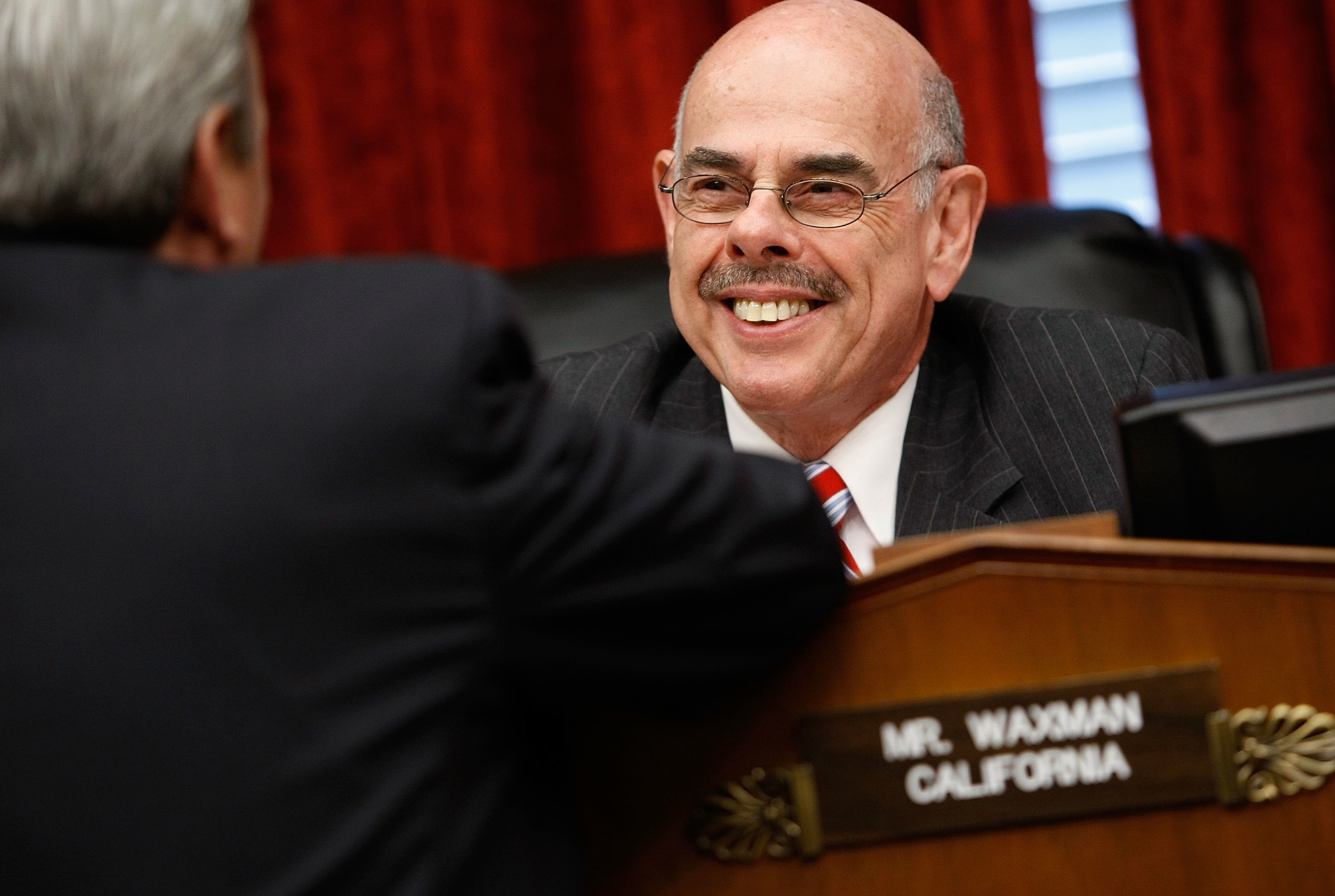
A Legislator’s Legislator

Cabinet Members And Top CEO's Testify On Clean Energy Security Act

Kilgore will miss Henry Waxman, who is retiring from Congress after 40 years as a Democratic party stalwart:

As a legislative craftsman, Waxman was sort of a rumpled, uncharismatic 5-foot-5-inch version of Ted Kennedy, and the comparison might actually slight (no pun intended) the Californian. There’s hardly any significant health or environmental legislation enacted during his long tenure in the House that doesn’t have his fingerprints all over it. But personally, I’ll always identify Waxman with his long, heroic effort to turn the twisted and inadequate federal-state Medicaid program into something that actually served as a safety net, particularly for kids. I’m sure the Affordable Care Act, and particularly its Medicaid expansion, were especially sweet accomplishments for Waxman.

Although he was a staunch liberal, Joshua Green points out that most of Waxman’s legislative achievements were bipartisan:

That Waxman’s most productive years occurred while the White House was controlled by the opposing party makes his example all the more notable today. It’s astonishing that Republicans don’t study him and emulate his methods.

Those methods are essentially the opposite of the ones that lawmakers such as Ted Cruz have employed—the refusal to compromise, the sweeping attempt to impose an entire agenda immediately through force. “You have to be willing to be at it, look for compromises, build coalitions, and get public opinion behind you so you can finally get to the point when legislation can be passed,” Waxman said.

Harold Meyerson recalls the congressman’s distinctive style:

Getting things done the Waxman way didn’t involve the bonhomie that politicians characteristically employ. He didn’t persuade his fellow congressmen by schmoozing. “Henry never entertains his colleagues,” his longtime aide Howard Ellison told me when I wrote a profile of Waxman for the Los Angeles Times Sunday Magazine in 1995. “He does no sports. His staff would say, ‘You should play golf with John Dingell [then chair of Waxman’s committee].’ Fat chance.”

Rather, as I wrote at the time, Waxman “persuades by argument, not by humor or force of personality. Where Ralph Nader unleashes a torrent of indignation, Barney Frank stings with wit and Tom Hayden still taps into a vein of adolescent anger, Waxman simply makes his case point by point. He is not liberalism’s man for all seasons. He is only its legislative genius.”

Masket highlights his role in building the Democratic power base in West LA:

To some, at least, the Waxman-[Howard] Berman machine would represent a form of political corruption. That is, they used money, influence, and technical skills to limit voters choices in elections and advance issues they felt were important. And they could certainly be competitive and cutthroat in their approaches, doing as much to hurt their opponents as help their friends. But it’s hard to find much evidence of graft or pettiness in their efforts. As much for his other accomplishments, Waxman deserves to be praised for building a serious political organization that affected dozens of political careers and literally millions of constituents.

Ben Adler explores Waxman’s environmental legacy:

Environmental advocates point to one major legislative accomplishment in particular: his role in writing the powerful 1990 amendments to the Clean Air Act. As the Times explains, “He is also credited with laying the foundation for many of the executive actions that Mr. Obama, during his State of the Union address on Tuesday, pledged to pursue. One involves the Clean Air Act, which Mr. Waxman helped write and which gives the Environmental Protection Agency the authority it is now exercising to regulate power plant emissions of greenhouse gases. Mr. Waxman saw to it that the bill would allow the president, on his own, to order improvements in automobile fuel efficiency and other energy saving efforts.”

Reflecting on Waxman and George Miller, who both entered the legislature as young men, Bernstein considers what a geezer Congress we have today:

There’s nothing wrong with people coming to politics, and Congress, later in life. But if we don’t get 30-somethings (and some 20-somethings) in the mix, we are going to have an overly geriatric legislature. That is increasingly the case.

I’m not sure exactly why it’s happening. It could be because more individual wealth is needed for House campaigns these days. It could be, in part, because the field of candidates has opened up to include women, and maybe others who were excluded in the past and take a little longer to stake their political claim. So there may be good and bad reasons. Still, we could use a few more House careers like those of George Miller and Henry Waxman.

And Sam Baker notes that Waxman’s retirement is just the latest in an exodus of Obamacare architects and Democratic health care experts from Congress:

Including Waxman, four of the five committee chairmen who helped write the law are gone or leaving. Democratic leaders and committed liberals can and will still defend Obamacare politically, along with the basic idea of universal coverage. But there aren’t many Democrats left who—like Waxman and some of his departing Congressional colleagues—are truly invested in the ins and outs of the Affordable Care Act as well as other nitty-gritty health care issues. (Waxman, along with Republican Sen. Orrin Hatch, essentially created the generic-drug industry.)

(Photo: House Energy and Commerce Committee Chairman Henry Waxman (D-CA) prepares to hear testimony from Obama Administration cabinet members on Capitol Hill April 22, 2009. By Chip Somodevilla/Getty Images)


Finding, Ctd

A reader takes the thread in another direction:

What I’m really wondering is when (or whether) we’ll have an animated Disney film with two Prince Charmings. If as a young child I had ever been shown that such a relationship was even thinkable, let alone gloried in Disney-style apotheosis, it could easily have set the groundwork for my teenage decade to be a “normal” one of healthy self-discovery instead of one filled with angst, duplicity and shame. Sometimes I have to explain to people why I didn’t come out much earlier, since neither I nor my family was religious, and the way I usually express it is: it’s not so much people disapproved, it mostly just never occurred to anyone as a serious possibility.

Passing The Buck On Rescheduling Pot

In his latest evolution on drug policy, Obama suggests that he wouldn’t oppose changing marijuana’s Schedule 1 designation – but he’s leaving that to Congress:

“First of all, what is and isn’t a Schedule I narcotic is a job for Congress,” Obama said. … The DEA is required to make determinations, Obama said, but based on laws passed by Congress. A spokesman for the White House Office of National Drug Control Policy tweeted Wednesday that the attorney general can reclassify marijuana after a scientific review, but that it was “not likely given current science.” But Obama said he would support congressional action to remove the schedule I classification for marijuana.

Sullum calls out Obama for acting like he doesn’t have to power to make that change himself:

While Congress can amend the Controlled Substances Act (CSA) to increase or reduce restrictions on particular drugs, the statute also gives that power to the attorney general, who has delegated it to the Drug Enforcement Administration (a division of the Justice Department). In fact, the DEA has repeatedly rejected petitions to reschedule marijuana, most recently in 2011. I forget: Who was president then?

Apparently Obama forgot too. Obama often speaks as if he is an outside observer of his own administration—condemning excessively long prison sentences while hardly ever using his clemency power to shorten them, sounding the alarm about his own abuses of executive power in the name of fighting terrorism, worrying about the threat to privacy posed by surveillance programs he authorized. Now here he is, trying to distance himself from his own administration’s refusal to reclassify marijuana.

Nicole Flatow points out that the state of “current science” on marijuana is subject to a catch-22, courtesy of the federal government:

[T]here have been many peer-reviewed studies, but very few of sufficient size and scope to satisfy the government, particularly about the drug’s medical benefits. Ironically, this dearth of research is perpetuated by the federal government’s position on marijuana. Federal funding, the lifeblood of academic research, is severely curtailed for large-scale studies of pot, particularly those that aim to study the plant’s potential benefits rather than its potential for abuse, because of the drug’s Schedule I designation. Perhaps even more significantly, the legal access to a supply of marijuana for conducting this research is controlled by one federal agency with a mission to combat drug abuse. And the panel that controls access to the marijuana has delayed and rejected academics’ FDA-approved requests to research some of the most pressing medical marijuana issues, including treatment for post-traumatic stress disorder.