Older, Wiser, Slower?

Susan Brink surveys research that investigated the question, “Who has the better memory: the young person who knows a little and remembers all of it, or the older person who has learned a lot and forgets a little of it?”

It could be that older, wiser heads are so chock full of knowledge that it simply takes longer to retrieve the right bits. …

[Researcher Michael] Ramscar created computer models simulating young brains and older brains. He fed information into both models but added buckets more information to the model meant to simulate an older brain. “I could see precious little evidence of decline in [the models of] healthy, older people,” he says. “Their slowness and slight forgetfulness were exactly what I’d expect” because with more to draw on, there are more places to search, and there’s more information to search through to find an answer.

Benedict Carey digs in (NYT):

[T]he new study is not likely to overturn 100 years of research, cognitive scientists say.

Neuroscientists have some reason to believe that neural processing speed, like many reflexes, slows over the years; anatomical studies suggest that the brain also undergoes subtle structural changes that could affect memory. Still, the new report will very likely add to a growing skepticism about how steep age-related decline really is.

It goes without saying that many people remain disarmingly razor-witted well into their 90s; yet doubts about the average extent of the decline are rooted not in individual differences but in study methodology. Many studies comparing older and younger people, for instance, did not take into account the effects of pre-symptomatic Alzheimer’s disease, said Laura Carstensen, a psychologist at Stanford University.

Thomas Hills weighs in:

Years of research have shown that older people have larger vocabularies than younger people, other things being equal. In their paper, Ramscar and associates show that even this we’ve probably underestimated, because older people tend to know a lot of very low frequency words such as “zaftig” and “arroyo” and “byzantine”, words that are difficult to test because there are so many of them. Younger people tend to know fewer of these words.
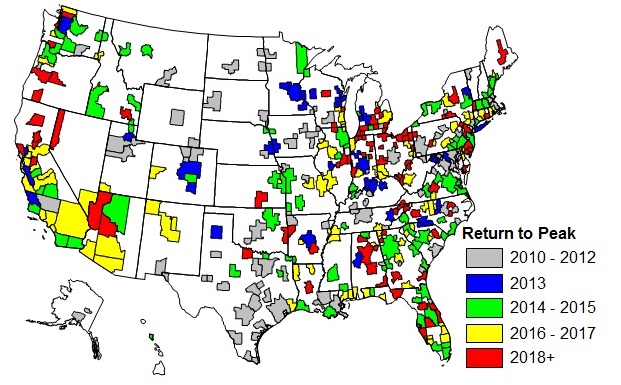
Unemployment Across America

dish_metromap

Richard Florida elaborates on the above map, which predicts the “time frame for return to peak employment in metro areas across the U.S.”:

My own view is that we are in the midst of a long-run Great Reset, one that is slow moving and uneven across cities and regions. A report [PDF] released at the annual meeting of the U.S. Conference of Mayors last week – though it was spun optimistically, with predictions of job growth in 357 of the country’s 363 metropolitan areas – lends support to this view. Just a third of all metros (121) are projected to have job creation rates of 2 percent or more. And while 40 percent are predicted to have unemployment rates below 6 percent during 2014, a worryingly high proportion – 35 percent – will see their rates hover above 7 percent. …

Many of the places that have already recovered, in gray and blue, are located in one of the two pillars of the new economy – the energy belt of Texas and the Great Plains, and knowledge hubs like Boston, New York, the Baltimore-Washington region, and the Bay Area. The places that likely won’t return to full employment until 2016-7 (yellow) or 2018 and beyond (red) include former manufacturing hubs of the Rustbelt; poorer, de-industrialized East Coast metros like Camden, New Jersey; and old Southern manufacturing cities like Birmingham, Alabama.

Art By Algorithm

http://twitter.com/AmIRiteBot/status/427384696918794241

Leon Neyfakh profiles Darius Kazemi, a botmaker whose “dozens of projects have won him admirers among a range of people so wide it suggests the world doesn’t quite have a category for him yet”:

Kazemi’s first foray into the field was called Metaphor-a-Minute. The way it worked was simple: The bot would pull nouns and adjectives from an online dictionary called Wordnik, and arrange them in a particular order so that each tweet presented a metaphor both bizarre and fleetingly plausible. (Examples: “a premonition is a warren: defenseless and tacit,” “an impression is a mucus: nondomestic, rootlike.”) The effect was that of a very smart but helplessly confused alien being trying to make sense of the English language. To date, the account has generated nearly half a million metaphors.

From there Kazemi was off to the races.

He made a RapBot that used a rhyming database to write hip-hop verses. He created Amirite, a hammy jerk of a bot that makes corny, often nonsensical “am I right” jokes that sometimes strike a nerve: “Wendy Davis? More like Trendy Davis, amirite?” His Startup Generator lampooned tech culture with a constant stream of dubious business ideas (“Paypal for dropouts”).

More recently he created his most popular bot to date, Two Headlines, which crawls the latest news stories on Google, picks two at random, and switches important keywords to generate a series of broken windows into the popular conversation: “Beirut seeks love advice from Katy Perry”; “Iran Is Working On Smart Contact Lenses That Can Monitor Your Body’s Health.” Bogost now considers himself part of Kazemi’s growing fan base, waiting for the next bot to be born. “You have a favorite comedian or favorite artist and you look forward to what they say, because you want to see the world through their eyes,” [professor Ian] Bogost said. “The same kind of thing is happening with Darius.”

Super Fail

Jonathan Mahler calls this year’s Super Bowl “a big fat failure”:

As of Tuesday, there were still 18,000 tickets available to the game. Hotel rates in New York City — and East Rutherford and Secaucus, for that matter — are plummeting. Weird. Who could have predicted that paying $2,000 to stand in the freezing cold and watch a football game might not be everyone’s idea of a great winter getaway?

Like all major sporting events, this one started with plenty of hooey about all of the money that it would generate for its host city (or cities). Random, obviously overstated estimates were thrown around. An economic-benefits study commissioned by the host committee — what major sporting event would be complete without an economic-benefits study? — reportedly put the number at $600 million. I say “reportedly” because the host committee has refused to release the study to the public, which tells you everything you need to know about the oil gusher of cash currently showering heretofore unimaginable prosperity on the New York metropolitan area.

On Thursday, Jesse Lawrence checked in on ticket sales:

Today, the average list price for Super Bowl tickets is now $2,465, a decline of 34% since the morning of Conference Championship Sunday [January 19th].  While the rate of decline is now much slower, it is still declining by $50-$100 each day.  The ticket decline has not discriminated to any areas of MetLife Stadium, with one exception: Club Seats.  The Chase and Lexus Clubs are located along the mezzanine sidelines on the east and west sides of the stadium. Both clubs offer the same amenities and services, including indoor food and beverage service.  While weather concerns have been a major culprit for the dropping prices,  Club prices have been immune to the elements, just like the lucky people that that will be sitting there. Since last Monday, Club Corner and Club Center seats have only declined by 6.61% and 9.34% respectively, to their current averages of $3,364 and $5,163.

Update from a reader:

Saying the Super Bowl is a failure because not enough people are buying tickets to the game is like saying Christmas is a failure because not enough people went to church.

Another:

To clarify, the Super Bowl is completely sold out. It is the secondary ticket broker market that has declining sales. There will be a packed house tomorrow night.

So Close

Screen Shot 2014-01-31 at 11.34.01 AM

[Re-posted from earlier today]

We just passed $505,000 in revenue in January, and there are now only hours to go before the month ends. Last year, we had $516,000 in the same month. Can we actually make it over the top?  [Update at 8.30 pm: $512,000 – almost there! Update at 10.30 pm: $515,000! Update at 12 am: We made it, right on the nose!] Renew here! Renew now! Or subscribe here if it’s your first time. Update from a reader who did just that:

Ok, you got me! After years of faithful reading, I finally decided to pony up and help get you over the 516K bump. Hopefully you make it.

Why did I stand on the sidelines for a year? I don’t know … I check your blog multiple times a day (with the exception of Sunday), I silently empathized when you lost your beagle (as I had lost mine just a few months prior) and I consider the time you linked to my blog a few years ago as the highpoint of my online life. Perhaps I needed a year to see if this new model would change the Dish in ways I wouldn’t like. If so, I clearly need not have worried. You all continue to do excellent work. Here’s to many more successful years!

Another gets novel:

Instead of renewing at a higher amount, I gave three gift subscriptions to my siblings. Seedlings!

Another creates another price-point to add to $4.20/month and double chai ($36):

I started to enter double the required annual price ($19.99), then decided to honor our current president with $44.

Banks For The Bud Business

Federal law makes it impossible for the legal marijuana industry to put its money in banks. The dangers this produces:

One benefit of banks is the security they offer. And with all the marijuana-related cash exchanging hands in Colorado these days, security is a pre-eminent concern. It doesn’t help that there seem to be fewer and fewer people around to help guard that cash. Last summer, the Drug Enforcement Administration reportedly began pressuring armored-car companies to stop working with marijuana companies. And last month, the Denver Police Department barred its off-duty officers from working security at marijuana operations, despite the fact that many moonlight as security guards at liquor stores and bars. That’s because department policy prohibits off-duty officers from working with any business that “constitutes a threat to the status of dignity of the police,” such as porn stores, strip clubs—and now, pot shops.

“They’re setting marijuana up to be a cash business that can’t protect itself,” says [Michael] Elliott [executive director of the Medical Marijuana Industry Group]. “The roles have switched. Now the marijuana industry is the one working to keep things safe.”

Update from a reader:

I’m a credit analyst for a small holding company with locations in Colorado. More and more over the last several years we’ve seen weed businesses on property rent rolls.

In previous years, if a customer wanted to purchase or refinance a building with a dispensary we would require removal of the tenant prior to closing. This was simply a matter a risk management. No one knew what would happen if the feds decided to shut it all down. Executives in most community banks have taken a ‘better safe than sorry’ approach.

I’m not a compliance expert, but right now it appears that Treasury is deciding how to handle the issue of suspicious activity reports required by law when large cash deposits are made. I am certain they understand that legalized cannabis is upon us and there’s no going back. Hell, even my most conservative friends in the industry have accepted as much. And I believe there is sincere concern among both bankers and regulators about the safety issues that arise from the transport and storage of huge piles of cash. They are just trying to figure out a way to solve the problem without a huge bureaucratic mess. When Treasury figures out how to finesse the issue, we will get some direction and can respond accordingly.

Once marijuana businesses can make deposits, they will quickly be considered legitimate in the eyes of their community banks. Instead of avoiding cannabis businesses, we will compete for them.

The Banality Of Absurdity

Rebecca Schuman is intrigued by the forthcoming Kafka videogame:

The game, according to [developer Denis] Galanin’s charmingly terse press kit, follows a hero named K., who “gets a sudden offer of employment” (ripped from the headlines, as it were—this is the premise of The Castle). This job offer “changes [K.’s] life, forcing him to make a distant voyage. Together with the hero you will experience an atmosphere of absurdity, surrealism, and total uncertainty.”

Sounds about right, yes? Maybe. What Kafka’s popular image obscures is that the real punch line of his works is not the fantastical, but the mundane. In The Trial, Josef K. gets arrested for no reason, but he doesn’t get thrown in a cell, waterboarded, and convicted. He goes back to work, and then spends the rest of his life wrestling with a bureaucracy that is vast, staggeringly incompetent—and boring. The primary story of The Metamorphosis is not actually that Gregor Samsa is a giant and disgusting bug-creature, it’s that his family is really, really bad at managing their finances. The centerpiece of In The Penal Colony, a massive and intricate torture machine, isn’t “remarkable” simply for its gory details—it’s remarkable because its inventor was a fool who wrote in gibberish, and it doesn’t actually work.

Face Of The Day

UKRAINE-UNREST-EU-RUSSIA-POLITICS

An anti-government protester stands at a demonstrators’ barricade in Kiev on January 31, 2014. A bill passed by Ukraine’s parliament to amnesty arrested activists gives protesters a 15-day deadline to leave occupied streets and administrative buildings otherwise it will not be implemented, according to the text published the day before. The Ukrainian army has previously said it would not interfere in the protests, which erupted in November after Yanukovych scrapped an integration deal with the European Union in favour of closer ties with Kiev’s historical master Moscow. By Angelos Tzortzinis/AFP/Getty Images.

Deportation Is No Joke

A petition to deport Canadian-born singer Justin Bieber over his recent arrest has attracted well over 100,000 signatures, which is “the required threshold for an official review and response from the executive office.” Christopher Flavelle, also Canadian, hates these sort of stunts:

Americans, could you stop making summary deportation the default remedy for people you decide you don’t like? In what universe does it make sense for somebody to be deported just because 100,000 people sign a petition? The same universe where a Democratic administration deports a record 400,000 people a year to look tough on enforcement, in the hopes of persuading Republicans to agree to immigration reform, that’s where. Please stop treating us as props for whatever populist whimsy catches your flitting glance.

Update from a reader:

While I don’t care if Justin Bieber stays in the country or not, Canadian outrage is misplaced.  Americans (or any foreigner) with DUIs on their record are, in general, forbidden to travel to Canada.