I was thrilled to see the aid debate come up on your blog, as it’s a discussion well worth having for a large forum. Aid itself is a brilliant idea, and one with far-reaching and lasting effects, but there are basically no metrics for ROI, and nobody is acting to direct it intelligently. This happens because of the phenomenon Easterly notes, wherein people truly donate to feel good, not to actually effect change (which requires much more work).
For every successful vaccination program, we have extravagant shenanigans like “spreading Internet,” or other nonsense. Paul Farmer is a fundraising machine, and after over a decade in Haiti, the public health situation is actually worse there due to a set of diseases that are shockingly easy to treat and prevent: diarrheal illness.
Now I’ll admit that this is my personal area of work, so I’m biased, but the fact of the matter is that diarrhea is still the number-one infectious disease killer in the developing world, with HIV/AIDS so far off in the distance as to be virtually irrelevant. But money is still flowing in gobbets to a project that while compelling emotionally, is functionally useless in comparison.
Aid has to be intelligent, or it’s just rich people quacking about how great they are.
One of the most effective and economical tools against diarrhea and other water-borne illnesses in the developing world is the biosand filter, demonstrated in the above video. A jaded reader writes:
I was a Peace Corps volunteer in Bahrain and then spent 23 years as a foreign service officer with USAID. In my opinion, 90 percent of all projects are crap. One hundred percent of the assistance given to Israel and Egypt is crap. We need to fix the United States before we run around the world “fixing” other places.
Stephen Kinzer notes that “one of the surest signs that Clinton is running for the presidency is her refusal to take a position on the greatest geopolitical question now facing the United States”:
A strong statement by Clinton in favor of reconciliation [with Iran] would be a game-changer in Washington. She would be giving a centrist, establishment endorsement of her former boss’s most important foreign policy initiative. That would provide political cover for moderate Democrats terrified of antagonizing the Netanyahu government and the American Israel Public Affairs Committee, which is leading the anti-reconciliation campaign in Washington.
Such a statement, however, would risk outraging pro-Netanyahu groups and individuals who have been among Clinton’s key supporters since her days as a Senator from New York. Having spent years painstakingly laying the ground for a presidential campaign, she does not want to risk a misstep that would alienate major campaign contributors.
Kinzer doesn’t think a deal with Iran would have been happened if Clinton had remained the Secretary of State. However, a few weeks ago, Crowley pointed out that Hillary was open to diplomacy:
She was the first Obama official to suggest that Iran could maintain a domestic uranium enrichment program under an international nuclear deal. And one of her most trusted State Department aides, Jake Sullivan, conducted secret talks with the Iranians in Oman. “She was skeptical that diplomacy would work with the Iranians but absolutely convinced that we had to test the possibilities,” [Dennis] Ross adds.
In response to Macklemore and Ryan Lewis’s “Same Love,” the soundtrack to the cringe-worthy Grammy wedding, Brandon Ambrosino asks whether we can support equality without imagining sexuality as biologically predetermined:
One of the reasons I think our activism is so insistent on sexual rigidity is because, in our push to make gay rights the new black rights, we’ve conflated the two issues. The result is that we’ve decided that skin color is the same thing as sexual behavior. I don’t think this is true. When we conflate race and sexuality, we overlook how fluid we are learning our sexualities truly are. To say it rather crassly: I’ve convinced a few men to try out my sexuality, but I’ve never managed to get them to try on my skin color. …
Arguing that gayness is as genetically fixed as race might have bolstered our rhetoric a few years ago, but is it necessary to argue that way now? I understand that the genetic argument for homosexuality is a direct response to the tired “You weren’t born that way” rhetoric of religious people. But in my opinion, we could strip that religious argument of much of its power if we responded like this: “Maybe I wasn’t born this way. Now tell me why you think that matters.” I imagine many religious people haven’t really thought through the implications of their own rhetoric. (What, for instance, does a socially-constructed word like “natural” even mean?)
Sigh. The salient fact for a vast majority of gays is that we experience our sexual orientation exactly as straights do. We experience it as a given – and even the old-school reparative therapists believed it was fixed by the age of three. The pomo left doesn’t want this to be true, just as the Christianist right doesn’t either. But it is. John Aravosis makes the obvious point:
I’d love to see the Great Ambrosino in action, willing an attraction to a gender where, only moments ago, there was none. It’s never happened in the history of the world.
Ambrosino is likely not formulating his thoughts terribly well (which happens when magazines hire people who can’t write). He’s not describing gay people actually choosing their sexual orientation. He’s talking about either bisexuals (or people who are predominantly of one orientation, but still have enough attraction the other way that if the right person came along they could act on it), or he’s describing people who legitimately have seen their orientation morph over the years, through no causation of their own. But all three of those categories are not people who “chose” to change their sexual orientation. They are simply people who chose to act on the already-appealling meal placed before them. Ambrosino didn’t choose to find men sexually attractive any more than I choose to love chocolate. I can choose whether to partake in chocolate, but I can’t choose to turn on and off the underlying desire for the sweet.
Savage, meanwhile takes the gay outrage machine to task for bitching about Same Love:
The queers complaining about Macklemore & Ryan Lewis now remind me of the queers who used to bitch and bitch and bitch about how big beer companies didn’t advertise in queer publications or sponsor pride parades. (“Queer people drink a lot of beer! They want us to support them and buy their beer but they don’t want to support us and our community!”) But when big beer companies began advertising in queer publications and sponsoring pride parades… the exact same queers who had been complaining about how big beer companies weren’t advertising in queer publications or sponsoring pride parades immediately started bitching about how the beer companies were trying to profit off our sexuality. (“The pride parade is not for sale! We are a community, not a commodity!”) Blah blah bitchy blah.
I kinda hoped this lefty whininess and escape from reality would dissipate at some point. But no! At least at this point they aren’t actively sabotaging the case for gay equality and integration, as they did in the 1990s. But you’d think these fantasies about fluid male sexual orientation and the social construction of everything all the way down would have faded away by now.
About 20 years ago, my father suffered a massive heart attack. He had no prior symptoms other than a bleeding nose about three or so years earlier that had to be cauterized. He did have high blood pressure and was overweight, and like any stereotypical Irish-American cop, he drank.
What makes his death “good” (he’d died far too early at the age of 69), was that he and my mom were having sex when he passed.
Supposedly, and purely on the basis of what our mom related to my brothers and our wives, he was on top of her and she thought he had completed his part of the act and fell asleep. Well, he did fall asleep, but forever.
While my mom had no nightmares from that experience, I’m sure she remembered that night until she passed years later. If one were to lose one’s spouse while in throes of passion and it caused no harm, I’d consider it to be a good death. I always thought that this was the right way to go –quickly, no drawn-out health problems, no hospital expenses, with a loved one nearby, and one last good fuck.
Amen. Another story:
It was sometime in October. The Navy chaplain pulled me aside and said I had to go home immediately because my grandmother was dying from her five-year battle with lung cancer. When I arrived at the hospital, she looked like a shell of a person. The doctors told us this was it and we needed to say our last goodbyes.
My grandmother had other plans, however.
She made me promise I would be home for Christmas. I told her I would, thinking that she wouldn’t make it through the weekend. Sure enough, when Christmas rolled around, my grandmother was still alive, receiving hospice care in her home. The entire family gathered in her living room on Christmas Eve to exchange gifts like we did every year. She sat there, propped up in her bed smiling as she watched over us. She even threw her typical fit when the scratch off lottery tickets we gave her were all losers.
At one point I stopped what I was doing and just watched her. She sat there with the purest smile you can imagine looking over the entire room, taking in every second of her entire family together with her. Then she just closed her eyes. At about 5:30 in the morning my mom woke me up, saying it was time for me to say my goodbyes. After we all said goodbye and kissed her, my grandmother told my mom that she could see her two kids who had died and that she wanted to be with them. My mom told her it was okay for her to go to them. My grandmother said okay, took a breath, and passed.
That was 22 years ago. I still think about it often. I would not even begin to pretend I could capture in words the absolute beauty and power of that moment. I’ve cried many tears over my grandmother’s death, but none that day. Sadness just didn’t seem like the right emotion for what I witnessed. Surrounded by those you love absolutely convinced you are going to see those you so dearly miss is surely a good death.
Another adds:
I’ve been stalling on my renewal because I’m broke, but reading this reminds me of the beauty and the special-ness of the Dish. It’s us, the readers, a community, and the sharing of those stories that bring tears to my eyes.
Ann Friedman finds it wanting. She focuses on Rep. Cathy McMorris Rodgers’s forgettable SOTU response:
Like Palin before her, McMorris Rodgers projects the supermom image that is quickly becoming the GOP’s go-to female archetype. Yet there’s a fair chance that even this superficial solidarity won’t resonate with women voters. “For most American women, this is the era of coming to grips with not having it all,” writes Hanna Rosin at Slate. “For Republican politicians, however, it’s the 1980s of the Enjoli, bring-home-the-bacon, 24-hour woman.” Why didn’t the GOP realize this decades earlier? The supermom archetype is perfect for a party whose policies send the message that if you’re not getting ahead, it’s because you aren’t working hard enough.
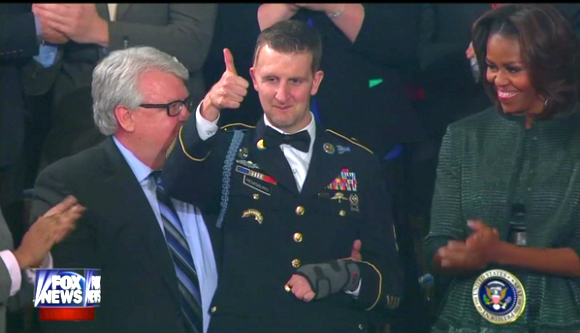
[W]hile that moment reflected limitless credit on Sgt. Remsburg, his family, and others similarly situated; and while I believe it was genuinely respectful on the president’s part, I don’t think the sustained ovation reflected well on the America of 2014. It was a good and honorable moment for him and his family. But I think the spectacle should make most Americans uneasy.
The vast majority of us play no part whatsoever in these prolonged overseas campaigns; people like Sgt. Remsburg go out on 10 deployments; we rousingly cheer their courage and will; and then we move on. Last month I mentioned that the most memorable book I read in 2013 was Billy Lynn’s Long Halftime Walk, by Ben Fountain. It’s about a group of U.S. soldiers who barely survive a terrible encounter in Iraq, and then are paraded around in a halftime tribute at a big Dallas Cowboys game. The crowd at Cowboys Stadium cheers in very much the way the Capitol audience did last night—then they get back to watching the game.
The entire reason Democrats and Republicans came together so unreservedly was that Obama didn’t use Remsburg’s ordeal to say anything about the war in Afghanistan, or about how America should conduct itself on matters of war and peace. The only lesson he drew was that Remsburg, like America itself, “never gives up and he does not quit.”
Which was, frankly, bizarre.
Because while Remsburg himself has clearly shown incredible determination in the face of almost unimaginable obstacles, when it comes to the war in which he fought, quitting is exactly what the United States plans to do. Obama said as much earlier in his speech. In lauding America’s exits from Afghanistan and Iraq, he didn’t cite a single thing the United States has accomplished in either country. How could he have? Parts of central Iraq are today in the hands of jihadists, and the carnage there has never been worse. When the U.S. and its allies leave Afghanistan, one expert recently predicted, “the likely outcome is a civil war, much more fierce and widespread than the one fought during recent years.”
The harsh reality is that America did not leave Iraq, and is not leaving Afghanistan, because we accomplished our goals there. We are leaving because we decided our goals of defeating the Taliban and fostering Iraqi democracy weren’t important enough to justify spending billions of dollars and losing more American lives.
Lydia DePillis explains the retirement savings account Obama touted on Tuesday:
The MyRA option would create a cheaper way for smaller employers to enroll their workers in some sort of plan, by taking an automatic payroll deduction that goes into a Roth IRA-style, government-backed account with the employee’s name on it. There’s only one investment option available, and it won’t appreciate that quickly, but it’ll be impossible to lose money. It’s basically the embodiment of former Office of Information and Regulatory Affairs director Cass Sunstein’s “nudge” philosophy, which pushes people by default into the choices that make most sense for them.
This program will have a modest cost to taxpayers: Essentially, instead of issuing short-term Treasury bills at almost no cost, the federal government will do a little bit of its borrowing through this G Fund-like security, paying an extra point or two of interest in the process. If you imagine a program at scale with 50 million accounts averaging $5,000 in balances, the cost to taxpayers would be $2.5 billion per year for every point of interest rate premium.
How many people will this attract, realistically? Just 24 percent of the public is confident in the stock market as place to save for retirement, according to one recent survey. That’s part of the appeal of the myRA, especially to groups that are more pro-government on balance in the first place — if another financial crisis hits, your money’s still safe — but Treasury rates are so low that it’s anyone’s guess how much encouragement a two-percent return will provide to people who are living paycheck to paycheck.
Bloomberg’s editors expect low participation. They note that currently fewer “than 1 in 10 workers who are eligible to contribute to existing Individual Retirement Accounts bother to do so”:
Employer contributions to retirement savings, whether in the form of defined-benefit pensions or employer-matched 401(k) plans, have fallen. Without those contributions, especially in programs that encourage or require workers to make contributions of their own, most Americans are saving too little to retire in comfort.
David Carr has a column on various models for the future of online journalism and the Dish reader-backed concept is one of the more promising. Here’s why:
In a little over two weeks, we’ve raised as much new revenue as we did in all of last January. We’re now at $499,000, compared with $516,000 in 2013. And many of you have yet to get around to renewing, since your subscriptions only actually expire for the first Founding Members starting February 4. The reason we’re doing better in money terms despite fewer subscribers is that the average price for a sub has gone up from around $31 to close to $38. If that trend continues with future renewals, we can really start shaking things up.
We had our weekly meeting last night at our regular diner. Here’s what we were talking about: how to develop and innovate and expand Deep Dish, if the resources emerge to do so. After all, our budget last year did not include Deep Dish, which had to remain in prototype for lack of staff, money and simply time. If this year’s budget increases in line with your subscriptions, it opens up far more territory for commissioning and publishing original journalism from the best writers out there. Right now, putting out this blog every day is a full-time task for an editorial staff of six (with three interns). But for the first time, we see glimmers of the revenue that could actually make Deep Dish a part of the rejuvenation of quality journalism on the web.
So help us get there. We’ve got just a day and half to reach last January’s total: a day and a half to add $17,000. If you’ve always intended to subscribe and have never gotten around to it, subscribe for the first time here (for just $1.99 a month or $19.99 a year). If you are already a rampart of this new model: Renew here! Renew now! We’ve already begun to make a difference. If we keep going, we can do much more.
Update from a reader just now:
Perhaps you can remind us how we can purchase gift subscriptions too? I have some extra-cranky Tea Partying in-laws who could use some Dishness in their lives. Or, at the very least, I can sling some more money your way!
A Public Policy Polling survey conducted Jan. 23-26 showed that the former governor of Alaska has a 70 percent favorability rating among GOP primary voters, topping six other potential candidates in the poll, even though her name was not on the list of 2016 GOP candidates to choose from.
“The best-liked person we tested on this poll with Republican primary voters is actually Sarah Palin,” the poll noted.
In the survey of 845 registered voters, including 457 Republican primary voters, former Arkansas Gov. Mike Huckabee tops the list of possible presidential contenders, with a favorability rating of 64 percent. Fifty-eight percent of respondents have a positive view of both Kentucky Sen. Rand Paul and Wisconsin Rep. Paul Ryan, the former 2012 vice presidential nominee.
Former Florida Gov. Jeb Bush has a 56 percent favorability rating, and 45 percent of respondents view Texas Sen. Ted Cruz in a positive light. Embattled New Jersey Gov. Chris Christie comes in last with a 40 percent favorability rating.