Republicans Endorse Obamacare-Lite

Olga Khazan points out that the GOP’s alternative to Obamacare shares a lot of Obamacare’s characteristics:

The GOP’s “Patient Choice, Affordability, Responsibility and Empowerment Act, or CARE” seems like a more timid and more market-oriented Obamacare, creating some reforms but stopping short of a total overhaul. “It checks a lot of the same boxes as the ACA, but doesn’t go as far,” Larry Levitt, a senior vice president at the Kaiser Family Foundation, said.

Reading it through in some detail yesterday, I was a little floored. After all the hysteria about Obamacare ending America as we know it, about its terrifying impact on the very nature of our polity, its devastating blow to the economy … the GOP’s alternative looks a hell of a lot like Obamacare – but with some gratuitous unconcern for some of the most vulnerable.

I think this new proposal, while certainly a substantive step forward, is so similar to Obamacare in so many ways, it effectively ends the real debate over it – although the rhetorical histrionics will no doubt endure. Any proposal that seeks to expand access, end the pre-existing conditions Catch-22 and control costs, turns out to look, in practice, much, much more like Obamacare than anything that preceded it. Once that is absorbed out there and the debate becomes a real one between actual alternatives, as opposed to an abstract one about America’s identity, the GOP is immediately on the defensive. The voters may well decide that if they’re going to get some version of Obamacare, better the real thing than an incoherent and vague knock-off. Or they may even decide that the GOP’s hysteria was bullshit. Because it was.

Frakt doubts the GOP’s bill will go anywhere (or was ever meant to):

Title 1 of the Patient CARE Act repeals Obamacare to provide “needed relief from job-crushing mandates.” That’s all it does. That’s its sole purpose—on paper. But Title 1 isn’t really there, on paper, to repeal Obamacare. It’s there to satisfy the need of GOP candidates to appear to be against everything actual and implied by Obamacare on the campaign trail and in primary debates, if not those for the general election. It’s there so that more moderate GOP Senators and Representatives can say they have a reform plan, but still minimize the risk they’ll be challenged on the right by a Tea Party candidate who is “really” for repeal.

Meanwhile, Democratic candidates, by and large, cannot be for repeal. Obamacare is their law, and explicitly so if they voted for it. Therefore, it hardly matters if the Patient CARE Act is similar in many ways to the ACA. No Democrat can be for anything that begins with repeal no matter how similar the guts are to the ACA (whether initially or after some compromise). That’s admitting political defeat on the ACA and handing victory to the GOP. Why would Democrats do that?

They won’t. They won’t today. And they won’t after the midterms. There’s no compromise here. One side needs to be for repeal, for political reasons. The other side cannot be, again for political reasons.
Art Imitating Trauma

After watching Lone Survivor, combat veteran Mikey Piro reflects on how he prepared himself for an experience that he knew was likely to trigger his PTSD:

Overall, I focused on being mindful and present when facing the visual and auditory triggers throughout the movie. No matter how good a makeup artist is on a movie, it is still not the real thing. It is close enough to make me remember.  Thankfully, though very convincing, it was easy to tell myself these were actors. That is not to say I did not jump a few times at sudden explosions or cracks of gunfire. And unlike when I watched “Zero Dark Thirty”, and perhaps because I just recently watched it, I did not face the anxiety of anticipation of the final and emotional events in movie.

What deeply impressed me about the movie was its being an antidote to Zero Dark Thirty (spoilers below).

Exposed to real danger in a way no one in Washington ever was, these soldiers were given a chance to commit a war crime to save their asses, and chose not to. They chose not to, even as they knew the consequences of abiding by the rules of combat could easily lead to their deaths (and it did).

The movie does not shrink from pointing out how excruciating this choice was, how tempting it would have been to have killed civilians in cold blood. But it also reveals something deep about the American military character and tradition. Unlike the war criminals in Washington who tore up the Geneva Conventions as a “no-brainer”, these heroes risked and lost their lives to maintain American honor. If you want to know the difference between patriotism and Cheneyism, this movie is a good place to start. While Cheney and Bush betrayed America’s core values with near-trivial abandon, these soldiers on the ground gave their lives to preserve them.

Mikey notes:

I think most importantly the film made me proud to be a Veteran and a Grunt. I hung up my boots and blue cord long ago, but I still love the Grunts and Scouts.  They hold a special place in my heart.  The “get it done” attitude in the face of steep odds is something I feel I still carry in my corporate job.  When work does get stressful, my perspective and approach to dial down the swirl around myself and others is valuable.  I don’t think I am able to do that without my time in combat and I feel my co-workers appreciate my “other 1%” view on it too. (At least I hope they do…)  I have heard this experience from my other friends who have moved on to the civilian workforce.  I walked out of the theatre sombre, but with my head held high.

Subscribers can listen to the Dish’s podcast with Mikey here.

The Selective Secrecy Of Bill De Blasio, Ctd

Scott McConnell calls the New York mayor “craven” for giving his AIPAC speech behind closed doors and claiming he had nothing to do with that decision:

While it’s true the secrecy raised eyebrows, de Blasio’s claim that it was at AIPAC’s insistence is not especially persuasive. AIPAC revels in eliciting public displays of support from American politicians: its annual event in Washington is a media-saturated “see and be seen” parade for established and aspiring office-holders. Why would AIPAC not wish to advertise the support of the hottest new property in progressive politics, a joyfully multicultural Italian-American elected by a landslide, at a very moment when AIPAC was worrying that its political brand was beginning to seem insufficiently bipartisan, too right wing, too narrowly Republican? I could be convinced, but not simply by de Blasio’s word for it. We have to, it seems to me, entertain the notion that the secrecy of the speech was at de Blasio’s behest and not AIPAC’s.

The reason would appear obvious: De Blasio wants AIPAC’s money and support, but does not want to alienate his progressive base. What makes this argument more persuasive to me is the crudely craven manner of the remarks he gave. You don’t often hear a politician in public say things like:

City Hall will always be open to AIPAC. When you need me to stand by you in Washington or anywhere, I will answer the call and I’ll answer it happily ’cause that’s my job.

It’s too blatant a pander. Which is why some prominent, progressive New York Jews have also penned an open letter to De Blasio. It’s to the point:

We understand that the job of mayor of New York is a complex one that often calls for your participation on the international stage, and we would not presume to define your job for you. But we do know that the needs and concerns of many of your constituents – U.S. Jews like us among them–are not aligned with those of AIPAC, and that no, your job is not to do AIPAC’s bidding when they call you to do so. AIPAC speaks for Israel’s hard-line government and its right-wing supporters, and for them alone; it does not speak for us.

Maybe I’m wrong and De Blasio has specifically said in public before that AIPAC will always have access to his office, and that part of his job is mayor is to do whatever AIPAC asks. If you can find identical remarks like that out there, I’ll note them. To be clear: secret pandering to any narrow interest group is always shifty, whatever the lobby.

People were rightly concerned when Dick Cheney secretly brought in the carbon lobby to frame Bush’s energy policy. Pandering to any lobby is, to my mind, a bad thing in the life of a polity. But pandering in secret obviously takes this to eleven. Eric Yoffie makes the obvious point about how bad this looks for both parties:

From AIPAC’s perspective, the “off-the-record” policy is silly from every perspective imaginable. Most troubling, it gives the event a conspiratorial air—which is both unnecessary and self-defeating. The whole purpose of pro-Israel advocacy is to generate public support for Israel’s cause, which already enjoys significant backing from the American people. Anything that seems to rely on behind-closed-doors confidences can only be harmful to Israel’s image and interests. With very rare exceptions, work on Israel’s behalf should be done right up front, in the light of day. In addition, it is astoundingly naïve to think that the mayor of New York can deliver a speech to a large gathering in midtown without it becoming a press issue. …

From Mayor de Blasio’s perspective, his bumbling could turn out to be very serious by conveying the impression that an emphatically pro-Israel mayor is perhaps not so pro-Israel after all. By attempting to dodge the press, the mayor provided an opening for critics to claim that he did not want his pro-Israel views to be widely disseminated because they might offend liberal supporters who are less supportive of Israel than he is. This is hogwash, but even the New York Times, which should know better, included the charge in its story.

Why is it hogwash? Occam’s razor would imply that’s precisely what was going on.

Our Secret Syria Policy

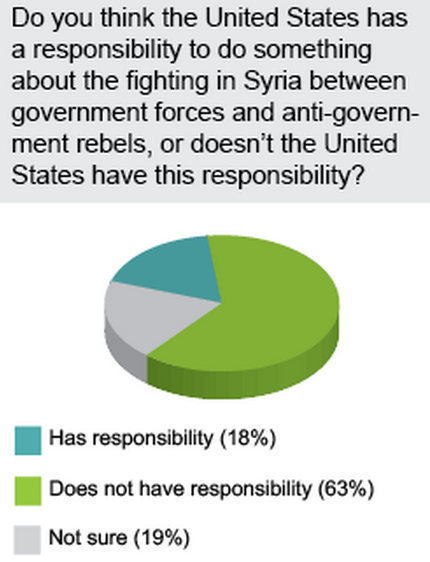
Earlier this week Reuters reported that small “arms supplied by the United States are flowing to ‘moderate’ Syrian rebel factions in the south of the country and U.S. funding for months of further deliveries has been approved by Congress.” The funding was approved behind closed doors “in classified sections of defense appropriations legislation.” Jonathan Coppage comments:

While there is surely great diversity in Syrian rebel forces, the inclination of many prominent foreign policy voices in SyriaCongress and the media to follow John McCain’s lead in seeing a George Washington in every irregular colonel does not give one great confidence that classified Congressional appropriators are well positioned to put guns in good hands. …

[W]hile secrecy surely has a necessary place in foreign policy and military decision making, the sheer amount of uncertainty created by classified national security and military budgets necessarily undermines the possibility of democratic governance and accountability. The fact that not even the reporters breaking the story can quite nail down when the classified budget was passed makes combating waste and fraud seemingly a fool’s errand.

Michael Brendan Dougherty fears that arming Syria’s rebels will prove counterproductive:

One of the typical measures in Just War theory is that the conflict have a reasonable expectation of succeeding in its aims. But American intervention in Syria seems to be about preserving the balance of chaos in a civil war. As counterterrorism expert Bruce Riedel told Reuters: “The Syrian war is a stalemate. The rebels lack the organization and weapons to defeat Assad; the regime lacks the loyal manpower to suppress the rebellion. Both sides’ external allies… are ready to supply enough money and arms to fuel the stalemate for the foreseeable future.”

And it gets worse: By offering the rebels only a modest amount of support, the U.S. is inviting precisely the kind of carnage that the international community has condemned with such force.

(Chart from YouGov’s latest polling on Syria)

Democrats For War With Iran, Ctd

Three Senators back off the AIPAC poison-pill bill to scuttle diplomacy with Iran, before it has been given a chance. It seems many were co-sponsoring a bill they never intended to vote on. Translation: it was an easy give for AIPAC, as long as it never actually happened. Or if you want to gussy that up into a rationale, this is about as good as it gets:

A spokesman for Sen. Michael Bennet (D-Colo.) said Wednesday that merely introducing the bill — but not voting on it — was helpful to negotiations. “Senator Bennet supports the President’s diplomatic efforts and would like them to succeed. The pertinent question isn’t about when we vote on the bill, but whether its introduction is helpful to the negotiations. He believes it is,” spokesman Adam Bozzi said.

And he believes that even though the president has said it isn’t helpful to the negotiations. Still, it’s good to see a small amount of pushback against AIPAC and in support of the president.

Who Can Beat Them?

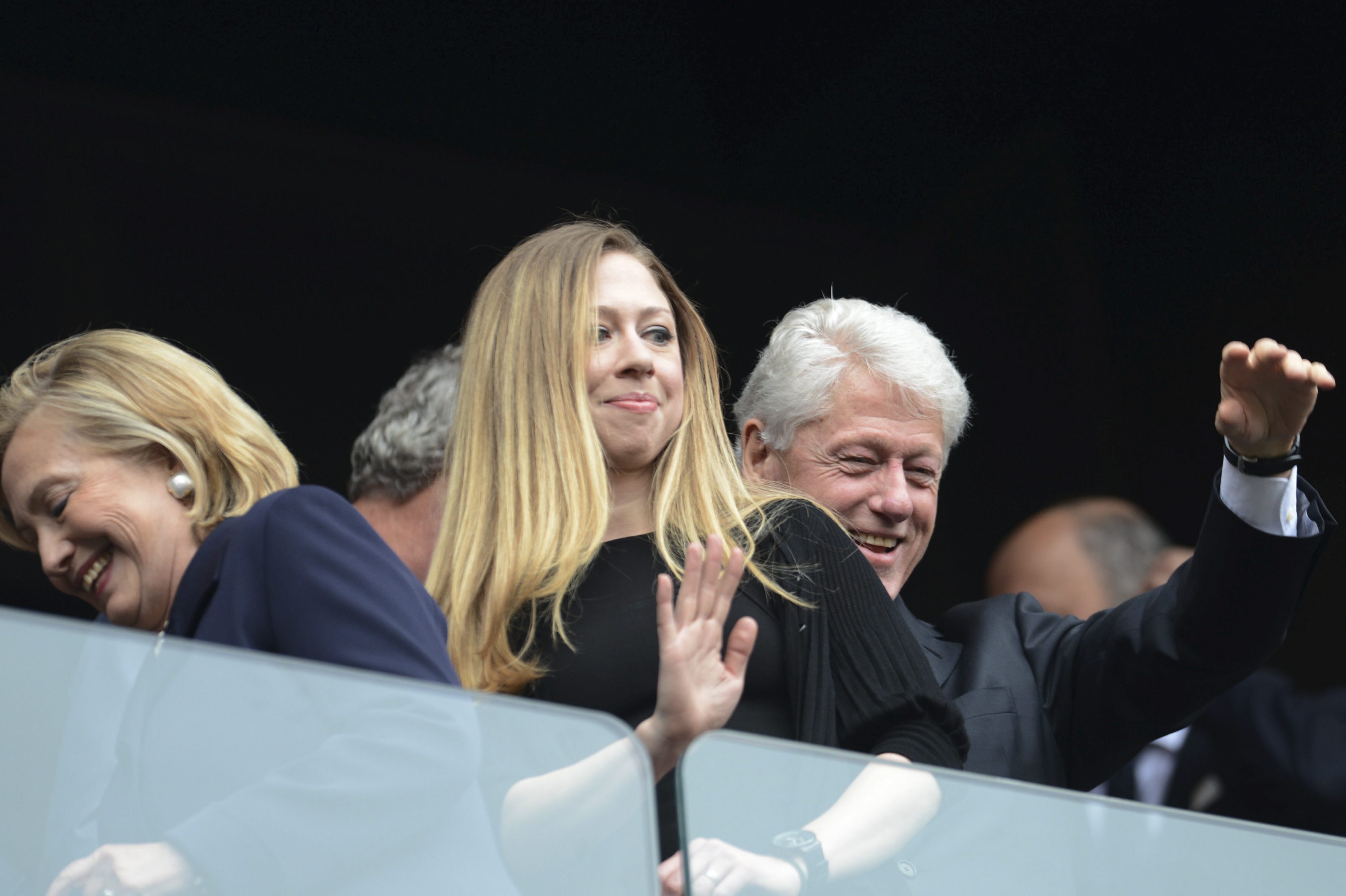
The State Funeral Of Former South African President Nelson Mandela

This is what you call “inevitability”:

Clinton stands at an eye-popping 73 percent in a  hypothetical 2016 primary race with Biden, the sitting vice president, who is the only other candidate in double digits at 12 percent. Massachusetts Sen. Elizabeth Warren, who has signed a letter along with a handful of other Democratic senators urging Clinton to run, is at 8 percent. And that’s it.

That lead is almost three times as large as the one Clinton enjoyed in Post-ABC polling in December 2006, the first time we asked the 2008 Democratic presidential primary ballot question.

Yes, the same was said last time as well, and she still managed to screw it up. But this time, there is no Obama in the wings, and this time, her coronation would follow a humiliation in 2008 and rehabilitation as secretary of state. Obama has also broken the barrier of an African-American president, and Democrats will find the appeal of the first woman president – and the gender gulf that could thereby open up – irresistible.  Even veteran Clinton-skeptics, ahem, find the appeal of a woman president galvanizing – the perfect way to add charisma and excitement to a very establishment and uncharismatic figure. Then there’s the Bill factor – a second Clinton presidency would be a reprise of the two-for-one package of 1992 and 1996. But this time, it would import into the White House the best political salesman in the country, with invaluable foreign policy experience and chops. If Hillary wins, Bill should be secretary of state. A formal role on the world stage is far preferable to an informal role on the inside fucking everything up.

What do her Democratic opponents have that could possibly match this appeal? And whom do the Republicans have? Their centrists are pedestrian, Pawlenty-style Midwesterners with little of the personality and star power that a presidential campaign demands. I mean: Walker? Kasich? They’re solid governors, but … it’s hard to see them in the White House. The base faves – a Ted Cruz or a Rand Paul – could get the nomination pretty quickly, given the new primary calendar and rules. But it would be very hard to frame a race between Clinton and, say, Cruz, as anything but a Johnson-Goldwater moment.

Which leaves Jeb Bush. It would, I guess, be a fitting testimony to the stalling of social mobility in America that a race in 2016 could be between a Clinton and a Bush, just as it was in 1992.

But since American politics is essentially an aristocratic, nepotistic oligarchy pretending to be a meritocratic democracy, many will presumably shrug their shoulders. Bush brings two things to the table: access to the big donor base, and raising the share of the Latino vote for the GOP. But it is hard to see Jeb really being able to unite the establishment and the Tea Party, without some serious internal ructions. And dynasty hurts Bush in a way it doesn’t Clinton.

Bill Clinton’s presidency now appears to have been an elysian time of peace and prosperity. George W Bush’s remains a recurring nightmare for many, especially Independents. And Jeb may not run anyway.

Of course, I may be missing something that throws all of this up in the air – like Christie’s bridge scandal. A scandal could emerge from the shadowy nexus of money, power and influence that comes with the Clinton network. Bill’s zipper could malfunction again. Hillary’s or Bill’s health may conceivably impact the race. Or simply “events, dear boy, events” could shake everything up.

What fascinates me is not just the dynamics of the race that is shaping up, but what could happen after. Imagine the GOP losing to Obama twice, and then losing to their bugaboo of the 1990s in 2016. Wouldn’t that be a shattering blow to morale? Could the GOP be drifting toward its role in the 1950s and 1960s again – a dyspeptic regional party with no ability to win a national majority? Or would a third presidential defeat in a row (and the fifth loss in in the national vote in six elections) lead to a civil war from which a saner Republican party could emerge at last?

I don’t know. But I don’t think this combination of factors will be boring.

There Goes Christie’s Electability Argument

NJ Governor Chris Christie Holds Town Hall Meeting

Christie numbers have taken a beating:

His net favorability has dropped 27 points in a month from +12 at 43/31 to now -15 at 31/46. He’s gone from having the best numbers of the potential Republican candidates to the worst in the span of a month. Christie had been popular because of his unusual amount of appeal to Democrats and independents. But now he’s become deeply unpopular with both of those groups, dropping from 38/36 to 20/58 with the former and from 46/28 to 29/44 with the latter.

Last month Christie led Clinton in a head to head, 45/42. Now Clinton has the upper hand on him at 45/43. That’s similar to the small leads Clinton holds over the rest of her potential Republican opponents- she’s up 45/43 on Bush, 46/44 on Ryan, 46/43 on Huckabee and Paul, and 47/41 on Cruz.

Christie, it seems to me, had a couple of very strong arguments to make not so long ago. The first was his personality: brusque, no-nonsense, a bull-in-a-china-shop who’d be a natural response to the professorial, no-drama POTUS we currently have. Now, that personality is easily viewed through the prism of a Tony Soprano style politics – with more petty vindictiveness and bullying. His second argument was that he could appeal to Independents and Democrats. In fact, that appeal was behind the absurdly maximalist re-election campaign as governor. Maybe he’ll recover some of that bipartisan mojo – but the bloom is way off that rose. Ramesh looks on the bright side:

Christie’s chances of winning the nomination seem better than those of anyone else. And his recent troubles may help him insofar as they cause him to discard a risky strategy.

Before the last few weeks, he may have thought that after winning the nomination his sheer charisma would lead him to a general-election victory. Many Republicans think that it was Romney’s lack of charisma that lost him the presidency in 2012. That’s a mistake: The actual electoral difficulties of the Republican Party run much deeper than that.

The traffic scandal makes it less likely that Christie will go down this blind alley. It has made the downside of his personality loom larger, and so will force him to base his campaign on something else.

Kilgore talks up Huckabee, whose numbers rose as Christie’s fell:

The guy who might have the ideal combination of genuine support from hard-core conservatives without being toxic to non-Republicans is actually Huck. As you may recall, in 2008 Huck benefitted from the same sort of dynamic until he ran out of money. He won Iowa thanks to support from serious Christian Right types, but at the same time, had a positive image in the MSM thanks to his sunny disposition (you know, jokiness plus bass playing) and his refusal to pretend the W. economy was just aces.

(Photo: Getty.)

Yglesias Award Nominee

“Part of it, I think — and I hate to say this, because these are my people — but I hate to say it, but it’s racial. If you go to town halls people say things like, ‘These people have different cultural customs than we do.’ And that’s code for race,” – a “Southern Republican lawmaker“, on opposition to immigration reform.

An Update From The Cannabis Closet

A reader writes:

Like many readers, I satisfyingly came out in the second edition of The Cannabis Closet, although I got a smackdown for talking about my two-year-old daughter’s help in the garden. I have since tripled the size of my grow and quit my teaching job. By now my children are bored by my “plants,” and I don’t let them help me.

I work part-time at a hydroponics store in Western Massachusetts, where the first medical marijuana dispensaries are set to open next month. As the laws evolve rapidly, there is a cracking open of the closet that is beautiful to watch. Middle-aged couples come in to the shop to learn about their first grow, and you can sense their relief and excitement that I’m cheerily (and vaguely) helping them grow something that was once hardly spoken of outside of criminal associations. Although some chronic smokers in the scene clearly need to take a month to clear the pot fog from their brains, the vibe is of a positive, mature, and healthy community wanting to make the world a better place.

I want the Dish community movers and shakers to know that we have fears that our grassroots capitalism, entrepreneurship, and peace-loving culture may be squashed by the over-the-top regulation of the industry and the inevitable hoop-jumping abilities of big money firms who can follow the regulations despite the investment cost. The culture has been thriving economically in the free (black) market for decades, and it would be deeply disappointing to “Walmart-ize” that away from the very beginning.

In the meantime, I do what I love, I raise and feed my family like all the other dads on my block, and I occasionally smoke a little pot to calm my nerves after a hard day of farming organic herbal medicine for my community. Wish I could send you all out a free sample.

I Blog Therefore I Am

Last week, Wilkinson reflected on blogging as an extension of the self:

There’s nothing wrong with blogging for money, but the terms of social exchange are queered a little by the cash nexus. A personal blog, a blog that is really your own, and not a channel of the The Daily Beast or Forbes or The Washington Post or what have you, is an iterated game with the purity of non-commercial social intercourse. The difference between hanging out and getting paid to hang out. Anyway, in old-school blogging, you put things out there, broadcast bits of your mind. You just give it away and in return maybe you get some attention, which is nice, and some gratitude, which is even nicer. The real return, though, is in the conclusions people draw about you based on what you have said, about what what you have said says about you, about what it means relative to what you used to say. People form expectations about you. They start to imagine a character of you, start to write a little story about you. Some of this is validating, some is irritating, and some is downright hateful. In any case it all contributes to self-definition, helps the blogger locate and comprehend himself as a node in the social world. We all lost something when the first-gen blogs and bloggers got bought up. Or, at any rate, those bloggers lost something. I’m proud of us all, but there’s also something ruinous about our success, such as it is.

The Epicurean Dealmaker responds:

Whether the creation of an online persona is a primary motivation for personal blogging, as Mr. Wilkinson maintains, or simply a (hopefully) beneficial side product thereof is not really my concern. But everybody does it.

Some of the motivations behind this character creation are the same or similar for everyone who blogs: we want our online persona to appear smarter, funnier, wiser, better-read, and more articulate than we are in real life. Some of them are more unique to my own situation and adopted persona: I want to appear richer, more powerful, better connected, more successful, more handsome, and more wicked here than I am in actuality. In any event, these exaggerations or deceptions add up—we hope—to create an online “self” that is more compelling and admirable than our own and in whose reflected glory we can bask our gratified egos. We tell ourselves that yes, my online self is the real me, me as I want others to see me, minus all those embarrassing, incidental flaws and imperfections which do not define me as I would be seen. As I want to be. As I really am.

Freddie contrasts blogging with social media:

The advantage of old-school blogs lay in the greater degree for self-ownership than social media. You controlled everything with your own space, and as a blog post was far slower and far more considered than your average Facebook status update, there was more of a sense of weight and finality to what you had to say. Twitter is never fully your space, even when looking at you’re own timeline. That’s what people like about it, but it has consequences. Sure, there was intense social conditioning involved with blogs, but it was slower and more disparate. On Tumblr and Facebook, the system of reward and punishment is so immediate, and your ownership so much less total than it was on blogs, that the speed and intensity of social conditioning are dramatically increased. It’s a wonder that the average internet obsessive has much of a differentiated self left to be affirmed or denied by others.