Where The Good Book Gets Read

Bible minded

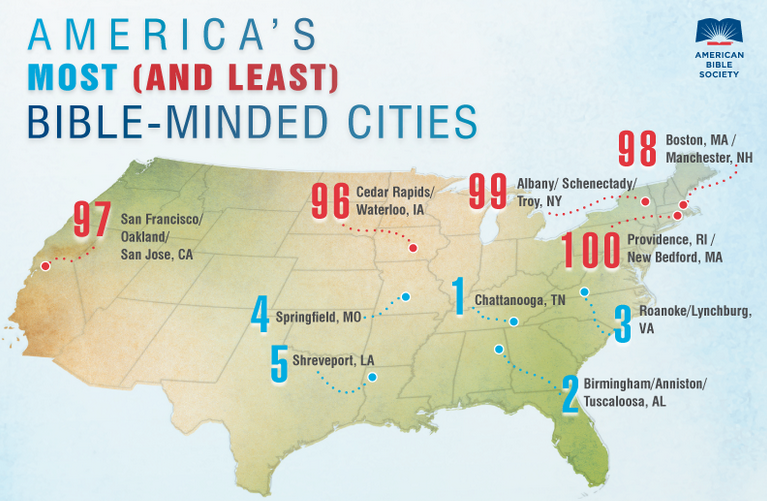
The American Bible Society has deemed Chattanooga the most “bible-minded city” in America:

Along with ranking the most and least Bible-minded cities, the study also found that an inverse relationship exists between population size and Bible friendliness. Of the top 25 Bible-minded markets, only three have a population of greater than 1 million households: Charlotte, N.C.; Nashville, Tenn.; and Dallas.

But Religion Dispatches’ S. Brent Plate takes issue with the concept of ”bible-mindedness”:

The first sentence of the Barna article explains that the poll was about “the role of the Bible in U.S. Society.” The fine print in the survey suggests something slightly different: “Respondents who report reading the Bible within the past seven days and who agree strongly in the accuracy of the Bible are classified as ‘Bible-minded.’” No suggestions are given that someone might act anything scriptural out, put the Bible to use, or otherwise engage it in real life. What we are left with is the idea that people read the Bible and call it accurate, and thus we know something about society.

The logical leaps here are vast. In reality, the survey is not telling us about any “role” of the Bible. It’s all just a mind game. The assumptions of the pollsters betray a larger misconception concerning who religious people are and what they do. Questionnaires are still mired in the mostly-Protestant notion that religious people read holy books and have “beliefs” in their heads. It makes for good fodder on the religion news circuits but necessarily leaves out the lived realities of religious existence.

Will Hillary Hatred Be The GOP’s Undoing?

Paul Waldman thinks so:

There are few things more fundamental to smart political strategy than the understanding that other people may not share your beliefs, and may not have the same emotional reactions you do to certain people and events. That understanding is what allows you to make thoughtful decisions about how to persuade the number of people you need to achieve your political goals, whether it’s passing a piece of legislation or winning an election. This is something Republicans often struggle with, but when it comes to the Clintons, they’re absolutely blinded by hate. To take just one example, if Hillary runs, we’re going to be hearing a lot about Benghazi, because Republicans are not only sure she did something scandalous, they’re also sure that if they just hammer away at it long enough, everybody else will become convinced, too. But just like with Bill’s impeachment, exactly the opposite is likely to happen: the more they talk about it, the more voters will become convinced that they’ve taken leave of their senses.

And that, more than anything else, may be what gives Hillary Clinton such a good chance of winning in 2016. When they’re looking at her, her opponents just can’t see straight.

The Second Amendment In Black America

Nicholas Johnson, the author of Negroes And The Gun, explains what motivated him to write the book:

The black tradition of arms has been submerged because it seems hard to reconcile with the dominant narrative of nonviolence in the modern civil-rights movement. But that superficial tension is resolved by the long-standing distinction that was vividly evoked by movement stalwart Fannie Lou Hamer. Hamer’s approach to segregationists who dominated Mississippi politics was, “Baby you just got to love ’em. Hating just makes you sick and weak.” But, asked how she survived the threats from midnight terrorists, Hamer responded, “I’ll tell you why. I keep a shotgun in every corner of my bedroom and the first cracker even look like he wants to throw some dynamite on my porch won’t write his mama again.”

Like Hartman Turnbow, Fannie Lou Hamer embraced private self-defense and political nonviolence without any sense of contradiction. In this she channeled a more-than-century-old practice and philosophy that evolved through every generation, sharpened by icons like Ida B. Wells, W. E. B. Du Bois and Daisy Bates, pressed by the burgeoning NAACP, and crystalized by Martin Luther King Jr.

Roving Against The Dying Of The Light, Ctd

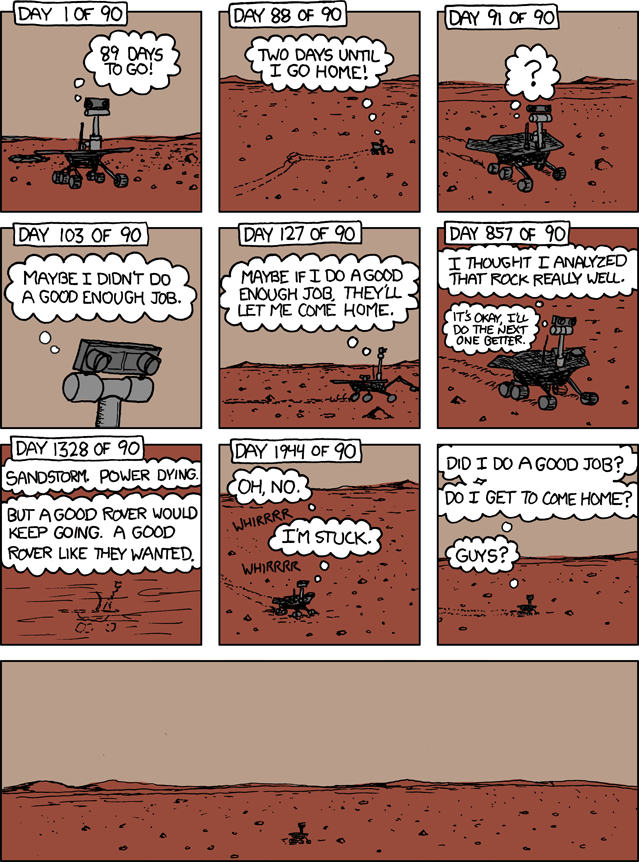
A reader sends the above cartoon:

Your post about the Jade Rabbit rover and the comment at the end about Curiosity on Mars made me think of this strip by xkcd. I know it’s just human projection, but somehow, these amazing machines take on their own personality in our minds. How can we not feel affection for them, and sadness at their ultimate fate? Maybe we recognize a bit of our own story in them. Go rovers!

Others offer some love for a veteran explorer:

If you think the Curiosity rover is awesome, I would like to remind you of a little rover named Opportunity.

Opportunity landed on Mars on January 25, 2004. It initially had a mission duration of 90 (Mars) days, and is still exploring Mars today.  You should check out the launch patch on Wikipedia [seen right]; it Nasa_mer_daffyhas Duck Dodgers and the words “Red Planet Gladiators.”

What’s even worse for Jade Rabbit’s is that the technical difficulties were announced on January 25, 2014, the tenth (Earth years) anniversary of Opportunity’s arrival on Mars.

Now I don’t view this as an “America, fuck yeah” moment because I think that any rover that manages to land successfully has exceptional scientific value and hopefully has a long operating life.  I feel the loss of Jade Rabbit is a loss for science which is more important than any amount of nationalism.

But I do agree with the idea that NASA is awesome.

Opportunity celebrated its 10th anniversary by taking a selfie. Meanwhile, another reader chides us for going all “America fuck yeah”:

You were comparing apples to oranges when comparing the different unmanned probes. Mars has an atmosphere and has no dust like the moon dust, which gets into everything and clings there with sharp edges.

Another nods:

“Abrasive lunar dust” is redundant. Unlike dust on Earth and Mars, where there are erosion processes to wear the particles somewhat smooth, on the moon the dust retains its knife’s-edge sharpness forever. By the third day on Apollo 17, astronauts Cernan and Schmitt were having a lot of trouble with the abrasive dust getting into the zippers and joint seals on their space suits. Moon dust will mess you up, man.

Do Writers Change?

Contemplating the question, novelist Tim Parks points to examples:

[S]ome writers do change their stories and their style quite decisively: Dickens shifted abruptly from optimism to pessimism, T.S. Eliot from a grumbling gloom to something approaching serenity, Joyce from relative simplicity to unspeakable complexity, Beckett from baroque English to the sparest French, Hardy from novels to poetry, or indeed, in the case of one of my favorite writers, Henry Green, from regular writing to silence.

In each case, if one examines the life of the author, it becomes clear that the earlier approach no longer “worked” for the writer, no longer contained the tensions that need to be contained in order to go on living in a certain way. Some other story was necessary. Or alternatively, change had happened, had been achieved, for better or worse, and the previous story was simply no longer appropriate, because no longer required.

I recall in this regard a recent conversation with a young novelist who was in some distress about his private life, in particular his obviously conflicted behavior with women. I encouraged him to see an analyst and hopefully sort things out. He said he had thought about this but was concerned that a successful analysis would alter the way he wrote, his ability to write tense, distraught stories about conflicted behavior with women, etc. I laughed. When despair brings home the bacon and self-esteem with it, it’s hard to let it go.

Interviewed To Death

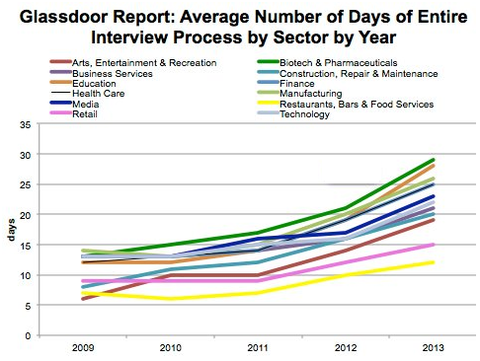
economix-24interviewprocessbysector-blog480-v2

Catherine Rampell wonders why employers’ hiring processes are getting longer and longer:

Some economists have argued that there is a growing “skills gap” between what workers have and what employees need. If that were true, though, we’d expect to see wages being bid up, and so far wages have remained relatively stagnant across the economy.

Another theory is that in an uncertain economy, companies are really, really worried about making a mistake and do not feel pressure to fill openings right away so long as they can still dump more work onto their existing staff members. As a result, employers exercise more exhaustive screening and vetting processes until they’re confident they’ve found their “purple squirrel,” H.R. jargon for an impossibly perfect, overqualified candidate usually willing to work for peanuts. Meanwhile, the costs that companies incur by making the hiring process more involved remain relatively hidden.

The Dish, Year 2: Update

[Re-posted from earlier today]

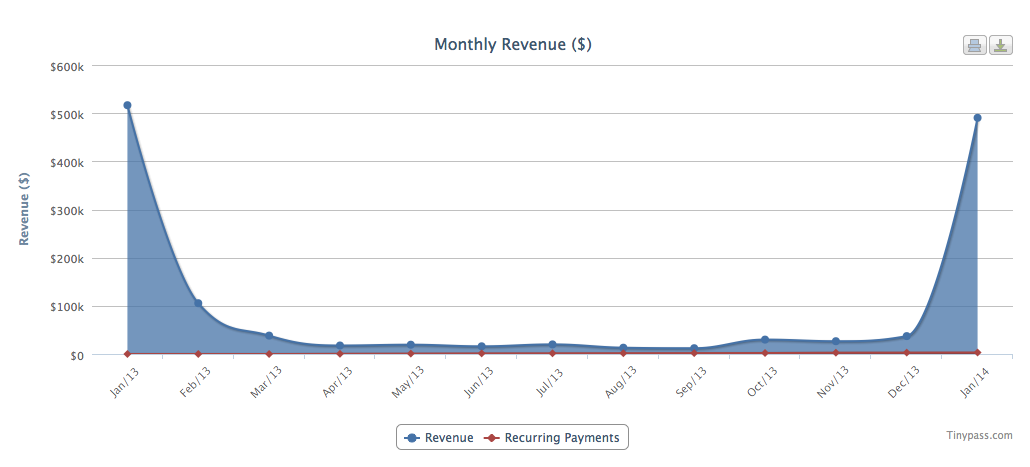
The latest numbers on renewals:

Screen Shot 2014-01-29 at 12.19.04 PM

There are two and a half days left in January – and revenue is almost equal to last year’s first month. In two weeks this January, we’ve gotten $490,000 in revenue. In all of last January, new subscription revenue was $516,000. Can we match it? I think this is now a real Rubicon for reader-supported content online. If we can prove that subscribers won’t just pay for content, but that they’ll pay consistently over time, we’ll be helping to prove that the web doesn’t have to be a blizzard of ads, gimmicks, slide-shows, sponsored content, and Upworthy headlines. It can actually have a much higher signal-to-noise ratio; it can be visually uncluttered; it can be intelligent and not crammed with flaming comments; it can begin to generate a business model that can invest in quality journalism, as we hope to do by expanding Deep Dish.

You’ve made this happen. And many of you still can. Renew here! Renew now! Or if you’ve always intended to subscribe and have never gotten around to it, subscribe for the first time here (for just $1.99 a month or $19.99 a year) and help us change the future of online journalism. Update from a reader, who adds a new price point to ones such as $4.20 and double chai:

So far the Dish is as significant in my Internet diet as Facebook, and I am kind of addicted to Facebook, so you can see I am milking every cent of my first year $19.99 subscription. This year I was planning to increase my subscription to $25, but I took the Euler number as an inspiration. This number is 2.718 … but I had a short circuit in my brain so I invested $23.18 (instead of my planned $27.18, I guess I’ll upgrade to $217.8 the day I have a real salary, but right now I am a graduate student, sigh).

Anyway, I googled 23.18 and I found the following Bible verse: Proverbs 23,18 “There is surely a future hope for you, and your hope will not be cut off.”

When Faithlessness Leaves Family Behind

Chris at Ordinary Times reveals how becoming an atheist alienated his devout Christian parents:

It should come as no surprise … that my leaving has caused them a great deal of distress and anxiety.  Nor should it come as a surprise to anyone who is familiar with either Christians or parents that they, again my mother in particular, have made their distress and anxiety abundantly clear to me on many occasions. And here enters a concept, and feeling, wholly alien I imagine to the native atheist, that of atheist guilt. I love my parents very much, so the knowledge that I am causing them pain is deeply disturbing to me. Yet what am I to do? Am I to lie to them and pretend that I have come back home? No, I respect them too much to deceive them. Am I to indulge them in their attempts to bring me back into the fold, with all of the praying and Bible verses and invitations to church when I visit? Nothing can come of such things, and I worry that false hopes inevitably dashed will only increase their suffering.

So my guilt is a dilemma, and the more I think on the dilemma, the more I am aware of being powerless to overcome it. Powerlessness in the face of guilt all but guarantees dysfunction in interpersonal relationships, and my relationship with my parents is no exception. I tip toe over many of the insensitive things they say, things that reveal how little respect they have for my world view while they, at the same time, are deeply intolerant of any perceived disrespect for theirs, and my doing so results in resentment — likely mutual at times — that occasionally spills over in the form of anger.

A Jewish commenter responds:

Judaism does not have the concept of hell that Christianity developed. Our version of “hell” is still supposed to be more peaceful than life on earth because life on earth is full of pain and misery. So an atheist child does not produce the amount of distress that seems to happen in Christian families. Furthermore, Judaism does not believe that not being Jewish means a life of damnation. My parents are atheist but raised me Jewish for cultural and ethnic reasons. I’ve never wrestled with whether there is a God or not.