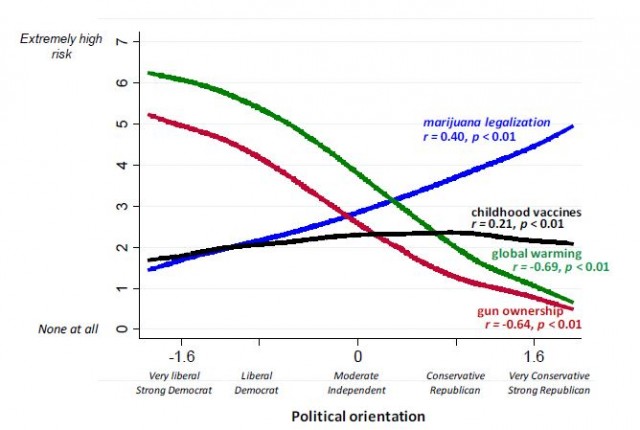
The erroneous belief that vaccines cause autism has little basis in partisan politics:
Yes, there may be a parent at your kid’s organic vegan locally sourced small-batch co-op nursery school who thinks it’s true, and dangerous lunatic Jenny McCarthy, the nation’s most prominent propagator of this theory, is a Hollywood celebrity and many Hollywood celebrities are liberals, but that doesn’t mean that liberals in general are more likely to believe in the fictional vaccine-autism link.
So here is some empirical data, from Dan Kahan of Yale Law School and the Cultural Cognition Project. Kahan did a study that included a survey and some experiments testing both what people believe about the topic and how they react to different kinds of information about it. And it turns out that not only do very few people believe that childhood vaccines pose a danger, liberals are no more likely to believe that than conservatives; in fact, they’re slightly less likely to believe it.
Ria Misra focuses on another finding from the study, that “vaccination rates and public acceptance of it are extremely high”:
But reports on both the science and the safety of vaccination don’t convince anti-vaxxers, and may even polarize them more. So what should we be doing instead? Kahan says that the best way to promote vaccination may be to report on the already existing high vaccination rates, creating a kind of peer-pressure to vaccinate as a public good
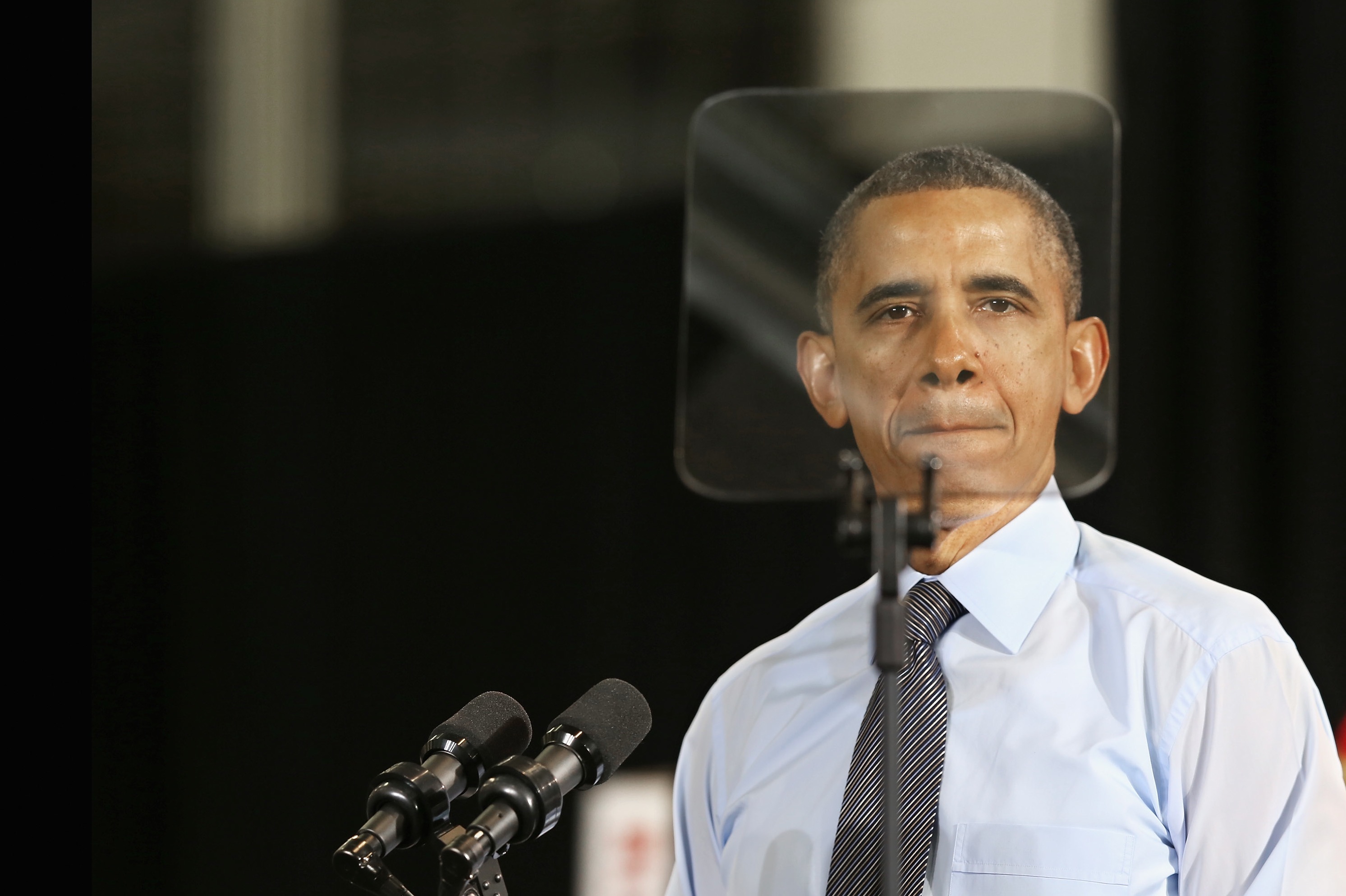
U.S. President Barack Obama is framed by his teleprompter while delivering remarks at the Costco wholesale store, repeating some of the same policy proposals from his State of the Union speech the night before January 29, 2014 in Lanham, Maryland. Obama is beginning a two-day, four-state tour to promote a raise in the minimum wage, immigration reform and other other policy ideas. By Chip Somodevilla/Getty Images.
Bill de Blasio may have failed the pizza-eating test, but at least his taste in bagels passes muster. L.V. Anderson explores the role the humble Jewish bread has played in New York mayoral politics:
So why do we—both journalists and New Yorkers in general—care about whether our mayors have good taste in bagels? Having a good answer to the bagel question is meant, in part, to demonstrate a politician’s appreciation for Jewish culture and, by extension, Jewish voters. But inquiring about our mayors’ bagels preferences also stems from the same culinary chauvinism that spawned Pizzagate. Bagels, like pizza, are an affordable food brought over by early NYC immigrants, and thus are seen to confer a kind of working-class credibility on those politicians who properly enjoy them. Plus, it’s easier to judge a mayor’s taste in breadstuffs than it is to evaluate his or her policies—particularly for the pundits in the press, who are sometimes loath to wade into the minutiae of, say, city tax rates.
Here are some of the things I didn’t know about Ebert that I learned from Life Itself. I’d always assumed that his rock-steady gaze and toweringly brash, domineering personality grew out of his status as America’s most influential celebrity movie critic — but, in fact, those things were fully there when he was in college, editing the school newspaper with a fearsome, cocky-beyond-his-years arrogance that made him a campus legend. I knew that countless filmmakers were indebted to him, but I didn’t know that Martin Scorsese, crawling out of his heavy addiction period, credited Ebert (and Siskel) with bringing him back from the dead through the tribute they organized at the Toronto Film Festival in the early 1980s. And though the movie should have done more digging into how Ebert first hooked up with Russ Meyer (it presents his penning of the script for Beyond the Valley of the Dolls as a fait accompli — and neglects to mention that he wrote several other, far more tawdry screenplays for Meyer), it’s pretty up front about Ebert’s involvement, for years, with reckless and unstable women. I bring this up only because it gets to Ebert’s dual nature: He was a tubby, ink-stained Midwestern geek who walked on the wild side.
In an interview, Chaz Ebert describes her amazement at the number of people who still approach her with a personal story about her late husband:
I think it’s because he was sincere. When he reached out to people, there were no cameras. People weren’t going to write stories about it. He did it because he really felt that way and he really liked communicating with other people and reaching out to them. He liked mentoring, and so he would answer letters and take time to talk to people who sincerely wanted to learn about journalism.
And he also sincerely was curious about what it was like to be another person. He liked getting inside the head of another person and inside the heart of another person. He said we are constrained in this box of life, but to get to know what it feels like to be a person of another age or race or gender is just a gift. If you’re curious and just reach out, you’ll find out.
The Dish noted Ebert’s passing here. Browse our archive for the critic’s influence here.
(Video: Martin Scorsese talks about Ebert and Life Itself)
Michael Gerson argues that drugs “damage and undermine families and communities and ultimately deprive the nation of competent, self-governing citizens.” Balko sees prohibition as the larger problem:
In 2012, the economist David Henderson wrote a piece for the right-leaning Hoover Institution about the “bottom one percent.”
By that, he was referring to the incarcerated, who of course have little to no annual income. There are currently well over a half million people in prison for non-violent drug offenses. There are about a million more on probation or parole. According to a study by Students for Sensible Drug Policy, about 200,000 young people have lost access to financial aid due to some sort of drug offense, although since that figure was from 2006, it’s probably much larger today. In 2012 alone, 1.5 million people were arrested for some sort of consensual drug crime. Of those, 1.2 million were arrested for possession, not distribution. On average, taxpayers pay $25,000 per year to house each prisoner. In some states, the figure can approach $50,000. As Henderson writes, we’re paying that money “so that the government can put poor people in prison and keep them poor,” and to “put non-poor people in prison and make them poor.”
If conservatives like Gerson and Frum are truly concerned about income inequality, income immobility, social disorder, erosion of the rule of law, disrespect for for public institutions, and the dissolution of the family, it seems they should at least address the drug war’s contribution to these problems. Instead, when contemplating solutions to these problems, reforming or ending the drug war is usually the first option they take off the table.
Fifty years after the release of Dr. Strangelove, Eric Schlosser reflects, “In retrospect, Kubrick’s black comedy provided a far more accurate description of the dangers inherent in nuclear command-and-control systems than the ones that the American people got from the White House, the Pentagon, and the mainstream media”:
The most unlikely and absurd plot element in “Strangelove” is the existence of a Soviet “Doomsday Machine.” The device would trigger itself, automatically, if the Soviet Union were attacked with nuclear weapons. It was meant to be the ultimate deterrent, a threat to destroy the world in order to prevent an American nuclear strike. But the failure of the Soviets to tell the United States about the contraption defeats its purpose and, at the end of the film, inadvertently causes a nuclear Armageddon. “The whole point of the Doomsday Machine is lost,” Dr. Strangelove, the President’s science adviser, explains to the Soviet Ambassador, “if you keep it a secret!”
A decade after the release of “Strangelove,” the Soviet Union began work on the Perimeter system—-a network of sensors and computers that could allow junior military officials to launch missiles without oversight from the Soviet leadership. Perhaps nobody at the Kremlin had seen the film. Completed in 1985, the system was known as the Dead Hand. Once it was activated, Perimeter would order the launch of long-range missiles at the United States if it detected nuclear detonations on Soviet soil and Soviet leaders couldn’t be reached. Like the Doomsday Machine in “Strangelove,” Perimeter was kept secret from the United States; its existence was not revealed until years after the Cold War ended.
Previous Dish on other nuclear close-calls here and here.
Paul Cassell discusses how the criminal justice system is exploring a three-participant model of trials in which the victim is allowed to pursue a case against the defendant alongside the state:
I have … heard defense attorneys argue against victim participation by claiming that this is ganging up on the defendant — double counting the prosecution’s view by adding in the victim’s view. Here again, that’s not quite right. While victims often are aligned with prosecutors, other times they may align with defense attorneys. Victims’ interests are not necessarily the same as prosecutors’ interests. Indeed, restitution may be an area where victims and defendants could make common cause. While prosecutors focus on long prison terms, victims are often worried about receiving compensation for their injuries. Victims might prefer, for example, a sentence under which the defendant is placed on work release and can make payments towards restitution instead of one that simply locks him up and throws away the key.
Andrew Cohen highlights a case whether the prosecutor is at odds with a murder victim’s family:
The last time [Edward] Montour faced trial for [Eric] Autobee’s death, the victim’s family supported the death penalty as an option. Not this time. This time, having educated themselves about capital punishment, and better understanding the nature of Montour’s mental illness at the time of Eric’s death, the Autobees have been vocally, stridently, ceaselessly against the imposition of death in this case. Earlier this month, for example, as potential jurors in the Montour case were lined up outside the courthouse waiting to learn about the case for which they were summoned, the Autobees picketed the line and pleaded with Brauchler to spare their son’s killer.
Episodes like this — and the media attention they inevitably generated — prompted [George] Brauchler, the prosecutor in the Montour case, to remove the family from his preliminary list of witnesses to be called during the sentencing of the case. And that removal, in turn, has prompted Montour’s attorneys to ask the trial judge in the case to allow the Autobees to testify during sentencing. That prompted an aggressive response from Brauchler, arguing that Colorado’s victims’ rights laws don’t apply to “mitigating” factors during sentencing but only to “aggravating factors.” And that is where we stand today.
Unlike our reader, Paul Berman reflects on Pete Seeger’s unsavory politics in his early years:
“If I Had a Hammer,” which he composed, is immortal. I do not know if people will be singing “If I Had a Hammer” a hundred years from now, but they would be fools not to do so. “Where Have All the Flowers Gone?“—this is magnificent. Those songs, with their crowd-sourcing capacity, are tremendously moving. And yet, if you can persuade crowds of people that simple morality and a childlike vision of right and wrong can be summed up in a few phrases, there is nothing you cannot achieve, and some of what you might achieve could turn out to be disastrous in the extreme—e.g., Stalin’s idea of dividing up the world with Hitler.
So it is good to remember that Pete Seeger, in his younger years, entertained some foolish and reactionary ideas. The appreciation of his errors can introduce a note of reflective irony into your excited response to his songs in favor of the civil rights revolution, and generally his songs in favor of the causes of democratic equality and rational reflection.
[A]s the encomiums threaten to overwhelm, it’s important to remember that Seeger, once an avowed Stalinist, was a political singer once devoted to a sinister political system–a position he held long after the Soviet experiment drenched itself in blood and collapsed in ignominy.
So while we wistfully recall the foot-stomping versions of This Land is Your Land, let us not forget Seeger’s musical assaults on the supposedly warmongering F.D.R. (see the justly forgotten Ballad of October 16th, which was featured on a record presciently released on the very day the Nazi-Soviet Pact collapsed. As Moscow instantly shifted its position from fascist accommodationism to fighting what it had previously denounced as a war for big business, Seeger and his fellow folkies in the Almanac Singers recalled the record and retooled their allegiances. It was soon replaced by a series of pro-war, pro-F.D.R. songs. Art must be used in service of the people—and is always subject to the vicissitudes of the party line.
In a 1999 interview, Seeger explained how his relationship to communism had changed:
I’m still a Communist in the sense I don’t believe the world will survive with the rich getting richer and the poor getting poorer. I think that the pressures will get so tremendous, if they’re not already that big, that the social contract will just come apart. On the other hand I’m no longer a member of the Communist Party, as I was in the 1940s. It was very sad to see the enthusiasm of the people in Russia who in those days thought we are going to create a new society, and how their dreams just came apart. There’s more socialism in America and around the world today than most people realize. The GI Bill was basically socialism. Public education is basically socialism. You might consider that all armies are basically socialist organizations.
But, despite his dedication to the proletarian cause, Seeger was a millionaire:
Seeger was exceedingly generous with both his money and his time. Thanks to this war on his own wealth, Seeger escaped inclusion in the infamous “1 percent” (a good thing, too, given that he was active in the Occupy Wall Street protests). But he was dangerously, perilously close: a recent estimate of his net worth pegged it at $4.2 million, putting him just a couple million shy of that infamous percentile. This accumulation of wealth may have been his greatest failure — perhaps his only failure. The man who sang at hobo camps, labor halls and at union rallies just couldn’t stop making money. An accidental entrepreneur and unwitting capitalist, Seeger was, despite his best efforts, the quintessential American success story.
Seeger, like other successful musicians of his era, also profited from the work of black songwriters:
His first major group, the Weavers, had a hit with their recording of “Goodnight, Irene,” the folk standard that Huddie Ledbetter, better known as Lead Belly, first recorded. (They also recorded “Wimoweh,” a mishearing of ““Mbube,” first recorded by the South African musician Solomon Popoli Linda.) Some contemporary reviews noted that the Weavers had made a song about suicide and romantic disappointment more palatable for a mass audience by eliminating some of Lead Belly’s lyrics, but the song went to number one and stayed there for thirteen weeks. In the version of the song I’ve linked to here, the groups works an acknowledgement of their debt to Ledbetter into their performance, and notes that he died before the song he originated became a national sensation. It’s a poignant illustration that the difficult conversations about race, credit, and art that occur today have been a feature of the American cultural landscape for sixty-five years.
Adam Garfinkle has mixed feelings about the man, but credits him for the enduring cultural impact of the protest song:
When you come right down to it, what Seeger did, probably without knowing it, was to devise a kind of new-age folk religion out of musical protest rituals. What he did made people feel good, made them feel like a part of something larger than themselves at a time when traditional means of religious communal expression weren’t working so well. The merging of environmental consciousness into the older leftist portfolio was almost too good to be true for this purpose: Lenin plus Gaia equaled countercultural nirvana. It was fine for most never to get beyond the lyrical slogans to the second paragraph of any thought about a political topic—that just wasn’t the point. Communal singing is a very powerful form of human celebration that creates and sustains spiritual connectedness; if you don’t realize that, it means you’ve never been involved in it. For all I know it probably has health benefits as well.
Josh Marshall examines Seeger’s influence on folk music and everything it touched:
One little nugget: It was Seeger who changed the cardinal lyric from “We will overcome” to “We shall overcome”, which he said “opened the song up.” And if you sing it to yourself you can hear how it does. A tiny little thing, far tinier than most of his achievements. But another of these little centralities. If you look back at the fabric of folk music and 30s labor radicalism, the civil rights movement and modern environmentalism, you see that if you pull the Seeger thread from it the fabric doesn’t quite fall apart but it’s simply not the same.
Jack Hamilton highlights Seeger’s stance against McCarthyism:
In 1955 Seeger was called before the House Un-American Activities Committee and refused to name names. “I will tell you about my songs,” he declared, “but I am not interested in telling you who wrote them, and I will tell you about my songs, and I am not interested in who listened to them.”
This is an extraordinary and brilliant statement, one that turns the inherent democracy and availability of folk music into a clarion call of moral righteousness. Seeger would ultimately be indicted and convicted for contempt of Congress, though his conviction was overturned in 1962. Of the many great things one can say about Pete Seeger, this might be the best: When the country he loved did its best to destroy him, he loved it too much to let it.
Update from a reader:
Okay, so the day after Seeger dies, you post links to three pieces that highlight his ties to communism as a young man. I guess when taking the measure of his 94 years-his activism in the labor and civil rights movements, his testimony before HUAC, or his work on the environment- that’s what you thought was most notable. Fair enough (except, Moynihan, really?). Now, I’ll admit that my economic politics might be closer to Seeger’s than to yours (the same could probably be said for your new crush Pope Francis), but that’s not what bothered me. What bothered me is that the post seemed the result of a google search of “Seeger + communist.” It seemed pretty lazy, as a matter of fact. If you weren’t going to give him a fair (read: balanced) shake, I can’t understand why you acknowledged his death at all, except for the fact that it led a lot of other news outlets? And to focus so narrowly on one aspect of his earlier life, on the day after he died, seemed a bit sensational to me, an attempt at contrarian “edginess.” He was, before all else, a musician, who made a huge contribution to the preservation of traditional folk music in America. Oh, and I can assure you that he hurt far fewer, and helped far more, than Ken Mehlman.
Your caritas for people, as you call it, seems to be increasingly selective. Please cancel my subscription.
A reader gives Gawker some due regarding their partnership with Newcastle Ale:
I just wanted to provide this insight in case no one else has. I use Adblock Plus in my Firefox browser. When I clicked through to the Gawker post from your feed, the very first word and other words were missing from the body text – every instance of “Newcastle.” I toggled off ADP for just that page, and voila, they appeared.
I’ve used ADP for years and have enjoyed a pretty damn clean browsing experience. It’s kept me from getting too annoyed at online ads in general. But I wouldn’t have assumed it would protect my delicate sensibilities from innovative trickery such as paid content.
So, tip of the hat to Gawker. They instituted some tagging that allowed the brand they’re advertising to be made invisible if the smart visitor has taken measures to be shielded from ads. I think that’s rather ethical and deserves recognition.
For the record, the Dish has praised Newcastle Ale for its creative ads – when they are not enmeshed with editorial copy. We love ads – especially creative ones. We’ve had a Cool Ad Watch on this site for years. And yes, Gawker deserves props for tagging sponsored content as advertising. My concern is with the deceptive attempt to disguise ads as editorial – undermining the credibility of journalism, and conflating copy-writing with writing, for short-term cash at the expense of long-term viability. Another reader zooms out:
While I generally agree with you on the problem of native advertising, I have more confidence than you have that the audience can detect and separate advertising from journalism and commentary. Remember: native advertising has been around for a long, long, time. For example:
there were the Mobil Oil ads, designed to mimic editorials, on the New York Times’s Op Ed page from its inception in 1970. William L. Bird’s Better Living and Stuart Ewen’s PR! discuss how corporations (and the National Association of Manufacturers, among others) have historically controlled, composed, produced and distributed advertising explicitly designed to imitate popular journalistic forms on the radio, in newspapers and magazines, and on television. Go to a library and flip through old Fortune magazines from the 1930s and 1940s and you’ll see precisely what I’m talking about.
The American audience is more savvy about their media than you give them credit for. All those Buzzfeed/Gawker/Upworthy clicks don’t represent influence, modified behavior, or much of anything in reality. That’s why digital advertising lags so far behind the pricing of print advertising – even in 2014. People respond to print ads and direct mail; they don’t respond to digital ads. The audience’s unresponsiveness to native advertising will ultimately lessen its effectiveness and presence (look at how The Atlantic‘s native ads on Scientology did precisely nothing to help the Church).
So I’m not as worried as you are. The real problem is that when native ads prove useless and disappear, their existence will have seriously degraded the credibility of journalism. And, when you get down to it, credibility is the ONLY thing the New York Times can sell that differentiates it from everything else on the web. That’s your point; and we agree that this short term fix is terrible in the long run.