The Sad Story Of Dr. V, Ctd

In light of the Grantland controversy, Parker Molloy defends transgender people who choose to stay in the closet:

I may meet someone, whether it be a coworker or acquaintance, and be treated with the same casual attitude I imagine they treat everyone. Then, should they find out that I’m trans, conversations start to take odd turns. Suddenly, the topic of my genitals becomes fair game in their minds. Suddenly, they feel the right to ask what my “real name” is. Suddenly, pronouns start slipping, and I find myself called “he” by these people who had just been referring to me as “she” five minutes earlier. Suddenly, I’m no longer a human being, but rather a biological freak show.

Is that something you’d like? For every conversation to veer away from you as an individual and to instead focus on one singular part of your history? As a writer, as an author, as an activist, this is a choice that I have made for myself. I am willing to endure the awkward questions, the stares, the misgenderings, and the gawking. I do this in an effort to urge society to come to terms with the fact that transgender people are just like anyone else. I do this because I choose to. Essay Vanderbilt did not choose to put her trans status front and center, and taking that from her is not journalism, but rather a betrayal of her right to privacy.

Update from a reader:

I read Parker Malloy’s piece on Dr. V and a lot of the commentary on the Grantland piece. And while I agree with Parker’s point of view – that no one has the right to “out” a person as transgender – I think Parker and others ignore an important fact:

Dr. V raised money from investors. When you do that, you may not make an untrue statement of a material fact or fail to disclose a material fact necessary to make the statements made, in the light of the circumstances in which they were made, not misleading. In almost all instances that means disclosing biographical information about key employees. I don’t know how Dr. V could have possibly done that without revealing, indirectly, that she was transgender.

Professional investors in businesses such as hers typically conduct background checks on the founders/inventors/key executives. How could they have conducted a thorough background check without knowing her prior stereotypically male name? I’m not saying that the fact she was transgender was itself material or the failure to disclose that fact was fraudulent, but it seems as though it would have been impossible to avoid revealing she was transgender in order to make accurate disclosures about other material details of her life, such as her work and credit history.

And ask yourself this question: what if you knew her background disclosures were misleading? The obvious course would have been to encourage her to update them or pull the offering, but what if she refused? A lawyer would be obligated to keep such information confidential, but probably would also be obligated to withdraw as her counsel (and perhaps make what’s called a “noisy” withdrawal).

But what if you were the CFO of the business, not subject to attorney-client confidentiality? Would the “you may not out a transgender person” rule apply to you? If you don’t say anything, you could find yourself in the legal crosshairs. Put another way, should you be forced to commit securities fraud because she chose to keep her transgender status a secret? Again, I’m not saying you’d be obliged to reveal she was transgender, but I can’t see how you could correct the misstatements and omissions without also inadvertently revealing she was.

People have rights – like a transgender person’s right to decide whether to keep her personal history secret – but they also have duties – like an entrepreneur’s obligation to make accurate and complete disclosures to investors. If a transgender person wants to keep that part of her personal history a secret, then she’s going to have a real hard time raising capital from investors in a manner that complies with law.
Scenting A Text Message

You may be doing it soon:

The obvious starting point for smell communication is the smartphone, a ubiquitous device we already bling to death, and for which a growing panoply of notificationsvibrations and ambient signals are added with each new release. Japan’s Scentee sells a plug-in atomizer for smartphones (currently selling for around $35 on Amazon.jp), which can be customized when triggered by an app to spritz standard aromas such as rose and lavender, as well as more unique tastes of curry, coffee or cinnamon roll, costing just over $5 for 100 sprays. The company suggests its product be shared by “lovers,” and lists use cases such as getting a whiff of your chosen scent each time you get a Facebook like or, as part of a wakeup alarm. There’s no word yet on whether it will come to the US.

Liz Stinson speaks to David Edwards about the oPhone, one of several “smellable” devices currently being developed:

There’s one big problem when it comes to doing this, says Edwards: “Odor transmission to date is not smart,” he explains. “If I give you the odor of a pizza, I have a difficult time immediately after giving you the odor of the sea and then giving you the odor of a cactus.” Basically what Edwards is saying, and what we already know from letting trash sit in our apartments a day too long, is that odors linger. Which makes it hard to craft any sort of cohesive and decipherable olfactive narrative.

The oPhone solves this problem with its main innovation: the oChip. This little cartridge, about the size of a fingernail, contains olfactive information that can produce hundreds (and soon thousands, says Edwards) of odor signals. The idea is that these chips can be installed in the oPhone, and via a bluetooth-connected app called oTracks, scents can be sent to yourself or an oPhone-carrying friend with the push of a button.

Where Language Is Slow To Evolve

John McWhorter doubts that English will ever embrace a gender-neutral pronoun:

In language there are open-class and closed-class words.

Open-class ones, such as nouns and verbs, can be made up, or used in brand new ways, as new things and actions arise in the course of human affairs. Closed-class words are much harder to create out of thin air. They aren’t things or actions, but tools to show the relationships between them. For example, prepositions situate things in space and time. Note that you can’t make one up, such as one that describes something being airborne instead of on the ground. The plane is gunch the air—cute, but hopeless.

Pronouns are the same way. They stand for something, namely nouns. They’re tools. We use them more than we use nouns themselves—rapidly, unconsciously, all day. Thus, we are no more likely to change them than we are to alter the way we swallow. We are, as one might say, “severely” conservative about pronouns.

Raised From The Bed

Amid serious drought in the American West, once-flooded towns are re-emerging:

6403502759_b6790dca0c_oNear this Sacramento suburb [of El Dorado Hills], man-made Folsom Lake has receded to less than one-fifth of its capacity amid bone-dry conditions in California, recently revealing outskirts of a ghost town called Mormon Island founded during the mid-19th century gold rush. On an unseasonably warm winter day recently, throngs of visitors descended on the cracked mud flats of the reservoir to inspect hand-forged nails, rusted hinges and other vestiges of frontier life that were inundated when the lake was created in 1955. …

Texas’s Lake Buchanan shrank in 2011 to reveal the original site of the town of Bluffton, drawing visitors to the remains of homesteads, a store and cotton gin that had been mostly under water since the reservoir was created in 1937, said Alfred Hallmark, a local historian. The town is one of more than 200 archaeological sites in Texas, including cemeteries, that have been uncovered by drought, said Pat Mercado-Allinger, director of the Texas Historical Commission’s archaeology division.

Geoff Manaugh stresses the fragility of these rediscovered locations:

6403495359_0b348c155f_bCurious visitors and amateur collectors alike are beginning to pick the old sites dry, rambling through the ruins of these dead towns revealed by drought, carrying metal detectors and looking for worthy artifacts. In the process, they are removing old objects – even whole pieces of architecture – before local authorities have the time and resources to catalog and protect what is re-emerging there. This surreal and unexpected opportunity to explore what was lost – in some cases nearly 100 years ago – mummified by water and preserved beneath the rising waves of western reservoirs, might thus simply go to waste.
Instead, the best option might be for the sites to be drowned all over again, assuming the drought will end and that these historic locales can once more be inundated, taken off the tourist map and sealed for their own protection beneath the calm surfaces of artificial lakes. Perhaps, then, future archaeologists better prepared for moments like this might yet be able to explore these historic sites when yet another drought rolls through.

(Photos from Texas’s Lake Buchanan by Merinda Brayfield)

Where No One Can Hear You Sneeze

Space is a bad place to be sick:

As far as space dangers go, illness doesn’t get much attention, which is kinda strange given that one of the most distinct effects of microgravity on the human body are tanking immune systems. A 2012 piece in Time reports, “the immune system can go on the fritz in space: wounds heal more slowly; infection-fighting T-cells send signals less efficiently; bone marrow replenishes itself less effectively; killer cells— another key immune system player—fight less energetically.” Meanwhile, many pathogens have an awesome time in space, growing stronger and increasing their resistance to antimicrobials. In particular, both herpes and staph have been shown to thrive in the gravity-free, hyper-sterile environment of a space vessel.

A study out this week examining space-born Drosophila flies—often studied because of the similarity between the flies’ immune systems and that of humans—found that in the case of fungal infections, microgravity effectively nullified the immune response.

How the study worked:

To figure out why the space flies had trouble with the fungus, the scientists analyzed all of the flies’ genes. Both the space flies and the Earth flies were born with the same genes, but exactly which of those genes turned on and went to work differed between them. In Earth flies, the genes associated with their immune systems kicked into high gear after they got infected with the fungus. Among other genes, Earth flies activated something called the Toll signaling pathway, which scientists have long known flies use to fight off fungi. Humans have Toll-like genes, too, and they also work in immunity.

The space flies reacted differently from their stay-at-home siblings. They turned on some immunity genes after encountering Beauveria bassiana, so it’s not like they were totally helpless. But they didn’t use all of the genes the Earth flies used, and they didn’t turn up their Toll pathway genes. In their paper, the biologists called their spacefaring flies “severely immunocompromised.” Strangely, when the biologists raised flies in a centrifuge to simulate higher-than-Earth gravity, they were more likely to survive a fungal infection than normal Earth flies.

Capital Gains And Losses

012414_unemployment_v2-01

Suzy Khimm points out the staggering inequality in Congress’s backyard:

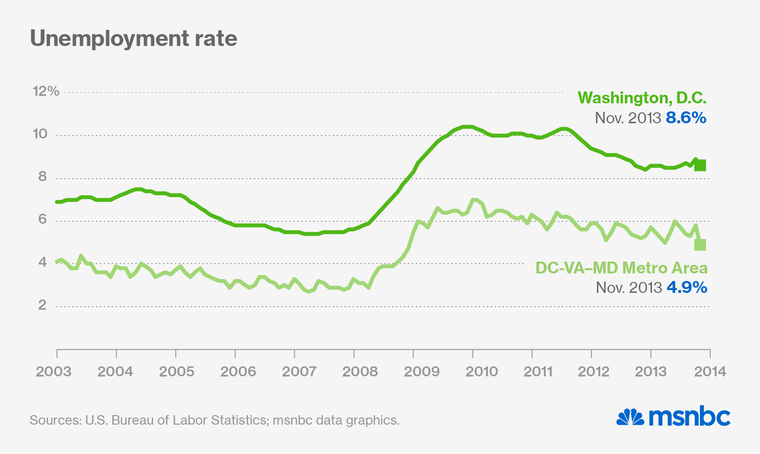
The gap between low- and high-income households in D.C. is one of the biggest in the country—the third-highest of the 50 largest cities in the U.S., according to the D.C. Fiscal Policy Institute. While the D.C. metro area was spared the worst of the recession, the downturn and subsequence recovery have exacerbated the long-standing differences between the area’s rich and poor.

Between 2007 and 2012, 18.5% of D.C.’s residents were in poverty, compared to 8.4% in the entire metro region, which includes six of the 10 richest counties in the U.S. The massive growth in federal contracting dollars—hitting $80 billion in 2010 alone—helped push the median household income to nearly $120,000 in Virginia’s Loudoun County. But the disparities aren’t just in terms of income. While the region’s unemployment rate has dipped to just 4.9%—far below the national rate—it’s stuck at 8.6% in the District. Within the city itself, the differences are even starker: The jobless rate in Ward 8, one of the city’s poorest neighborhoods is 18.6 percent; in Ward 3, it’s 1.8 percent.

Alex Leary examines the demographic shifts driving these changes:

Washington, which boasts one of the most educated workforces in the country, has gotten younger. The “millennials” — those 18 to 29 — now account for 35 percent of the population, while the same group is only 23 percent of the national population. It also has gotten whiter.

The black middle class began to leave after riots that followed the assassination of Dr. Martin Luther King Jr., leaving 14th Street, Columbia Heights and other parts of the city in ruins. In 1970, African-Americans made up 70 percent of the city’s population. In 2010, it was down to 51 percent and many of those left are among the poorest and least educated, concentrated in neighborhoods east of the Anacostia River that have been untouched by revitalization.

The Land Before Fidel

trinidad

Michael Totten visits the Spanish colonial town of Trinidad, Cuba:

Trinidad is not a nice place because of its communist government. Trinidad is a nice place despite its communist government. It’s five hundred years old. None of it was built by the communists. The city looked as it does now centuries before Karl Marx wrote The Communist Manifesto. Fidel Castro is responsible for precisely nothing I love about it. All he did was fail to destroy it. That’s not progress or a point scored for the revolution. It’s just damage control.

But I will give Cuban communists this much—they feel a connection with the pre-communist past and aren’t trying to obliterate it from the earth or from memory. They are not at war with every single last thing that predates them. There was no Year Zero in Fidel Castro’s Cuba like there was in Pol Pot’s Cambodia. The colonial buildings of Trinidad were not razed and replaced with horrifying tower blocks as was so much of the Soviet bloc. Cuban communists did build some ghastly new structures, but not at the expense of what came before, and not in the old center of Trinidad.

That’s a low bar for praise, to be sure, but so many communist regimes failed to live up even to that. Look at what the Soviet Union did to Chisinau in Moldova, which is even older than Trinidad.

(Photo by Flickr user F Mira)

Nearly There For January

Screen Shot 2014-01-27 at 3.28.26 PM

[Re-posted and updated from earlier today]

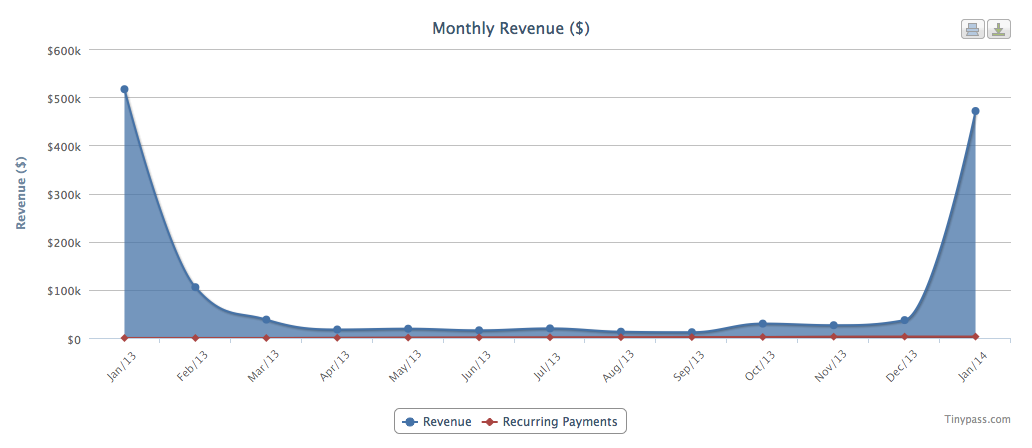
The above graph is the state of play in our renewals drive so far in January. That towering peak on the far left is the amount of revenue we raised for the entire month of January of last year – beginning on January 2. The peak on the right is the amount of revenue we have raised so far in renewals and new subs since January 13 this year. The revenue last year was $516,500 for all of January. The revenue in January 2014 – with five days to go until February – is, as of this posting [at 3.40 pm], $471,000 [currently $475,000]. We still have to match February 2013’s $105,000 and most of March 2013’s $35,000 in the coming two months, but January was the huge mountain we had to climb first.

And the summit is in sight –  we have five days to make that graph above exactly symmetrical. And what a statement that would make about the viability of reader-supported online journalism.

So if you haven’t gotten around to it yet, and still intend to renew, take a second to do it now. It’s real easy – only a couple of minutes of your time for a year’s worth of full Dish and Deep Dish access. And if you have howler beagleput off [tinypass_offer text=”subscribing in the first place”], now would be the perfect time to help push us over the top. Subscribe for the first time [tinypass_offer text=”here”] – and help us make it.

To say we’re grateful for this vote of confidence and support would be an understatement. But apart from gratitude, the other thing we’re feeling is excitement: that this simple, basic business model is beginning to prove it can work. And if it can, then the possibilities of rebuilding intelligent journalism online just began to expand a little.

Can you get us to match last January by February 1 – and blaze a trail for new reader-supported online journalism? We’ll keep you posted with the progress, as we have so far, and will do as long as we are around.

Renew here! Renew now! And help change the future of online journalism.

Update from a reader, who isn’t so sure:

Thank you for validating my decision not to subscribe today. As I have written previously (and you have published at least once), I will not subscribe to an online publication that allows an editor to decide which reader opinions are worthy of being aired and which can be safely ignored. We had that model with print newspapers and it’s one of the reasons I was an early adopter of online news sources.

You wrote today that “victimology … began on the hard left, of course, in the 1990s” without a single citation or example. You wrote it as something that is self-evident. If you allowed comments I would have called you out on that on your own website, and I assume other readers would have to. You would, of course, still have had the option of addressing us or ignoring us, but it would all be transparent. Until you allow that transparency I won’t be subscribing to the Dish.

P.S. I’m sure you’ve thought of it already, but there is probably money to be made from enhanced “subscription plus” model that allows the subscriber to comment for a higher price.

As long-time readers know, the Dish has run multiple polls asking readers if they want to see an unmoderated comments section, and each time they have voted it down. As far as the reader’s “P.S.”, the Dish will never be pay-to-play. The only speech here is free. Another reader:

I just re-upped for another year with a $10 a month subscription. We get at least that much use of the site as a marital aid. Let me explain …

I began reading the Dish during the 2004 election cycle, and not long after convinced my husband that he should as well. We had been married 3 years at the time, and though we were both interested in politics and such, I am convinced that our shared readership has inspired numerous opportunities for us to connect on a more intimate level. We usually discuss some link or another during dinner every night. That inevitably leads to a deeper conversation in which we sometimes agree and sometimes disagree. Either way, we have shared some intense conversations about what we individually believe and why we believe it. We have shared a lot of laughs as well as some passionate discussions. Occasionally, the proverbial soap box got dusted off.

Either way, the conversation often morphs into a discussion about our childhood and early adult experiences that have turned us into the people that we are today in this marriage together. Couples pay thousands of dollars on therapy in order to try to bridge that understanding gap, and here you are offering it for the lowly price of $19.99!

The Best Of The Dish Today

One of the interesting aspect in reviewing the data on the Dish is you see some patterns. Today, for example, the second most popular post remains one published on Friday night. It’s about the most extraordinary act of pandering to AIPAC by the new lefty mayor of New York City – and was deliberately kept off his public schedule and would never have seen the light of day if not for a Capital New York reporter getting hauled out of the room for recording it.

The story was covered elsewhere, but in many places it is simply not done to air the cravenness of so many politicians to various lobbies of all stripes. Or at least it is not done with respect to the Israel Lobby, whose very existence we have been told is a myth. Such a myth led De Blasio to say in ringing terms:

City Hall will always be open to AIPAC. When you need me to stand by you in Washington or anywhere, I will answer the call and I’ll answer it happily ’cause that’s my job.

Translation: “When you ask me to jump, just be extra sure to include how high.” And since that lobby is doing all it can to end a peaceful dialogue with Iran – in a Senate bill co-sponsored by 59 Senators, and mercifully pushed back on by two Senators today in the NYT – its ability to have politicians jump as soon as they call seems a relevant fact of public life in America. And readers seem to know this.

These posts – like the hugely popular ones on Sarah Palin in the 2008 campaign that asked questions the MSM wouldn’t – are very popular. The most recent one is the second most popular in the last week. You can’t bury them, even on a Friday evening. And that tells you something about what others may sometimes be too intimidated to publish and write about. And, not to add a plug for the Dish, but it’s the kind of thing that only a truly independent website can afford to do.

Three other posts worth noting: my attempt at psycho-analyzing the anger of the One Percent; the ethics of watching the Super Bowl; and the growing enrollment in Obamacare.

The most popular post was The Selective Secrecy Of Bill De Blasio; next up was “Ted Cruz’s Reality.”

See you in the morning.