Ukraine Reignites, Ctd

A handful of passionate readers are pressing us to stay on top of things:

US press coverage is, on the whole, pathetic.  Anne Applebaum’s recent piece is the most intelligent assessment I’ve read yet.  BBC and The Guardian have some good articles.  The German press is somewhat better; Der Zeit is doing a pretty good job, because they have contacts on the ground. But Twitter is the best place to work from.  Start with #Euromaidan, and work from there.

Please, do more.  What has happened since your last post is truly extraordinary.

Another reader who was in Ukraine recently recommends the Facebook page of Euromaiden, which is “translating into English the latest news being passed along the social networks and the Internet.” Another:

Ukrainska Pravda has a live feed that’s updating every day in English.  Here’s a summary of what’s going on and an updated map of who is in control of what from yesterday.  My friends who are there/have family there have been warning that the Internet in Ukraine and Kyiv might go down, so I’m not sure how accurate any updates can be or will be.

Another reader from a few days ago takes stock:

Sit with this news from Ukraine for a second. A country of 40 million people in the heart of Europe, divided between a pro-European, conservative-to-liberal, Christian (Catholic and Orthdox) west that is corrupt and a pro-Russian, illiberal east that lives by corruption too is descending into an extremely dangerous political crisis.

The president of the country, twice convicted of violent crimes in his youth, has grown obscenely wealthy at the expense of the people of his country, while mouthing platitudes about joining Europe. When he turns his back on Europe in November, protests turn up in Kyiv. That very night, student activists are beaten, some very seriously. Ukrainian society is outraged and the protests grow even more massive.

The protests last for weeks on end, and they attempt to disperse them violently December 11. The opposition negotiates with the government. Then things settle down. Then the government once again provokes the protesters by passing an insane law outlawing any protest activity whatsoever on January 17. Banned are: wearing helmets, wearing camouflage, driving in groups of more than 5 vehicles, criticizing the judiciary, and retroactively giving amnesty to members of the “Berkut” riot police for any beatings that they have delivered to protesters. It is at this point that the violence has truly escalated and protesters have began to arm themselves with clubs and helmets and actively fight with the police. I lived in Ukraine for 13 months in the last couple of years and can testify firsthand that the place is seething with political discontent with the Yanukovych regime. They will not be satisfied with anything short of a change in government; if Russia intervenes, the western half of Ukraine will fight to the death to defend its long-repressed statehood.

Given Ukraine’s regional divisions (which may be exaggerated, but which are nevertheless real), half the country completely rejects the legitimacy of the Yanukovych government. And they will be willing to fight the government, leading to a possible Syrian scenario in a state that borders on the European Union. When will Europeans wake up and see that this directly affects them? Ukraine is not some forgotten Siberia thousands of miles from Paris and Berlin (not to mention London). It is a border state with Poland, Slovakia, Romania, Hungary, Moldova, and Belarus! Not only that, but the fate of democracy and market reforms there are a hugely influential example to all of the post-Soviet states, from Belarus to Moldova to Kazakhstan and all the way to Moscow itself. If democracy in Ukraine succeeds, ordinary Russians will be forced to ask themselves, why not here?

And with all of this at stake, Obama remains absolutely silent. And you have remained largely silent yourself. Please! I urge you: take some time to reflect on this crisis and the stakes that it has for the U.S. and especially for Europe. I should mention that the U.S. and Russia are guarantors of the country’s borders and independence as a result of the country’s renunciation of its Soviet-era nuclear arsenal in 1994. This country cannot be ceded to the Russians to do whatever they want with simply because it borders on their country. The futures of millions of people and dozens of my personal friends and family are 0 in a Russian-dominated Ukraine.

I should know: I am the great-grandson of a Ukrainian Greek Catholic priest who spent 10 years in Siberia for continuing to practice his faith – performing baptisms, hearing confessions, and performing the liturgy -after his church was “outlawed” at a spurious synod in 1946. The Ukrainian Greek Catholic Church is by far the largest Eastern Rite Catholic Church, fully in communion with Rome, and for the 42 years during which it was outlawed by the Soviets, it was the largest “catacomb” church in the world.

Please educate yourself and speak out! This is an issue of fundamental importance to security on the European continent and a moral issue par excellence. I was inspired with your coverage of the Green Revolution and wonder why there has been so little about Ukraine! If you want to escape America’s foreign policy fixation on the Middle East, then take an interest in a major foreign policy issue outside of it!

The World Of Christian Meditation

Christopher Harding explores it:

People from all sorts of Churches — and none — come together to practise: meditation builds its own ‘community of faith’, Freeman says — faith, in this sense, being ‘our capacity for relationship, for enduring, transcending the instinct to run away and have an easier time somewhere else’.

This is ‘faith’, then, not as some watered-down alternative to propositional belief, but a commitment made and remade even while its object comes into view only gradually and uncertainly (‘through a glass, darkly’, as St Paul put it). It’s a commitment, too, to facing whatever silence throws at you. Boredom and busy schedules are familiar obstacles in any meditation practice, Christian or otherwise, but tougher still are those times when practitioners find themselves frightened or unwilling to follow where the silence seems to be leading them. Questions of theology and Church teaching will come up, of course, but Freeman insists that we must allow them to emerge in the midst of all the other doubts — about ourselves and the world — that arise as we practise. As he puts it, meditation ‘opens Pandora’s box… everything starts to look different’.

Face Of The Day

POLAND-JEWS-HOLOCAUST

A Holocaust survivor huddles in a blanket to stay warm during a ceremony in the former Nazi concentration camp Auschwitz-Birkenau in Oswiecim, Poland, on Holocaust Day, January 27, 2014. The ceremony took place 69 years after the liberation of the death camp by Soviet troops. By Janek Skarzynski/AFP/Getty Images.

Cashing In On The Campaign

It doesn’t end when a candidate loses:

The erectile-dysfunction ad is one of more than 50 similar pitches for miracle cures and easy-money tricks that [Herman] Cain has passed along to his e-mail followers over the past two years. While he has been particularly unabashed in his embrace of the practice, he is not the only past presidential candidate hawking sketchy products. Newt Gingrich now pings the e-mail subscribers to his Gingrich Productions with messages from an investment firm formed by a conspiracy theorist successfully sued for fraud by the Securities and Exchange Commission. Mike Huckabee uses his own production company’s list to blast out links to heart-disease fixes and can’t-miss annuities.

The joke about Cain and Gingrich during the 2012 campaign was that they weren’t at all serious about their pursuits of the presidency but instead just lining up future paydays. After Huckabee, who’d parlayed a strong showing in 2008 into publishing deals and his own Fox News show, declined to run again, some wags snickered that his new livelihood must have been too hard to give up. Now all three seem to be proving the cynics right.

A Linguistic Rift

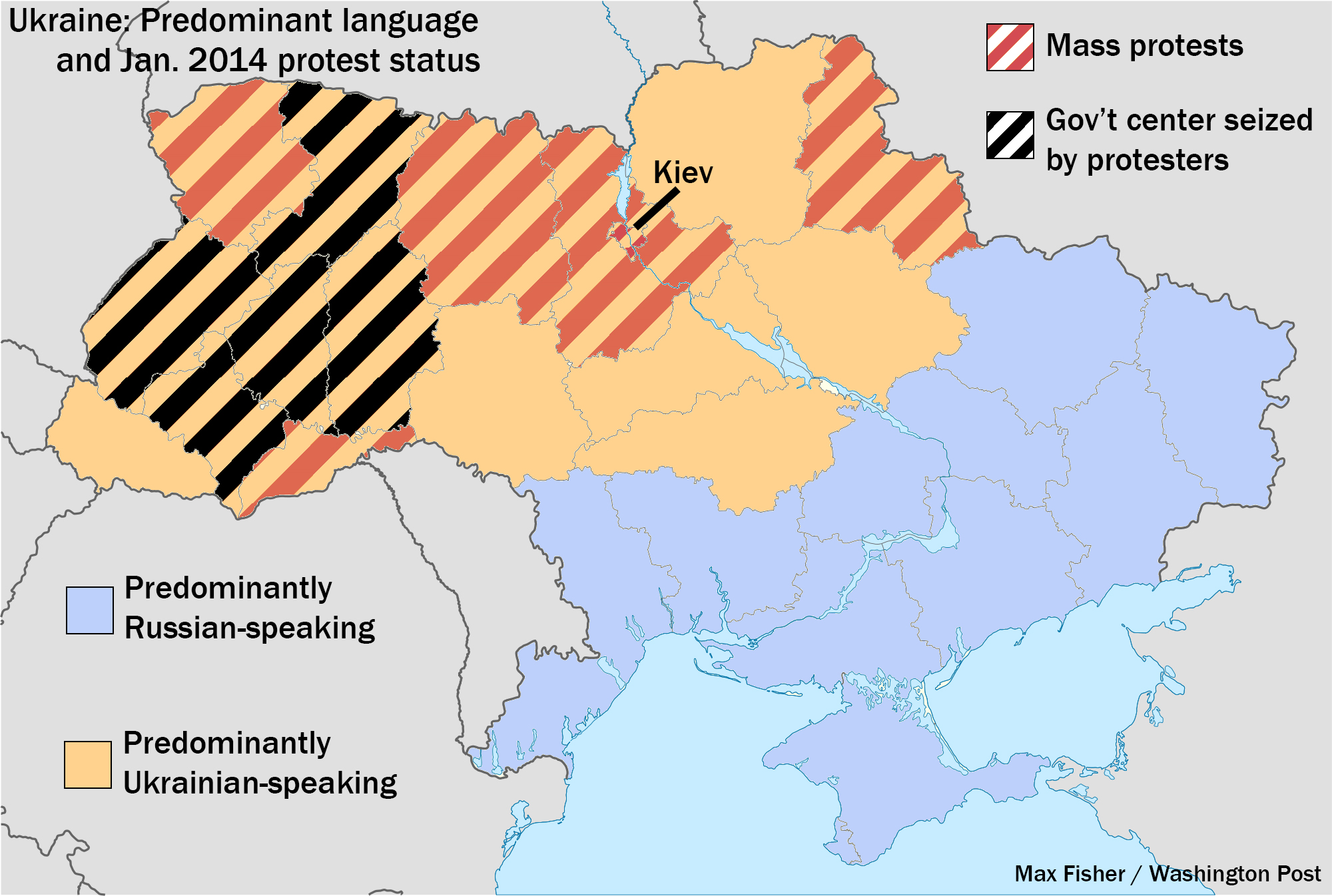
In 2010, Ukrainian President Viktor Yanukovych won all of the country’s Russian-speaking provinces and lost all the others. The recent protests have intensified this split:

ukraine-protests-map-by-language-k

Fisher explains:

Ukraine’s ethno-lingistic political division is sort of like the United States’ “red America” and “blue America” divide, but in many ways much deeper — imagine if red and blue America literally spoke different languages. The current political conflict, which at its most basic level is over whether the country will lean toward Europe or toward Russia, is part of a long-running and unresolved national identity crisis. Yes, it’s also about Yanukovych’s failures to fix the economy and his draconian restrictions against basic freedoms. But there’s so much more to it than that, which helps make the crisis so intractable.

Adding Insult To Injury

Joe Entwistle, a quadriplegic disability rights advocate, reveals how thin the safety net is for Americans with disabilities:

The reality for someone in my situation is that retirement usually isn’t an option. You work until you die, literally. A friend of mine is a perfect example. It’s almost creepy the similarities in our life. Both of us had a spinal cord injury at 16. Both of us were injured wrestling. Both of us are policy analysts. He’s a really good guy. He’s 63 years old. He started working for the state many years ago. Yet because of the odd rules around Medicaid eligibility and the differential treatment of earned and unearned income, he literally cannot retire. He knows he has to work until he’s dead or until some rules change. As soon as he starts to draw unearned income (retirement), he’s not going to be eligible for health-care programs or he’ll have to spend down to essentially $710 a month. He could no longer afford his house. He could no longer afford even the taxes on the house.

Where Only Print Is Permitted

Meredith Broussard doesn’t allow e-books in her digital journalism class:

I really do believe that print is the ideal interface for a classroom. I used to allow e-readers in class. For a couple of semesters, I patiently endured students announcing their technical difficulties to the entire class: “Wait, I’m out of juice, I have to find a plug.” “What page is that on? My Kindle has different pages, so I can’t find the passage we’re talking about.” “Professor, do you have an iPad charging cord I could use?” After a while, I realized that I was spending an awful lot of class time doing tech support. The 2-minute interruptions were starting to add up. E-readers were a disruptive technology in the classroom—and not in a good way.

I went back to print. I required all the students to buy the same edition of the book.

Now, when I say, “Please look at the passage on page 45,” everybody opens the book to page 45 and looks at the passage and we have a conversation without getting bogged down in technical glitches.

I know that today’s students are supposed to be digital natives, but in my experience, most students are only good at using basic end-user technology. It’s possible that students don’t know how to use e-readers in class because they don’t use e-books: According to the 2012 Pew Internet & American Life Library Services Study, only 25 percent of Americans 16-29 read at least one e-book in the past year. By contrast, 100 percent of college students know how to use a book. So, in my classes, we use computers for the things that computers are good for, and we use books for the things that books are good for.

Previous Dish on e-books here, here, and here.

Egypt’s Unhappy Anniversary

Over the weekend, at least 49 Egyptians died in clashes with police while marking the anniversary of the country’s 2011 uprising.  Soon thereafter, the interim government announced that it would hold early presidential elections and that army chief Abdel Fattah Al-Sisi has been promoted to Field Marshal, paving the way for a presidential bid that most expect him to win. Bel Trew looks ahead:

The few public statements made by leading generals suggest that the army will endorse his candidacy. He can also count on popular support: the media, several grass-roots campaigns and political parties have called for him to run. A photoshopped presidential campaign poster for the general went viral minutes after the preliminary results of the referendum were released. …

If Sisi wins, he will oversee the implementation of the constitution, new draft laws and, crucially, parliamentary elections. It is likely the general will form his own party. “It’s easy to imagine a situation when Sisi’s new party sweeps the parliament, whose election will be as free and fair as the referendum,” said Hisham Hellyer of the Brookings Institution. “You won’t have ballot-stuffing because they won’t need to.”

Amid these events, Nathan Brown pins Egypt’s problems on its institutions rather than its political personalities:

Egypt’s political affliction is not one dictatorial person but a host of dictatorial institutions, and much of Egyptian society is a happy participant rather than cowering victim in the wave of repression.

Let us turn first to the Egyptian state—a set of balkanized institutions, each with its own keen sense of mission and privilege. President Adli Mansour—a man almost as genial and modest as Shahin—is no thundering Mussolini. Even military leader General ‘Abd al-Fattah al-Sisi, while powerful, shows few signs of micromanaging the Egyptian state. Instead, various institutional actors who spent years under what they came to feel was a domineering and sometimes corrupt political leadership under Mubarak, are finally free to act on their own. And each one is doing so with a vengeance.

Eric Trager stresses the complicity of the Egyptian people themselves in the endless turmoil:

Within the Beltway, Egypt’s autocratic recidivism is often blamed on Egypt’s poisonous media and draconian military-backed government, thereby casting ordinary Egyptians as passive actors in their own country’s story. But they aren’t. Time and again, critical masses of Egyptians have cast and recast their lot: first with the 2011 anti-Mubarak uprising, then with the military junta that succeeded Mubarak, then with the Muslim Brotherhood during the 2011-2012 parliamentary and presidential elections, and then with the military once again during the July 2013 uprising-cum-coup that ousted Mohamed Morsi.

In all likelihood, these critical masses of Egyptians will change their minds again, because even as the rules of Egypt’s political game have been written and rewritten repeatedly, one hard law has emerged: nothing is permanent.

Are We Too Hard On Hackers?

Hanni Fakhoury thinks so. He points to the disparity between sentences for physical and digital vandalism:

Take the case of Matthew Keys, a former social media editor at Reuters, charged with violating the CFAA in federal court in Sacramento.

He allegedly turned over the username and password of a server belonging to the Tribune Company to members of Anonymous, who made changes to the article of a headline in a Los Angeles Times story online. Among other changes, the headline was changed from “Pressure builds in House to pass tax-cut package” to “Pressure builds in House to elect CHIPPY 1337.” It seems like a clear-cut case of vandalism, a prank that caused some damage but little other harm.

Under California law, physical vandalism – like spray painting graffiti on a building — can be punished as either a misdemeanor or a felony, with probation available for both types of charges. If probation is granted, the longest sentence a defendant can serve as a condition of probation is one year in county jail.

But look at the punishment awaiting Keys. He didn’t get charged with a misdemeanor; he got indicted on three felony charges, for which he faces a harsh prison sentence. No, he won’t get anything close to the 10-year maximum. But a cursory calculation of his potential sentence under the federal sentencing guidelines suggest he’s looking at a sentence between 21 and 27 months — about three years of his life — if he decides to go to trial and loses.

Related Dish on the new Aaron Schwartz documentary here.