“New information is not always — and perhaps not even usually — the most important information for understanding a topic. The overriding focus on the new made sense when the dominant technology was newsprint: limited space forces hard choices. You can’t print a newspaper telling readers everything they need to know about the world, day after day. But you can print a newspaper telling them what they need to know about what happened on Monday. The constraint of newness was crucial. The web has no such limits. There’s space to tell people both what happened today and what happened that led to today,” – Ezra Klein.
A Forgotten Firebombing, Ctd
Several readers recommend the 1988 anime film Grave of the Fireflies for some insight into Japan’s wartime experience:
The movie opens, very memorably, with the firebombing of Kobe and the intense panic, horror, and death of those bombings. Roger Ebert called it “an emotional experience so powerful that it forces a rethinking of animation,” and I can only agree. Viewing the movie is the only reason I became aware of the firebombings of Japan, and I imagine it played a similar role for many other people outside of Japan.
Another suggests re-watching Errol Morris’ The Fog Of War:
Morris interviews Bob McNamara, an architect of the war in Vietnam, about his participation in the planning and execution of the firebombing campaign in WWII. It wasn’t just Tokyo. Start at 2:43 or so in this clip (though the whole thing is a valuable viewing).
Meanwhile, another reader found herself confronting America’s wartime past on a trip to Japan:
In 1995, I visited Tokyo on business. A couple of us went to the recently opened Edo-Tokyo Museum, which focuses on the history of the city. Browsing the exhibits, we came upon a television that was set to run footage of the firebombing of Tokyo. A group of fellow museum-goers was watching the footage in silence. We did as well. We were the only Caucasians in the museum that day – Easter Sunday, as it happens – and it was probably obvious we were Americans. I can think of few occasions on which I have felt more uncomfortable.
The Future Of Legal Cannabis
It may have arrived, and it’s not exactly the stoner stereotype:
Sinsemil.la is the first marijuana experience dedicated to fine dining. Founded in New York City, this underground supper club
highlights exceptional and locally-sourced ingredients according to season.
The meal is a carefully calibrated experience from start to finish. Marijuana varietals are tested not just for their organic qualities, but specifically to balance the flavors of each dish and for their psychoactive properties throughout the flow of the dinner.

It’s starting … now if only we could let the free market and sane regulation do the rest.
“We Need Faith, Not Dogma”
Nick Ripatrazone warns against “devotional fiction” that “feels too insular, too ‘finished,’ too contingent upon assumptions of shared dogma”:
We probably wouldn’t have many Catholics if identification required living one’s entire life–every moment–according to the Catechism. Hopefully good Catholics are shooting for everything, but we slip up. We need faith, not dogma. And the point is that God is watching us, but there’s not someone there with a chart, checking yes or no to each decision. The responsibility is on us. In the same way, characters in great Catholic or religious fiction need that free will.
Dana Gioia, a Catholic poet, makes a similar point:
I don’t think most people come to God (or most other core beliefs) through rational argumentation. They usually do the reasoning afterwards to explain to themselves and others why they believe. We experience faith, as we do almost everything else in life, holistically. We feel it with our emotions, intuition, and imagination as much as with our intellect. We even experience with our physical bodies.
The power of art is that it speaks to us in the fullness of our humanity. When the Church loses that capacity, it loses [its] ability to speak to most of humanity in its natural language. Theological arguments don’t even convince theologians to change their minds on a topic.
A Poem For Sunday
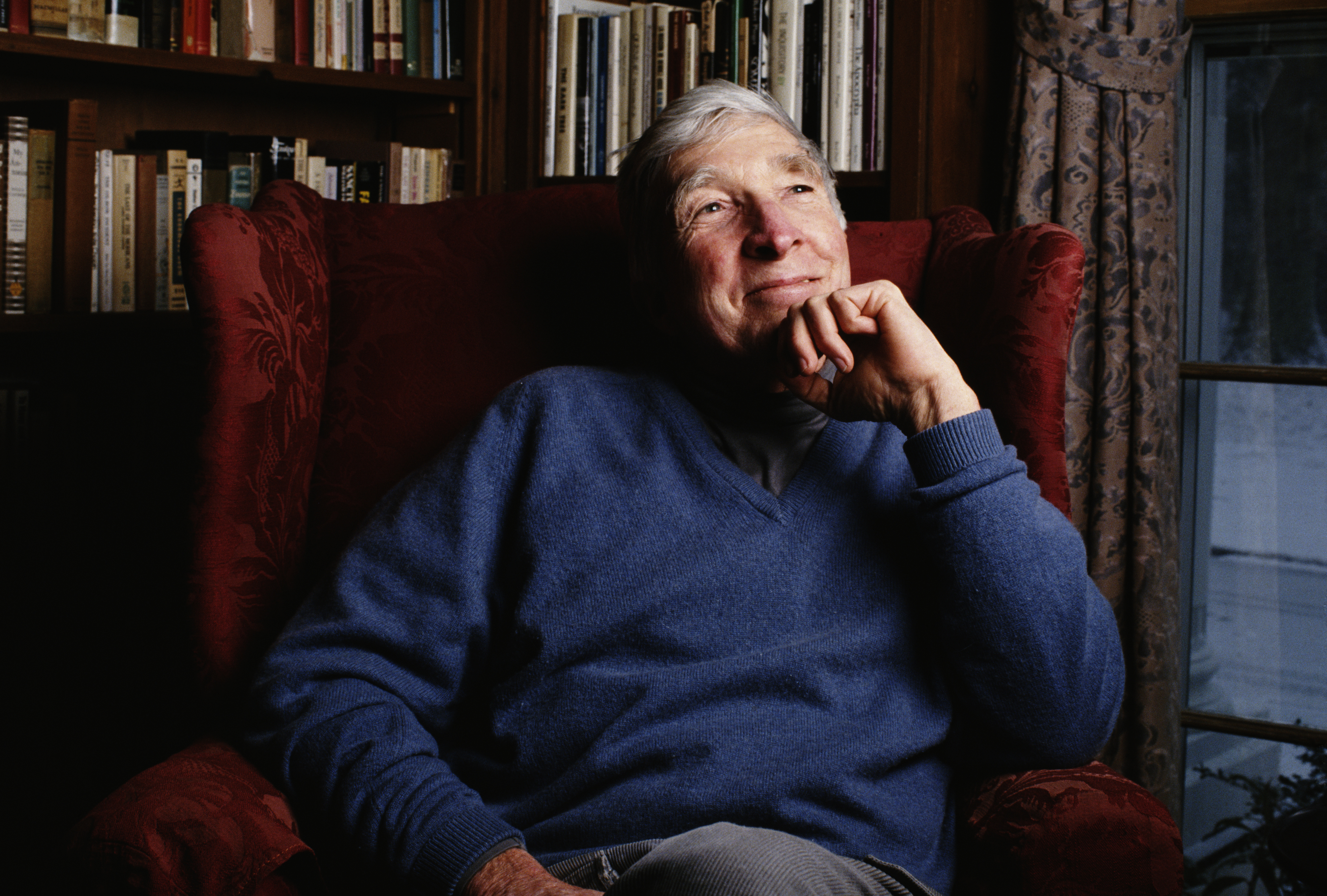
“Perfection Wasted” by John Updike:
And another regrettable thing about death
is the ceasing of your own brand of magic,
which took a whole life to develop and market—
the quips, the witticisms, the slant
adjusted to a few, those loved ones nearest
the lip of the stage, their soft faces blanched
in the footlight glow, their laughter close to tears,
their tears confused with their diamond earrings,
their warm pooled breath in and out with your heartbeat,
their response and your performance twinned.
The jokes over the phone. The memories packed
in the rapid-access file. The whole act.
Who will do it again? That’s it: no one;
imitators and descendants aren’t the same.
(From Collected Poems, 1953-1993 by John Updike © 1993 by John Updike. Used by permission of Alfred A. Knopf, an imprint of the Knopf Doubleday Publishing Group, a division of Random House LLC. All rights reserved. Photo: John Updike (1932 – 2009) in Massachusetts, February 1994. By Michael Brennan/Getty Images)
Why Mediocrity Matters
James Matthew Wilson explains:
Mediocrity makes visible something about tradition that greatness can often obscure. It is one thing to say, for instance, that the West possesses a valuable tradition because, within it, we find a sampling of awesome geniuses, from Homer and Plato, to Dante, Shakespeare, and Nietzsche. But this hardly explains the value of tradition. Traditions are self-authenticating. They are good in themselves. To live within and participate in a tradition is, again, to keep something alive and to draw things and persons together, across time, in a community of knowledge and love. The second-rate imitator of Keats in Kentucky, the belated composer of an oratorio in Ohio, may seem derivative, as if merely preserving the shadow of greatness in amber. But, to the contrary, they take their place in a way of being and keep that way open for others to tread.
Authors’ names not withstanding, art, technology, and science, the whole world of work and culture, are starkly impersonal enterprises. The anonymous mediocrity, no less than the legendary maestro, gives his life in the service of keeping a tradition alive; in being himself forgotten he helps something else to be remembered. What a blessed thing to do.
Citing Wilson, Gracy Olmstead considers how writers of fan fiction might fit into this paradigm:
Few authors, writers, and journalists will admit their work is mediocre (whether fan fiction or otherwise). At root, we want to write classics. But perhaps our mediocrity will help transmit a tradition, as Wilson writes…. Does fan fiction accomplish this? Not always; but within its diverse and sundry works, nuggets of a valuable literary tradition can flourish and grow.
Mental Health Break
Where roads end:
Where the Road Ends from The Atlantic on Vimeo.
Using Google Street View, we “drove” thousands of miles around the world to find places where the road ends. Our virtual travels took us from the fields of Italy to the fjords of Norway and the tip of South Africa. This video was inspired by Alan Taylor’s In Focus photo gallery, “The Ends of the Road“. The Street View “hyperlapse” shots were made possible by the team at Teehan+Lax, who created an open source Street View hyperlapse script. Their original Street View hyperlapse video is here. Special thanks goes to Jonas Naimark and Peter Nitsch for all of their help. To create your own hyperlapse, visit the T+L hyperlapse site here.
Quote For The Day
“There must be a time of day when the man who makes plans forgets his plans, and acts as if he had no plans at all.
There must be a time of day when the man who has to speak falls very silent. And his mind forms no more propositions, and he asks himself: Did they have a meaning?
There must be a time when the man of prayer goes to pray as if it were the first time in his life he had ever prayed; when the man of resolutions puts his resolutions aside as if they had all been broken, and he learns a different wisdom: distinguishing the sun from the moon, the stars from the darkness, the sea from the dry land, and the night sky from the shoulder of a hill,” – Thomas Merton, No Man Is an Island.
“My Favorite Picture Of You”
That’s the title of a brief, brilliant documentary (above) by Oscar winners TJ Martin and Dan Lindsay. Paul Rosenfeld captions the film:
With simplicity and depth directors TJ Martin and Dan Lindsay bring us an emotionally charged documentary about family and the pains of old age. The film revolves around an audio conversation between Martin’s grandfather and grandmother, who was dying of cancer at the time. Featured alongside a selection of home videos and photos, the conversation is a portrait of the life the couple lived. But more than a simple celebration of those moments, the film challenges the viewer to grapple with the highs and lows of life, including age, decay, and death.
In an interview last February, Lindsay described the short film’s origins:
My filmmaking partner, TJ Martin, filmed a conversation between his grandfather and his grandmother almost a month before she passed away. She was dying of cancer, and her husband is reminiscing about their life, and she’s having a hard time remembering things. It just happened that they filmed a lot of footage of themselves and had a lot of great photographs, so one day we thought it would be interesting to take that conversation and tie in the idea of what memory means to identity.
The View From Your Window
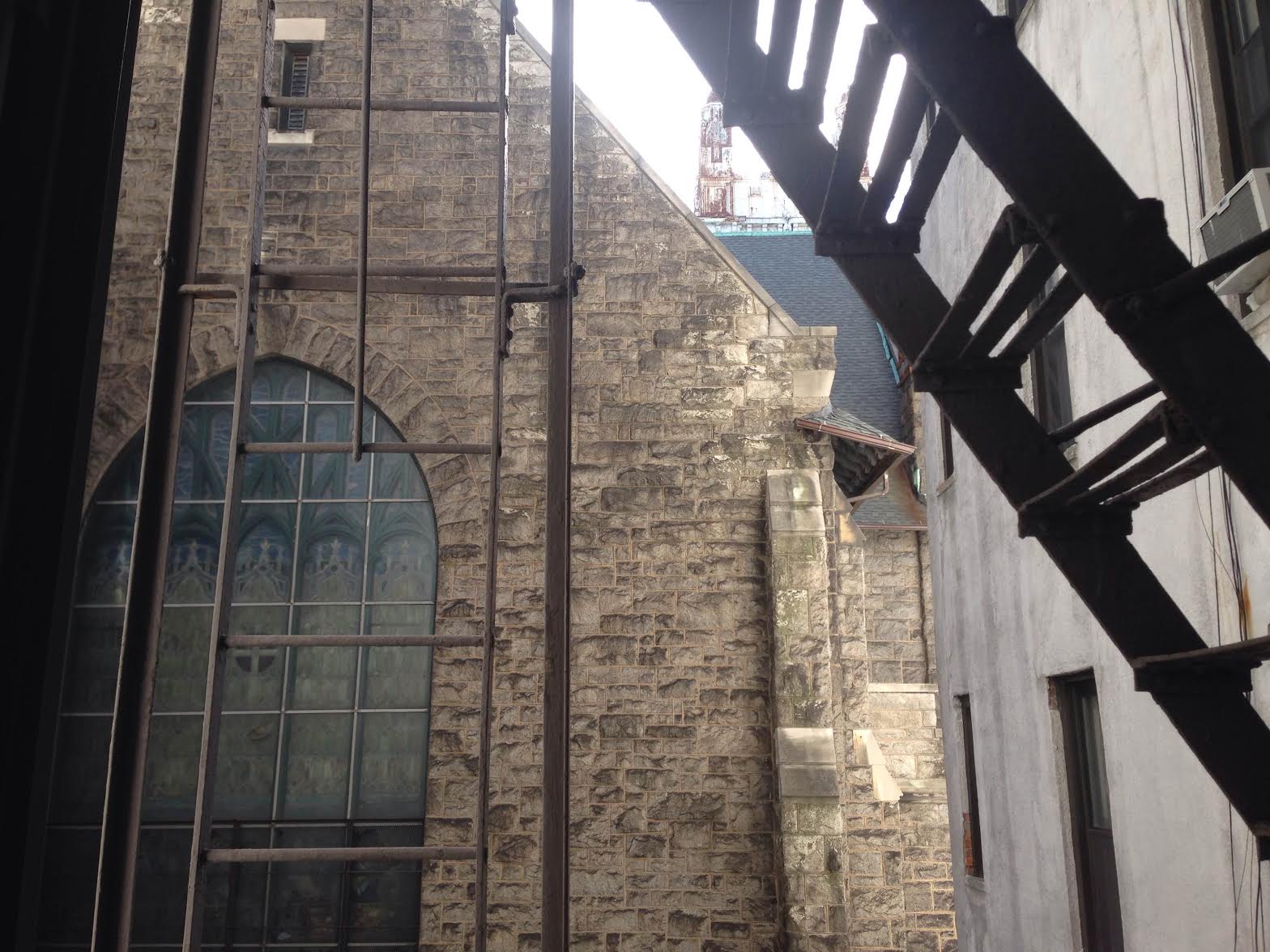
Ditmas Park, New York, 12.45 pm

