Stalled On The Road To Freedom

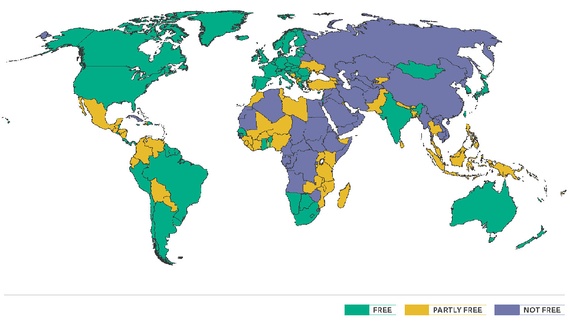
Freedom map

For the eighth straight year, Freedom House’s “Freedom in the World” report has registered a global decline in civil liberties:

“There just haven’t been any really significant breakthroughs in the important authoritarian powers that resisted democratization in the past 30 years—Russia, the other Eurasia countries, the Middle East, China, Iran, Venezuela,” Arch Puddington, vice president for research at Freedom House, told me.

The leaders of these countries, Puddington added, have learned from the collapse of the Soviet Union not to make major, uncontrollable reforms, and from the Color Revolutions in Ukraine and Georgia not to permit a pro-democracy, oppositional civil society to flourish. They are “modern authoritarians,” according to the report’s terminology, who “[d]evote full-time attention to the challenge of crippling the opposition without annihilating it, and flouting the rule of law while maintaining a veneer of order, legitimacy, and prosperity.”

Despite these setbacks, Ulfelder points out that democracy is not in retreat:

Freedom House looks at the data from a different angle than I do, calling out the fact that the number of declines in scores on its Political Rights or Civil Liberties indices outstripped the number of gains for the eighth year in a row. This is factually true, but I think it’s also important to note that many of those declines are occurring in countries in the former Soviet Union and the Middle East that we already regard as authoritarian. In other words, this eight-year trend is not primarily the result of more and more democracies slipping into authoritarianism; instead, it’s more that many existing autocracies keep tightening the screws.

Keating sees little movement in either direction:

I think it’s true that what we’re seeing is more a matter of fluctuation within countries that are long-standing members of one category or another. There hasn’t been a major trend toward countries either fully adopting democracy or abandoning it for quite some time. But as my old colleague Christian Caryl argued in a recent debate on this subject sponsored by the Economist, the important thing to remember is that “many citizens do not see democracy as an end in itself. People want freedom, to be sure, but they also yearn for economic growth, social justice and security. When elected leaders fail to produce these public goods, voters can hardly be blamed for their disillusionment.”

What If We Threw An Olympics And Nobody Came? Ctd

A reader builds on Leon Aron’s analysis to consider Putin’s geopolitical motives for holding the Games in Sochi:

Aron writes, “[This will be] the first Olympics to be held in an area of mass expulsion of an indigenous people, whose descendants accuse Russia of genocide. Perhaps most hazardously of all, it is the first (and almost certainly the last) Olympiad to be held within a few hundred miles of a low-intensity but deadly jihad.”

Russia has committed military assets to this region to varying degrees since the early ’90s. The proximity to the disputed territory of Abkhazia strikes me as a feature of Putin’s strategy, rather than a bug. Russia has supported Abkhazia and South Ossetia’s independence from Georgia since the dissolution of the Soviet Union. Access to warm-water ports and the ability to transport troops through the Caucasus Mountains have always been security interests of the Russian state. The Olympic games give Putin an opportunity to build up reconnaissance and logistical infrastructure in a way that previously would have required a hot war. In one stroke, he’s able to build up security presence in the region and preemptively kill any number of jihadists, all while presenting himself as a peaceful world player.

Another reader notes:

One thing that’s going unsaid amid the lead-up to Sochi is that this is something of a rehearsal for the much larger World Cup that Russia is hosting in 2018. If Sochi is a security nightmare, I can only imagine how difficult it’s going to be to secure 11 cities, from Sochi to Moscow to Kaliningrad. If I were FIFA, I’d be crapping myself.

Correction Of The Day

58164404_1571ea9e6b_z

“An earlier version of this article misstated the plantings on the building’s green roof. They were native flora, not native fauna,” – the NYT, referring to the Portland, Oregon home of Lily Copenagle and Jamie Kennel.

(Photo of Al Johnson’s Swedish Restaurant in Sister Bay, Wisconsin by Kim Scarborough)

The Real Benefits Of “Placebo Sleep”

A new study indicates that “if you’re in the mindset that you’re well-rested, your brain will perform better, regardless of the actual quality of your sleep”:

Participating undergrads first reported how deeply they’d slept the night before, on a scale of one to 10. The researchers then gave the participants a quick, five-minute lesson about sleep’s effect on cognitive function, telling them it was just background information for the study. … Then participants were hooked up to equipment that they were told would read their pulse, heartrate, and brainwave frequency, though it actually just measured their brainwave frequency. They were told that these measurements would allow the researchers to tell how much REM sleep they’d gotten the night before. This was not true. …

Participants who were told they had above-average REM sleep performed better on the test, and those who were told their REM sleep was below average performed worse, even when researchers controlled for the subjects’ self-reported sleep quality.

What Good Is Foreign Aid?

Last week an annual letter from the Bill & Melinda Gates Foundation sparked a passionate debate over that question between Jeffrey Sachs and William Easterly in the pages of Foreign Policy. From the Gates letter:

The lifesaving power of aid is so obvious that even aid critics acknowledge it. In the middle of his book White Man’s Burden, William Easterly (one of the best-known aid critics) lists several global health successes that were funded by aid. Here are a few highlights:

  • “A vaccination campaign in southern Africa virtually eliminated measles as a killer of children.”
  • “An international effort eradicated smallpox worldwide.”
  • “A program to control tuberculosis in China cut the number of cases by 40 percent between 1990 and 2000.”
  • “A regional program to eliminate polio in Latin America after 1985 has eliminated it as a public health threat in the Americas.”

The last point is worth expanding on. Today there are only three countries left that have never been polio-free: Afghanistan, Pakistan, and Nigeria.

Recent Dish on polio here. Fareed is on board with Gates:

Savings people’s lives, making them healthy and ensuring that they get an education is not simply and deeply a moral thing to do – it has practical benefits as well. These people now work, earn a living, and help make their countries less reliant on aid. Many countries that received large amounts of foreign aid from the West are now developed enough that they don’t need it anymore: among them, China, Mexico, Brazil, Malaysia, Singapore, South Korea, Morocco, Peru. In fact, China is now a big donor of foreign aid.

But Easterly dissents (paywalled), arguing that the public health revolution “is a story of many actors rather than conspicuous heroes”:

The contribution made by philanthropists and politicians should not be overplayed. Yet, if aid is a feeble instrument of economic progress, it is nonetheless a powerful tool of self-aggrandizement for the western elite. “We” are important because we are the rich people giving aid, the political leaders of the poor countries that receive it and the experts who broker the exchange.

True, some aid programs have targeted sickness with triumphant success. Mass vaccination campaigns kept millions of children from dying of measles and smallpox. Unicef promoted oral rehydration therapy to fight diarrheal diseases that used to cause far more deaths. But even if health aid has been a success, it does not follow that most progress on health is due to aid.

Gideon Rachman, who interviewed Gates at Davos, pushes back:

Gates does not argue “most progress” on health is down to aid. He simply argues that in certain cases, with certain diseases, aid can be really important. And if it does indeed keep millions of children from dying – surely it is worth doing? The alleged vanity of Gates or his audience in Davos seems a small price to pay for that.

Development economist Chris Blattman cautions:

Plenty of aid projects have huge impact. There’s a paradox, though: even though so many projects work, aid in total doesn’t have the association with growth or development we’d expect to see. Some of the finest minds in development (like Angus Deaton) think aid is fundamentally flawed, with good reasons. The evidence that aid projects are associated with growth is amazingly absent. This is frustrating for those of us (including me) who believe in aid. My guess is that we throw a lot of good money after bad, and most aid is much more wasteful than it needs to be. But I think aid basically works and can do better.

Jeff Bloem zooms out:

The aid debate currently just asks the question “does aid work?” Perhaps we should be asking questions like: “Under what conditions does aid make a difference?” “What can we do to increase the efficacy of aid?” and “What kinds of aid should we continue and what kinds should we abolish all together?” …  Economists have been debating the big questions for decades. See J.M. Keynes vs. F.A. Hayek. While these debates make for some great YouTube videos (Keynes vs Hayek Part 1 and part 2) they don’t really teach us anything substantive about how the world works.

The debate between Sachs and Easterly should probably be over, but not because either “won the debate.” The topic just needs to focus on smaller (more specific rather than bigger and more general) and better debates.

Subscribing On Sunday

[Re-posted from earlier today]

Quite a while back, I wanted to create at the Dish a real online conversation about the last things and the first things – as well as the present things. In due time, the Dish’s weekend has emerged, from my original ramblings and readings and now curated and edited by the Dish team, led by Jessie Roberts, elevated by Alice Quinn, and deepened by Matt Sitman. We’ve created, I hope, a very rare place online that takes Saturday_Poemsome time in the week to gather and air the best ideas, arguments, insights in online writing about literature, love, death, philosophy, faith, art, atheism, and sexuality.

In one of our reader surveys, we discovered that 50 percent of Dish readers are believers and 50 percent are non-believers. Where else do you find that kind of mix online or in the culture at large? I know it drives a lot of readers nuts that we actually take religious faith and experience seriously at the Dish – but I also know that many others of you really appreciate what we do here each weekend, and, even when you disagree strongly with stuff I write or we link to, see the importance of a civil space for this vital conversation.

My own belief is that you cannot understand politics today without also understanding religion – whatever your beliefs may be. And, while I am obviously a believing Christian, I hope the Dish is a place where a passionate atheist can also read views and arguments consonant with her own. It’s the conversation that counts. Or rather: the civil conversation.

kcpoem2So forgive me for interrupting this Sunday’s coverage by asking those of you who value its unique mix to renew your expiring subscription here, if you haven’t yet, or to subscribe for the first time here, if you never have. Just ask yourself how much this coverage is worth to you over a year and pay your own price. If you’ve read something that made you think, or spurred your imagination, or provoked a memory, or generated a prayer, or cemented your atheism, ask yourself how much that experience is worth, compared with everything else you pay for.

I know things are tight, which is why we aren’t changing our basic subscription of $1.99 a month and $19.99 a year, but if you can give more, we will plow those resources into this part of the weekend and into consolidating Deep Dish’s coverage of these questions as well – see The Untier Of Knots, my essay on Pope Francis as a prototype of how we hope at some point to start commissioning  and publishing essays as well as curating and commenting on them.

And thanks for being here each week. I’ve learned so much and hope to learn so much more in the years to come.

Renew now! Renew here! Or subscribe for the first time here!

A reader quotes another who isn’t a big fan of Sunday Dish:

The fact is you are kind of a blowhard. And a drama queen. Plus, also, you’re wrong. A LOT. Sometimes I wonder why I keep reading someone with such knee-jerk initial reactions (to insane wars, to mildly flubbed debates, to brain dead women being propped up by the state in order to fulfill some religious freaks’ rules). And don’t get me started on your devotion to your god. I never, EVER read the Dish on Sundays – I’d rather burn in hell.

I too hate the Sunday content, and often disagree with you (at least in the interval before you come around) but I renewed my subscription for $100 yesterday when I originally intended to send $50. This is why: You published this letter, when none of your readers would ever have known if you had simply discarded it. Just try to imagine Limbaugh doing such a thing.

A new subscriber, on the other hand, doesn’t mind all the God stuff:

It is important to me to point out that I have not found, elsewhere, a more vocal Christian who also engages with the world-as-it-is. You have managed to simultaneously embrace your faith without having to demean the world around as obstacles, enemies or contradictory. It is the first time I have seen my faith reflected in a public persona. You manage to speak about your own faith with poignance, without doing so in a way that comes off as agenda-driven, heavy-handed, or argumentative.

So, I always find it curious how some find it off-putting.  I, as you, find value in people describing the things that bring them passion – even if I do not agree. You offer counter-points to your own views – and not caricatures, but rather the best arguments of your opponents.  That is rare today.  I’ll pay for that.

From an M.Div.:

If there’s one category of reader comment I really, really, really wish you’d stop featuring, it’s your readers who whine incessantly about the fact that you are a Christian. The degree to which these class of folks will just sort of go out of the way to try to remind you that you are somehow less intelligent for these reasons is just amazing. I mean, it’s just so insufferable. “I read you, you link to interesting things, you share different sides of the debate, but by goodness, you are just so stupid what with the praying and the kneeling!” It’s like they can’t fathom an interesting, well-rounded person who happens to not believe in the gospel according to Richard Dawkins.

I know that you should keep highlighting these readers out of principle, but if no one ever writes to say thank you for a Sunday that takes me places I want to actually go from time to time, then consider this message that thanks.

The Best Of The Dish This Weekend

“You start with a random clump of atoms, and if you shine light on it for long enough, it should not be so surprising that you get a plant,” is one sentence you want to read more about. Here you can.

“Simply living in an area with a large concentration of conservative Protestants increases the chances of divorce, even for those who are not themselves conservative Protestants,” is another. Read more here.

Here’s the post on a new theory of life. A brilliant 3 minute documentary about a grandfather and a grandmother and a life together is your Sunday cry. Thomas Merton channels Chuang Tzu, as was increasingly his wont before his untimely death.

Four more: The “art of presence“, some Democrats’ betrayal of Obama on Iran, dirty sex with Bigfoot, and two Updike poems of exquisite truth.

The most popular post of the weekend was Denominational Divorce; runner-up: The Selective Secrecy Of Bill de Blasio.

See you in the morning.

Into The Woods

dish_campsite

Environmental illness made Jill Neimark “insanely reactive to everything – most clothing, my gas stove, a new mattress, the faint odour of fragrances on my partner, Paul, when he came in from work.” She sought health and solace in living outside:

Camping has not cured me, but it has helped to heal me. I’m still sick – vulnerable genetics, a few tick bites, and some bad environmental luck has made me forever fragile. … Yet I’m back in the game of life. Much of the world and its chemicals sit well with me now. I wear whatever I want, cook over gas and propane stoves, and don’t notice residues of fabric softener on [my partner] Paul’s clothes. I’ve camped winter and summer, and enjoyed them both. Where once I could barely walk to my bathroom, I now walk miles on nature trails and country roads. I become cold-adapted in winter, cooking in a hoodie and sandals, in temperatures that might have formerly made me shiver – and research backs me up there, too (cold thermogenesis, as it’s called, burns brown fat and raises antioxidant levels. It’s the reason Finns like to jump in the snow after a sauna).

This summer I spent time at an RV park in the northeast corner of Georgia, where I saw the glitter and dust of the Milky Way from horizon to horizon. And all the clichés held true: I was awestruck by my beautiful universe, and grateful to see it before me.

(Photo of “the night sky as seen from our camp at Machame Huts” at Kilimanjaro by Stig Nygaard)

A Death Blow To Net Neutrality, Ctd

Readers push back on Matthew C. Klein’s claim that net neutrality amounts to “one-size pricing” and “an effective subsidy” for high-bandwidth users:

I have worked for a web-hosting company for over a decade, and customers are absolutely charged for how much bandwidth they use. I’m certain that The Dish pays for how much bandwidth it uses. Klein can’t even hide behind the wiggle words “same rates” because larger customers get a volume discount and pay a lower rate per megabit than smaller customers, so in reality the all-text websites “subsidize” the video-streaming sites. For example The Dish pays more for its bandwidth than Netflix on a per-megabit basis.

The real issue here is that the ISPs are accustomed to selling more bandwidth than they are able to provide. When service ultimately degrades, they are forced to build out infrastructure to support what they have sold. Yes, this is expensive, but it’s a matter of customers getting what they paid for. One way to avoid the cost of building out infrastructure is to prioritize packets for your largest customers so they never feel the effects, while the little guy gets screwed. Even better if you charge a fee for this “service.”

Another adds:

The telco/cable duopoly is trying to confuse the issue. What they don’t like to pay for is Internet backbone capacity. If the traffic is on their network (local to the Verizon or Comcast network), the ISP does not pay for this traffic. They only pay for traffic that hits the “real” internet. There are many ways to reduce the internet backbone bill. Verizon/Comcast could install proxy servers that cache popular content. They could set up peering so that the Verizon network can talk directly to Amazon or Youtube. To me, this is just another cash grab, and it shows how incredibly corrupt our political system has become. The death of net neutrality will cost each of us a lot more than we think.

Another:

I used to sympathize with the argument that the ISPs paid for the infrastructure to support the Internet, and should not be forced to subsidize content providers. I see the moral and logical appeal of that point.

However, that argument assumes that Internet infrastructure is a normal commodity that can be sold or created by others to increase competition. For example, say a downtown area contains only one parking garage that only accepts Ford cars or charges $50/day. Someone else will likely build another parking garage that accepts all cars to take advantage of the irrational discrimination against non-Ford cars. Or someone will build a new garage and charge less than $50. If there are not enough cars to fill both garages, the first garage will have to lower its rate, benefiting consumers and allowing the market to work.

Internet infrastructure, like power lines or telephone wires, does not work that way. It is extremely onerous to build. So much so that only one of the most cash-flush and influential companies in the world (Google) has seriously attempted to challenge the incumbents by building new infrastructure, as it did in Kansas City. The incumbents’ infrastructure also just piggybacks on preexisting phone and cable TV networks. I concede they have to maintain the infrastructure, but it’s not like they paid billions upon billions of present dollars to build new infrastructure, the way a new entrant into the industry would. ISPs are more like utilities than a typical business in the current setup. If they want the monopoly, perhaps they should be regulated like utilities. I bet they’d love that.

Another raises a free-speech concern:

If someone can pay for faster, ‘premium’ delivery of information, why can’t they also pay to slow, or even block the service of their competitor?

For all these reasons, and having studied this some more, I’m emphatically for net neutrality – for reasons of democratic equality in online speech in an economically unequal age. Can we not have one oasis in which one argument is always just as accessible as any other. This, after all, is the great thrill of the democratic web. Every page is like every other page; that principle of a core check on power.

20,050 20,352 21,000!

6a00d83451c45669e2017d40a16c9a970c-800wi

[Updated and re-posted from yesterday]

Thursday night I wondered if we could make it to 20,000 auto-renewing subscribers (out of 35,000 total subscribers) by the end of the week. You did it overnight. It confirms a new trend. The average subscription price is much higher than last year – try the “double chai” option increasingly popular with readers –  and revenue in our second week this year is now twice what it was last year.  (Here’s a Washington Post piece on our progress.)

Could we get to 21,000 by Saturday night? We inched ever closer – but just passed the 21,000 milestone three minutes ago. Thanks – and keep the momentum going. Renew now! Renew here!

It’s really easy, as a reader just emailed to say:

You may have pointed this out to potential subscribers before, but it bears repeating: the interface you use for subscribing (Tinypass) is the best I’ve ever encountered for purchasing a subscription and managing access.  Nothing I’ve encountered – donation pages for the non-profits and political folks I donate to, sign-up sites for dozens of running events, or commerce sites – comes close to its simplicity and unobtrusiveness.  Anyone who’s putting off subscribing because they’re dreading of the hassle of yet another Gordian knot of password, address and credit card information fields should have no fear.

Seriously, it takes two minutes and is still as little as $1.99 a month and $19.99 a year. And what other blog gives you the range of topics we cover on the weekend? Or poetry? Or an actual conversation about faith and non-faith, life and death, that doesn’t degenerate fast into flame-wars or invective? If you appreciate our weekend coverage, there’s only one way to keep it alive: Renew now! Renew here!

Update from a Founding Member:

I just, finally, renewed today, increasing to $39.98 – it’s the most I could realistically go to for now, and doubling the base amount after dipping my toe in last year at the minimum price. My suspicion is that today or this weekend you’ll see a spike in the number of people renewing, since it’s payday for a lot of folk and one that’s far enough away from the backlog of Christmas that we start to have what looks something like a disposable income again.

Another:

I renewed after one or two pitches from you, and did so at $5/month on auto-renewal.  My wife and I have made 2014 the year of Balance and Order. We spent our holiday break organizing, throwing away, upgrading, cleaning, sorting, and generally deciding what was really important for us to feel ordered and balanced, and what wasn’t.  We’re artists – we both have managed to find stable careers working in the arts, with two reasonably well-off salaries.  We’re in our late 30s and have no children, so there is some (some) disposable income each month.very-gradual-change

What I’ve come to love about The Dish since I was first introduced to you by Bill Maher about five years ago is that you, your staff, and all Dishheads order my day.  I check the blog in the morning, during my lunch break, and again in the evening to catch up on developments throughout the day. During the political season, I find that the analysis and commentary helps order my own arguments pro and con for whichever issue is being debated.  And as for balance – your occasional lack of it (for example, your reaction to Obama’s first debate performance) throws me out of sync, and I find I need to take a day or two off from reading The Dish, otherwise I might teeter over the edge.

So here’s to both of us maintaining more balance throughout the year.  It’s only going to get crazier and crazier as we approach the mid-terms.

On that note:

I laughed out loud when I read the email from another subscriber who called you a “blowhard.” Because when I renewed my membership, I thought, “Well, he is a fucking blowhard, but he’s my fucking blowhard.”

(Photos of Dish subscribers used with permission)