Joe Mathews argues that the average city council chamber is designed to kill civic conversation:
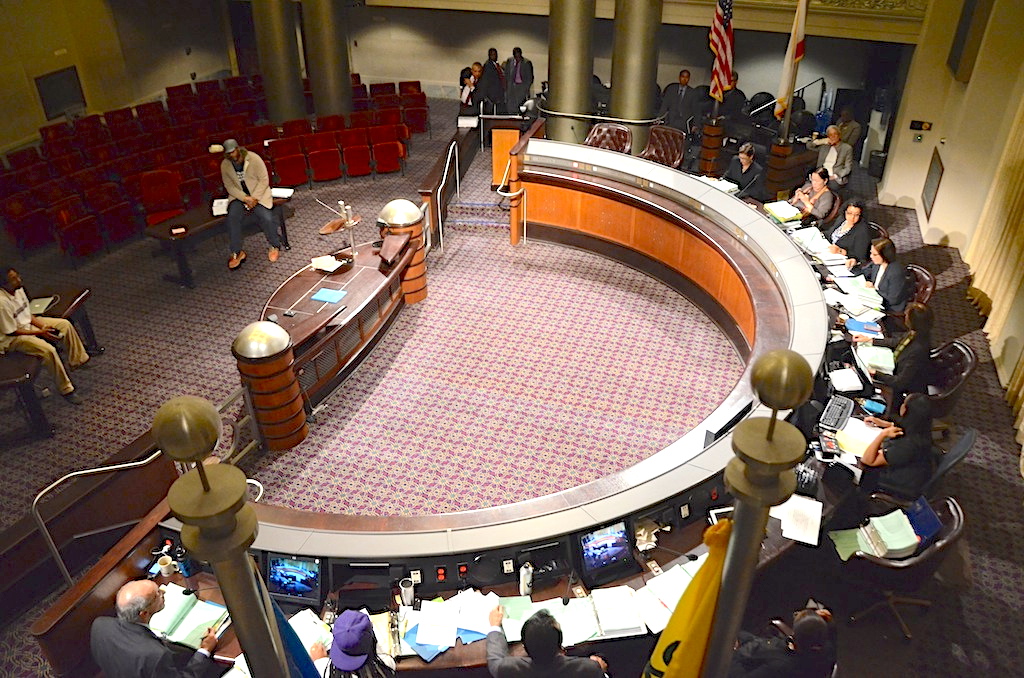
Walk into a council chamber or school board meeting room in your town, and you’ll likely see rows of chairs facing some sort of raised dais or stage, where the council members or board members sit. The whole point of the setup is to have you look at the politicians, not your fellow citizens. Essentially, city council chambers are laid out like church, and, as in church, you’re not supposed to talk too much. So it’s not surprising that fewer and fewer Americans bother to go to city council meetings (or, for that matter, to church).
For a better idea, he suggests looking to a certain coffee chain:
To unleash the untapped power of council and school board meetings – to make them about creating conversations – we must flip our priorities and redesign the spaces, so that council chambers and boardrooms are foremost places for people to gather and talk. What does that look like? Well, it looks like Starbucks. Take out the old fixed benches and seating of your council chamber. Set up tables and chairs and nice couches. Have a bar for serving coffee and healthy snacks and maybe even beer and wine. (I’m a teetotaler, but I don’t know how an elected official could summon the courage to grapple with California cities’ outsized pension problems without a slug of Jim Beam.) …
[People] go to places where they feel comfortable, where they can eat and drink, where tables and chairs are arranged in ways that encourage conversation. In my San Gabriel Valley community, there are so many people spending time sitting and talking at the three local Starbucks that it’s often hard to get a table. Great bars and restaurants always seem full. I don’t think I’ve ever managed to find an empty seat at our local ice cream parlor, Fosselman’s in Alhambra. Rarely have I had this problem at city council or school board meetings.
(Photo of Oakland City Council meeting by Daniel Arauz)
In his book Marijuana Gateway to Health: How Cannabis Protects Us from Cancer and Alzheimer’s Disease, author and researcher Clint Werner notes that the federal government holds US Patent 6630507, titled “Cannabinoids as antioxidants and neuroprotectants,” before concluding that the herb should be “as common in an NFL locker room as icepacks.” And not just to prevent dementia. Marijuana is also a remarkably safe, effective pain reliever, with none of the dangerous side effects of commonly prescribed pharmaceuticals. Meanwhile, according to a study published in Drug and Alcohol Dependence, retired NFL players misuse prescription painkillers at a rate more than four times higher than the general population. “[NFL] players have a legitimate and substantial claim to use medical marijuana,” former Broncos receiver Nate Jackson recently told the Denver Post. “[Instead] teams pass out opioid painkillers, which are highly addictive. They are a derivative of the poppy plant—so it is basically pharmaceutical heroin.”
In an interview, Scott Stossel discusses his new book, My Age of Anxiety. Why he doesn’t appear outwardly anxious:
Some people say that in stressful situations I can seem unflappable, and I think that’s partly because I’m always kind of internally flapped. And so … when there’s actually something real to be concerned about, it’s actually less anxiety-provoking than these irrational things. It’s also fairly typical … of certain kinds of anxiety-disorder sufferers, particularly people with panic disorder, [they] are exceptionally good at hiding it. They’re able to convey an impression of competence, calmness and confidence, which is maybe substantially real … but there’s an internal fear. … The gap between that and this façade where people see you as competent and effective — you’re always afraid of being exposed, which is in itself anxiety-producing.
One of my more recent therapists calls this phenomenon impression management. Impression management is not only a symptom of anxiety, because you’re worried about being exposed, but it’s also a cause because you’re constantly worried that the house of cards that is your outward image … is going to come crashing down.
“My Age of Anxiety” is not a memoir. Stossel tells us things about his parents, his marriage, and his children, but only things that are relevant to what he calls, after a famous remark of Freud’s, “the ‘riddle’ of anxiety.” The same is true of what he tells us about himself. He appears simply as a sufferer. Most of his book is a scholarly exploration of the history of anxiety and a journalistic account of the present state of medical knowledge. It’s intelligent, interesting, and well written, but the subject of anxiety is a mess, and the book, intentionally or not, is an accurate representation of its subject.
It doesn’t solve the riddle, either, but that’s not Stossel’s fault. It’s because anxiety of the kind he is afflicted with is not a riddle. It’s an illness. There is therefore nothing, except in the medical sense, to solve. That’s not what Stossel wants to believe, though. He has an idea that more is at stake. He thinks that there is a metaphysics of anxiety. “To grapple with and understand anxiety,” he says, “is, in some sense, to grapple with and understand the human condition.”
But he nevertheless praises Stossel:
He is an honest guide. He is committed to thinking through the philosophical, scientific, and human implications of a mood that appears to be universal (though people who live in underdeveloped countries seem to be less anxious) and that has attracted the attention of writers from Aristotle and Robert Burton (the seventeenth-century author of “The Anatomy of Melancholy”) to Søren Kierkegaard and William James. One of the best things about him is that he’s generally agnostic toward the theories and treatments he examines. He sees the possibilities in everything.
George Scialabba thinks Stossel lets capitalism off too easily:
Late in the book, buried in a footnote, a few sentences speculate that “life in a capitalist economy produces anxiety and uneasiness [and] can be psychologically corrosive. . . . Perhaps the human organism is not equipped to live life as society”—“society,” really?—“has lately designed it—a harsh zero-sum competition where the only gains to be had are at the expense of someone else, where ‘neurotic competition’ has displaced solidarity and cooperation.” That’s it. He devotes more space to the etymology of panic (the slightly crazy god Pan) and the physiology of blushing.
Harris v. Quinn asks whether public employees can be compelled to pay “agency fees” to unions they don’t belong to. Garrett Epps explains the case:
[T]he state of Illinois in 2003 designated the home-care workers as state employees for the purpose of collective bargaining. The workers then held an official vote, and a majority voted to certify the Service Employees International Union as their “exclusive bargaining agent.” Non-members, like the plaintiffs in this case, pay a fee that is a set annual “chargeable” percentage of union dues. The rationale for the agency fees is that non-union employees benefit from the contracts unions negotiate, and thus would be “free riders” if the union could not charge them. If unions cannot collect fees, soon employees would stop joining, and they would lose their ability to speak for workers. …
The argument against public-sector agency fees is this: Since public employees work for government, everything they bargain about is political. Higher wages, better benefits, new work rules—all affect the state budget. Assessing fees from non-members thus requires them to pay for political speech. All the expenses, in other words, are non-chargeable.
Aside from what was said explicitly from the bench, the atmospherics of Tuesday’s argument suggested strongly that this case has very large potential. The mood of the Court’s more liberal members was one of obvious trepidation, and that of its more conservative members — except for Justice Scalia — was of apparent eagerness to reach anew the core constitutionality of compulsory union support among public workers.
Ian Millhiser presents the pro-union view of the issue:
For decades, public sector unions have operated under a simple bargain. Unions are subject to two restrictions — they may not require non-members to fund the union’s political activity, and they must bargain on behalf of every worker in a unionized shop, regardless of whether each individual worker belongs to the union. In other words, the union cannot encourage non-members to join by bargaining for higher wages or other benefits that only apply to union members. When a union secures a wage increase, the non-members benefit from the higher wages as well.
The cost of bargaining with an employer can be significant, however. Negotiators must have the sophistication determine what sort of bargain would be beneficial to the workers but also feasible for the company to deliver. Lawyers are needed to review contracts and to draft them. Because non-union members benefit from the high wages, increased benefits and other advantages of having a union bargain on their behalf, unions are permitted to charge agency fees to non-members in order to cover those non-members’ share of the bargaining costs.
In practice, these agency fees are typically paid out of the increased wages that the non-members receive through the collective bargaining process, so the non-members wind up wealthier in the long run even though they are paying some fees to the union. If a union fails to deliver higher wages, a majority of the workers in a bargaining unit always have the option to vote not to be represented by the union.
Scott Shackford reads the Cato institute’s amicus brief in support of the plaintiffs:
Of note in Cato’s argument is that they tackle two of the major arguments that the courts have accepted to allow for compulsory membership in unions at places of government – to preserve “labor peace” (conflicts resulting from multiple bargaining representatives for different employees doing the same work) and to avoid “free riders,” those who reap the rewards of collective agreements without contributing to the costs of representation.
It should be fairly obvious that in the case of often self-employed home health workers, these two arguments don’t apply. The workers are hired by and work for individuals, and that’s not changing. There are no threats to labor peace, nor would there be any free riders. These home care workers all work in the same field but they are in no sense in the same business together. In Cato’s brief, they note that this forced unionization is only about lobbying for more pay and benefits, using the union to give “feedback” to the state about rates set by laws. It is offering nothing else. Thus, Cato notes, the state has no actual compelling interest in forcing home care workers into accepting union representation
Justice Alito was the most skeptical of the union/government position, pointing out that unions don’t necessarily act in all workers’ interest, even when they succeed in negotiating certain “gains.” For example, a productive young worker might prefer merit pay to tenure provisions or a defined-benefit pension plan. Chief Justice Roberts was similarly concerned about administering the line between those union expenses that could be “charged” even to nonmembers (because related to collective bargaining) versus those that can’t because they involve political activity. Justice Kennedy, meanwhile, noted that in this era of growing government, increasing the size and cost of the public workforce is more than simple bargaining over wages and benefits; it’s “a fundamental issue of political belief.” In no other context could a government seek to compel its citizens to subsidize such speech. A worker who disagrees with the union view on these political questions is still made to subsidize it.
Waldman wonders why ambition isn’t an acceptable reason to run for high office:
I have to ask why we assume there is something morally superior about the “conviction politician” like Ronald Reagan or Barry Goldwater, and something morally inferior about the guy who just thinks he’d like to be president and would do the job well. No matter how firm their ideology, conviction politicians are just as ambitious as people like Romney or Bill Clinton who knew they would one day run for president from the time they got to middle school.
What happens then is that the less ideological candidate, who can’t say “I’m running for president to defeat the socialist menace that lurks in every free school lunch,” has to convince us that he’s running because of some equally powerful impulse that exists outside of his own desires. So he presents himself as something like a firefighter. He doesn’t want the glory, he doesn’t want the hug from the grateful homeowner, the nation is on fire and he has no choice but to douse the flames with his brilliant leadership.
The easy answer is that many of the people that pay the closest attention to politics make this assumption about politicians because they have very firm and strongly-held political convictions.
They take an interest in election campaigns because they want someone holding as many of their convictions as possible to prevail, and so they tend to view conviction politicians more sympathetically than opportunists or technocratic managers. Many activists and pundits also tend to be more interested in conviction politicians because they want to be able to identify with a candidate because of what he professes to believe, and for the same reason they will usually be harder on candidates whose convictions are easily changed or cast aside. The opportunist is viewed with suspicion because he appears to be (may indeed be) unprincipled and is therefore potentially unscrupulous and untrustworthy, and the manager type is perceived as dull, bloodless, and excessively calculating.
Bernstein thinks of ambition “first as a job requirement for all politicians and second as a plus, not a minus”:
The idea is that ambition isn’t just about getting to the White House, but also seeking to be personally powerful after getting there — that it’s the (obsessive?) quest for power that produces presidential success. I’ve made this point about George W. Bush. As I see it, Bush was not particularly ambitious, and thus saw nothing wrong with his Vice President and his Secretary of Defense running the show, with predictably terrible results. Why predictably terrible? Because ambitious presidents aren’t going to accept the harm to themselves from catastrophic policy failure, while true believers (in the Oval Office or elsewhere) just might.
It’s worth noting that the consensus choices for the three greatest American presidents — Washington, Lincoln, and Franklin Roosevelt — were all extraordinarily ambitious. None is usually classified as a true believer. Granted, there’s no guarantee of success: Richard Nixon was surely a very ambitious non-ideologue, and he was a terrible president.
(Photo by Lefty Shivambu/Gallo Images/Getty Images)
A confession. I have long had an aversion to gay-themed plays, TV shows, movies, etc. I wasn’t born with it. I learned it. I learned it through what can only be called a series of cringes. I cringed at Philadelphia‘s well-intentioned hagiography of the “AIDS victim”; I cringed through Tony Kushner’s view of the plague as a post-script to the heroism of American communists; I winced at the eunuch, the sassy girlfriend, and the witty queen in Will And Grace; I had to look away as Ellen initially over-played her hand (understandably and totally forgivably, but still …). The US version of Queer as Folk was something I could not get out of my recoiling head for weeks – and I barely got through fifteen minutes of it. And please don’t ask me about Jeffrey. Please.
Maybe I should have sucked it up and celebrated each and every portrayal of gay people in any form – after so many decades and centuries of invisibility or minstrelsy. But, like many members of any minority group seeing themselves portrayed for the first time on screen, I felt betrayed when my own life wasn’t depicted, my worldview was ignored, my politics wasn’t acknowledged. In many ways this was utterly irrational. But it was emotionally real. When there are so few cultural expressions of your core identity, the few become weighted with far more cultural baggage than they can hope to uphold. In a fraught time – between liberation and mass extinction, between criminality and civil equality – it was hard to forgive anything that might be conceived as counter-productive or inaccurate or ideologized.
The same dynamic operated the other way on me, as well. When I rather naively became a gay public figure by answering “yes” to the question, “Are you gay?” after I became the editor of The New Republic at the crazy age of 27, the shoe was on the other foot. Suddenly I was supposed to represent all “virtually normal” gay men, because I was one of very, very few out people in the mainstream media in 1991. And boy did I not represent them. I never claimed to, of course, and said so explicitly; but that really didn’t matter. I was out there and not representative of many others. So I had to be knocked off my perch in a period of great exhilaration but also great personal pain. Looking back, the necessary madness of that period, its extraordinary range of sheer emotion as we fought not just for our dignity but for our very lives, seems clearer and more understandable now. But no less painful.
So when the opening scene of the new HBO series, Looking, shows a young gay man cruising for sex in a public park, I tensed up. But almost as quickly I realized that this was the most meta of the show’s moments (I’ve been able to watch all four of the first few episodes). As the dude starts to grope around, his cell phone goes off, the other guy’s hands are freezing on his cock, he tries to answer the phone, then drops it into a ditch. His friends – out for a lark to see if old gay culture still exists in San Francisco – were calling him; and they reunite to talk about the fun in exploring the old world of cruising. And so the circle is complete. Gay culture has evolved into a million-petaled flower, and the old petals are still in there, but ironized for many, if still urgent for others. Gay life in 2014 is … well, finally just life.
I loved the show. It is the first non-cringe-inducing, mass market portrayal of gay life in America since the civil rights movement took off. Well, the first since Weekend, the breakthrough movie of 2011:
For some reason, it wasn’t until Aaron reminded me last night that both Looking and Weekend are by the same Andrew Haigh that I put it all together.
Along with Michael Lannan, Haigh is the first director and writer to actually bring no apparent cultural or ideological baggage to the subject matter. There is no shame here and no shadow of shame. There is simply living – in its complexity, realism, and elusive truth. To get to this point – past being either for or against homosexuality – is a real achievement.
The emotional conflicts, the awkwardness of dating, the mixed feelings about some aspects of gay culture, the workaholism, the weed, the generational divides, the girlfriends and monogamish coupling, the weddings and the fetishes, the bears and the twinks: it’s all here, and served crisply as a well-mixed cocktail on the rocks. Sometimes, its realism becomes mere darkness as the show is filmed in weirdly dark tones. Sometimes there’s a false note: I’ve never heard anyone use the expression “Drug-Disease-Free” in speech, for example. It’s only ever used – with chilling HIV-phobic effect – on the web. And yes, this is not yet what I’d like to be able to watch: a convincing drama about gay men in, say, Houston or Atlanta, in 2014. And it doesn’t have the nuances and writerly quirks of Girls, even as it is close to it in realism (but not as much sex as in Girls). There are also a few frustratingly implausible plot developments and unpersuasive character developments that accumulate as the shows progress.
But I nonetheless recognized the reality of gay life now in this show. And not just mine – but intimations of countless others. The characters are not minstrels; and they are not eunuchs. They are for the first time recognizable human beings who happen to be gay. And that’s enough. Actually, it’s more than enough.
I identify with your reader’s point that being a black atheist can be leave one feeling an outsider, particularly in social situations where people have a tendency to attribute life’s ups and down to “his will.” However, I wonder about him attributing his lack of black friends to his atheism. I am a black atheist from a Catholic family, but being raised in a largely segregated black community (Chicago), I am very familiar with the conventional black church. Though I don’t believe in God myself, I do understand and appreciate to role of the church and religion historically played in the lives of my people – but I am also wary about its influence.
Ironically, I came to atheism through my acceptance of conservatism, beginning in my senior year of high school and solidified as an undergraduate at Howard University. Specifically, I rejected a belief in God in conjunction with my rejection of the traditional civil rights style of politics. After numerous debates with classmates who came from a very church-grounded liberal politics, I found the notion of a “loving” god who allowed so many to suffer unbelievable. Because I believed there was no god, I must take care and do for myself, with no expectation of help. I was tired of my people believing “God will provide” and “He will save us,” which I felt generated the same sort of feeling about government help. Thus, I became a supporter of personal responsibility and free markets, culminating in me voting for GWB in my first presidential election.
Graduate school, maturity, and observation of bigotry and incompetence within Republican governance have moderated my politics substantially, but I’ve maintained the atheism.
A new report (pdf) from Oxfam, issued just in time for Davos, reveals that the richest 85 people in the world own as much wealth as the poorest 3.5 billion. Will Oremus comments:
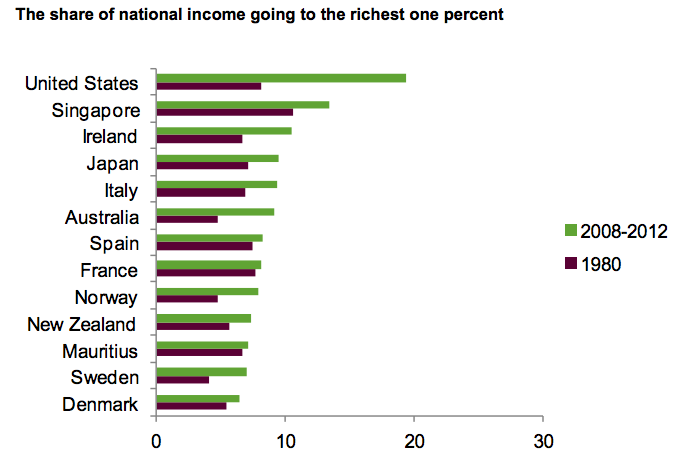
If there’s one kernel of hope—not mentioned in the Oxfam report, as far as I can tell—it’s that inequality between countries may be easing slightly (though it’s hard to tell for sure). On a country-by-country basis, though, the filthy rich have only been getting richer. Between 1980 and 2012, the wealthiest 1 percent increased their share of the spoils in 24 of the 26 countries Oxfam surveyed. This includes the United States, where the wealthiest 1 percent have captured 95 percent of all economic growth since the financial crisis of 2009, while the bottom 90 percent have gotten poorer.
Oxfam’s concern is not just that half the world’s population could be bought and sold by a group of individuals who could fit in a single large boardroom. It’s that this staggering disparity creates a vicious cycle.
First, does Oxfam’s simplistic narrative of crony capitalism tell the economic story of the past three decades better than the 80% decline in extreme poverty? And why exactly are there 250 million fewer extremely poor people in the world today? As economist Deirdre McCloskey puts it, “The Big Economic Story of our own times is that the Chinese in 1978 and then the Indians in 1991 adopted liberal ideas in the economy … And then China and India exploded in economic growth.”
The rise in wealth inequality isn’t a measure of the poor getting poorer. It’s a measure of the rich getting fantastically richer thanks to the cascading benefits of privilege and the tremendous growth in stock wealth in the last decade. (Even in the U.S., 75 percent of household wealth is held by the richest 5 percent.)
Brian Merchant links rising inequality to automation:
Two hugely important statistics concerning the future of employment as we know it made waves recently:
2. 47 percent of the world’s currently existing jobs are likely to be automated over the next two decades.
Combined, those two stats portend a quickly-exacerbating dystopia. As more and more automated machinery (robots, if you like) are brought in to generate efficiency gains for companies, more and more jobs will be displaced, and more and more income will accumulate higher up the corporate ladder. The inequality gulf will widen as jobs grow permanently scarce—there are only so many service sector jobs to replace manufacturing ones as it is—and the latest wave of automation will hijack not just factory workers but accountants, telemarketers, and real estate agents.
Kevin D. Williamson claims that liberals don’t actually want to do anything about global inequality:
What can we do about the situation of the global poor? We could seize all of the wealth of those 85 super-rich people whose portfolios so fascinate the Los Angeles Times, which would have the effect of raising the average wealth of the world’s poor from about $485 to about $970 — not exactly a solution.
The only way to help the world’s poor to a position of relative prosperity and economic independence is to help them to participate in the global economy, and here our progressive friends take a damned-if-you-do/damned-if-you-don’t approach. They’re scandalized by the scanty assets of the world’s poor, and they’re even more scandalized when rich countries open their markets to the global poor, or when companies from rich countries invest in poor countries and employ the poor people residing therein. The Democrats refer to Americans who do business with the global poor as “economic traitors,” and their most recent national convention was an energetic pageant of xenophobia, replete with ritualistic denunciations of the Yellow Peril come to steal our jobs.
Casey N. Cep points out that chances are, “if you read the report, then you are part of the problem”:
It will always be easier to rage against the one percent than to scrutinize our own wealth. Last week, I shook my fist at the Oxfam report while drinking a chai latte with the other, then emailed a friend from my iPhone to rant about those 85 moguls who own half the world. Trouble is, I’m a mogul in my own life: the iPhone is newer than it needs to be, I ate out twice last week, and I saw a movie the other day because it’s Oscar season. Yes, I have debts and I can’t even see the super-rich from my rung of America’s income brackets, but there are still more than a few luxuries in my life. I like to think they’re essentials, but like almost everyone, I have a talent for rationalizing my spending.
When Peter Singer writes that 19,000 children die every single day because of preventable, poverty-related causes, he’s not blaming their deaths on 85 individuals or a single percent of the world’s population: he’s blaming the rest of us, too. The rich might be able to do more, but we can all do something. Mammon isn’t just a mistress for the rich, but a companion for us all, whatever our percent.
You can offshore manufacturing, but a new study shows that doing so doesn’t mean you’ll fully escape the pollution. … According to this study, published in Proceedings of the National Academy of Sciences, up to one quarter of sulfate pollution on the West Coast can be traced back to Chinese factories making goods for export. Overall, pollution being dragged across the Pacific by the wind is responsible for Los Angeles experiencing one additional day each year where smog exceeds federal ozone limits. Smaller amounts of black carbon pollution, a significant component of both climate change and unhealthy air quality, also reaches the west coast of North America.
Previous research, conducted by the US Department of Energy, found that one third of airborne lead particles in the San Francisco Bay area could be traced to pollution originating in Asia.
A reader sent the above photo last month:
It’s from Pyoengtaek, South Korea (about 60 miles south of Seoul). Thanks, Chinese pollution! See here for a related article on the problem.
That pollution definitely translates to a health impact on American citizens, says the study’s co-author, University of California-Davis earth scientist Steve Davis. Still, he points out a small conundrum. “If you imagine we tried to make these things at home, rather than having them made for us in China, that manufacturing would happen on the East Coast. So air quality on the East Coast would suffer, but the West Coast would improve because we wouldn’t have this Chinese pollution blowing over.” Homegrown manufacturing, however, would likely create a net environmental benefit. “In terms of global pollution, for every widget that is made in the U.S., there is less pollution than that widget made in China,” Davis said. “They have less controls and technologies in place at this point.”
Keating notes that viewed another way, China has imported much more pollution from the US than it sends back:
This is one area where China may have something of a point when it comes to culpability for emissions. China’s pollution isn’t solely of its own doing. They’re tied to an export economy making goods for other countries, the U.S. most of all. America’s emissions are lower partially because China’s are higher. Viewed a different way, this is not so much a question of “China’s smog” reaching America as the vast majority of smog from the manufacture of American goods staying in China. Of course, as China’s economy continues to shift from export to consumption, this equation is going to change.


 The Dish