What’s Next For The Religious Right?

According to Damon Linker, the religious right is “finished” and its remaining followers “have been reduced to playing defense.” He asks, “What will come next for these voters, now that the original religious right is fading out?”:

The first and most likely development is one that’s already underway: A stepping back from national ambitions across a range of issues to a narrower emphasis on state-level initiatives that restrict access to abortion. This is a shrewd move, politically speaking. Thanks to advances in ultrasound technology, public opinion on abortion is likely to remain deeply conflicted, with strong support for reproductive freedom coupled with a strong moral aversion to both late-term abortions and the termination of pregnancies for what many judge to be frivolous reasons.

The focus on passing legislation in conservative-leaning states, meanwhile, allows the remnants of the religious right to maximize the impact of their limited resources. The end result, at least in the short-to-medium term, is likely to be greater ideological polarization across the country, with abortion harder than ever to procure in some states and others proudly trumpeting their absolute commitment to reproductive freedom.

Another possibility he entertains is that “the next generation of religious conservatives will take a different path, withdrawing from politics altogether”:

There is already some evidence that younger religious conservatives are more inclined than their parents to look with suspicion on politicized faith. If this inclination persists, perhaps further encouraged by increasing disappointment with the available political alternatives in the United States, it could drive religiously devout conservatives away from activist engagement entirely.

African-Americans And Prohibition Of Weed, Ctd

A Medical Marijuana Operation In Colorado Run By Kristi Kelly, Co-Founder Of Good Meds Network

A reader quotes me:

So one of the most powerful arguments for legalization of marijuana – that Prohibition grotesquely singles out African-Americans for criminal enforcement and spares whites – carries no more weight among African-Americans than it does among whites. Of those African-Americans who feel strongly about the subject, 40 percent oppose legalization and only 32 percent support it. Overall, there’s no statistically significant difference between whites and blacks on this. I’d be fascinated to hear from readers why they think this might be so. It seems on the surface that social conservatism is outweighing civil rights. But I’m genuinely baffled.

The answer to your question is that African-American marijuana users aren’t being arrested at higher levels. African-Americans in general are being arrested at higher level for everything then their white counterparts. The weed is just along for the ride. We understand this, so that argument doesn’t hold as much sway as it could.

That reader is echoed by another with a “perspective as a public defender”:

I think that people in the African American community see the different treatment of blacks and whites vis a vis marijuana enforcement as a symptom, and not a cause, of deep-seated racism in the criminal justice system.

That’s the kind of thing my confirmation biases can blind me to. Which is why I love my job. Another reader with expertise on the subject:

I co-founded the grassroots nonprofit now leading legalization in Rhode Island. You’ve addressed the most unasked question in the legalization debate, but it only demonstrates the complete tone deafness of white people like you who have their heart in the right place but don’t fully appreciate the wider racial dynamics of prohibition. As my colleagues said after observing the sea of white at a major drug policy reform conference: “If these guys are trying to save black people, why can’t they bring any of them to their conferences?” The partial answer is the indefatigable pride and resilience in communities of color we’ve worked with. I encourage you to approach an elderly, church-going woman of color who’s seen her neighborhood destroyed by drugs. Try shooting the shit about legalizing weed and see how far you get.

But the second answer reveals one of the paradoxes of legalization.

In this country, the archetypal divide for social change is between activists who feel an acute, moral zeal, and the rest of us whose allegiance lies with pragmatism and decide from the sidelines. But legalization completely inverts this rule: because there is such an enormous long-term price tag attached to reform, the open secret in legalization circles is that the types of activists it attracts tend to think of themselves as pragmatic, forward thinking businesspeople getting in on the ground floor of a major industry – not really as moral crusaders. Meanwhile, the moral case for marijuana comes less from its activists than observers and commentators, often in journalism, like you.

Thus your “bafflement,” like most sympathetic white people, is pretty common. The irony will be that that the people unharmed by prohibition were the only ones privileged enough to lobby against it. It raises the Faustian question: given the eventual multi-billion dollar windfall, how much lower would black support actually need to be before white invocation of their plight was exploitative? As has so often been the case in this country, the outcome of finally rectifying long overdo injustice will be black people moving out of prison, and white people (in this case, overwhelmingly men) moving out of their tax bracket. I guess that’s the price of change.

Another reader:

I will keep shouting this from the rooftops until somebody listens but “Black people are conservative!”. This applies not just to African-Americans but all of our diaspora. I’m Nigerian and we are some of the most homophobic, biblical literalist, anti-drug people on the planet.

As it relates to drugs and the Af-Am experience, one has to remember the deleterious affect that drugs had on the community (see the crack epidemic). Many older AA (over 55) would never fathom drug use since it’s a highway, in their minds, to brokenness, incarceration and a slew of other ills. Also, many older Black people see drugs as something white people do that’s been introduced to us to keep us down.

Most AA are live-and-let-live libertarian types on some matters, but by and large the older set really don’t get this new liberalism amongst the younger set.  I’m sure if you tease out the younger AA cohort on the data you will see a fairly prominent divide. My Gen-X AA contemporaries fall into two camps weed legalization: “meh, not for me but let’s tax it” and “more fiya!”

Another:

For lower-income families, an addiction to drugs or alcohol, an illness, a pregnancy, etc. can have far more devastating effects than for wealthier people. So it would make sense if there was a stronger sense of social conservatism there. Leave aside that not going to jail is better for the families than going to jail. It might be a more general ethic of “don’t screw up, be safe, etc.”  The consequences are more severe. If on the whole, the African-American population has more lower-income families, you might have a greater number of those who oppose.

(Photo: Matthew Staver for the Washington Post via Getty Images)

Outsourcing Injustice

Jon Fasman calls private probation an extortion racket:

It works like this: say you get a $200 speeding ticket, and you don’t have the money to pay it. You are placed on probation, and for a monthly supervisory fee you can pay the fine off in instalments over the course of your probation term. The devil, as ever, is in the details, as a great Sunday story from the Atlanta Journal Constitution makes clear. Those supervisory fees vary markedly: in Cobb County, for instance, just north of Atlanta, the government charges a $22 monthly fee. Private companies charge $39, and often add extra costs on top of that to cover drug testing, electronic monitoring and even classes they decide offenders need. Fees often rise and even multiply when probationers cannot pay—and remember, these are people, for the most part, who could not come up with a hundred bucks and change to pay the initial fee; you have to expect they’ll have some trouble paying.

Even worse, people who fail to pay the fines imposed by these private companies can find warrants for their arrests sworn out and the period of their probation extended. I spoke with an attorney for a couple in Alabama who say they were threatened with Tasers and the removal of their children if they did not pay the company what they owed. In 2012 a court found that the fees levied by private-probation companies in Harpersville, Alabama, could turn a $200 fine and a year’s probation into $2,100 in fees and fines stretched over 41 months. A judge in Richmond and Columbia counties ruled such probation extensions illegal last autumn.

Drum adds:

Isn’t that great? It’s the free market at work, all right. It reminds me of last year’s piece in the Washington Post about the privatization of the debt collection in Washington DC[.] … You may remember this as the story of the 76-year-old man struggling with dementia who was thrown out on the street and had his house seized because of a mix-up over a $134 property tax bill.

Toward A Smaller, Smarter Army

A short history of US military spending:

Gordon Lubold looks at the consequences of downsizing:

The Army has long been criticized for being too big and lumbering – qualities that perhaps suited it all right for the conventional land wars of the past decade. Calls for a lighter, nimbler one haven’t made huge impacts yet on the institution. But aside from the conventional threats in the Asia Pacific like China, most people argue that in this budgetary environment, there are few reasons to have a large, sitting Army that topped about 570,000 just a few years ago. And an Army sized at 420,000 soldiers is not exactly skeletal. In fact, it’s roughly the size of the pre-war Army in 2000. And cutting it back isn’t anything like the hundreds of thousands of forces cut in the early 1990s.

A smaller force may have an impact on one of the Army’s cherished new concepts:

regionalized brigades. The idea is to give soldiers assigned to a brigade basic language and cultural skills for a certain region. Although the brigades are not assigned to a specific part of the world, they are theoretically “on the step” to deploy there — most typically in smaller, platoon- and company-sized units — for training and advising or potentially more “kinetic” missions. It’s an ambitious approach and one not without its critics. But for example, the Army has begun using the Army’s 2-1 brigade combat team as one of the first ones trained and ready to deploy to Africa. “I think what we want to make sure is that they’re much more culturally attuned to the area they’re going to,” an Army official working on the initiative, told Foreign Policy’s Situation Report last year. “I think that is an important part, and it’s certainly something that 12 years of operations in Iraq and Afghanistan has highlighted to us, that you’ve got to understand the culture within which you operate. If you don’t, it does come with potentially cataclysmic problems.”

The Will To Work Out

It may be genetic:

To a certain kind of sports fan—the sort with a Ph.D. in physiology—Olga Kotelko is just about the most interesting athlete in the world. A track and field amateur from Vancouver, Canada, Kotelko has no peer when it comes to the javelin, the long jump, and the 100-meter dash (to name just a few of the 11 events she has competed in avidly for 18 years). And that’s only partly because peers in her age bracket tend overwhelmingly to avoid athletic throwing and jumping events. Kotelko, you see, is 94 years old.

Scientists want to know what’s different about Olga Kotelko. Many people assume she simply won the genetic lottery—end of story. But in some ways that appears not to be true. Some athletes carry genetic variants that make them highly “trainable,” acutely responsive to aerobic exercise. Kotelko doesn’t have many of them. Some people have genes that let them lose weight easily on a workout regime. Kotelko doesn’t.

Olga’s DNA instead may help her out in a subtler way. There’s increasing evidence that the will to work out is partly genetically determined. It’s an advantage that could help explain the apparently Mars/Venus difference between people for whom exercise is pleasure—the Olga Kotelkos of the world—and the couch potatoes among us for whom it’s torture.

The Polls Of The Past

HistOpinion

Rebecca Onion profiles @HistOpinion, a Twitter account that tweets the results of public opinion surveys conducted more than 70 years ago:

The volume that supplies source material for the tweets is Public Opinion, 1935-1946, by Princeton psychologist Hadley Cantril. Cantril was a pioneer in the field of public opinion research, which took off in the mid-1930s after pollsters George Gallup, Elmo Roper, and Archibald Crossley successfully predicted FDR’s victory using statistical sampling in 1936. From his perch at Princeton, Cantril adapted these new methods for academic purposes, and advised presidents including FDR and Eisenhower. (Cantril also authored the first study of the Orson Welles War of the Worlds “panic” of 1938.) Public Opinion compiles data from 23 polling organizations around the world, with results coming from Hungary, France, Germany, Denmark, Sweden, Australia, and Britain, as well as the U.S. Shulman is working his way through the volume, selecting the most surprising, intriguing, or unusual responses to share on the Twitter feed.

Working Too Much Is Bad For Business

So why do we do it?

The perplexing thing about the cult of overwork is that, as we’ve known for a while, long hours diminish both productivity and quality. Among industrial workers, overtime raises the rate of mistakes and safety mishaps; likewise, for knowledge workers fatigue and sleep-deprivation make it hard to perform at a high cognitive level. As Solomon put it, past a certain point overworked people become “less efficient and less effective.” And the effects are cumulative. The bankers Michel studied started to break down in their fourth year on the job. They suffered from depression, anxiety, and immune-system problems, and performance reviews showed that their creativity and judgment declined.

If the benefits of working fewer hours are this clear, why has it been so hard for businesses to embrace the idea? Simple economics certainly plays a role: in some cases, such as law firms that bill by the hour, the system can reward you for working longer, not smarter. And even if a person pulling all-nighters is less productive than a well-rested substitute would be, it’s still cheaper to pay one person to work a hundred hours a week than two people to work fifty hours apiece.

Recent Dish on work hours here.

Checking In On PreCheck

Amar Toor examines the TSA program that expedites the security screening process for travelers who either have applied for the program or who have been invited by “behavior-detection officers”:

There are … doubts over whether the TSA’s behavior-detection methods are even effective at identifying potential threats. A November report from the nonpartisan Government Accountability Office (GAO) found that behavior-detection techniques work only “slightly better than chance”, and that they may be applied on inconsistent or subjective bases. The report was especially discouraging considering that the TSA has spent an estimated $1 billion on implementing behavior-detection protocols since launching the program in 2007. The TSA later contested the report’s findings, saying they were based on a survey of academic studies focused on identifying liars, rather than the suspicious behaviors that its agents are looking for. …

Yet [the Cato Institute’s Director of Information Policy Studies Jim] Harper and security experts see value in PreCheck’s unpredictability. TSA agents select passengers to pass through PreCheck at irregular times and locations, usually depending on queue length, and some eligible travelers are randomly selected prior to going through security. That makes it harder for would-be terrorists to exploit the system, but Harper still has reservations about a two-tiered approach to airport security. As the program expands, he argues, it’s not hard to imagine a situation where affluent passengers whisk through PreCheck, while poorer or less experienced travelers remain trapped in longer lines.

Update from a reader:

Your note and link about TSA PreCheck is a little off base – and I should know as I designed and implemented PreCheck for United! There are currently five methods of obtaining access to the TSA PreCheck lane:

1) qualify for PreCheck based on flight criteria, 2) qualify based on membership in the DHS Global Entry program (which requires a background check and in-person interview), 3) qualify based on membership in the new TSA PreCheck application program (which again requires a background check and in-person interview but is cheaper than Global Entry), 4) have your itinerary selected at random by the TSA’s black box, and 5) be admitted to the lane by a Behavioral Detection Officer.

Of all of these, selection by BDO is a tiny, tiny percentage of the total.  I’m not in a place to speak about how well the BDO’s do their jobs, but I know for a fact that the first four methods I mentioned (and a sixth that may or may not occur this year) are designed thoughtfully and do provide a less stringent security posture for people who concretely pose less risk.

The TSA’s stated goal is to get an ever larger share of the traveling public into the more trusted security screening lanes over this year and the next, and I expect we can return to pre-9/11 screening for a large majority of passengers within the next five years.  This will all be done without any BDOs.

Dish Renewal: Your Thoughts, Ctd

dish-readers

A reader writes:

I want to pass along a short encouraging email to you all: I for one don’t feel annoyed by your posts asking people to renew. It’s no worse than what NPR or Wikipedia do once a year, and unlike them, your appeals seem genuine (rather than automated) and express how passionate you are about what you do. After reading your blog off and on for about three years, my wife and I decided to fully commit and become subscribers a few weeks ago. In fact, it was one of your “please pay us!” posts that helped convince us. That, and the fact that your site is better than any other news site out there. Keep it up!

Another quips, “I figure with the amount of lost productivity I can blame on the Dish, the least I can do is forward along a small share of my paycheck.” Another dissents:

I can’t be the only one to notice the irony of your recent railing about the blurred lines between editorial and advertising at traditional publications, and your use of the exact same practice with the extensive posts about renewing to The Dish. I’m gonna renew, but just sayin.

Exact same practice? Really? Another reader:

I look forward to renewing my subscription. You have for years been my #1 go-to blog. There have been many many topics discussed at length that have direct relevance to my life. It is the one place I can go where I feel like my life as a 20-year HIV survivor is not lost to memory. Also, your discussion of how Vietnam veterans were ill-received by the old soldiers at the VFW was so enlightening to me. After sharing with my partner of twelve years, himself a Vietnam Vet, he really opened up some more – even after twelve years – since he speaks so little of it. So much pain. Both of us are isolated and “forgotten” soldiers in our respective ways. It has also been a great pleasure to share the warmth and excitement of the Grace that is Pope Francis. And I am so grateful to your blog for not forgetting the incarcerated and the travails of the mentally ill. Your blog is truly more like a place to me than a digital abstraction. It’s a good place to go. Have a Jaeger for me.

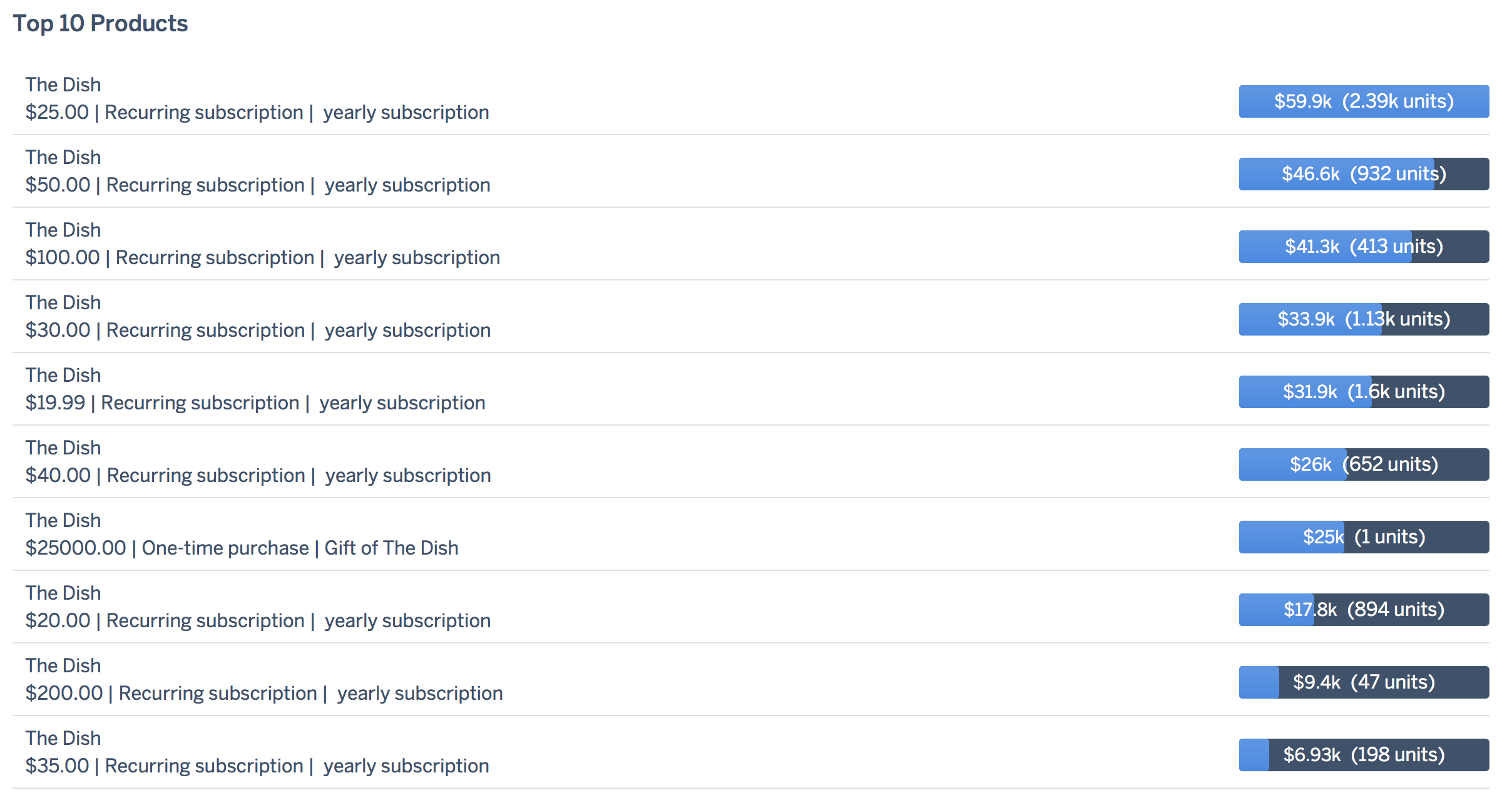
We’re not celebrating yet, since we still have a long way to go before matching last year’s budget. But we’re off to a great start: about 52% of our Founding Member revenue has been recouped so far. Below is a breakdown of the top 10 prices set by readers, ranked by total revenue for each chosen price (click to enlarge):

Screen Shot 2014-01-21 at 5.08.26 AM

The minimum price for a Dish subscription is still only $1.99/month or $19.99/year, but the average chosen price for an annual subscription is still hovering high at $37. One of the top contributors went with the monthly option:

I paid $19.99 the first day you opened for TinyPass business last year.  This year, when you asked for an extra $5, I thought “Hell, I can do more than that, and I WANT to do more than that”, and looked at my checkbook to see how much more I could do.  A quick review reminded that I pay $7.99 a month for Netflix, and I consume MUCH more Dish than Netflix.  So, I decided on a $7.99/month Dish renewal.  I also pay $9.99 a month for unlimited music on Spotify for my husband and me and our myriad devices.  I consume MUCH more Dish than Spotify.  Okay, I’ll hike it to $9.99 a month.

And then the killer: $32.80 every four weeks (13x year!) for The New York Times.  I read the hell out of The New York Times, but $32.80 is for digital access only on our computers, iPads, iPhones, etc.  (We get one dead-tree paper on Sunday, which we wouldn’t prefer.)  So, the nearest price point for the media item that I use/consume the most similarly to how I use/consume The Dish is The New York Times, and I pay them more than $425 a year.

So I renewed for $40/month – which comes out to $480/year.  It’s a huge sum, and I won’t be able to afford it forever, but today, as I measure its value to me compared to all the other media I pay for, it gets the pole position by far.

dish-launch-reax

Another reader:

I’m heartened to see the second-year spike in subscriptions you’ve received so far. And I want to apologize a bit: My own subscription isn’t up until February 4, and dollars are really really tight right now, so I’ll be re-upping with automatic renewal in early February.

But if that reader renews today, he won’t be double-charged for the next two weeks. (More details on that reader’s concern and others here.) So if you are already planning to renew your subscription, there’s really no need to delay. One more reader:

Happy to have renewed my subscription and thrown in $5 more than last year. I love the Dish, and I really loved the podcast with Dan Savage. Hopefully those in-depth conversations with interesting people will become a much more regular part of the Dish. (As a pioneer in blogging, I’d love to hear you chat with another pioneer of new media, podcaster Marc Maron, who I think has popped up before.) But I’m sure no matter what direction you take the Dish in, I’ll continue to find it informative, thought provoking and a unique voice in the noise.

Now that that’s out of the way, I’d like to ask you to pass something along to the free-riders: Pay up! No more excuses in year two. Andrew and the team have bent over backwards to make the Dish accessible and affordable to everyone, and they are truly putting themselves out there financially to provide you with content that you’re clearly consuming on a regular basis. $1.99 a month! That’s it! A cup of freaking coffee!

Renew now! Renew here! Update from a subscriber:

But my usual is a triple latte – almost $5.  So that’s what I renewed for – $5 a month. I hadn’t really thought of a monthly subscription. I was contemplating renewing at a higher yearly rate, but money is tight. Thanks to that subscriber, I thought of it differently. I can forgo an occasional latte to increase my Dish subscription amount – and doing it monthly will make it virtually unnoticeable.

And don’t forget to subscribe here if you haven’t already – another reader just did:

I’m a white married heterosexual atheist, inhabiting a Southern city with a rural job where I work in tractor/farm equipment sales. I chew tobacco, smoke pot, support marriage equality, love baking cakes and pies, making homemade ice cream (with a waistline that shows it), and I don’t drink – except from the Dish, which I now do with no inner pangs, as I finally coughed up some dough to support your enterprise. Cheesy segue I know, but I got nothing better. Thanks to all and keep it up!

One more renewal update, because who can resist this one:

I renewed for $100 – extended out to February 4th, 2015 – which happens to be the 36th anniversary of me losing my virginity. And now that I think of it, I will always be renewing my membership as of February 4th. So, two reasons to celebrate!

(Photos of Dish subscribers used with permission)