Some genius decided to do to O’Reilly’s "Talking Points Memo" what Stephen Colbert does to his own commentaries on "The Word." A little uneven at times, but occasionally a bull’s eye. Enjoy.
Stuff Happens Watch
From the NYT this morning:
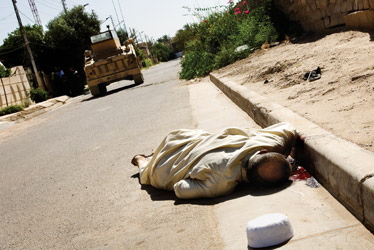
Security in the capital has deteriorated precipitously in recent months. Increasingly brazen assassinations torment neighborhoods and no longer seem to follow any obvious patterns. In May, the Baghdad morgue recorded the highest number of bodies received since the beginning of the war: 1,375, approximately double the toll of May 2005.
This isn’t spin. There’s no data as hard as corpses. And by that measure, Baghdad is half as secure as it was a year ago. Rumsfeld’s strategy has unleashed spiraling anarchy.
(Photo: Franco Pagetti for Time.)
AIDS At 25

The anniversary is American – and a little arbitrary. It was 25 years ago yesterday that the CDC reported two deaths from a form of pneumocystis that turned out to be a consequence of HIV. What has happened since cannot be summarized, because there are, in fact, dozens of HIV epidemics around the world today, each with distinctive patterns, populations, cultures, and prognoses. The world of HIV even within the gay male Western world is complex enough, which is why prevention efforts and drug regimens now have to be carefully recallibrated all the time to deal with a constantly moving target. One thing we can say, though. There was a turning point in 1996, when a critical mass of treatments turned the plague in America into something else. I wrote the first big essay celebrating and analyzing this – and nothing I have ever written prompted more hostility or anger from my gay brothers. It’s the first chapter in my book, "Love Undetectable," my own attempt to absorb what plague had taught. Now, the 1996 Rubicon is taken as a premise of most AIDS journalism. From a subtle and truthful account in the NYT today:
Twenty-five years ago, treading water in that black sea of untreatable illness, we had only one answer to give. Only a lunatic would look back to those days with nostalgia, but certain parts of them have, inevitably, taken on that glow tricks of memory can sometimes confer on the terrible past. With no possibility of saving our patients, life was sadder but far simpler. The big war was already lost, so we could concentrate on small victories instead.
Now, a complete rundown of all the news from the front would take hours. Risk of death from AIDS: way down. Risk of death from other things: going up. Risk of drug reaction: depends. Risk of fatal drug reaction: low but not zero. Risk of drug resistance: gets higher every year. The statistics change almost hourly as new treatments appear. It is all too cold, too mathematical, too scary to dump on the head of a sick, frightened person. So we simplify. "We have good treatments now," we say. "You should do fine."
Most do. My last bloodwork came back with undetectable levels of virus, and an immune system stronger than at any time in the thirteen years I have lived with HIV. It is both great news that this has occurred for me and so many others, but it makes the tragedy of continuing death and suffering in the developing world more poignant and terrible. We are making progress in many ways. But the path toward brighter years is strewn with pockets of deep darkness. The demonized drug companies did a lot of this work, and have never received their fair share of praise; the Bush administration too has done much more than its critics will ever concede; the private charitable sector – you only have to think of Bill Gates’ work – has been astonishing; the efforts of gay men, lesbians and countless heterosexuals as well have made lives with HIV easier, better, more hopeful.
And yet AIDS exhaustion is also real. The first words of my book are the following: "First, the resistance to memory." I knew I would one day want to block it out, that one day, I would forget most of it, especially the terror of it, and so I made myself write it out at the time. Now I find myself with little new to say, or, rather, nothing to say, except the obvious. I survived. Others I loved didn’t. There was no fairness in this. None. Countless more are dying – and surviving – with the same senseless randomness. In this sense, AIDS and HIV are just more intense experiences of life itself. Except death, once encountered, becomes always more real; and life never again resumes the ease and oblivion it once contained. HIV is a crash-course in being human. And everyone passes.
Iraq’s Resurgent Taliban
Zeyad offers news of what is happening to the Iraqi capital:
Baghdadis are reporting that radical Islamists have taken control over the Dora, Amiriya and Ghazaliya districts of Baghdad, where they operate in broad daylight. They have near full control of Saidiya, Jihad, Jami’a, Khadhraa’ and Adil. And their area of influence has spread over the last few weeks to Mansour, Yarmouk, Harthiya, and very recently, to Adhamiya.
All of these districts, with the exception of Adhamiya, are more or less mixed or Sunni majority areas. They make up the western part of the capital, or what is known as the Karkh sector (the eastern half of Baghdad is called Rusafa)…
So far, enforcing the hijab for women and a ban on shorts for men are consistent in most districts of western Baghdad. In other areas, women are not allowed to drive, to go out without a chaperone, and to use cell phones in public; men are not allowed to dress in jeans, shave their beards, wear goatees, put styling hair gel, or to wear necklaces; it is forbidden to sell ice, to sell cigarettes at street stands, to sell Iranian merchandise, to sell newspapers, and to sell ring tones, CDs, and DVDs. Butchers are not allowed to slaughter during certain religious anniversaries. Municipality workers will be killed if they try to collect garbage from certain areas…
According to their sick creed, it is not against Islam to detonate a car bomb at a bustling market or to shoot a kid twice in the head because he had gel on his hair. No, that is okay in Islam.
Zeyad links to many other Iraqi bloggers seeing the same thing. I don’t think they’re biased members of the MSM.
Taken Seriously
A reader writes:
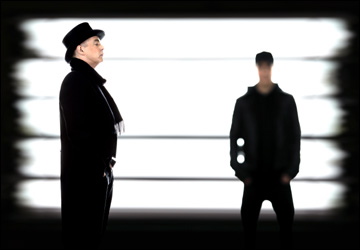
It may sound trite, but I think it’s fair to say that my tolerance for gay rights generally and the marriage right specifically is due in no small part to the Pet Shop Boys. Their music was deliberately ambiguous and over time, I came to appreciate how appropriate that was. The typical Pet Shop Boys song is about love – new love, love on the decline, lost love, inappropriate love – sentiments felt similarly by straights and gays. Times have certainly changed over the last twenty years, but even now, as a straight man with few gay friends, the Pet Shop Boys’ music is as close as I usually come to encountering gay culture.
For years, I’ve loved their music; somewhere along the line, though, I came away with something I hadn’t bargained for – an appreciation that gays were not really "different" and that, once superficial differences were set aside, we had more common ground than I would have thought. I think that, just as racial equality gained ground once whites came to view blacks as not particularly different than themselves, the Pet Shop Boys enabled many straights like myself to appreciate gays’ humanity rather than being distracted by their sexuality. What Tennant and Lowe still convey to clueless straight boys like myself is not an overt message which has to be confronted (and which we might, even now, instinctively resist), but is instead a quieter comment on universal things, regardless of your gender and that of the person you love.
I’m a Pethead and I’m a better person for it.
One day, Americans may finally see them less as an ’80s nostalgia band, and more as the consistently brilliant artists and writers they are. The rest of the world has already grasped this, but America has eluded them. Their musical charting of the AIDS epidemic, in particular, from the chilling single, "It Couldn’t Happen Here," through "Dreaming of the Queen," the heart-breaking "Your Funny Uncle" all the way through "Discoteca" and "The Survivors" makes them, I’d argue, the finest artistic chroniclers of the epidemic as it has affected Western gay men. And they conveyed this through universal themes of love and loss – long before Brokeback Mountain. Neil Tennant wrote me an appreciative personal note after reading "Virtually Normal." I’ve never been more flattered.
A Marine in Fallujah
He writes a letter to his home-town paper. His view deserves an airing as well. Money quote:
In Fallujah, the people watch Al Jazeerah. However, they also watch CNN. A lot of them fear that the United States will soon cut and run. The people of Iraq see when our country is divided. When they see rallies to "Bring The Troops Home," they see that as a sign that we will end our efforts prematurely.
Furthermore, they know that the insurgents will not end their efforts early. That leads them to the conclusion that when we leave, the insurgents will still be there. Therefore, if they help us, their lives and the lives of their loved ones will be in great jeopardy the minute we leave ‚Äî if we don’t finish the job.
Much that they see on American television leads them to believe that we intend to abandon our efforts before the new Iraqi government is capable of defending itself and its citizens.
The Ultimate Weapon Against Crime
Barry Manilow. Of course. How did it take us so long?
In Defense of ’80s Music
I’ve had several emails on these lines:
It is truly amusing that, as your reader stated, ‘people look back at the 80s as a wasteland music-wise.’ In retrospect, as a child and teen of the 80’s, there were numerous and influential artists who were simply ahead of their time. U2 and REM, the two alt-giants of the era, were not widely popular for much of the 80’s. Black Flag, the Dead Kennedys, the Misfits, and X emerged in the 80’s, as did the Cure, XTC, the Simths, the Pixies, and the Pogues. Husker Du was, in fact, just one of the artists that made Minneapolis the 80’s version of 90’s Seattle. Prince, Soul Asylum, the Replacements also fleshed out the Minneapolis sound. Throw in, for good measure, Elvis Costello, The Police, Kraftwerk, Run-DMC, Sonic Youth, and Public Enemy. I‚Äôm sure I’m missing some others, but still quite an impressive legacy.
Amen.
The View From Your Window

Cambridge, Massachusetts, students packing up before leaving.
The Glories of American Science
Don’t get discouraged. Scientists are hard at work figuring out what happens when you combine over 200 liters of diet coke with 523 Mentos. Enjoy.
 The Dish