Breaking Into Prison

by Dish Staff

Maya Schenwar reflects on what she’s learned from exchanging letters with prisoners:

Prison is built on a logic of isolation and disconnection. Letters between pen pals are almost always exchanged for the opposite purpose and with the opposite effect: connection.

The act of pen-palling mirrors the mindset shift that will be necessary to rethink how our society “does justice” on a much larger scale. My conversations, correspondences, and relationships with prison-torn families have taught me that separation breeds more separation, that the coldness and isolation of prison breed the coldness and isolation of violence. And I think about how the one-on-one relationship, in which the prisoner emerges as a person (with thoughts, a personality, a history, hopes, dreams, nightmares), might serve as a model for the beginnings of a person-based, connection-based justice system.

Previous Dish on a reader with a pen pal in solitary confinement here.

So, Jeb Bush Is Running

by Dish Staff

Noah Millman expects “Jeb Bush will be a very formidable candidate whose entry will seriously change the shape of the race.” And that we “have every reason to believe that the most-likely choice the voters will be presented with in 2016 will be Bush versus Clinton”:

The 2016 primaries on the Democratic side will feature Hillary Clinton ignoring a handful of protest candidates who never get any traction. And on the Republican side they will feature Jeb Bush coopting his most formidable opponents on his way to defeating a Rand Paul insurgency that more closely resembles Eugene McCarthy in ’68 than Ronald Reagan in ’76. And the general election will be the most-depressing of our lifetimes.

Kilgore sizes up the race:

Bush is now the Establishment fave who has taken the most overt steps towards running for president, which puts some extra pressure on Chris Christie since Bush’s PAC will at a minimum put the arm on many potential campaign donors in a way that will tend to commit them.

As fate would have it, McLatchey put out a new national poll this very day showing Jeb running second to Mitt Romney … and taking the lead if Mitt stays out. This will be enough for many Establishment types, who can be expected to begin calling Jeb the “frontrunner.” But truth is, he’s only running at 14% (16% if Mitt doesn’t run), and in a trial heat against Hillary Clinton, he’s trailing 53-40, which doesn’t exactly burnish the “electability” credentials he’d definitely need to convince conservatives to ignore his policy heresies and his family’s reputation for playing them for fools.

Larison downplays Jeb’s chances:

Certainly there would be no better way to announce that the GOP remains in thrall to the Bush era than to choose another Bush as standard-bearer. The problem with this isn’t just that it would reward dynasticism, but that it would be rewarding an especially incompetent dynasty. That’s why I assume that there will be enough Republican voters that won’t go along with a Bush revival. For one thing, they don’t have to, and for another Bush isn’t likely to be the best or most compelling candidate in the 2016 field.

Allahpundit gives Bush better odds:

Even as I write this, conservatives are scoffing on Twitter that Bush is way overhyped and will flame out badly in the primaries. I disagree … There are a lot — a lot — of low-information “somewhat conservative” voters who won’t particularly care that Jeb supports Common Core or immigration reform; he’ll have hundreds of millions of dollars behind him to give him a rosy glow on early-state TV sets. He probably can’t win Iowa, especially if Christie or Romney runs and splits the centrist vote with him, but I’m not sure why he can’t win New Hampshire, South Carolina (which just reelected Lindsey Graham, remember), and of course Florida. He’s smart and polished and he’ll have big-name establishmentarians like Rove slobbering all over him in the media for months to come. How many times do we need to see a McCain or Romney nominated before we internalize the reality that yes, Jeb Bush has a decent chance?

Paul Constant also takes Jeb seriously:

We will have two candidates with eminently familiar names spending hundreds of millions of dollars on advertising every two weeks, trying to convince us simultaneously that their brand of nostalgia is the best. If this election really does turn out to be a marketing battle between the Clinton brand and the Bush brand, I could see Americans tuning out of the election process in droves. Nothing will make people feel sicker about participating in politics than the sense that they’re pawns in a battle between two wealthy arms of American aristocracy. This matchup could bring the lowest turnout we’ve ever seen in a national election, and we all know that when turnout is down, Republicans win elections. I believe President Jeb Bush is absolutely a very real possibility.

Jonathan Bernstein chips in his two cents:

Republicans haven’t had to live with extreme uncertainty about their nominee for a long time; and some may be very tempted to just settle for the next Bush in line. And by all accounts, Jeb is simply a better politician than either his brother or his father (or, for that matter, his grandfather).

On the other hand, this field looks a lot more like the impressive 1980 candidate group in which George H.W. Bush finished as the far-back runner-up than it does the uninspiring 2000 array that George W. Bush trounced. What’s more, W. checked off all the conservative boxes; Jeb doesn’t. His positions on education (supporting Common Core) and immigration reform (he’s for it) may not disqualify him from the nomination, but both will draw serious opposition, and there are several potential candidates who could exploit that.

Beutler wonders how Jeb will handle immigration:

[T]he central question facing Republicans at the outset of the primary will be what the next president should do not about immigration in the abstract, but about Obama’s deportation program specifically. Most candidates will be pledge to end it. To test his formula, Bush will have to promise not just to end it, but to replace the executive actionswhich he called “extraconstitutional”with a more legitimate legislative scheme.

It’s not a replacement, though, if it doesn’t create a legal status for the people who will benefit from Obama’s deferred action plan. And if he pledges to create such a status, the right will abandon him.

Waldman welcomes that debate:

Bush doesn’t just support comprehensive immigration reform, he talks about the subject in a very different way from most other Republicans. In a speech earlier this year, he described undocumented immigrants this way: “Yes, they broke the law, but it’s not a felony. It’s an act of love, it’s an act of commitment to your family.” And there’s no question that Bush feels this sincerely. He wrote a book on immigration reform (which his opponents’ aides are no doubt scouring for quotes that can be used against him). His wife is an immigrant from Mexico. He speaks Spanish. His kids look Hispanic. He’s not going to suddenly change his position on immigration.

What this means is that by being one of the top-tier candidates in the race, Bush instantly changes the immigration debate in the primaries. It isn’t that any of the other candidates are going to move to the left, but the discussion will not just be about who wants to build the highest border fence. There will be at least one person talking about immigrants in human terms.

Haley Sweetland Edwards focuses on Jeb’s other big vulnerability – his support for Common Core:

Louisiana Governor Bobby Jindal, who is often listed among the potential Republican presidential hopefuls, used to support Common Core, but now is so publicly against it that he has launched lawsuits against his own state and the U.S. Department of Education, claiming that the standards are a violation of state rights.

While most of that is shameless political theater, it still leaves Jeb Bush in a tricky position: in order to win the Republican nomination, he’s going to have to win over the Republican conservative base, which hates Common Core with the fire of a thousand suns. The easiest way to do that would be to disown Common Core. But that’s not likely to be in the cards.

With Jeb running, Vinik thinks Rubio is toast:

If there is one loser from Bush’s decision to explore a presidential run, it’s Senator Marco Rubio, also from Florida. Bush has deep connections to the donor base in Florida thanks to his eight years running the state. If Bush does choose to runand the signs clearly point that way nowit will leave little room for Rubio to mount his own presidential campaign.

Rich Lowry sees an opening for Cruz:

The Texas senator wants a pure establishment–Tea Party fight and a Jeb candidacy does the most to tee that up by potentially squeezing out the candidates who have some appeal to both wings. So Jeb getting in would be the biggest windfall for Cruz since the shutdown fight, without which he wouldn’t be in such a strong position (it gave him an enormous boost among the grassroots and a huge e-mail list).

Jim Newell speculates about Christie’s ability to raise money:

Chris Christie, who, if he runs, will be vying for the same pile of dough — let’s call it the “Wall Street Journal CEO Council” money. Christie is in a difficult situation now. He wants to run for president and is willing to torture however many pigs as necessary to prove his mettle. But all those people who begged him to run in 2012 may be more interested in Jeb Bush, their private equity blood brother and considerably less of a loudmouth.

Relatedly, Cillizza hears that fundraising was one reason for Jeb jumping in early:

[S]everal people I talked to suggested that with a 2016 primary price tag, likely somewhere between $150 million and $200 million, even a Bush has to start raising money sooner rather than later.  “It allows the organization of the donor community,” noted one Republican. “The Bush network grinds into gear and gets big commitments.” (An interesting side point worth considering: Does the “Bush network” exist in anything close to its 2004 form? “Most of these people haven’t raised money in a long time,” said one unaligned consultant.)

Finally, Aaron Blake views “biggest question from here on out is not so much who leads in the polls, but who runs”:

If Marco Rubio, Chris Christie and Romney all run, that cuts into Bush’s chances, because he draws from the same pools of supporters and donors. That’s not so much the case with Carson, Mike Huckabee, Rand Paul and Ted Cruz.

Would You Report Your Rape? Ctd

by Dish Staff

Another reader adds his story to the powerful thread:

I want to offer a male perspective from someone who has been through something similar, in order to say it’s not just women who have these reactions. As a young teenager I was sexually abused by a teacher/coach, someone who had become like a father-figure to me (I’ve never met my real father, who left before I was born). It happened a few times, but I was eventually able to avoid him when the teacher transferred to another school.

I never told anyone until I was 19 or so, when I just couldn’t deal with my depression on my own and finally told certain friends and family. My mom reported it to the original school and contacted the police. They were sympathetic but didn’t do anything to follow up or take away his position. Mine was the only reported case. I did write a letter for the police and have it filed as a report, but I never followed up. I spoke briefly with a police investigator on the phone who was pretty clear that since it was several years prior, and my word against his, that it would be a tough case to push forward. I told myself that if other reports came up then I would testify or participate in whatever investigation was necessary, but didn’t want to go any further if it was just me, and ultimately didn’t ever follow up on it.

Later in my early-20s I did get counseling for my depression. The counselor wanted to pursue the police case again, since the individual was still a teacher in the school system.

I was doing better psychologically and she felt obligated to by law, as well as her personal desire to see the man behind bars. With my permission, she contacted a police investigator again. I spoke with him initially on the phone, but ultimately I still couldn’t handle it. I stopped seeing the counselor and did not follow up any more with the police. It wasn’t necessarily a conscious decision. It was like everything would shut down. I became so anxious that I went numb and just couldn’t face it. When pushed, I would answer questions and was open about it. But my subconscious reaction was to avoid the situation as much as possible.

I am not a weak man or someone afraid of confrontation. I served in the military, including a tour in Iraq. I have seen and faced some tough situations, but I never suffered the fear and anxiety that I faced when trying to report what happened to me or the idea of confronting my abuser. For the most part I do not suffer from PTSD related to my Iraq experiences. But I do, even still, suffer from PTSD related to my sexual abuse and find it difficult to have long-term, intimate relationships. I am in a far-better place then I was, but it is still there.

I know that if other reports came up that my abuser had done similar things to someone else, then I would gladly testify and confront him, do whatever I could do put that person behind bars. I’m not sure I could do that for myself though, and would still find it very hard to face him. I still feel guilty that I didn’t do more to report and push the case, as your other reader stated, and pray that no one else was ever abused because I didn’t have the courage or ability to follow through. I can understand completely why a woman wouldn’t want to report her rape, or might only report it to the school, but not push for a criminal case. That seems to be the natural reaction.

I agree with you completely that there has to be some defense process for the accused, even at the school level, but at the same time many schools and police need to be more assertive in pushing for investigations and going to the next step. Many victims just won’t be able to be their own advocates.

Sentenced To A Violent Death

by Dish Staff

Daniel Genis, a former inmate, gets real about how going to prison raises your risk of getting murdered, and how little anyone will care if you do:

Obviously, incarceration increases one’s odds of a violent death. Living in a society openly governed by force with those who have demonstrated their familiarity with it increases the danger. There are steps to lower the risk: Don’t join a gang, don’t get high, don’t gamble or owe anyone—all fairly obvious. Also important: don’t join the dating pool or compete for the attention of homosexuals. If the most common reason for jailhouse murder is money, the second is jealousy.

I did 10 years without being scarred; I fought infrequently, only when I had no other option, and mostly in the beginning. Nevertheless, I saw a man die 10 feet from me in my first year.

I knew both killer and victim but not the reason. I knew only that the hit was commissioned; the man who took the contract was a specialist. He had come to prison with a parole date two decades away, but by the time I met him he would have to be Methuselah to ever see a board. With few other options, he became a hitman and killed many times. The victim was himself dangerous, and also the strongest man in the yard. He could lift a concrete table. But he couldn’t stop the shank to his heart. …

I was shown how much the value of my life had shrunk on my very first day in the state system. A notorious sex offender got off the bus with us. After processing in everyone else, the cops took him somewhere for a reminder of their thoughts on “rapos.” He was old, frail and handcuffed; 20 minutes later they had a crime to cover up. Something had gone wrong in that room and the guy was dead. His corpse was quickly re-shackled and returned to the bus. The paperwork was spotless: he had died in transit, the conjunction of a weak heart and long trip. I had nine years ahead of me and plenty of transit. Therefore I decided not to remember anything if anyone came investigating. But no one ever did.

The Pessimist’s View of Facts

by Michelle Dean

It hasn’t been a good fall for firm believers in stable capital-T Truth, has it?

The courtroom, which Americans often seem to venerate as a kind of church, hit a lot of speedbumps. Here’s just two: A significant swath of the country was obsessed with Serial, the podcast which deconstructed a fifteen-year-old murder prosecution in Baltimore and found more than a few factual holes in the case. But unless some big reveal is waiting for us in the Thursday finale, the podcasters didn’t find exonerating evidence, either, for the man convicted of the offense. Similarly, in spite of the theatrics of a three-month grand jury, the “truth” about what happened to Mike Brown in Ferguson, Missouri on August 5 remains subject to considerable dispute. (The very latest from The Smoking Gun has it that one of the key witnesses in the case had a history of racism and fabrication.)

And it’s obviously not just the court system that seems to be failing at truth-telling. The debacle of Rolling Stone‘s article about rape at the University of Virginia rages on. It’s exposed what a lot of journalists already knew: even the fanciest magazine pieces can have shadowy bits and rely on unconfirmed accounts. As though to prove that point, just yesterday New York magazine found itself thrown onto a similar fire when the New York Observer revealed that a high-schooler had entirely fabricated his account of being a multi-millionaireNew York is fact-checked, but that wasn’t a failsafe here.

For some people this is very depressing. They’ll write you long op-ed pieces decrying the work of lazy judges, craven lawyers, and shoddy reporters. There’s often a sense of betrayal driving those pieces, anger at professionals for not doing their jobs. I don’t excuse any malfeasance of course, and my opinion of Bob McCulloch is extremely low. But I’m rather more ambivalent about whether it’s a bad thing that we all recognize that the Truth isn’t one, and it’s often hard to uncover.

Obviously I’d like not to have to second-guess every piece of big journalism I read. Obviously I’d like to think that the courts are doing the best they can. But I was once a lawyer. Seeing how courtroom sausage got made undermined any faith I’d had in the relationship between litigation and the truth. I’ll spare you my full Eeyore on this subject, but suffice to say that the rules of evidence, and the winner-takes-all attitude of the judicial system, don’t have much to do with finding out what really happened.

When I first became a journalist I thought that things in this field would be better. But then I learned to report by being someone’s fact-checker. It was intellectually transformative. Trying to nail down the simplest things, like dates, turned into hours of discussion, phone calls, cross-checking documents and interview transcripts and more than once, the weather report. There were few outright lies involved, but lots of half-memories, mix-ups, and forgetfulness. The truth could get to be a bit of a black hole.

Recognizing that doesn’t, to my mind, excuse laziness. If anything it makes you more vigilant than you might otherwise be. It makes you want to ask about the work behind the story. Call me a glum Canadian if you like, but I think self-doubt can actually be positive. I don’t think the blind self-confidence we encourage in prosecutors and sometimes journalists is always that great for them. The latter half of 2014 has been clear enough testament of that.

A Different Kind Of Digital Server

by Dish Staff

Annie Lowrey witnesses the slow transition towards robot waitstaffs:

The advantages for the restaurant are clear. Tablets are cheaper than human waiters, even given how cheap those human waiters are. (The federal tipped minimum wage is just $2.13 an hour.) They nudge consumers to spend a little more than they would otherwise, encouraging them to get appetizers, desserts, or fancier drinks. They also reduce time spent per visit by making the ordering process quicker, leading to higher table turnover and ultimately higher revenue.

I suspect that eventually the advantages for restaurant patrons might come to outweigh the early disadvantages as well. Many of the problems I witnessed at Newark were problems of unfamiliarity. How do you use this thing? Why don’t you come help me? Where is the waiter? Over time, those questions should fade.

Dick Cheney’s Moral Standard, Ctd

by Dish Staff

Damon Linker is perturbed at what Cheney – “along with a distressingly large number of Americans – understands by patriotism: a willingness to do just about anything to advance the interests of the United States and decimate its enemies”:

Cheney’s hardly the first person to defend such a position. Machiavelli advocated a version of it in The Prince. It’s been favored by some of the most ruthless nationalists and totalitarians in modern history. And it’s expressed in Book 1 of Plato’s Republic by the character Polemarchus (the name means “leader in battle”), who defines justice as helping friends (fellow citizens) and harming enemies (anyone who poses a threat to the political community). This is what patriotism looks like when it’s cut off from any notion of a higher morality that could limit or rein it in. All that counts is whether an action benefits the political community. Other considerations, moral and otherwise, are irrelevant.

The problem with this view, which Socrates soon gets Polemarchus to see, is that amoral patriotism is indistinguishable from collective selfishness. It turns the political community into a gang of robbers, a crime syndicate like the mafia, that seeks to advance its own interests while screwing over everyone else. If such behavior is wrong for an individual criminal, then it must also be wrong for a collective.

Chait helpfully dismantles Cheney’s defense of torture. And Waldman focuses on his refusal to define the term:

[E]ven after this repeated questioning, we still don’t know how Dick Cheney or any other torture advocate defines it. Why not? It seems pretty clear. There is simply no definition that anyone could devise that wouldn’t apply to things like stress positions or waterboarding. Try to imagine one. Torture is the infliction of severe physical or mental suffering to obtain information or a confession — but only if it leaves a mark? Or only if it’s done by non-Americans? Any such definition would be absurd on its face.

So when people like Cheney are asked what the definition of torture is, they say, “September 11!” When asked what definition of torture wouldn’t apply to the particular techniques the CIA employed, they just repeat, “We didn’t torture” over and over. They not only defend torture as a means of obtaining intelligence, they sing its praises and insist that it was spectacularly successful, all without having the courage to call the thing by its true and only name.

Froomkin is concerned that, for Cheney, his Meet The Press appearance “was still a win – at least in the short term, until history passes a more considered verdict”:

Because our elite political media is unwilling to call out the morally abhorrent self-interested ravings of a torturer, Cheney’s statements effectively push the envelope for what is treated as legitimate debate. So while we finally have this long-awaited Senate Intelligence Committee report, full of achingly detailed descriptions of abuse and lies even more depraved and duplicitous than any of us had imagined, the media just sees the “revisiting of a debate” about torture.

Previous Dish on Cheney’s MTP appearance here. Andrew’s take here.

Ruble Trouble, Ctd

by Dish Staff

Screen Shot 2014-12-16 at 11.56.43 AM

Matt O’Brien highlights the latest piece of bad news for the Russian currency:

Russia’s central bank raised interest rates from 10.5 to 17 percent at an emergency 1 a.m. meeting in an attempt to stop the ruble, which is down 50 percent on the year against the dollar, from falling any further. It’s a desperate move to save Russia’s currency that comes at the cost of sacrificing Russia’s economy.

But even that wasn’t enough. After a brief rally, the ruble resumed its cliff-diving ways on Tuesday, falling another 14 percent to a low of 80 rubles per dollar. It was 60 rubles per dollar just the day before. The problem is simple. Oil is still falling, and ordinary Russians don’t want to hold their money in rubles even if they get paid 17 percent interest to do so. In other words, there’s a well-justified panic. So now Russia is left with the double whammy of a collapsing currency and exorbitant interest rates. Checkmate.

Neil Irwin elaborates, pointing out that even the central bank’s attempt to stanch the bleeding is a big risk:

Perhaps the higher interest rates will make those moving money out of Russia think twice, and a resulting reversal in currency markets will lead speculators to conclude that betting against the ruble is no longer a sure thing. But the move shows how Russian policy makers are stuck with no good options. Already the central bank has reportedly been intervening to try to short-circuit the sell-off, buying rubles to try to arrest the declines.

The problem is that if you try to defend your currency and lose, you are essentially throwing your money at currency traders for nothing. As Russia has deployed its reserves to (so far unsuccessfully) stop the currency collapse, it has made traders betting against the ruble richer while leaving the Russian government poorer. Poorer by $80 billion, to be precise.

“Putin’s policy choices in this matter,” Yglesias adds, “have important implications for the distribution of wealth in Russia”:

The collapse in the value of the ruble is a disaster for Russians who have debts denominated in foreign currencies, but it’s not necessarily the worst thing in the world for those who don’t. Indeed, Russians working in tourism (which, admittedly, isn’t that many people since Russia is mostly cold and empty) or in the country’s handful of export industries that aren’t oil and gas actually benefit from a cheap currency. Conversely, much higher interest rates will be devastating to the fortunes of Russians who need to roll over ruble-denominated loans or who depend on rate-sensitive sectors like construction for their employment.

Bershidsky suggests that Moscow’s next step might be to impose capital controls like Malaysia did in 1997. But the really troubling question is what the political implications are. Noah Millman wonders whether a currency crash will be Putin’s downfall, and if so, what happens next:

If an economic meltdown leads to widespread popular discontent, the regime will have to respond in some way. The most appealing way – because the least risky for the regime – would be to stage-manage a change in leadership that promises change while changing very little. But who is Putin’s Putin? Once upon a time, the obvious answer would have been Dmitri Medvedev. But in the wake of his administration, and his agreement to hand the Presidency back to Putin after one term, I’d argue Medvedev is too closely-identified with Putin to be a plausible replacement for the regime in the event of any real discontent. …

If the regime cannot stage a satisfactory bit of theater, then the remaining options are uglier. Putin could deliberately try to provoke the West in the hopes of blaming Russia’s economic troubles on foreigners. Or he could turn force inward against internal “enemies” of Russia. Or the regime could hand Putin’s head to the mob without a clear plan for succession, leading to a period without clear leadership at the top until someone emerges from the internal struggle for power. Least likely of all would be a genuinely revolutionary situation such as obtained in 1991. None of Russia’s organs of power are willing to take that kind of risk again.

Keating fears that the crisis will inspire even more belligerent behavior from the Kremlin:

Putin can’t do much of anything about oil prices and any steps to cooperate with NATO to secure sanctions relief will make him look weak. There’s a fair chance, then, that he may actually escalate tensions to get back the rally-round-the-flag effect that has sustained his popularity through the Ukraine crisis. Russian jets continue to buzz the airspace of NATO countries, and the military recently carried out snap drills in Russia’s westernmost region, Kaliningrad. This doesn’t look like a leader on the verge of de-escalating.

Slow Down, You Move Too Fast

by Will Wilkinson

0627110720

The “Intellectual Situation” column in the latest edition of N+1 contains a stimulating meditation on the sense that the pace of life is perpetually quickening, leaving us with ever less unharried time.

The centrality of this feeling to our age, and to the ages that preceded it, has received its most comprehensive treatment in the recent work of German theorist Hartmut Rosa and his concept of an “acceleration society.” For Rosa, the sense of speedup created by labor-saving is one of the major paradoxes of modernity, and one of the exemplary versions of this paradox is that “the dramatic rise in feelings of stress and lack of time” in our epoch has been “accompanied by an equally significant increase in free time.”

The paradox, in a nutshell, is that economic growth and technological progress actually does free up time, but also produces a profusion of diversions clamoring for limited attention. “The feeling comes about because the variety of social experiences available is ceaselessly proliferating: the number of things you might be able to do becomes impossibly large, and expands every day with implacable speed,” say the N+1 editors.

I certainly know the feeling. But I would suggest that this doesn’t really amount to real problem for people who have no aspiration to live on the bleeding edge, or to, to say the same thing, to live in reaction against the bleeding edge. The N+1 editors may not encounter many placidly unhurried folks in Brooklyn, where “artisanal” slow-living presents itself as one among many enticing lifestyle choices, attractive precisely due to the sort of depletion they describe.

Here in Chattanooga, though, I cannot say that I see people breathless from the proliferating options of modern life.

Chattanoogans do have smart phones, but are oddly disinclined to make use of their mapping functions. When, new to town, we purchased a patio furniture set at the Home Depot, the clerk responsible for setting up delivery asked us for detailed directions to our house, which she wrote down on a pad of paper. “Don’t the drivers have GPS?” I asked. The question was met with a quizzical look, perhaps because, unbeknownst to me at the time, GPS in Chattanooga refers to Girls Preparatory School. “Can’t they just get directions on their phone?” She conceded that this might be possible, but would not let the matter rest until she had affirmed, by means of an exceedingly drawn-out exchange, that we indeed lived off the “S-curve” on Hixson Pike, as she had suspected. We may have been a little annoyed by the imposition on our very precious time, but that’s because we were the odd ones, the outsiders, the people who live, for no good reason, in a hurry.

Since moving to the South, I have had I don’t know how many leisurely conversations about the breed of my dog or the age and weight of my baby, as if I had appeared in the supermarket parking lot, or headed up my street in unsociable headphones, specifically to burn my minutes in vacuous neighborly chit chat. I try not to look like I’m itching to get away because, really, what’s the hurry? Anyway, people here go to work, where they do not hurry, go home to their kids and maybe watch a little TV, maybe “like” a few baby pictures on Facebook, on Sundays go to a lot of church, and it’s all slower than it was when I was a kid up in Iowa, sedate Iowa. (The Chamber of Commerce would have you know, however, that Chattanooga has the fastest broadband in the United States.) I may make myself frantic trawling the infinite internet, reading “year’s best” lists full of things I will never ever have time to get around to. I may sit in front of my Roku’s menu screen feeling stymied by the profusion of choices. But I could just relax and live like a regular person.

I’d meant to comment on the N+1 editors’ extraordinary ability to connect the putative problem of feeling like we have no time, like all putative problems, to “neoliberalism.”  (“An era of social acceleration has its political consequences too, in which neoliberalism, the pensée unique, monopolizes the language of inevitability, obligation, fidelity to the one best way.”) But, really, who has the time? Pensée unique? I’ll say. Get another idea.

(Photo from a reader: “Walden, TN overlooking Chattanooga, 7.20 am”)

The View From Your Window Contest: Winner #235

by Chas Danner

VFYW-Contest-235

A reader is thinking Central America:

Only a guess, but I went to Guatemala years ago and it was one of the most beautiful places I’d ever been. This has the same feel.

Another argues that “palm trees and high mountains suggest an equatorial highland location such as Bogotá, Colombia, where the McDonald’s (near right edge) would not be out of place”. Then again, maybe it’s Bosnia:

Some of the architecture looks like old Soviet-style buildings … there are some fir trees … city has a vague Eastern European feel to it … and there is a mosque on the far right of the picture …the multi-variate correlation that fits is Sarajevo. Here’s to hoping I’m right.  BTW, these contests alone are worth the $20 subscription.

Another shares a vivid memory:

I remember standing on the parapet of Chapultepec Castle on a remarkably clear day in Mexico, DF and seeing the spectacular view of the mountains Iztaccihuatl (Sleeping Woman) image005and Popocatepetl (Smoking Man). This was in the ’90s and the air was rarely clear enough to afford such an opportunity.  I asked a gentlemen in my poor Spanish how often you could see the mountains and he replied maybe two days a year.  It’s a much more frequent sight now, but only the Mexican calendar artists can give you this [seen above].

The most popular incorrect guess ended up being Rio, with other readers throwing their darts at Tehran, Lima, Scottsdale, Bogota, Taipei, Barcelona, Jakarta and Yavin IV (again). And this reader has hobbits on the brain:

This is clearly taken from the Galadriel Suite (Room 407) of the Sheraton Minas Ithil and Suites (formerly the Trump Morgul). That modernist geometrical building is the Osgiliath Convention Centre, designed by Daniel Liebeskind. The post-war (of the Ring) Gondor official plan called for low density housing and parkland in much of the Anduin Valley lands, but a succession of Wardens of the White Tower allowed for the condominium developments that now dominate the view of most Minas Tirith residents (small mountain at rear on left).

Either that or Santiago, Chile.

Another explains:

At first I thought this might be an untypical view of Rio – that iconic mountain from some other angle. But with my limited ability to manipulate Google Earth, I couldn’t make it work. And what really bothered me were what appeared to be Italian cypress trees. They grow in a Mediterranean climate, of which there are several outside the Mediterranean itself. (I went down the Sicily path for a while, but to no avail.) I know from my environmental scientist sister that Brazil does not have a Mediterranean climate, but Chile does. AND it has the Andes! So on that flimsy evidence, I’m going with Santiago de Chile. With my luck, this is really in Southeast Asia …

Southwest Asia, actually, where this reader arrives, nailing the right country:

There is no useful Street View in Ankara, Turkey but I’m pretty convinced that’s where we’re looking. I’d love to spend more time on it, but I’m at a conference with terrible WiFi. Hope I’m not a hemisphere off!

Another sets the city straight:

I see you threw in some Rio-esque mountains in the background just to trick us. I started my search with pyramid buildings in Rio  there actually is one! But it’s nothing like this one. So I moved on to searching for pyramid buildings around the world, and spent about 5 minutes before finding one that looked a hell of a lot like this one. Antalya, Turkey! A beautiful place I’d never heard of … I’ll put it on my “places to go some day” list. Then I just lined up the view with objects from Google Maps satellite view.. the pool… the green structure … the gazebo. It’s gotta be the Falez Hotel. But I can’t find any matching balcony photos or anything like that  the railing and the overhang don’t seem to look like anything I can find. So I’m just saying the 6th floor to say something.

I wouldn’t recommend staying in this hotel. All the pics submitted to TripAdvisor are of broken things, dirty things, and a Russian woman with her hands on her hips.

The pyramid was of course the key breadcrumb for most correct guessers this week:

Pretty easy one after last week’s stumper.  I’m sure the ratio of mud brick houses to glass pyramids (not in Paris or Las Vegas) is a million to one or better.

Capture

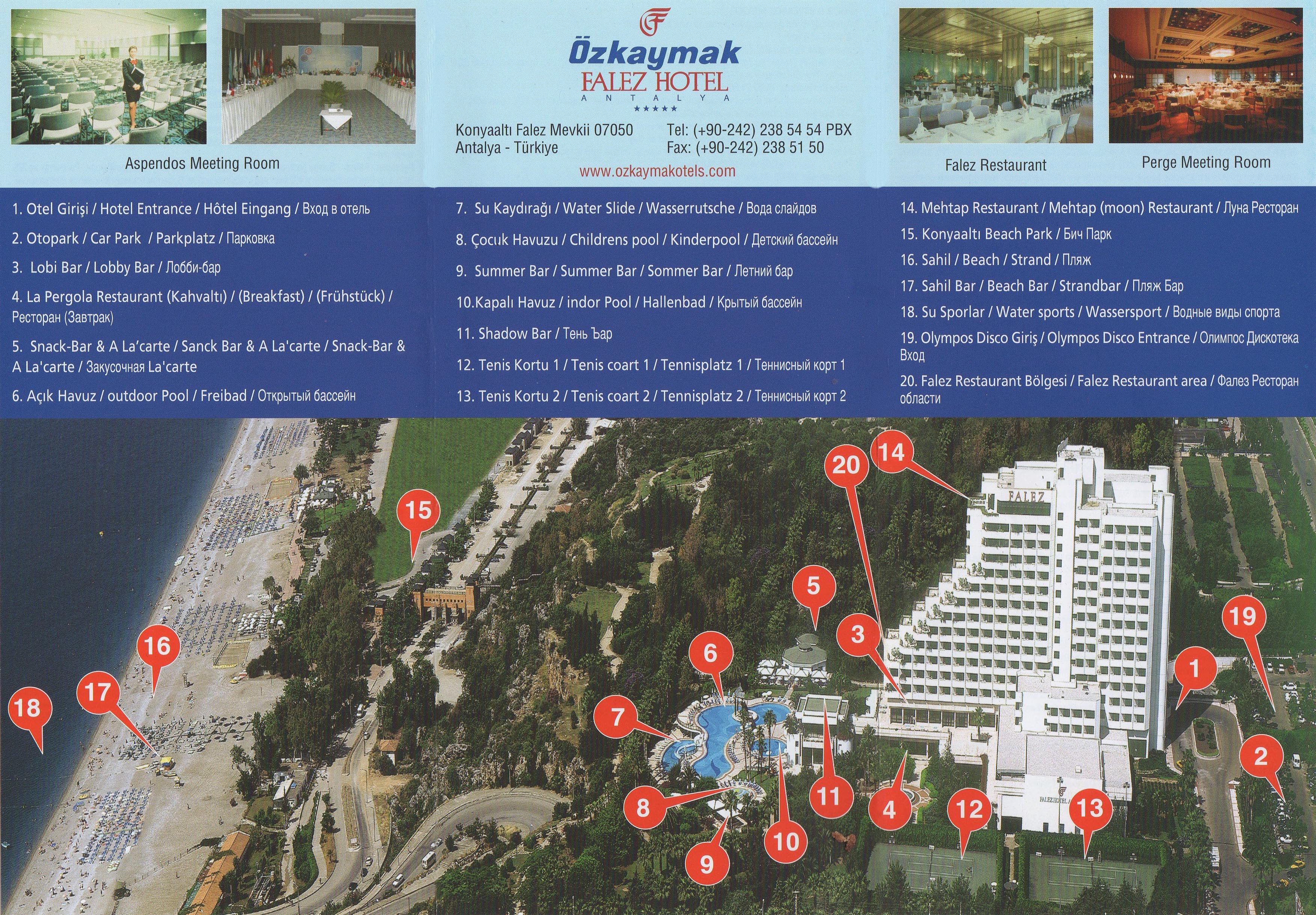
Lots of readers flagged the right building but named the wrong hotel (the Ozkaymak Falez), and this former winner explains why:

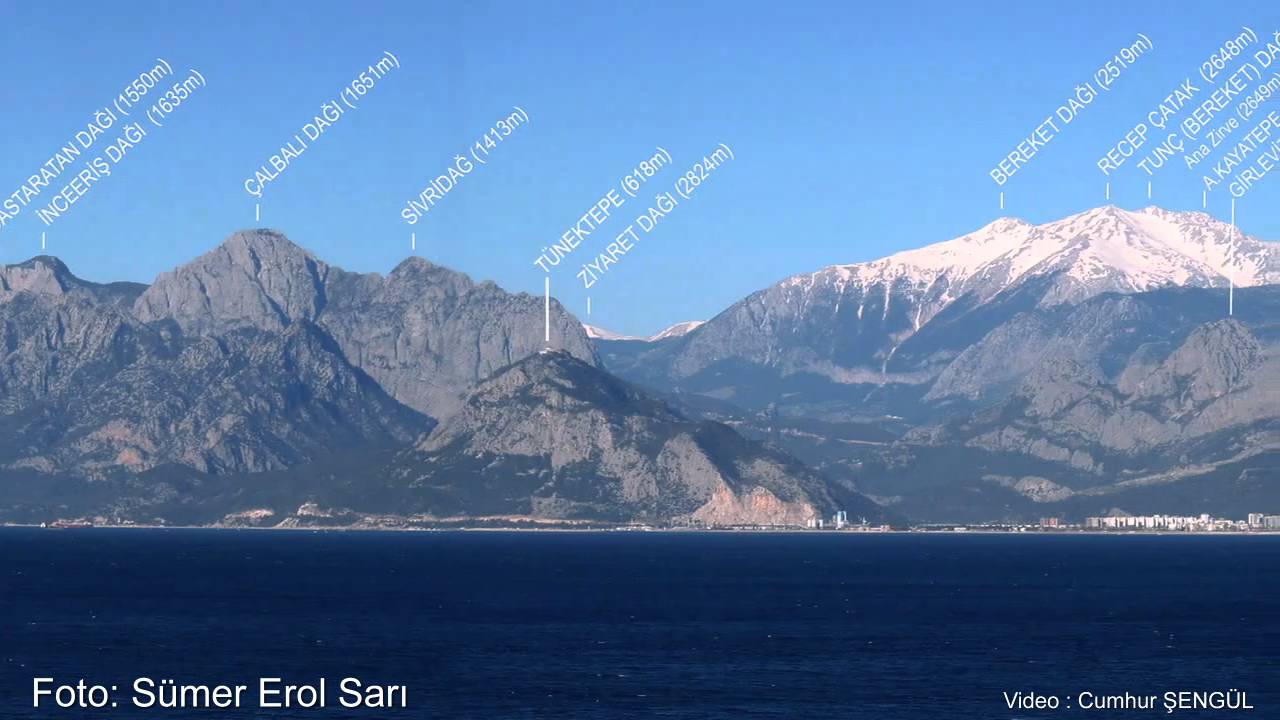
Much easier this week.  The contest picture contained so many clues that Turkey’s southern coast became the only place to search.  Antalya, Turkey popped up right away with this beautiful image.  Once in Antalya, the position of the beach, the McDonald’s and the hills of the Beydağları Coastal National Park to Antalya’s west led to a particular hotel.  Google Maps incorrectly identifies the hotel as the Ozkaymak Falez Hotel, a rundown establishment popular with both male and female Russian tourists and garners scathing reviews on TripAdvisor.  Luckily for the person that submitted the contest picture, he or she stated next door to the Falez Hotel at the Rixos Downtown Antalya (a former Sheraton).

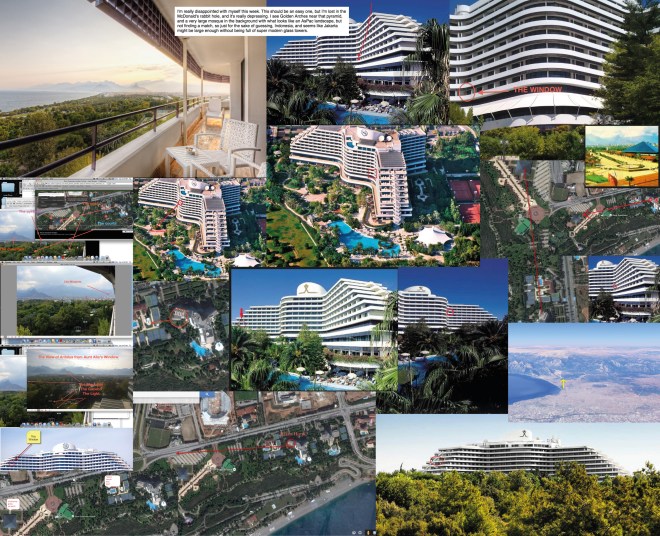
As for the window, massive hotels are always difficult.  The window is on the hotel’s west side on a fairly low floor.  Because the tennis court lights are visible but the trees block us from seeing the courts’ surface, I’ll guess the 5th floor.  The hotel contains a few curves on its west side.  Because the hanging lattice shows the building curves right where the contest window is positioned and because the balcony railing goes only a short distance before curving away to the north, I’m guessing that the contest window is in a room right at the southernmost curve on the hotel’s west side.  My window guess is highlighted:
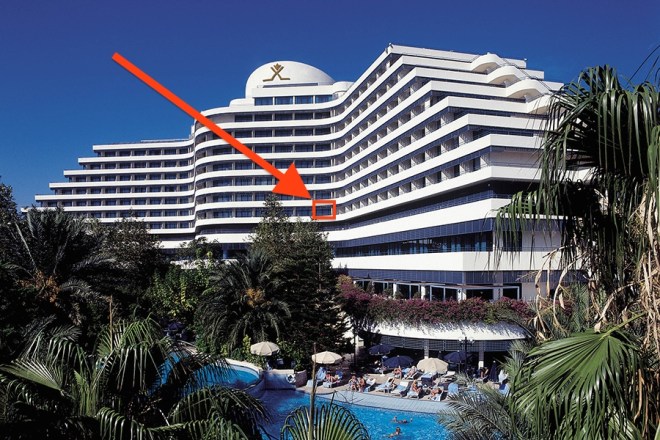
hotel view with label

Another veteran took a different route:

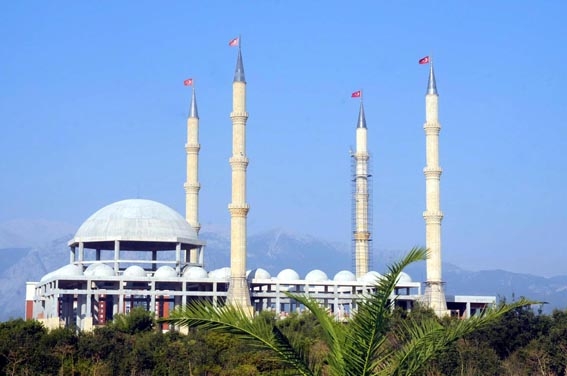
A tricky contest. The clue that eventually gives the country away could also get you bogged down. The mosque at the right end of the picture tells you that this is (probably) an Islamic country; but another photo of that same mosque is nowhere to be found. After a fruitless (and very boring) search, you give up and begin simply looking for a city at the foot of a mountain range; since those minarets have their closest counterparts in Turkey, this is the country to start with (well, actually I started with Indonesia and Malaysia: all those palms got me a little off track). And in fact, this week’s picture was taken from the Rixos Downtown Hotel (Sakıp Sabancı Boulevard, Konyaaltı Beach) in Antalya, Turkey. As for the mysterious mosque, it belongs to the Faculty of Theology of the nearby Akdeniz University. There are not many photos of the mosque because it isn’t there yet  at least not entirely  it’s still in construction:

mosque

For you new players out there, this is how it’s done:

Good thing there was a McDonalds in the picture.  That was the big giveaway.

 image003

My first thought was “Great. Deciduous, conifer AND palm trees.”  But the tall, dark, narrow conifers appeared to be Mediterranean Cypress, so that narrowed the search area. Then there was the mosque in the far right background.  That narrowed it further. Of course, it was the “Cam Piramit”, that determined the correct city. This picture shows another view of the Can Pirimit with that uniquely shaped hill behind it:
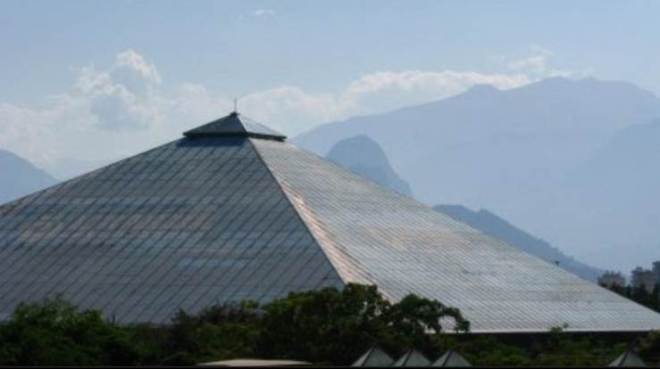
image002

Flying video tour of the Cam Piramit here, complete with resounding music:

[youtube https://www.youtube.com/watch?v=ZPRXvg1rRsU]

The picture you posted was taken from what is now the Rixos Downtown Antalya but used to be the Sheraton Voyager Hotel. Here is another picture from that hotel, but one taken from before the trees grew up to mask the tennis courts of the “Antalya Tenis İhtisas ve Spor Kulübü” next door. The picture also clearly shows the yellow ball topped sculpture:
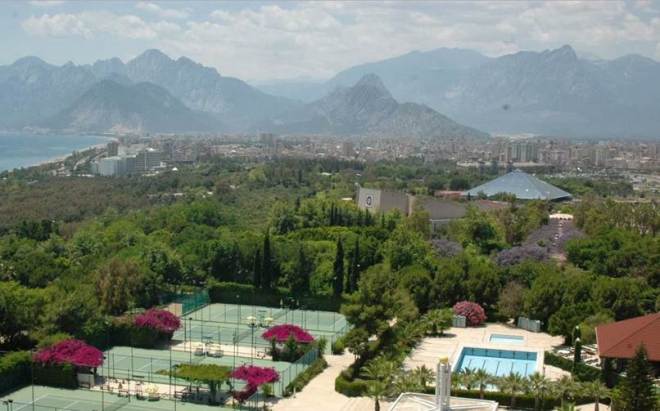
image005

OK.  So correct building.  What about the window? It is on an inside curve, so my best guess as to which window is this one.  At least I’m closer that I was last week in Morocco:
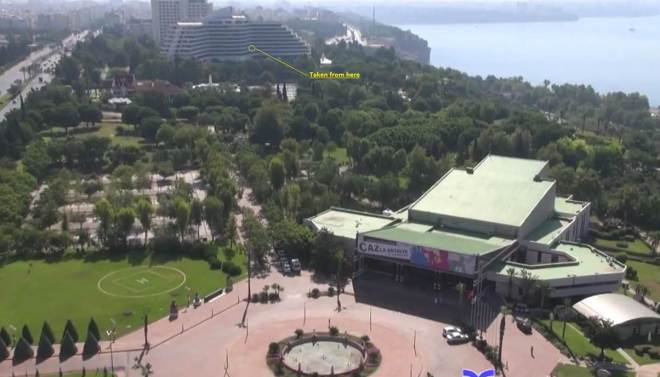
image008

Another reader laments the changes the city has undergone:

I am not going to look for the exact hotel room, because this gets depressing. Many of your readers share wonderful memories of those hotels from where the picture comes. I have not been to the hotel, but the contest does bring up memories of the location. Growing up as an expat in Istanbul, I have been on vacation on those beaches west of Antalya in the late seventies. There was a little country road running parallel to the beach, towards Kemer, and there were a few primitive campgrounds tucked away under the pine trees, where you’d set up the tent in the sand (or you didn’t, because it wouldn’t rain anyway), and a crazy guy called Arap Mustafa would cook wonderful village food for dinner, on a gas stove set up on a concrete slab under a makeshift roof. Sandy beach, crystal-clear clean water, pine trees. Nothing else.

Seeing how today the entire stretch of beach between old Antalya and the mountains, a good 10 km, is occupied by urban sprawl, unregulated industry, freeways, ugly cheap hotels, and ugly expensive hotels, I want to cry. Or puke. There are many places in Turkey I want to go back to. But Antalya I am not going to visit before the next massive earthquake or tsunami.

It is one of the most egregious instances, where one of the most beautiful regions of one of the most beautiful countries in the world has been mindlessly sacrificed to global tourism. And, of course, the push to open the next pristine beaches or nature preserves for tourism development continues full throttle, so that the buddies of the Erdoğan administration can make more money.

Apologies to the reader who is probably enjoying their vacation there. I hope you had a great time. But to me, it was a reminder how deeply ambivalent modern tourism is in third- and second-world countries.

Another master class:

I was pleased to see minarets on the left side of the photograph as they are among my favorite architectural elements. The style was reminiscent of those in Istanbul and other major cities of Turkey and the vegetation was also consistent with landscaped sections of these cities. None, however, had the distinct and dramatic mountains of the contest photograph. Eventually I found them in a photograph of Antalya. Once there, the hotel, its ample grounds, the tennis courts, swimming pool, and the glass pyramid in the contest view were fairly obvious.

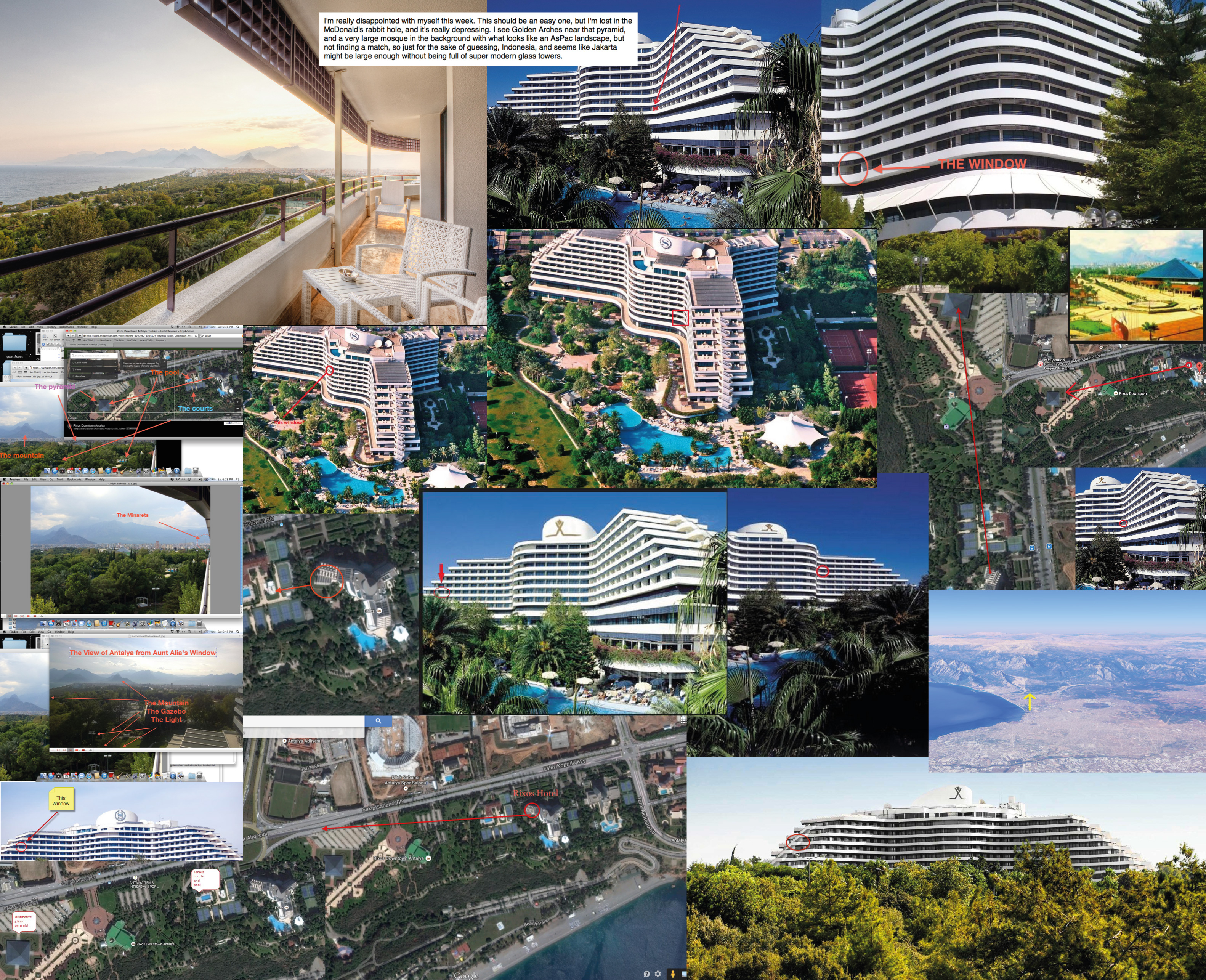
vfyw_HMcollage_12-13-2014 copy

The photograph was taken from a balcony where a major turn occurs in the hotel’s curving exterior. This change in angle is clear in the railing and sun shade alignments in the foreground of the contest photograph. The line-of-sight along the balcony railing appears to extend along this entire section of the hotel’s façade, including railings for five or six rooms, until the railing turns out-of-sight around the next bend. This is the only location I could find that explains these bends while also avoiding views of other sections of the hotel’s façade (see illustration). The floor chosen was based roughly on the height of the trees seen in the contest photograph and their relative heights in photographs of the grounds.

Chini reminds us:

It’s been two years since we last visited this country in VFYWC #126, a contest which I remember only because it was the same weekend Hurricane Sandy arrived. This one takes place under far less hellish circumstances and, given the wealth of clues, I suspect someone is gonna have to nail the right room number to win their VFYW book.

VFYW Antalya Bird's Eye Reverse Marked - Copy

This week’s view comes from the Rixos Downtown Hotel in Antalya, Turkey. The picture was taken on roughly the fourth floor (room #443, perhaps?) and looks west-south-west along a heading of 257.85 degrees.

Wow that’s a close guess, as this week’s photographer explains:

It is from the Rixos Hotel, Room 445, Sakip Sabanci Bulvari, Konyaalti Sahili, in Antalya,  Turkey.  We had a great time there.  There was a film festival happening when we were there at the pyramid-shaped building seen in the photo.

This week’s winner got pretty close too:

I must say, I thought this week’s contest was going to be hard, but all the clues, as Chini says are right there: Mountains, palm trees, sports (tennis anyone or swimming?), minarets in the background, etc all point to Turkey. The pyramid building was the big fat clue and that place, the Sabanci Congress and Exhibition Center just puts everything into place.

The shot was from the Sheraton Voyager Otel hotel. Now the room, without a map, and a good photo, I’m going to guess that it’s on the 4th floor, and room 455.

In perusing the various websites (Tripadvisor, Hotels, etc.) I can’t believe how cheap the resort hotels are in Antalya are. I also found out that Antalya is ranked third behind London and Paris for international arrivals. There’s Greek, Ottoman, Byzantine and Turkish history all over this town with ruins, clock towers, etc. As of the 2010 census there are over a million people living there. Another interesting place in the world!

Well, I know I’ll lose to a better room finder than I, but just in case this week’s contest is too damn hard and I won’t enter – I want to wish everyone at the Dish a Happy Holidays – you guys often make my day. Here’s to a great 2015!

Same to you, though be advised our final contest for 2014 arrives this Saturday. Until then, here are some more of the images you submitted this week:
VFYWC-235-Guess_Collage

(Archive: Text|Gallery)