Your favourite sports commentator is back:
The Masochism Of Theater Lovers
Emma Brockes argues that Broadway is “the last bastion of a certain kind of thinking, which is: if it hurts, it must be working”:
For many of us, going to the theater is still bound by notions leftover from school that art is occurring and we’d better knuckle down and enjoy it, or else. If it’s uncomfortable, all the better, and everything is set up to encourage this mindset: making you wait outside the theatre, no matter the weather, until the last possible moment.
Even in the West End, where the seats are as small but the tickets at least cheaper [than in New York], you’re allowed to mill in the foyer long before showtime – and then marshaling you brusquely across the threshold, past the bar where you can drop $20 for a gin and tonic and on to your seat, where, getting up to let others pass, you threaten to pitch forward into oblivion, never to return. (Unless you’re in the expensive seats, where all you suffer is the indignity of a chest or knee bump with the person you’ll be listening to breath for the next two hours.) At the end of the performance, you are chucked out a side-door into an alley by the dumpster. …
The odd thing is that these conditions persist in an age when all forms of entertainment are subject to such fierce competition. As the tech expo, CES, has been demonstrating this week, the sophistication of home entertainment is such that it is a wonder any of us ever leaves the house. Even going to the movies, at $20 a shot, looks increasingly unappealing in the face of new 4S screen technology: “four times sharper than HD,” say the releases, which Netflix among others will be filming in this year and will presumably make reality look like a shabby also-ran. In such a climate, you would think theaters would make an effort to coddle their patrons, but perhaps they know something we don’t.
How Will The Recession Change Us?
McArdle wonders about the long-term psychological affects of the financial crisis:
The economy does seem to be easing back into a slightly more normal pattern of jobs and growth (at least, as long as we think that the dismal December jobs report was a fluke, rather than a harbinger of worse to come). But it still faces a big test: Can people who survived the Great Recession shed the fear they acquired during those wretched years? The people who survived the Great Depression, particularly its early years, bore permanent scars. There were labor market scars – then, as now, being out of work for a long time was not good for your long-term earnings prospects. And there were psychological scars. My grandfather used to hide money in the house in case the banks closed, to the point where my grandmother found $10,000 stashed in a teapot she was about to donate to the church jumble sale. (Thank heavens she decided to clean it first!) U.S. household savings rates began to decline just as the last children of the Great Depression began to retire and let the baby boomers take over, and while a lot of factors contributed to that, struggling through the Great Depression may have made those generations more conservative in their financial habits.
A recent study suggests that growing up in a recession has a lasting effect on young people’s belief in a just world:
It turns out that a severe regional recession strikingly alters the attitudes and beliefs of individuals growing up there. Recessions do alter perceptions, especially of people between the ages of 18 and 25. Recession-influenced respondents expressed a stronger preference for government redistribution and tended to believe that success in life was more a matter of luck than hard work; as a result they are also more likely to vote for a Democratic president. Four points are worth noting:
- First, the effects of a severe recession experienced are large when the individual is between the ages of 18 and 25 – the so-called formative age – during which social psychologists think most of social beliefs are formed; the effects are not so strong when the recession is experienced later in life.
- Second, these effects are permanent because attitudes of recession-stricken individuals remain significantly altered many years after the severe recession ends.
- Third, we control for individuals’ endowments such as income, level of education, and ownership of a house that could also have an impact on beliefs. We thus measure the direct effect of a recession on beliefs; this effect could be even bigger if we added also the indirect effect through the personal endowments, which are also affected by a recession.
- Fourth, our estimation represents a lower bound of the effect of a recession on beliefs because our identification strategy relies only on regional shocks implicitly ignoring the effects of nationwide recessions.
That same pattern is found in an analysis of the World Value Survey, which includes data from 37 countries. When we worked with this larger sample of countries, we also found that coming of age in a lousy economic environment breeds the belief that success in life depends more on luck than effort, which in turn leads to more support for social welfare policies.
The Art Of Protest

In an interview with Der Spiegel, Ai Weiwei discusses self-surveillance and the possibilities of the Internet:
Ai: When I counted that [the Chinese government] had installed 15 cameras around my house, I decided to install four further cameras inside my home – one in my bedroom, one at my desk and so on. I thought: If you want to know everything about me, then I’ll broadcast and show everything to you. Then I went live with the webcams.
SPIEGEL: Do you consider that to be art or politics?
Ai: Both. I applied their tactics in order to push them into another more philosophical light and to wait and see what happened.
It didn’t take long for them to call and ask me to please turn off the cameras. I said: “You want to know what I’m doing. Hundreds of thousands of others want to know as well and have been following me for days.” It became a big event. They said: “Please turn off the cameras.” I asked them if it was a suggestion or an order – it turned out it was an order. Then I switched them off.
SPIEGEL: The Internet is strictly censored in China, but it is still brimming with ideas and criticism.
Ai: That’s why the Internet is the best thing that ever happened to China. It turns us into individuals and also enables us to share our perceptions and feelings. It creates a culture of individualism and exchange even though the real society doesn’t promote it. There isn’t a single Chinese university that can invite me to give a talk. Even though I know there are many students who would like to hear what I have to say.
SPIEGEL: How do these limitations affect your work?
Ai: It doesn’t really affect me because I work and live in the Internet. My virtual life has become my real life.
(Screenshot from Ai’s now-defunct overhead webcam via Wikimedia)
Is The US Too Corrupt For Single-Payer?
Ezra wonders:
The key to a single-payer system is that the government sets prices. Usually, it empowers boards of independent experts who set those prices low. [Uwe] Reinhardt’s argument is that in the United States, health industry interests have so much sway over Congress that the prices would end up being set by health-care interests.
“When you go to Taiwan or Canada,” Reinhardt said, “the kind of lobbying we have here is illegal there. You can’t pay money to influence the party the same way. Therefore the bureaucrats who run these systems are pretty much insulated from these pressures. Here you have basically a board of directors in the House Ways and Means Committee that gets money from lobbyists both at the regulatory writing stage and during normal operations. And they can call an administrator and demand they stop something from happening.”
The question in any argument like this is the counterfactual. Outside of Medicare, Medicaid and some other government-run health systems, prices are set by health-care interests now. But they’re much lower in Medicare and Medicaid than they are for private insurers. So it’s simultaneously possible for the U.S. government to be much worse at setting prices than, say, France’s government, but still be able to negotiate much lower prices than private insurers can manage. Still, Reinhardt’s argument is a reminder that the simple fact that a policy worked in another country does not mean it will work in this country.
A Whale Of A Documentary
Noah Davis notes how Blackfish, the documentary about killer whales at SeaWorld that was just snubbed for an Oscar nomination, took almost a year after its premiere at last year’s Sundance festival to go from obscurity to enormous popularity:
On one hand, it’s amazing it took Blackfish this long to explode given that it’s a well-done film about animal cruelty, a subject Americans jump all over. On the other, it makes you realize how many steps it takes to break through the noise. Consider the path:
Sundance to theaters to cable to Netflix, a chain 12 months in the making. And it’s not as though the film was ignored at each step. Blackfish garnered positive press everywhere it played, landing write-ups in major newspapers and on websites. There was an easy, relatable narrative, one that people would feel good (or self-righteous) about telling their friends. Blackfish is sharable, not in a LOL Cats way but in a “look at how caring/socially conscious I am” and “in a people really like animals” way. It’s the type of thing people put on their Facebook pages or share on their Twitter feeds. And still, it took a year to spread.
I think the bigger point here is that the thing “everybody’s talking about” isn’t really being talked about by everybody. It’s being talked about by people you know. I’m guilty of this, too. I only watched it because a close friend recommended it to me. Before I started researching this piece, I assumed it came out of nowhere. I had no idea it was shown on CNN, much less played at Sundance. It wasn’t on my radar, and then it was, and then it was everywhere. The Blackfish phenomenon continues to grow, and it’s having at least some tangential effect. SeaWorld’s stock has dropped almost nine percent since July 19 and more than six percent in the last month.
Update from a reader:
It was with great disappointment that I saw that Blackfish lost out on a well-deserved nomination. I work in the wildlife tour industry (the film ends with a trip on a boat similar to ours!) located in the Salish Sea. What Sea World does to the orcas is a crime against nature. The film accurately exposes this and needs to be seen. Whether it should win or not is another question. (The film on the Indonesian mass killers, The Act of Killing, is the most compelling and original piece of filmmaking I have ever watched.)
Another notes that “Seaworld stock soared with the news of Oscar snub”:
Shares of SeaWorld Entertainment surged 8.39 percent on Thursday to close at $33.59 a share, the stock’s highest level since August. On a day with little news about SeaWorld, based in Orlando, Fla., it’s not a stretch to suggest that the Oscar snub was fueling the stock’s rise.
Email Of The Day
Every now and then, one comes along that seems to capture it all:
It is with a lot of thought that I am renewing my subscription to The Dish this year. There are a lot of pros for me – I support you going independent and trying to figure out a sustainable way to “do” new media. I adore the way The Dish presents all sides of the issues, by linking to a variety of sources. And I know that I will find thoughtful, smart links on all sorts of things that I never would have known about. I am going to see The Inexplicable Dina Martina for the fourth time next week and I never would have known about her but for you. THANKS!!
But there are also cons. The main one being, well, YOU. The fact is you are kind of a blowhard. And a drama queen. Plus, also, you’re wrong. A LOT. Sometimes I wonder why I keep reading someone with such knee-jerk initial reactions (to insane wars, to mildly flubbed debates, to brain dead women being propped up by the state in order to fulfill some religious freaks’ rules). And don’t get me started on your devotion to your god. I never, EVER read the dish on Sundays – I’d rather burn in hell. And, yes, I know, you generally DO come around to the sane, humane way of thinking about things. You apologize, you re-think, you humble yourself. But your first reaction is just such a big pose to act like you know everything. I’m not asking you to stop – it’s obvious you can’t – but just know that a lot of people won’t, and don’t, give you the second and third chance to get it right.
All I can say is if you were a cat person, I’d be outta here.
RIP Dusty.
How Profitable Is Legal Pot?

It’s less lucrative that you might expect:
Generally speaking, investors are interested in checking out a company’s gross profit margin, which is the ratio of its revenue minus cost of goods to its overall revenue. A high gross profit margin suggests the company could be highly profitable as it scales up its production. Over a six-month period, Brandon’s dispensary had an average gross profit margin of 32 percent. That’s not terrible—most grocery stores have gross profit margins around 20 percent—but it’s not great either, and not at all the financial bonanza many people make the legal marijuana business out to be. Starbucks, another company that deals in mind-altering, plant-based substances, regularly has gross profit margins of 57 percent, nearly twice that of Brandon’s dispensary.
When we shared a redacted version of Brandon’s financials with Alexander Ooms, managing partner at ClearCreek Partners, a Denver financial advisory firm, he was circumspect, to say the least. “Since I help companies raise capital, my thought here is, ‘Wow, it’s going to be really hard for any marijuana business to raise institutional equity,’ ” he says. “Can retail marijuana be a solid business? Clearly, yes. Can it be highly profitable? Not sure.”
Meanwhile, Harrison Jacobs looks at how legal weed threatens Washington’s medical marijuana system:
Medical marijuana’s lack of oversight was a prime reason so many voters with no stake in the marijuana debate voted to legalize recreational weed. Under I-502, the Washington Liquor Control Board authorizes licenses for businesses, enforces regulations and collects 25% excise taxes at three separate points: when the producer sells to the processor, when the processor sells to the retailer, and when the retailer sells to the customer.
Tack on state sales taxes and you are looking at nearly a 40% tax rate for recreational marijuana. A regulated, heavily taxed system had voters, politicians, and even potential marijuana investors with dollar signs in their eyes. Medical marijuana, on the other hand, is subject to only the state’s regular sales tax rate, which is just 6.5%.
It’s now clear that it doesn’t make sense to maintain Washington’s loosely medical marijuana business alongside the new, highly taxed recreational system. If people can obtain legal high-quality marijuana at a far cheaper price, users will likely attempt to go to the medical marijuana stores. That could be a lot of lost revenue for Washington state and provide ammunition for legalization’s opponents to call the experiment a bust.
Sullum also covers the issue:
Last summer Mark Kleiman, the UCLA drug policy expert who has advised Washington state’s marijuana regulators, told me “the legal market is going to have a hard time competing with the illegal market, but a particularly hard time competing with the untaxed, unregulated sort-of-legal market.” He was referring to the hundreds of medical marijuana suppliers in Washington, which are not licensed by the state but operate under creative interpretations of a provision allowing patients to create “collective gardens.” Yesterday the state House of Representatives took up the question of how to deal with these competitors. The leading proposal, reflected in a bill considered by the House Health and Wellness Committee, is to ban them. …
What works for patients … does not necessarily work for the state, which wants to maximize tax revenue and head off federal intervention by creating a tightly regulated system aimed at preventing diversion to minors and other states. Although the backers of I-502, Washington’s legalization initiative, assured skeptics that the measure would not change the rules for medical marijuana, it was pretty much inevitable that legislators would once they absorbed the fiscal and political realities created by the new distribution system.
(Photo: Tyler Williams of Blanchester, Ohio selects marijuana strains to purchase at the 3-D Denver Discrete Dispensary in Denver, Colorado. By Theo Stroomer/Getty Images)
Taking An Interest In National Interest
Beinart liked Rand Paul’s foreign policy speech:
Paul approvingly quoted the diplomat and scholar George Kennan as distinguishing “between vital and peripheral interests.” That may not seem significant, but it is. For most of American history, U.S. foreign policymakers had a rough idea of which chunks of the globe really mattered to American security. They started with the Monroe Doctrine, the belief that no foreign power should make the Americas a base for operations against the United States. In the 20th century that expanded to include the belief that no single power should be allowed to dominate Western Europe or East Asia, since that power might then threaten American access to key overseas markets. That principle was finally extended to the Middle East on the theory that no adversary should be allowed to threaten America’s access to oil. …
When the Cold War ended, however, the idea of a foreign power dominating Western Europe or East Asia, or creating a beachhead in the Western Hemisphere, suddenly seemed fanciful.
As a result, the language of national interest largely disappeared. It has been replaced by a discussion of foreign “threats” and American “values.” But without a definition of interests, it’s impossible to define what constitutes a threat. And without a definition of interests, supporting American “values” is a limitless pursuit. Americans will never reach a consensus on where exactly our interests lie, but just reintroducing the concept suggests an overdue recognition that because America’s power is finite, its interests must be too. Which is what Paul did on Tuesday night.
Larison responds:
[T]he problem of the last twenty years isn’t that American politicians and policymakers have ceased referring to national interest, but that many of them tend to treat even relatively minor foreign disputes and conflicts as things that threaten “our vital interests” and some go beyond that to pretend that “our vital interests” are at stake wherever our “values” are coming under attack. It isn’t enough to “reintroduce” the phrase national interest to the debate. It is essential that it be defined in a much less expansive, bloated way than it has been for the last twenty years, or else it will continue to be used to justify endless meddling all around the world.
Chart Of The Day
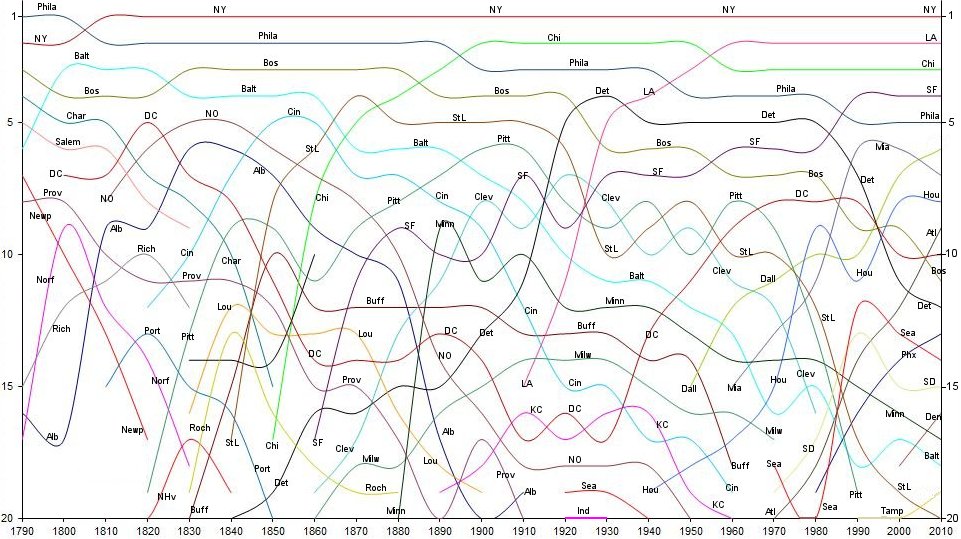
The rankings of the top 20 metro areas in the US over the past 200 years (click to enlarge):
Cillizza comments:
Starting in the early 19th century, New York City has been number one and never given up that pole position. (It’s the Kentucky hoops recruiting class of big city populations.) Philadelphia, too, has been relatively consistent population-wise over the centuries — starting at number one in 1790 and standing at number five in 2010. Los Angeles, which only entered the top 20 metros in 1910, is now the second largest. Chicago — President Obama’s hometown — has risen from the mid-teens in late 1800s all the way to number three in 2010. …
Even more intriguing are the metros that have tumbled significantly over the decades.
Follow Detroit’s rise and fall and you follow the rise and fall of the manufacturing industry in America. The Motor City broke into the top 20 in 1840 and within 100 years was one of the five largest metro areas in the country. The last three decades have seen a population free fall in Detroit, however, all the way to the number 12 in 2010. St. Louis is now barely on the list after peaking at the fourth most populous metro area in the late 1800s. Baltimore has fallen from top five to barely top twenty.
He also looks at how current trends could change the electoral map:
In short, the demographic changes that began in the 1980s — population losses in the Northeast and Midwest, population gains in the South, Southwest and Plains — will only accelerate over the next few decades. … Republicans are right then to note that the states that will grow population-wise over the next five decades are in places where they have traditionally done well at the presidential level. But, the areas of growth within those states tend to be in places and groups where Republicans have struggled in recent elections. And, even if the 2060 map were in place in 2012, Romney still loses the election by a wide margin.


