Democrats For War With Iran, Ctd

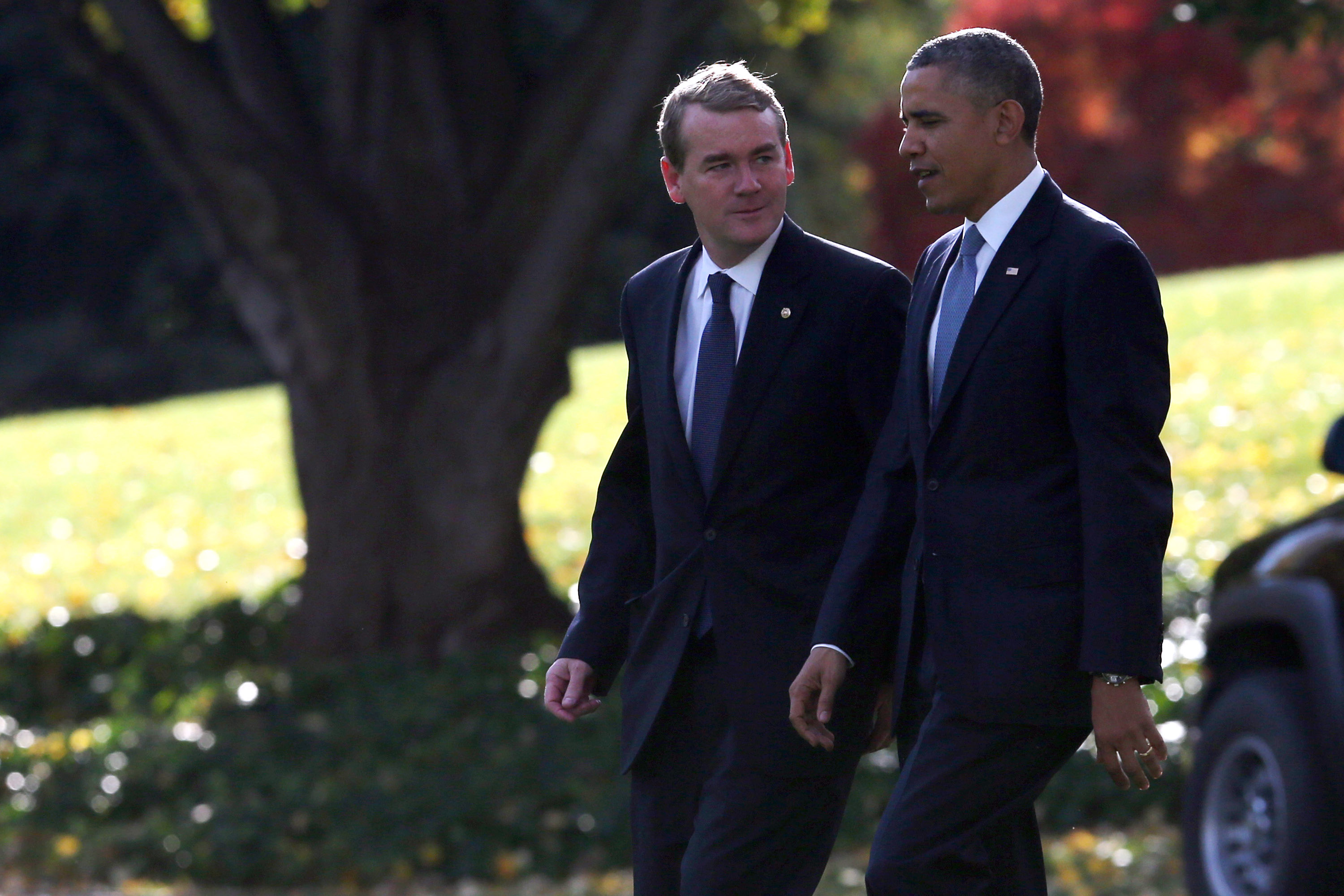
President Obama Departs The White House

Fallows weighs in. Read it. This truly is a critical moment for the US after 9/11. It’s one reason we elected Obama twice. And yet his own party is now trying to sabotage it, when the possibility of a breakthrough – agreed to by all the major powers – is real and as yet not fully tested. Money quote:

Republicans led by Mitch McConnell are pushing for a sanctions bill that is universally recognized (except by its sponsors) as a poison-pill for the current negotiations. Fine; opposing the administration is the GOP’s default position.

But a striking number of Democrats have joined them, for no evident reason other than AIPAC’s whole-hearted, priority-one support for the sanctions bill. The screen clip below is from AIPAC’s site, and here is some political reporting on AIPAC’s role in the sanctions push: NYT, Politico, JTA, Jerusalem Post-JTA, and our own National Journal here and here. Also see Greg Sargent in the Washington Post.

Fallows has a quote from the AIPAC website, the main lobbying group for war. It’s worth reading as well. Fournier, no Obama fan, also gives a great money quote here:

Obama dithered and stumbled on Syria, but his instincts were right: Avoid bloodshed if at all possible. He is acting prudently on Iran. He is the commander in chief, and you’d expect fellow Democrats to give him the benefit of the doubt. Is the Democratic opposition to Obama based on the merits or born of political calculation? If it’s the former, wayward Democrats had better be right, because the stakes are high. If it’s the latter, shame on them and their “antiwar” party.

Amen. None of these Democratic Senators are prepared to give the president the lee-way to try to avoid another disastrous and unwinnable war in the Middle East. Their sanctions bill would kill the only alternative to the war AIPAC wants. Democrats in New York and New Jersey should let Schumer and Menendez and Booker know that sabotaging their own president and the only potential for peace is inexcusable. That goes for Michael Bennet’s inexplicable betrayal as well.

(Photo: U.S. President Barack Obama walks with Sen. Michael Bennet toward Marine One to depart the White House November 6, 2013 in Washington, DC. By Mark Wilson/Getty Images.)

Chart Of The Day

Climate Pie Chart

James Powell updates his chart on global warming research:

I have brought my previous study (see here and here) up-to-date by reviewing peer-reviewed articles in scientific journals over the period from Nov. 12, 2012 through December 31, 2013. I found 2,258 articles, written by a total of 9,136 authors. (Download the chart above here.) Only one article, by a single author in the Herald of the Russian Academy of Sciences, rejected man-made global warming. I discuss that article here.

Holly Richmond passed along the chart:

[I]f a year-long sample isn’t good enough for you, Powell previously examined 21 years of peer-reviewed literature and found that only 24 out of 13,950 articles — or two-tenths of a percent — came out and rejected human-caused climate change.

The fact that one major political party in the US rejects outright this massive preponderance of scientific research is now so familiar to us that we forget just how obscene it is. It is not a position or an argument. It is a transparent lie in defense of short-term material interest against the long-term interests of everyone. There can and should be plenty of debate about what to do about human-caused climate change; but there should simply be no serious debate about its causes. It’s impossible to take the GOP seriously until they recant their knownothingness on this subject. At this point, it is simply an affront to reason.

Paying The Jobless To Look For Work

Why cutting off benefits is a bad idea:

Recipients of unemployment benefits are required to actively search for work. With few job openings around, losing that requirement takes away the only reason many unemployed Americans kept searching. A study by economists Henry Farber and Robert Valletta found that unemployment insurance has little effect on people’s readiness to take a job, but it has a big one on people’s decision to keep searching for work. The view that desperation will force the unemployed to get a job, which seems to drive Republican opposition to extending federal benefits, just isn’t supported by the data. And that’s leaving aside the moral problems with starvation as a policy strategy.

“No Discernible Impact”

Terrorism Cases

A New America Foundation study calls into question the government’s claims about the NSA’s metadata dragnet:

Surveillance of American phone metadata has had no discernible impact on preventing acts of terrorism and only the most marginal of impacts on preventing terrorist-related activity, such as fundraising for a terrorist group. Furthermore, our examination of the role of the database of U.S. citizens’ telephone metadata in the single plot the government uses to justify the importance of the program – that of Basaaly Moalin, a San Diego cabdriver who in 2007 and 2008 provided $8,500 to al-Shabaab, al-Qaeda’s affiliate in Somalia – calls into question the necessity of the Section 215 bulk collection program.

According to the government, the database of American phone metadata allows intelligence authorities to quickly circumvent the traditional burden of proof associated with criminal warrants, thus allowing them to “connect the dots” faster and prevent future 9/11-scale attacks. Yet in the Moalin case, after using the NSA’s phone database to link a number in Somalia to Moalin, the FBI waited two months to begin an investigation and wiretap his phone. Although it’s unclear why there was a delay between the NSA tip and the FBI wiretapping, court documents show there was a two-month period in which the FBI was not monitoring Moalin’s calls, despite official statements that the bureau had Moalin’s phone number and had identified him. This undercuts the government’s theory that the database of Americans’ telephone metadata is necessary to expedite the investigative process, since it clearly didn’t expedite the process in the single case the government uses to extol its virtues.

Meghan Neal is unsurprised:

This is hardly the first time experts have searched for a link between bulk metadata collection and foiled terrorist plots and come up empty-handed. So far, the only real value in collecting and monitoring billions of US phone records has been to provide extra support in investigations already underway by the FBI or another agency, or to verify that a rumored threat isn’t real (the “peace of mind” metric), the report found. But that hasn’t stopped NSA officials and the Obama administration from drumming up a connection between terrorist attacks and surveillance to defend the agency’s snooping.

Morrissey examines the pie chart seen above and asks if the program is worth it:

What has been the most effective method? Of those explicitly stated, it’s “if you see something, say something.” Community and family tips accounted for 17.8% of the origins of investigations, followed closely by 16% started by other informants. However, 27.6% are categorized as “unclear” — the largest single category, which makes the analysis much less reliable,  and might raise questions about how the NSA got those FISA warrants. Still, there were four cases unearthed through Section 215 (and possibly more in the “unclear” category). Is that enough to justify the program as a necessary evil to prevent worse evil from prevailing?

Zack Beauchamp thinks not:

NSA metadata collection isn’t totally useless; it’s just not very useful. When you start to look at the specific cases that metadata surveillance played a key role in, the picture gets grimmer for the NSA. The New America researchers found that metadata searches never led to an arrest that actually prevented a terrorist attack. Take, for instance, the arrest of Basaaly Moalin — the only case, according to NSA Director Keith Alexander’s sworn testimony, metadata surveillance may have sparked an investigation that stopped “terrorist activity.” All the government found on Moalin was $8,500 donated to Somali terrorist group al-Shabaab; “the case involved no attack plot anywhere in the world,” according to New America’s review. In almost all of the cases profiled by New America, metadata surveillance played a supporting role, unnecessarily displaced traditional investigative methods, or failed to uncover a serious plot.

Digby reminds us that for all it doesn’t do, this data program costs an awful lot of money:

And keep in mind this whole thing is happening in the context of an ongoing, long term austerity push that has us cutting off the long term unemployed and ending food stamp benefits. That Utah data farm alone cost 1.2 billion and is reportedly going to cost at least a couple billion more before it’s online. There was a moment in the early days of the NSA story in which we discussed the incredible boondoggle all this really was but it passed as the revelations unfolded. It’s good that the congress has decided to shine a light on that again, however briefly, in this budget process. After all, we have real people suffering in a stuck economy without enough jobs. We have a growing poverty rate. Our bridges and schools are crumbling. And yet the money for the military, police and all these attendant “intelligence” agencies has been kept secret until now. It’s only right that the people should at least know what the numbers really are.

Putting The “Why” In History

Eric Foner argues for a more analytical approach to history in high school:

I’m strongly in favor of students knowing the facts of history, not just memorizing or having it drilled into their heads. I’m certainly against this testing mania that’s going on now where you can judge whether someone really understands history by their performance on a multiple-choice test. Knowledge of the events of history is important, obviously, but also I think what I see in college students, that seems to be lacking at least when they come into college, is writing experience. In other words, being able to write that little essay with an argument. I see that they think, “OK, there are the facts of history and that’s it—what more is there to be said?” But of course, the very selection of what is a fact, or what is important as a fact, is itself based on an interpretation. You can’t just separate fact and interpretation quite as simply as many people seem to think.

Are Younger Evangelicals Shifting On Israel?

McKay Coppins has a superb piece on an increasing sense among a new generation that the past fusion of evangelicals and neo-conservative views on Israel is too lop-sided. One key factor? Palestinian Christians, and their plight. And it’s not only a lefty fringe:

Organizations like the Telos Group and the large Christian nonprofit World Vision have joined a small army of ministers and Christian opinion-makers working to reorient Evangelicals’ stance on the Israeli-Palestinian conflict — producing documentaries about the plight of Palestinian Christians, providing theological rationale for a more “balanced” view of the issue, and taking Evangelicals on trips to the Middle East … One of the evangelical leaders calling for a more “nuanced” view of the conflict is Todd Deatherage, who spent five years in the Bush State Department before co-founding the Telos Group to expose Evangelicals to the complexities of the issue. He said their purpose is not to persuade Christians to turn against Israel, but rather “to affirm and support the dignity of all the people of the Holy Land, to be truly pro-Israel and pro-Palestinian at the same time.”

That’s exactly the point: pro-Israel and pro-Palestinian at the same time. In my view, all US foreign policy should be framed around that rubric, and the knee-jerk, Dispensationalist End-Times rhetoric that is routinely used to crush any even-handedness needs to be supplemented by a less Christianist politics and more Christian temperament. Peace will never come through immiserating and stigmatizing one side of this tragic conflict – and defending it automatically by religious fiat. We need nuance and moderation. And given the coalition that still operates to provide Israel with a carte blanche at US expense, a shift among evangelicals may be far more important than any signs of flexibility among American Jews.

“Fuck You,” Explained The Israeli Defense Minister

How else to describe this unvarnished attack on any idea of a two-state solution from Moshe Ya’alon, Israel’s defense minister:

Abu Mazen (Palestinian President Mahmoud Abbas) is alive and well thanks to us. The moment we leave Judea and Samaria (the West Bank) he is finished. In reality, there have been no negotiations between us and the Palestinians for all these months – but rather between us and the Americans. The only thing that can ‘save us’ is for John Kerry to win a Nobel Prize and leave us in peace … The American security plan presented to us is not worth the paper it’s written on. It contains no peace and no security. Only our continued presence in Judea and Samaria and the River Jordan will ensure that Ben-Gurion Airport and Netanya don’t become targets for rockets from every direction. American Secretary of State John Kerry, who turned up here determined and acting out of misplaced obsession and messianic fervor, cannot teach me anything about the conflict with the Palestinians.

I’m not sure this kind of contemptuous language is even used by America’s enemies, let alone its allies. Which is why an apology has been offered by Netanyahu. But it’s a reality check, of sorts. The Israelis are never going to give up an inch of the West Bank, let alone a viable Palestinian state. They are allies of the US only in so far as the US asks nothing in return, which is no real alliance. I admire the president for trying to coax these fanatics into some kind of peace agreement. But this contempt for the United States’ pursuit of peace is as dismaying as it is disgusting.

Google Is Inside The House

Brian Ries sees Google’s $3.2 billion acquisition of the smart-home tech company Nest as part of a push for total data dominance:

No longer satisfied crunching data gleaned from the lives we lead on computers and smartphones, Google will soon have a hand in data that maps the patterns of our lives in our homes. Our home-data. Smart-thermostats will lead to smart-sinks. Smart-sinks will leak into smart-refrigerators. Smart-refrigerators to smart-stoves. Smart-stoves to smart-beds (already a thing). And so on. … The company, it can be surmised, could soon know the hours we sleep. The time we wake up. The amount of water we used when we bathe.

Madrigal’s take:

I think it’s easier to slot in this purchase with Google’s recent push into robotics, led by the former head of Android, Andy Rubin. Nest always thought of itself as a robotics company; the robot is just hidden inside this sleek Appleish case. Look at who the company brought in as its VP of technology: Yoky Matsuoka, a roboticist and artificial intelligence expert from the University of Washington. In an interview I did with her in 2012, Matsuoka explained why that made sense. She saw Nest positioned right in a place where it could help machine and human intelligence work together: “The intersection of neuroscience and robotics is about how the human brain learns to do things and how machine learning comes in to augment that.”

Joshua Gans worries that Google’s acquisitions are stifling innovation:

Some are concerned about the data. Nest have said that it will remain private. Frankly, that is the last of my concerns. The data is something that can be used to make things work better. In any case, my bet is that Google will provide an option to opt in to share data in return for some better features down the line. As with pretty much every other case involving privacy, people will give it up in a heartbeat without much in the way of negative consequences. That was inevitable — Google or no Google — and, in fact, Google has a reputation to stabilise with this and so is surely a better place for that data to reside.

My main worry is on the innovation front. I don’t want Nest to stop. But there are precedents for that happening with Google. My favourite example is GrandCentral. In 2007, GrandCentral had done the seemingly impossible — finally worked out a sensible way for people to have a single contact number. David Pogue described it quite perfectly and enthusiastically. Soon after Google bought GrandCentral. The hope is that they would bring it to scale and move it beyond the US. In other words, do what they are promising to do for Nest. It then lay dormant for 2 years before being relaunched as Google Voice. Apart from some basic integration, not much has changed. This was a service that should have replaced all others — including Skype — and it didn’t happen. It is hard to point the finger anywhere else but Google for that.

Henry Blodget wonders why Apple didn’t snatch up Nest first:

Nest makes connected thermostats and smoke detectors. It was founded by Tony Fadell, one of the guys who designed Apple’s iPod. Nest products look like Apple products. Nest products are beloved by people who love Apple products. Nest products are sold in Apple stores. Nest, in short, looked like a perfect acquisition for Apple, which is struggling to find new product lines to expand into and has a mountain of cash rotting away on its balance sheet with which it could buy things. But Apple didn’t buy Nest. Google did. And this appears to continue a pattern in which — in the bitter head-to-head battle between Apple and Google — Google is fixing its weaknesses (hardware) much faster than Apple is fixing its own weaknesses (software and services). At first glance, in other words, it appears that Google’s aggressiveness has once again caught Apple snoozing. And now a company that looked to be a perfect future division of Apple is gone for good.

Calling A Time Out On Recess Appointments

Yesterday, SCOTUS heard oral arguments for National Labor Relations Board v. Noel Canning, the case challenging Obama’s controversial recess appointments made during an intrasession Congressional break. Lyle Denniston observes that “some of the Justices whose votes the government almost certainly needs to salvage an important presidential power were more than skeptical”:

Perhaps the most unfortunate moment for presidential authority was a comment by Justice Stephen G. Breyer that modern Senate-White House battles over nominations were a political problem, not a constitutional problem.  Senators of both parties have used the Constitution’s recess appointment provisions to their own advantage in their “political fights,” Breyer said, but noted that he could not find anything in the history of the clause that would “allow the president to overcome Senate resistance” to nominees.

Serwer analyzes the case:

The question is how big of a headache the high court wants to give the Obama administration and future presidents–from either party.

Siding with the D.C. Circuit ruling entirely would make it much harder for the government to function, especially if the opposing party controls the Senate. With the filibuster nuked for presidential appointments, the stakes are lower because nominees can be confirmed by a majority vote. But the high court could rule that the Senate gets to decide when it’s in recess, ruling that only Obama’s recess appointments, made in defiance of unprecedented Republican obstruction, are invalid.

“If the Court does not allow the traditional recess appointments, you’ll have a federal bureau created by Congress but one that Congress won’t allow the president to staff,” said Adam Winkler, a law professor at the UCLA School of Law. It would also mean the recess appointment power would be all but useless to future presidents if the opposite party controls the Senate, because they could just keep it in session virtually all the time. That could be Obama’s fate if Republicans take back the Senate in 2014.

Ilya Sharpiro weighs in:

Justice Kennedy said that he was “in search of a limiting principle” to the government’s position—so as not to simply give the president sole discretion to determine when the Senate is or isn’t in recess. Justice Kagan was left asking both sides how the Court should rule given that the presidential practice—whose history prior to the Truman administration the parties dispute—seemed to so clearly contradict the constitutional text and structure.

And indeed that is the question: If it’s true, as an overwhelming majority of the justices seemed to think, that the president was only supposed to have the power to make recess appointments during intersession recesses, and only for vacancies that arose during such recesses, what does it mean that this correct interpretation has never been followed?

Last week, Eric Posner urged the Supreme Court not to rely on originalism when deciding the case:

[C]onsider what the originalist must ignore: the huge growth of the country, and the vastly expanded federal bureaucracy that allows the national government to be much more involved in the regulation of everyday life. In 1789, the president made do with a single part-time attorney general. Today, the Justice Department employs more than 100,000 people. The founders did not anticipate the party system, and could not foresee that opportunities for conflict between the president and Senate would multiply infinitely. They surely did not foresee all the opportunities for obstruction afforded to a Senate with 100 members (compared with 26 at the founding) that often operates by consensus, or supermajority rule.’

Andrew Rudalevige thinks Obama is in the wrong:

The basic issue facing the court is what counts as a “recess” — and, along the way, whether the Senate, or the president, gets to decide whether the Senate is sitting. Here I tend to agree that the Obama administration overstepped. In its memo in January 2012, the DOJ’s Office of Legal Counsel concluded that “the President… has discretion to conclude that the Senate is unavailable to perform its advise-and-consent function and to exercise his power to make recess appointments.” But as the D.C. Circuit responded, “Allowing the President to define the scope of his own appointments power would eviscerate the Constitution’s separation of powers.”  The president was acting rationally in the face of opposition obstructionism, seeking to activate the CFPB and rescue the NLRB from quorum-less impotence. But that doesn’t mean his actions were legal.

Bernstein approves of Rudalevige’s solution:

Presidency scholar Andrew Rudalevige runs though the issues involved, and suggests the Supreme Court should opt for a middle ground: Retain the president’s traditional recess appointment power, but allow senators to prevent recess appointments by remaining in session — even if “in session” means only holding pro forma meetings. That’s not a bad outcome. The Senate should have the ability to block presidential appointments; if a Senate under divided government really wants to refuse to staff the government, that desire is probably constitutionally protected, for better or worse. Those senators who refuse the president’s requests would risk the possibility of a backlash.

Earlier this month, Victor Williams hoped that the Court will decline to rule on the issue at all:

As I argued in amicus briefs to the DC Circuit and the Supreme Court [PDF], this case presents a non-reviewable political question. Throughout our Republic’s history, the court has recognized that some questions are committed by the Constitution’s text to the exclusive discretion of the elected political branches.

Allahpundit dismisses this argument:

Per Gabe Malor, there’s a chance that the Court could decline to rule at all on grounds that this is a political question, i.e. a dispute over powers between the executive and legislature on which the Constitution provides no meaningful guidance. Let the political process sort that out, not the courts. Two problems with that in this case, though. One: The plaintiff challenging O’s recess appointments in the NLRB case isn’t the Senate, it’s a corporation. Technically, this is a case about the executive’s power to regulate private entities by making appointments to regulatory bodies through dubious procedures.

Lastly, Harsanyi argues that, contra Andrew Rosenthal, that the extremism of the GOP is no excuse for abusing executive power:

“In this particular case” is the favored argument for ignoring tradition and the law. Neither party is innocent. I noticed John Yoo making a similar rationalization in a NRO piece criticizing Obama for executive overreach (snicker if you must) on NLRB appointments: “Presidents, I think, should make broader claims of presidential power when the stakes for the nation and the office are higher than whether Boeing should be allowed to open a plant in South Carolina,” he wrote.

If only Obama had a better imagination and loftier goals! Then, misusing executive power might be worth arguing for. For Yoo, The War on Terror trumps any concern about abuse. For Rosenthal, and many liberals, it’s Republican obstinacy to Obama’s agenda that is an unprecedented roadblock that excuses overreach.