Caught In An Instant

[vimeo 83664407 w=580]

Joshua Hammer profiles the photographer and video artist Adam Magyar, who creates stunning panoramas of urban life:

In a growing body of photographic and video art done over the past decade, Magyar bends conventional representations of time and space, stretching milliseconds into minutes, freezing moments with a resolution that the naked eye could never have perceived. His art evokes such variegated sources as Albert Einstein, Zen Buddhism, even the 1960s TV series The Twilight Zone. The images – sleek silver subway cars, solemn commuters lost in private worlds – are beautiful and elegant, but also produce feelings of disquiet. “These moments I capture are meaningless, there is no story in them, and if you can catch the core, the essence of being, you capture probably everything,” Magyar says in one of the many cryptic comments about his work that reflect both their hypnotic appeal and their elusiveness. There is a sense of stepping into a different dimension, of inhabiting a space between stillness and movement, a time-warp world where the rules of physics don’t apply.

The above video is from Magyar’s Stainless series, which captures fast-moving subway trains and waiting straphangers:

Magyar shot the footage at 56 times normal speed, turning 12-second blurs into nearly 12-minute films of excruciating slowness. His commuters stand, together yet apart, with the studied, three-dimensional grace of statues – only the twitch of a lip or a finger drawn toward an iPhone indicating that these people were caught in hyper-slow motion, inhabiting an elongated moment. Magyar extracts drama from an infinitesimal flash of time. “I want to capture something that happens in milliseconds, something that you don’t even realize took place,” he told me. “I’m extending the moments – the present, the now – because as humans we live only in the past and the future. But the only existence we have is now, and that is something that we don’t even consider.”

Carrying A Child In A Borrowed Womb

Nine women in Sweden have received womb transplants:

“This is a new kind of surgery,” Dr Mats Brannstrom said in an interview from Gothenburg. “We have no textbook to look at.” Brannstrom, chair of the obstetrics and gynaecology department at the University of Gothenburg, is leading the initiative. Next month, he and colleagues will run the first-ever workshop on how to perform womb transplants and they plan to publish a scientific report on their efforts soon. He said the nine womb recipients were doing well. Many had had periods six weeks after the transplants, an early sign that the wombs were healthy and functioning. One woman had an infection in her newly received uterus and others had some minor rejection episodes, but none of the recipients or donors needed intensive care after the surgery, Brannstrom said. All left the hospital within days.

Victoria Turk explains why the procedure is controversial:

[O]ne of the stickiest points in this particular study is the element of risk undertaken by the donors, and not just the receivers, of the transplant uteruses.

Because more blood vessels have to be taken from around the womb for it to have a better chance of functioning well, it’s a riskier operation than a regular hysterectomy. The question then, is whether it’s fair to let healthy people risk such medical complications for the non-life-saving benefit of someone else? The UK doesn’t think so, but there is a way around this. In a similar project planned for the end of 2014, doctors in Britain will instead use wombs from brain-dead donors whose hearts are still beating for transplants in five women. That’s more comparable to what usually happens in organ donation situations, and is a lot less controversial than asking a healthy person to go through the donation procedure.

Ultimately, however, all the risks for both parties—donor and recipient—must be weighed against the benefit of having a womb in the first place. Because the womb transplant won’t allow the women to have children the conventional way, and only through IVF, the only real advantage it offers is the chance to carry biological pregnancies. While that might seem a pretty slim benefit in itself, the problem is that right now, that’s pretty pivotal to having children at all. We’re not yet growing babies in Matrix-like pods. Sure, there’s adoption—but our widespread acceptance of IVF suggests we understand the desire to have our own biological children, so should women without a womb not also be given the same opportunity, if it’s at all possible?

George Dvorsky is more succinct:

This is all quite amazing — and it’ll truly be a major step forward for science and personal reproductive autonomy if and when the first baby is born as a result of this procedure. At the same time, however, it does feel a bit… privileged.

Nigeria Doubles Down On Terrorizing Gays

Homosexuality has been illegal there already, but for good measure, the government just enacted a new law criminalizing gay marriage and gay rights activism:

A new law in Nigeria, dubbed the “Jail the Gays” bill, is encouraging the persecution of gays and will endanger programs fighting HIV-AIDS in the gay community, said Dorothy Aken’Ova, executive director of Nigeria’s International Center for Reproductive Health and Sexual Rights. On Monday, President Goodluck Jonathan’s office confirmed that the Nigerian leader signed the Same Sex Marriage Prohibition Act that criminalizes gay marriage, gay organizations and anyone working with or promoting them. In Bauchi state, police entrapped four gay men and tortured them into naming others, Aken’Ova said. She said the police have drawn up a list of 168 wanted gay men, of whom 38 have been arrested in recent weeks.

Shackford is especially disturbed by the new restrictions on speech:

Any person who registers, operates or participates in gay clubs, societies and organizations or directly or indirectly makes public show of same-sex amorous relationship in Nigeria commits an offence and shall each be liable on conviction to a term of 10 years in prison.

That’s some scary stuff right there. Much like Russia’s ban on “gay propaganda” making it next to impossible to legally advocate for gays having the same rights as their heterosexual counterparts, this part of the law essentially criminalizes any sort of organizational efforts to ultimately overturn the law or attempt to change public opinion so that Nigerians don’t see homosexuals as enemies.

Robyn Pennacchia urges the Obama administration to reconsider US aid to Nigeria:

If we’re not going to support Russia because of their hideous anti-gay laws, I certainly don’t think we should be engaging with Nigeria either, terrorism or no. The reason we’re giving them support is because the Christian government is in danger of being overthrown by the northern Islamic population that seeks to implement Sharia Law. Which is bad, but this, quite frankly, is not the biggest step up. While the aid provided by France and other European nations may not be enough to convince Jonathan to repeal the law, the military and economic aid from the U.S. just might. In all likelihood, they probably need us more than they need to send people to jail for being gay. If he wants to fight terrorism, he can do it with all his oil money and perhaps some of his jaunty hat money, not ours. Because, quite frankly, this is terrorism. If we fund Nigeria while this law is in effect, we are funding terrorism of LGBT citizens.

If Not Christie, Who?

Beinart eyes the GOP’s shallow bench:

There are other potential Republican contenders who share some of Christie’s strengths. Like Christie, Wisconsin Governor Scott Walker can run as a tough, capable manager who isn’t from Washington. Like Christie, Rand Paul has defied his party on key issues—for instance, NSA surveillance—and may have somewhat greater appeal to the young. But of the potential candidates right now, only Christie can run as the bipartisan to Clinton’s partisan, the outsider to her insider, and the plain-speaking everyman to her scripted, poll-tested inauthenticity.

The weaker a political party, the more it requires a candidate of outsized reputation or unusual talent to overcome its deficiencies. That’s what that Republicans had in 1952, when a party still paying for its opposition to the New Deal changed the subject by nominating the general who oversaw D-Day. It’s what Democrats had in 1992, when a party hemorrhaging support among white voters found a governor gifted and ruthless enough to win some of them back. And it’s what the GOP had with Chris Christie, the rare national Republican who seems neither removed from the problems of ordinary Americans nor hostile to the cultural changes transforming the country.

Republicans had better hope Christie can still be that man. Because it’s hard to see who else in their party can.

I find it hard to disagree. Scott Walker as presidential timber? Seriously? Kilgore doubts Christie can recover:

Personally, I never saw Christie winning the nomination; his record on guns, his lack of ties to the Christian Right (his mockery of the “Shariah Law” obsession will infuriate them) and his support for Medicaid expansion would be terrible handicaps even when memories of his “treasonous” cooperation with Barack Obama on Sandy response late in the 2012 campaign faded. But whatever else transpires from the strange saga on the George Washington Bridge, Christie has very likely lost the talisman of being a certain general election winner for the GOP.

Chotiner agrees that Christie’s 2016 strategy is in shambles:

It will simply not be possible to view him in the same light. “Toughness” will come across as bullying; “straight-talk” will seem gimmicky; anger will appear thuggish.

What this means, most likely, is that he will have to reinvent himself into a different kind of politician: more buttoned-up, more responsible, less wild. This is a very difficult thing for even a skilled politician like Christie to do (especially if not all of his outbursts are planned). But it also defeats the entire purpose of his candidacy. Why not just nominate Marco Rubio or Scott Walker? (It also makes it impossible for him to paper over his differences with the Republican right; his plan was to do so by using his tough-guy demeanor.)

Drum’s bottom line:

I could see Christie winning if the country were undergoing some kind of horrific disaster, like the Great Depression. In a case like that, it’s possible that Americans would just want someone who’d kick all the right asses and wouldn’t much care about the other stuff. But 2016 seems likely to be a fairly ordinary year, with a decent economy and no huge foreign crises. If that’s how it turns out, I have a hard time seeing how Christie manages to win.

India Eradicates Polio

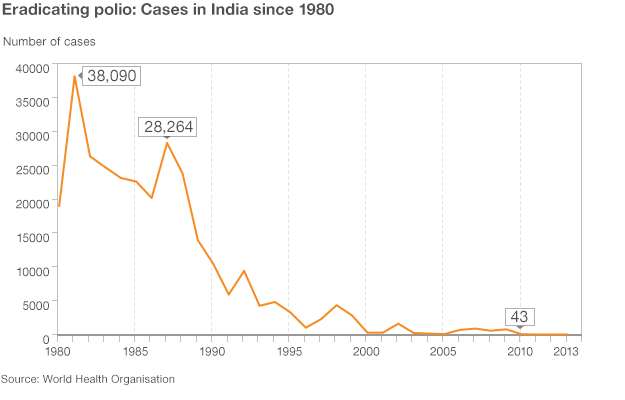
india_polio

Dylan Matthews details the good news:

More than 50 years since Jonas Salk discovered the first successful polio vaccine, the disease persists in developing countries. According to the Global Polio Eradication Initiative, 372 cases were reported in 2013, up from 223 in 2012. So it’s encouraging that India — which had 741 cases as recently as 2009 —  appears to have finally eradicated the illness, with the last reported case occurring three years ago.

Bill Gates applauds the diligence of the Indian government:

Five years ago, India was home to nearly half of the world’s new polio cases. At the time, if you asked any health expert, they would have said India would be the last place on earth to end polio.

India’s population density and high birth rate (27 million new children are born each year), combined with poor sanitation, was like a petri dish for polio. But the government of India, with help from the organizations that make up the Global Polio Eradication Initiative including Rotary International launched an all-out effort to stop the disease. The country deployed 2 million vaccinators to reach children who had never before been reached with polio vaccines or any other health services—children who live in flooded regions or hard-to-find rural towns, or are regularly in-transit with their families.

One of the most powerful images I’ve seen during my visits to India is that of parents proudly holding vaccination cards showing that their children were protected from deadly diseases for the first time. And now that these children have been found, health workers can supply them with much more than just polio drops. They can provide other critical health services like measles vaccines, clean water, and information about how to deliver their babies safely and care for them during their first weeks of life.

Keating examines how the disease still hangs on in some parts of the world, a problem the Dish recently highlighted:

Globally, there’s a strong link between polio and political instability. The disease has recently made a comeback in both the Horn of Africa and Syria, where years of brutal fighting have broken down national vaccination campaigns. There’s also a striking contrast between India, where 170 million children are immunized annually as part of a nationwide campaign involving hundreds of thousands of volunteers begun in the 1990s, and neighboring Pakistan, where a similarly aggressive campaign has been hampered by extremist attacks on volunteers. At least a dozen government vaccinators, whose efforts are portrayed by the Taliban as a Western conspiracy, have been killed or wounded in northwest Pakistan, in the past three months. Eighty-three new cases of the disease were reported in the country last year, making it one of only three in the world—along with Afghanistan and Nigeria—where polio remains endemic.

Francie Diep looks ahead:

Should the day come when polio is truly gone from the world, it would be the second vaccine-preventable disease that humans have eradicated. The only precedent is smallpox. The next, [epidemiologist Carol] Pandak thinks, may be measles and rubella. There are a couple of reasons those diseases are promising. Like polio and smallpox, they don’t have any animal carriers, which means no wrangling with microbes lying in wait in monkeys, bats or mosquitoes. There are also safe, effective vaccines for measles and rubella that work in children.

Democrats For War With Iran, Ctd

https://twitter.com/JeffreyGoldberg/status/421715207652515840

Sargent is concerned about the growing support for a new Iran sanctions bill, which threatens to derail negotiations:

The basic storyline in recent days has been that the pro-sanctions-bill side is gaining in numbers, while the anti-sanctions-bill side hasn’t — even though the White House has been lobbying Dems very aggressively to back off on this bill, on the grounds that it could imperil the chances for a historic long-term breakthrough with Iran. As Josh Rogin puts it, “the White House’s warnings have had little effect.”

We’re very close now to the 60 votes it needs to pass. The Dem leadership has no plans to bring it to the floor, but there are other procedural ways proponents could try to force a vote. And if the numbers in favor of the bill continue to mount, it could increase pressure on Harry Reid to move it forward. Yes, the president could veto it if it did pass. But we’re actually not all that far away from a veto-proof majority. And in any case, having such a bill pass and get vetoed by the president is presumably not what most Democrats want to see happen.

Steve Benen adds:

Congress passed sanctions to entice Iran to come to the table, and Iran came to the table. Pressure from sanctions was intended to encourage Iran to reach a deal, and Iran reached a deal. If Congress could resist the urge to destroy its own success – new sanctions would derail all talks, force Iran from the table, and tell the world the United States isn’t serious about peaceful solutions – real progress could move forward.

Ryan Cooper thinks Democratic senators, like sanctions-supporter Cory Booker, are making a mistake:

It may seem to Booker et al. that dynamiting sanctions is the smart political play, given the strength of AIPAC and other neoconservative groups. Or it could be that he really believes this stuff: Booker has long been strongly pro-Israel, and has key rabbinical allies with similar views. Or perhaps he hasn’t grasped the danger yet. As Peter Beinart has pointed out, the anti-war left has never been very good at teaching politicians to head off conflicts in the making, as opposed to punishing them for it after the fact.

Regardless of the reason, Booker and company are making a serious error if they think that the anti-war left is dead forever, or that they’ll pay no price if they manage to successfully sabotage these negotiations.

Weigel points out that all the Senate Democrats facing tough reelection campaigns have supported new sanctions on Iran. On Friday, Trita Parsi looked at the situation from Iran’s perspective:

Khamenei supports Rouhani’s diplomacy not because he agrees with it, but because he has turned it into a win-win for himself. As long as he patiently waits till the talks either succeed or collapse due to American foul play – courtesy of senators Menendez and Kirk – he will strengthen his position both internationally and domestically.

If diplomacy succeeds, he will take credit for it. If diplomacy fails as a result of American sabotage, he will claim vindication. His mistrust of the West will have proven correct, as will his line that Iran’s interest is best served by resisting rather than collaborating with the West. Iran’s moderates and pragmatists will once again be pushed to the margins of Iranian politics. Rouhani will be weakened and momentum will shift back to Khamenei and the hardliners.

My take here.

The Right Backs Affirmative Action!

Gay Marriage Becomes Legal In California

It’s a surprising move, but perhaps the only possible shred of an argument they have left in the fight to deny marriage equality to gay citizens. In Utah, the state has tried to muster legal arguments as to why they have an interest in marginalizing gay unions as opposed to heterosexual ones. Their first try was to argue that heterosexual-only marriage was important for “responsible procreation.” The Judge agreed, but couldn’t understand why allowing civil marriage for gays would somehow undermine that. In fact, he made the socially conservative counter-point that by mandating that gay couples remain unmarried, “the state reinforces a norm that sexual activity may take place outside of marriage.”

So they came up with a second argument: that by asserting the importance of heterosexual-only marriage, the state was making it more likely that children would be born into stable, two-parent homes, where they would fare better. The judge was puzzled again:

Utah’s ban, he wrote, “does not make it any more likely that children will be raised by opposite-sex couples.” But it certainly demeans and humiliates the thousands of children being raised by same-sex couples in the state, he said.

So Utah tried another tack in appealing to the state Supreme Court (and no, I’m not making this up). They said that having a woman and a man in a marriage was important for … wait for it … diversity. Money quote:

“The state does not contend that the individual parents in same-sex couples are somehow ‘inferior’ as parents to the individual parents who are involved in married, mother-father parenting,” the state said.

But, drawing on Supreme Court decisions endorsing the value of diversity in deciding who may attend public universities, the state now said it was pursuing “gender diversity” in marriages. “Society has long recognized that diversity in education brings a host of benefits to students,” the brief said. “If that is true in education, why not in parenting?”

“Gender diversity” is an argument I haven’t yet heard in the two and a half decades I’ve been debating this question. I have heard that in Catholic teaching, a mother and a father are vital complements to each other because of their differing genders.

But that’s an argument from natural law, and doesn’t actually hold up in the many studies of how well children do in same-sex and opposite-sex households. The idea of diversity like a university is somewhat different. But it begs a further question. If gender diversity is important, why not religious diversity? Or racial diversity? If the state has an interest in providing “diversity” in parenting, should it not privilege inter-racial marriage or religiously mixed ones? That’s an interesting argument in social engineering, but not one, I suspect, that can hold much water in front of a court.

When I first read it, it actually made me laugh out loud it seemed so transparently desperate as an argument. And that’s the core thing about this debate. As it has gone on, the logic of equality has proven far stronger than the logic of exclusion. In the courts, often denigrated, the standard of logic applies more rigorously than in the emotional and human maelstrom of democratic votes. If the arguments just don’t stand up to reasonable inspection – and they sure haven’t – what is even a conservative court supposed to do? And if Utah‘s supreme court cannot provide a convincing case to retain this kind of public discrimination, what hope the others?

This began as a strange outlier. Maybe, as the court deliberates over the next couple of months, it will end up in a much more radical place.

(Photo: Same-sex couple Ariel Owens (R) and his spouse Joseph Barham walk arm in arm after they were married at San Francisco City Hall June 17, 2008 in San Francisco, California. By Justin Sullivan/Getty Images)