The Milky Way from Chile:
Ancients from Nicholas Buer on Vimeo.
The Milky Way from Chile:
Ancients from Nicholas Buer on Vimeo.
Damon Linker praises David Bentley Hart’s The Experience of God for dismantling the New Atheist view of God as merely “the biggest, most powerful object or thing in, or perhaps alongside, the universe”:
Scientists are heroically proficient at detecting the laws that govern the natural world. They interrogate phenomena, trace effects back to their contingent causes, and then those causes back to even prior causes, developing and testing theories that seek to explain the temporal sequence. In the case of cosmology, that sequence extends all the way back to origins of the universe — to the first contingent cause of every subsequent cause over the past 13.82 billion years or so.
God concerns something else entirely. He is certainly not one of the many contingent causes within the natural world. But neither is he the first contingent cause, setting off the Big Bang from some blast-resistant fallout shelter lodged, somehow, outside of and prior to the universe as we know it.
On the contrary, according to the classical metaphysical traditions of both the East and West, God is the unconditioned cause of reality — of absolutely everything that is — from the beginning to the end of time. Understood in this way, one can’t even say that God “exists” in the sense that my car or Mount Everest or electrons exist. God is what grounds the existence of every contingent thing, making it possible, sustaining it through time, unifying it, giving it actuality. God is the condition of the possibility of anything existing at all.
He goes on to note Hart’s provocative argument “that faith in this classical notion of God can never be ‘wholly and coherently rejected'”:
The deeper reason why theism can’t be rejected, according to Hart, is that every pursuit of truth, every attempt to be good, every longing for beauty presupposes the existence of some idea of truth, goodness, and beauty from which these particular instances are derived. And these transcendental ideas unite in the classical concept of God, who simply is truth, goodness, and beauty. That’s why, although it isn’t necessary to believe in God in some explicit way in order to be good, it certainly is the case (in Hart’s words) “that to seek the good is already to believe in God, whether one wishes to do so or not.”
In a recent interview, Hart also expressed his scorn for the way Intelligent Design enthusiasts understand God:
My real problem with the movement is the disastrously silly picture of the universe and God that one finds lurking between the lines or in the last chapters of their books. ID theorists merely repeat the mechanistic narrative about physical reality and then reinsert an intelligent designer—a deist God—into the picture, one whose role is little more than that of a discrete causal agency among others, making periodic interventions in a reality outside himself. But such a God could be removed from the picture again just as easily, by the rise of another scientific paradigm, and (more to the point) such a God is not the fullness of being that classical theism sees as the logically necessary source and ground and end of all finite things.
Previous Dish on Hart’s work here.
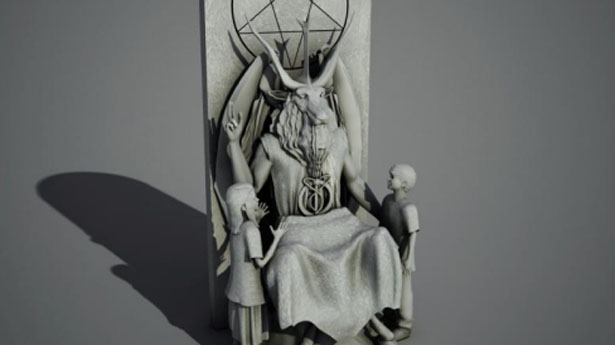
This monument might soon grace the Oklahoma statehouse:
Satanists have unveiled their design for a proposed statue at the Oklahoma state Capitol, including a place for people to sit on the devil’s lap “for inspiration and contemplation.” The New York-based Satanic Temple submitted its proposal to Oklahoma officials this month after applying for a spot on capitol grounds late last year. The Satanists say their statue would “complement and contrast” with a Ten Commandments monument placed at the Capitol in Oklahoma City in 2012.
The Satanists’ proposed monument depicts Baphomet, a goat-headed pagan idol sitting on a 7-foot-tall throne inscribed with an inverted pentagram. In an artist’s rendering provided by the Satanic Temple, smiling children look adoringly at the devilish figure. “The statue will serve as a beacon calling for compassion and empathy among all living creatures,” Lucien Greaves, a spokesman for the Satanic Temple, said in a statement. “The statue will also have a functional purpose as a chair where people of all ages may sit on the lap of Satan for inspiration and contemplation.”
Pareene considers whether the proposal will become a reality:
The Supreme Court’s current take on sectarian religious monuments in public spaces is basically incoherent (they are OK if they are “historical,” maybe less OK if they are not, with certain exceptions) but if one privately funded religious monument is OK, another ought to be as well. This is a similar tack to that taken by the people behind Florida’s famous beer-can Festivus pole, a protest elevated from similar ones thanks to its choice of materials. (PBR cans, though Natty Ice or something would’ve been even better.) Florida had to allow that display to justify the Christmas decorations they were very attached to. If the right is going to continue to attempt to subvert the Establishment Clause in the hopes of eventually getting the Supreme Court to decide that it means its opposite, we may as well also use the opportunity to spread the gospel of Satan.
So far, though, Oklahoma is being less accommodating than Florida.
Oklahoma Rep. Earl Sears told the AP, “I do not see Satanism as a religion, and they have no place at the state Capitol.” Not very Christ-like of you, Rep. Sears! I mean, yes, we can all agree that trying to build a statue of Satan at the Oklahoma state Capitol is childish, but it is also pretty good protest because there really aren’t any good arguments against it once you have accepted that this “privately funded” Ten Commandments monument is kosher. Plus, Satan is way cooler than the atheist Internet “spaghetti monster” joke.
Religion Dispatches’ Joseph Laycock initially pegged Greaves as a mere “smartass,” but now he sees a sincere believer in the Satanist spokesman:
In 2005, Greaves had lunch with Peter H. Gilmore, high priest of the Church of Satan founded by Anton LaVey. Greaves felt that a cultural shift had occurred with the rise of the New Atheist movement, led by the likes of Richard Dawkins and Sam Harris, and that Satanists should participate in this new conversation about religion in the public sphere. As a cognitive scientist, he was suspicious of Dawkins’ claims that humanity can live without religion since he felt that humans are “hard wired” to interpret the world through a rich language of symbol, narrative, and ritual. So Greaves imagined Satanism as a religion that could combine Dawkins’ aversion to supernaturalism with powerful and compelling symbols – what might be called a “sacralized” atheism.
Laycock concludes, “If the Satanic Temple’s campaign has any traction it will force a public discussion not simply on the Constitutional issues surrounding religion, but on the perennial problem of what religion is.”
David E. Cooper argues they’re not just for the religious:
An epiphany does not have to be a theophany, a manifestation of a divine being. In James Joyce’s A Portrait of the Artist as a Young Man, Stephen explains to a friend, as
they walk down Westmoreland Street, that a clock on a building is not simply part of “Dublin’s street furniture.” It is an “epiphany,” “a sudden spiritual manifestation,” in which the “whatness” or essence of a great city shines forth. So “epiphany” need not be invested with a theological sense. Experiences of sunlit seas need not have a specifically religious significance. Nor need an epiphany be dramatic and sudden, like Krishna’s appearance before Arjuna. The experience may be relaxed and cheerful: like Stephen’s on a Dublin street, it may be abiding and steady.
What should be retained from the ancient notion of epiphany is the sense of a showing forth — a becoming manifest to experience — of what has been occluded or recessive. We should retain as well the sense that what is manifested is something that matters — a significant, even fundamental, aspect of reality. You can appropriately speak of epiphanies of divine splendor, spiritual force, or the soul of a city, but not, usually, of epiphanies of cabbage leaves and rubber bands. An epiphany is something that is experienced by a person as a showing or bodying forth of a profound aspect of the way of things. An epiphany brings a truth about the world into the sphere of vivid personal experience.
(Image from Camille Flammarion, L’Atmosphere: Météorologie Populaire, 1888, via Wikimedia Commons)
Mark Slouka struggles to come to terms with the death of his father:
[A]s far as I can tell, there is no after-map or, more precisely, we each begin making our own the instant the news reaches us that someone we loved is gone. Which is unsettling: this terra is your own, brother, and as incognita as they come. Kübler-Ross? Sorry, the good doctor can’t help you here. The run-up to death may have its stages, as clearly marked as the Tour de France, but past Paris, so to speak, for those remaining on the field, things get fuzzy quick.
No search engine can find you. The guides have disappeared—they don’t know this place. And what were you going to do, anyway, Google: “Dad, who used to tip up sixty-pound rocks so I could grab the red-backed salamanders hiding underneath them when I was four”? No, in the aftermath of loss, the ones you love will keep you whole, but the journey is yours alone. Whatever you do, whatever you feel, becomes the map.
So it’s a problem. Because I miss him. Because I want to tear down this fucking wall between us with my hands. Because the angels and the harps don’t work for me. Because it wasn’t Our Heavenly Father who carried me out to the car at dawn when I was a child, who laid me down on the back seat of the DeSoto and covered me, who was there as I grew, who embarrassed me, disappointed me, loved me.
After experiencing the loss of their parents, Rebecca Soffer and Gabrielle Birkner started a website, Modern Loss, for mourners in their 20s and 30s:
“This project is called Modern Loss for a reason,” said Soffer. “Older generations seemed to deal traditionally with discussing loss in different ways than we do. And that is a huge generalization, but I didn’t get from people my age ‘they’re in a better place now,’ or ‘now they’re an angel,’ or ‘it was meant to be’ as much as I did from older people, because they’re used to saying that. They’re used to brushing it under the rug, they’re used to not being open about the excruciating aspects of loss.” Birkner and Soffer envisioned a site that would match their group’s conversations: loose, occasionally sarcastic, wide-ranging, and nonjudgmental. Without encouraging readers to wallow in their grief, it would seek to remind them that there is no expiration date to sadness. “The narrative of the long arc of loss is forever. It doesn’t have to own you, but you’re going to experience it in many different ways. It’s OK, because we still experience it,” said Soffer.

Panama City, Panama, 12 pm
In an interview about his new book, The Slavery of Death, Richard Beck thinks through the question:
The answer most of us would give, shaped as we are by the culture, is this: you’re a nobody. If you’re not someone who “stands out” you’re a nobody. Brene Brown calls this the “shame-based fear of being ordinary.” Nobody wants to be ordinary. We want to be extraordinary.
And why is that? Because of existential (death) anxiety. We want our lives to matter, to be noteworthy and significant in the face of death. We don’t want to fade away, we want to leave a dent in the universe. So we grasp at anything that makes us stand out from the crowd, that allows us to make and leave a mark. And so we get caught up in the neurotic social comparison game–online, at work, and in our social relationships. The main symptom of this “shame-based fear of being ordinary” is envy/jealousy fused with a feeling of inferiority and inadequacy. The trouble with this, and here is the pastoral turn, is that everywhere we see Jesus asking us to “take the last place.” To be a servant. To be the littlest, least, and last.
But that is impossible if our egos are being driven by a neurotic and shamed-based anxiety. Because the reality of Good Friday is that if you become like Jesus–if you carry his cross–nobody will pay attention, no one will say thank you, no one will recognize your work. That’s crucifixion. Of the ego, of the self, of our aspirations to be “a somebody.”
So that’s the rub. Jesus asks us to become a “nobody” in the eyes of the world. In our own eyes. But because of our death-infected neurosis–the shamed-based fear of being ordinary–we can’t accept Jesus’s offer. We don’t want to take up the cross. It’s too embarrassing. We don’t want to be a servant. No one will applaud or like us on Facebook.
The Dish previously has featured Beck’s work here, here, and here.
On February 4th, Bill Nye will debate Creation Museum founder Ken Ham at the Creation Museum in Petersburg, Kentucky. The question: “Is creation a viable model of origins?” Ham explains why he set up the event:
Because our ministry theme for 2013 and for 2014 is “Standing Our Ground, Rescuing Our Kids,” our staff thought that a debate on creation vs. evolution with a man who has influenced so many children to believe in evolution would be a good idea. Now, those of you who know me realize that I don’t relish public debates, so please pray for me. But this debate will help highlight the fact that so many young people are dismissing the Bible because of evolution, and even many young people who had grown up in the church decided to leave the church because they saw evolution as showing the Bible could not be trusted.
Jerry Coyne thinks Nye should stay away:
My worries are these. First, Nye is likely helping fund the Creation Museum and its mission to teach children Biblically based untruths about the origin and diversity of life. Had I been Nye, I would have suggested some other recipient of the money. Not only that, but why hold such debates in a Temple of Ignorance instead of on neutral ground? Second, Nye, by his very appearance, is giving some credibility to Ham and his views. After all, The Science Guy is known and beloved by many Americans as a popularizer of science. Why debase himself this way? My third worry, then, is this will look great on Ham’s curriculum vitae, but not so good on Nye’s. It is my practice not to debate creationists for reasons #2 and #3. Nye can attack creationism in his own talks and writings, as he has been doing with great effectiveness. Debates are not the way to help people accept evolution.
Tyler Francke is also strongly against Nye’s participation:
[A]ny modern-day public debate over the fundamental tenets of creationism is a sham, a mockery of real discourse. That’s because there is no scientific debate to be had over whether the earth is billions of years old, or whether life shows strong evidence of common descent, or whether a global flood occurred within the memory of modern man. These questions (particularly the first and third) were settled by the experts who are paid to study such matters long before any of the would-be “debaters” were even born.
Joe Hanson agrees the premise of the debate is flawed:
[W]ho is this going to convince?
Are there large numbers of people who are on the fence about whether evolution or creationism is the One True Way? And I mean really, truly “on the fence” in the sense that they could be tipped to one side by the words of either a hero of their elementary school afternoons and Tumblr memes and bow-tie-shipping, or … that other guy?
Chaplain Mike predicts the debate “will only serve to further separate a segment of very vocal Christians into their little cubbyhole of biblicism and obscurantism”:
By holding this “debate,” Ham continues to attempt to reinforce the impression that his opinion is the Christian worldview, that his organization is engaged in serious interaction with scientists, and that the way Christians should “engage and impact the culture” is through trying to defeat them publicly with arguments. And if you can stack the deck, hold the debate on your home field, and raise a lot of money for your cause in the meantime, all the better! Christianity’s reputation for hucksterism is taking a giant step forward with this event.
But James Kirk Wall thinks “the people against the debate are wrong”:
Bill Nye is absolutely right in doing this, and here’s why. If someone had a belief that human babies came from storks, we wouldn’t need a debate. If one third of the adults in this country believed that babies came from storks, as insane as it sounds, yes, we need to have the debate. And that’s where we are. … Bill Nye has an opportunity to valiantly promote science over creationist nonsense. I expect Bill is going to do very well.
Ham’s response to Nye’s video at the top of the page is here.
“I know I would not want a vision of art that is purely utilitarian—that would not be not art, it would be advertising or propaganda. A sonnet is neither a wrench nor a voting booth. And yet, even useless joy is not inconsequential. Joy is reasonless and “accomplishes” nothing, yet is an indispensable enlargement of measure in any life. Why do we want justice, or any other diminishment of suffering, if not for the increase of simple happiness it brings? Or why would we want what Buddhism might call a right sorrow, for that matter, as we—I at least—do want that? We know when a pool is clarified, when it is muddied. We know when a poem of darkness is opulent, in its saying, in its relationship to existence—Hopkins’s “Carrion Comfort,” for example—and that the existence of opulent grief, fully offered, is a counterweight even to despair.
I’m not saying that art is a matter of beauty, solace, or calmness, though it can be, and that can be welcome. I’m not saying that art is about rectification of character or making visible the existence of injustice, though it can be, and that can be welcome. I suppose I’m saying that good art is a truing of vision, in the way that a saw is trued in the saw shop, to cut more cleanly. And that anything that lessens our astigmatisms of being or makes more magnificent the eye, ear, tongue, and heart cannot help but help a person better meet the larger decisions that we, as individuals and in aggregate, ponder. That the rearrangement of words can re-open the fate of both inner and outer worlds—I cannot say why I feel this to be true, except that I feel it so in my pulses, when I read good poems,” – Jane Hirshfield.
(Hat tip: Jennifer Haupt)

“Evidence” by William Stafford:
First, this face—history did it,
winters, two world wars, long
days bent in the fields in the sun,
a few blows, fear, sorrow.This face is evidence left over
when those years denied what happened
and stole away, the shell still whispering
of treasure and wreckage in the sea.And then beyond this mask—that’s where
everything else begins to wake up:
what the wars were about, how the field boss
discovered a truth God had in mind.There’s a bell somewhere. This face
looks up, the way old people listen.
(From The Way It Is: New & Selected Poems by William Stafford © 1998 by the Estate of William Stafford. Used by permission of Graywolf Press. Photo by Pawel Maryanov)


