Daniel Carlson rolls his eyes at the media gossip over “snubs”:
It’s not just that focusing on awards is the easiest way to miss the real fun and joy of movies and television. It’s that talking about nominees and winners in terms of snubs or triumph means admitting that there’s an accepted annual canon of award contenders, and that awards should only draw from that pool, and that anyone in that pool who isn’t nominated has been unjustly ignored, while those who sneak in from the outside are somehow “surprises” or “upsets.”…
Most importantly, though, nobody deserves anything. The warped relationship between award prognosticators and those who actually hand out the awards isn’t specific to entertainment writers/fans.
About 36 days later, according to psychologists at the University of Colorado who used an online survey to gauge people’s reactions to jokes about Hurricane Sandy:
The researchers divided the surveys into “during crisis” and “after crisis.” The day before the storm made landfall, people thought the tweets were pretty funny—they didn’t yet know it would be a tragedy. Over the next nine days, as people learned the extent of the damage, perceived humor declined. Participants found the tweets least funny 15 days after Sandy’s landfall. Then, it slowly started to be “okay” to find humor in the situation again, leading to a high point of humor 36 days after landfall. Humor fell again after that, and researchers saw another low point 99 days after the disaster. The study also showed that during the first dip in perceived humor, participants found the tweets more offensive.
[A. Peter] McGraw and his colleagues argue these results provide evidence supporting the “benign violation theory” of humor. It states that “humor arises when something that threatens a person’s well-being, identity, or normative belief structure simultaneously seems OK, safe, or acceptable.” Or to put it more simply: “Humor requires threat, but not too much, or too little.”
So if you fear an approaching hurricane could actually hurt you, your interests, or someone you love, there’s nothing funny about it. If the threat has safely passed, its potential to generate humor rapidly retreats. But the moment when you feel you have dodged a bullet: That’s ripe for laughs. Humor, McGraw and his colleagues write, is a great example of “the human capacity for taking a source of pain and transforming it into a source of pleasure.” (In that way, it’s like the blues.) This ability, they add, “is a critical feature of the psychological immune system.”
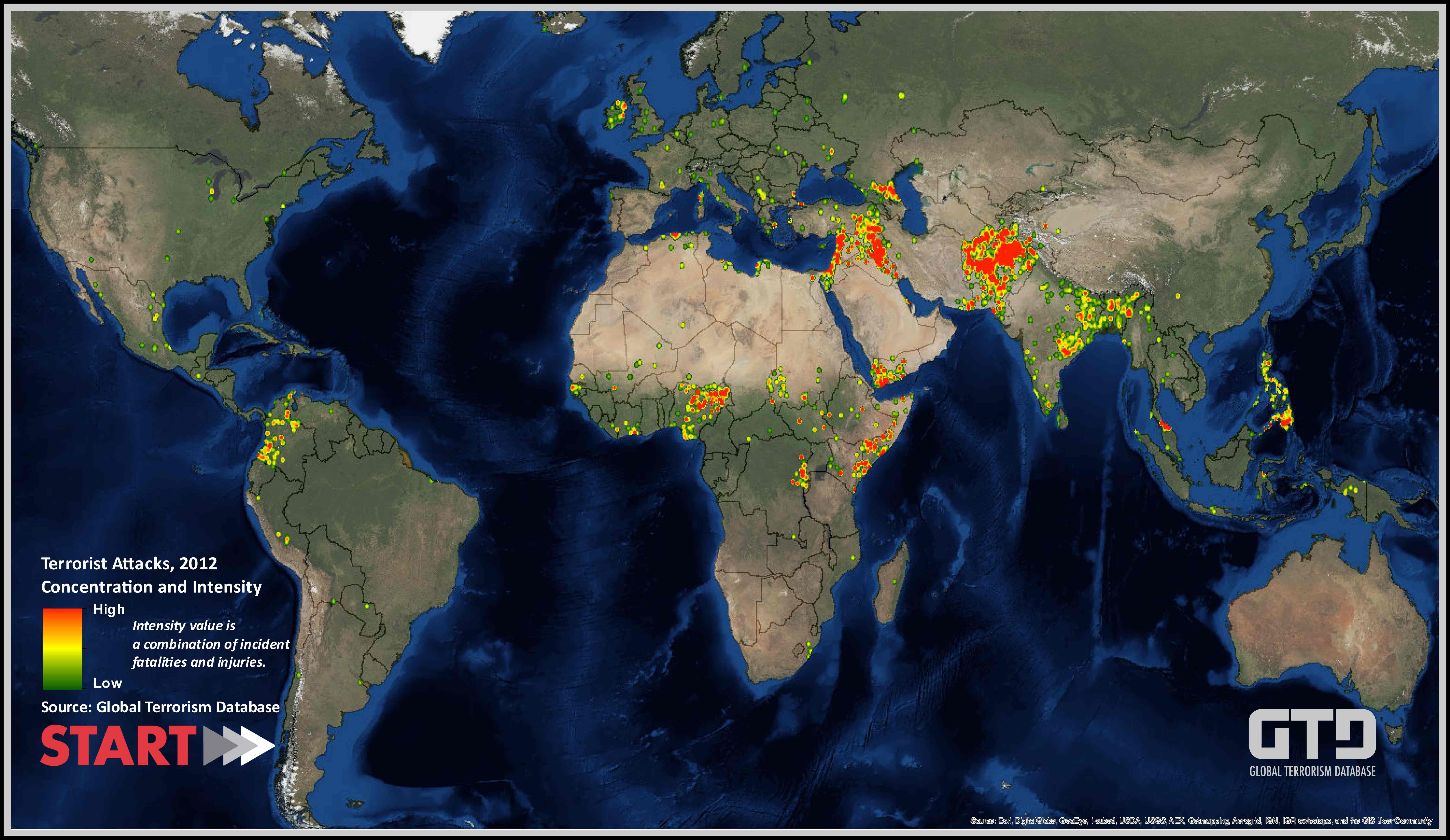
The National Consortium for the Study of Terrorism and Responses to Terrorism released new data on Thursday showing that the majority of the terrorist attacks and fatalities in 2012 happened in just three countries: Pakistan, Iraq, and Afghanistan:
The next five most frequently targeted countries were India, Nigeria, Somalia, Yemen and Thailand. “While terrorist attacks have in large part moved away from Western Europe and North America to Asia, the Middle East and Africa, worldwide terrorism is reaching new levels of destructiveness,” said Gary LaFree, START director and professor of criminology and criminal justice at the University of Maryland. In addition to illustrating a continued shift in location of attacks, the new data — with more than 8,400 terrorist attacks killing more than 15,400 people in 2012 — also show an increase in attacks and fatalities over the past decade. The previous record for attacks was set in 2011 with more than 5,000 incidents; for fatalities, the previous high was 2007 with more than 12,500 deaths.
These record numbers are partly due to a change in START’s data collection methodology, however, so the report cautions against a direct year-to-year comparison. Zach Rausnitz looks at who committed the deadliest attacks, and where:
Three of the five deadliest attacks from the year took place in Yemen. One perpetrated by al Qaeda in the Arabian Peninsula killed 210 people. Al Qaeda central did not itself carry out any attacks in 2012, but the six groups responsible for the most deaths worldwide had some affiliation with al Qaeda, START says. They include the Taliban, Boko Haram and AQAP. Along with Yemen, the Democratic Republic of Congo, Syria and Iraq each suffered individual attacks that killed more than 50 people. The only fatal attack listed in the database that took place in the United States in 2012 was the killing of six people at a Sikh temple in Oak Creek, Wisc., by a member of a white supremacist organization.
Benjamin H. Freidman points out that in the longer term, terrorism is really on the decline:
We should … be skeptical that the recent increase in terrorism means more danger for Americans. The cause of terrorism’s recent increase is civil wars and political unrest in Africa, the Middle-East and South Asia, where the vast majority of recent terrorist attacks have occurred. Meanwhile, terrorists killed fifteen, seventeen, and ten private U.S. citizens (that is, non-military) in 2010, 2011, 2012, respectively. That means the danger to Americans either did not grow or that they mostly avoided it. The real problem then is not al Qaeda, but the fractured political order in Iraq, Syria, Afghanistan, Yemen, Pakistan, Somalia, Nigeria and the like.
Frank J. Oteri bemoans “the Great Man myth that still permeates classical music and which has also found its way into the new music claiming its lineage from that tradition”:
Until we rid ourselves of the notion that the best music of all time was created by a handful of men who lived an ocean away from us and who all died more than a century before any of us were born, we will never have programming that truly reflects the vast array of musical creativity all around us. It’s the same myth that locks American repertoire out of most programming at opera houses and symphony orchestras as well as music by anyone from anywhere who is currently alive. When a work by someone who is alive, American, or female (or a combination of those attributes) is played, it’s inevitably a single work wedged in between the obligatory performances of works by Great Men.
Some progress:
Sound and Music, the national agency for contemporary music in the United Kingdom, is attempting to make a difference. … Under the leadership of its new Chief Executive, Susanna Eastburn, the organization makes clear in its criteria that “it expects applications to its multiple composer programmes to include women composers and that there would need to be an exceptionally good reason why this was not the case to secure funding.”
(Video: A performance of “Nocturne,” a piece by Lili Boulanger)
A meerkat plays with a Christmas present at Hanover Zoo on December 20, 2013. Keepers at the German zoo gave the some of the animals presents containing festive treats. By Nigel Treblin/Getty Images.
This paragraph about gun shopping in December of 2012—one first grader at Sandy Hook was shot 11 times—ends with Palin bragging about her tits. I’m not kidding.
Richard Lea contributes to the debate spurred by Tom Scocca’s essay:
Not even Scocca is really arguing for snark. Instead he’s arguing for the licence to adopt a negative tone when you confront “smarm”, which he defines as a “kind of performance” that takes on “the forms of seriousness, of virtue, of constructiveness, without the substance”. Scocca assembles examples from literature and politics of smarmy doublespeak – and who could possibly be in favour of that? – where practitioners short-circuit dispute about real issues by claiming any criticism is merely personal attack and suggests that those who argue against snark are really concerned about preserving their own status.
But he’s not really arguing about snark at all, as becomes clear when he admits that “the complaints against snark are not entirely without merit”.
Some snark is harmful and rotten and stupid. Just as, to various degrees, some poems and page-one newspaper stories and sermons and football gambling advice columns are harmful and rotten and stupid. Like every other mode, snark can sometimes be done badly or to bad purposes. …
Instead we need to steer a course between snark and smarm, to remember that it is enormously hard to write a good book, and to engage with the book, which has eventually been written on its own terms. Those terms are, of course, subject to criticism themselves, but we have to remember that we’re not in Hollywood. In a world where US publishers produce more than 300,000 titles a year – not to mention the 390,000 US titles published directly by their authors – the duty to “review books negatively” that Dowd upholds is constrained by limits of time and space. Confronted with a bad book, we should say it’s bad, of course, and how and why, but unless it is important or dangerous, why bother to confront it at all? Why not find something better to review? If we renounce snark, then the negativity we permit ourselves must have a point, and must be balanced with generous explorations of those few books that aspire to something interesting and manage to match those aspirations with at least a little success. Otherwise we’re not really talking about literature at all.
According to IMF calculations issued earlier this year, global fossil-fuel subsidies in 2011 cost $1.9 trillion — fully 2.5% of global gross domestic product — and the biggest single source of subsidies was the United States. Eliminating these subsidies globally, the IMF said, would cut energy-related carbon-dioxide emissions a whopping 13%.
Fuel subsidies are terrible primarily because, by “reducing the cost consumers pay for oil, natural gas and coal, subsidies promote the wasteful use of these polluting — and, at least in theory, finite — resources.” But they can also be harmful in a multitude of other ways. For example:
Earlier this year, Iran devalued its currency — the rial — against the US dollar. But when it did the devaluation, it failed to compensate by raising the rial-denominated price of fuel. As a result, the devaluation reduced the price in real terms that consumers in Iran pay for fuel. The market responded swiftly and sensibly: Massive amounts of diesel fuel are being smuggled out of Iran and into neighboring Pakistan, where the price of diesel at the pump now is 10 times what it is in Iran. According to the IEA, 60,000 barrels of diesel fuel are being smuggled out of Iran, mainly into Pakistan, every day.
Christopher Orr considersHer the best film of the year:
Her is a remarkably ingenious film but, more important, it is a film that transcends its own ingenuity to achieve something akin to wisdom. By turns sad, funny, optimistic, and flat-out weird, it is a work of sincere and forceful humanism. Taken in conjunction with [Spike] Jonze’s prior oeuvre—and in particular his misunderstood 2009 masterpieceWhere the Wild Things Are—it establishes him firmly in the very top tier of filmmakers working today. Like Eternal Sunshine of the Spotless Mind—of which Her is a clear descendant—Jonze’s film uses the tools of lightly scienced fiction to pose questions of genuine emotional and philosophical weight. What makes love real: the lover, the loved one, or the means by which love is conveyed? Need it be all three?
Her isn’t, in the end, a political or socio-cultural satire, much less a nostalgic tract about the need to throw away our devices and truly live. It’s a wistful portrait of our current love affair with technology in all its promise and disappointment, a post-human Annie Hall.
Brett McCracken compares the protagonist to the operating system:
Theodore earns a living communicating emotion for a populace presumably deficient in the art. In this world, communication itself has become a necessary nuisance. You need it to live, but it’s devoid of pleasure and avoided whenever possible. Other people write intimate letters for you; your OS writes your e-mails, makes your calls, chooses and buys presents for your goddaughter, and navigates dicey dynamics with divorce lawyers.
Theodore is paid to know people better than they know themselves, to dig into their quirks and nuances to best capture how and what they love. This is also, of course, what Samantha does for Theodore. In this and many other ways she is a mirror for him, a reflektor (to use a neologism from Arcade Fire, who provide the soundtrack for the film and whose latest album is in part about connection in the digital age).
Jonze imagines a future where we trust our devices more than we do today — and we trust them a lot already. Think about how many secrets we tell them in the form of sexts and selfies, Snapchats and private e-mails. Increasingly, the love we get day to day comes in form of “hearts” on Instagram and Likes on Facebook. Would it really be so weird if the machines themselves got in on the conversation? They’ve been listening in all along; maybe it’s about time they piped up.
In Her – like our hyper-connected lives today – it’s possible to fall in love with someone you can’t touch, and to feel it every bit as much as you would with someone who’s there in flesh and blood.
The movie has more on its mind than the old question of “What is love?” In a bracingly original way, Jonze suggests that whatever the future of digital evolution might hold in store for human romance, the danger of heartbreak will always remain, along with its attendant torments of desperate yearning and unfocused jealousy. “You helped me to discover my ability to want,” Samantha tells Theodore. Want what, he wonders.