All of our previous Christmas Hathos here.
What If Fewer Young People Buy Insurance? Ctd
Obamacare won’t collapse if somewhat fewer young Americans sign up for coverage. Jonathan Cohn examines the big picture:
None of this means that unexpectedly low enrollment from healthy people would be a good thing—or without consequences. Premiums would rise, potentially increasing the cost of federal subsidies and/or premiums for people buying coverage without federal tax credits. But the increases would not be disastrous. And that’s a pretty good lesson to remember. People tend to talk about Obamacare as if it’s going to be a ringing success or a total catastrophe. In reality, it’s likely to be a mix of good and bad news, with lots of variation from state to state, and with lots of unanswered questions that linger for months and even years.
Philip Klein reframes the death spiral debate:
[W]hat’s been largely lost in the ongoing discussion about whether a death spiral can happen is that there isn’t one Obamacare “risk pool” and thus, there isn’t one potential “death spiral.”
In reality, there are 51 different risk pools (for each state plus the District of Columbia), which means 51 chances to get things right, as well as 51 possible death spirals.
It’s perfectly possible that come March 31 – the current end of the open enrollment period – evidence will show a bit of both. That is, some exchanges may be viable, and some may find themselves in deep trouble.
Larry Levitt of Kaiser looks ahead:
I expect a mixture of stories at the beginning of January. There will likely be reports of some remaining errors in the back-end transmissions to insurers, with some people thinking they’re enrolled when they’re not. And, as I said, some people will be surprised by which providers are or are not in their plans. Some people may also start to discover that they have enrolled in plans with modest premiums but high deductibles, which may not cover their more routine medical expenses. At the same time, we’ll start hearing many more stories than we have to date about people who have signed up and getting help that wasn’t available before. That will include people with pre-existing conditions who have been locked out of insurance before, or low- and middle-income people who are getting tax credits that make coverage much more affordable. What we’ll start to see in January are the real effects of the law, rather than the more hypothetical ones we’ve been talking about up until now.
Mental Health Break
If only Phil Robertson were as enlightened as Joad Cressbeckler:
An HIV Breakthrough?
Researchers may have figured out how HIV kills white blood cells and causes AIDS:
Scientists have long known that HIV sets up little biological factories inside the the body’s protective CD-4 T cells they infect, producing millions of copies that eventually lead to a massive destruction of the immune system. Until now, investigators have not understood why the virus becomes so aggressive. It turns out HIV, which infects only a small number of T cells at the start, destroys approximately 95 percent of immune cells through a process known as the bystander effect.
Warner Greene, head of virology and immunology at the Gladstone Institutes in California, says bystander cells that are in the neighborhood of HIV-infected cells succumb to a fiery death. “Most CD4-T cells during HIV infection die not because of the toxic effect of the virus, but because of an immune response against the virus. So, CD4 cell depletion is more of a suicide than a murder,” said Greene.
This violent immune response seems to contribute to the progression of the disease:
The response is a self-destruct protocol called pyroptosis. In contrast to the better-known apoptosis, in which cells die quietly without triggering inflammation, pyroptosis is “not a bland, but a fiery death,” Greene says. These cells spew inflammation-causing chemicals as they die, attracting more T-cells that can then become infected themselves by the newly freed HIV. “In a bacterial infection, recruiting all these cells might be a good strategy for containing the infection,” Greene says, but with HIV a vicious cycle of infection results. Pyroptosis also explains why AIDS is associated with high levels of inflammation.
This finding may lead to new HIV therapies:
Greene thinks that pyroptosis (or the lack of it) could explain why HIV usually causes AIDS in humans but its relatives, the SIVs, barely sickens the apes and monkeys that they infect. SIVs can kill CD4 cells directly, but they can’t trigger the same pyroptosis response in other primates. They kill a few cells but the majority survive, and the immune system stays strong. “That’s the evolutionary solution—not to control the virus but to control the host response,” says Greene. “I think if we had another million years, we’d evolve in the same way.” Thankfully, his team is working to a tighter schedule. They’ve already found a molecule that can stop pyroptosis, at least in lab-grown cells.
The whole messy process depends on a protein called caspase-1. Without it, you don’t get any mature IL1β, and without that, you don’t trigger the vicious cycle of CD4 cell death. Caspase-1 plays many other roles in the body, and several pharmaceutical companies have tried to make drugs that block it, for the purposes of treating other diseases. One of these, VX-765, was developed to treat chronic epilepsy and autoimmune diseases. Greene’s team showed that it completely prevents HIV from killing the bystander CD4 cells. No caspase-1 activity. No IL1β signals. No inflammation. No mass cell death. No AIDS? That remains to be seen. These are only lab experiments, after all, and the drug still needs to be tested in actual HIV patients.
What Happened To Jesus’ Willy?
Before diving deep into self-parody here, some background:
By the eleventh century, several churches in Europe explained they had the Holy Foreskin – the story often went something like this – Jesus’ mother Mary kept the foreskin, along with the umbilical cord, and later gave it to Mary Magdalene. We then jump forward several centuries to the time of Charlemagne, when an angel gave the relic to the Emperor. From there it went to this place or that place, including to Rome. In 1421, it was even sent to Catherine of Valois in England, so that it would bring good fortune (and a pregnancy) to her marriage with Henry V.
The relic has provoked “a lot of theological commentary about whether or not [it] could be real, much of it negative”:
The whole matter was even brought before Pope Innocent III, who was asked to decide whether or not the foreskin and umbilical cord was a true relic. The Pope replied, “Rather than attempt rash answers to such questions, it is better that they be left entirely to God.” This seems to be the line that the Papacy has taken since, although as the idea became criticized and mocked by Protestants, the Holy Foreskin has been gradually hidden away and not talked about by the church.
The last place known to have publicly shown the Holy Foreskin was the Italian village of Calcata, which lies 30 miles north of Rome. The locals claimed that the relic had been there since 1527 and every year on January 1st, it would be taken out of the local church and paraded around. Then in 1983, it mysteriously disappeared, taken from a shoebox underneath the priest’s bed. Many locals believe that it was the Vatican that was responsible for taking away their precious relic. It has, however, brought an end to one of the strangest stories of medieval Christianity.
(Video: trailer for The Quest for the Holy Foreskin. Another video investigating the matter is here.)
(Hat tip: 3QD)
The “Obama As Bush” Meme
Chait doesn’t buy it:
The conventional wisdom – propounded by many of the same pundits now equating Obama with Bush – held that Obama’s hardball tactics would backfire. Obama needed to negotiate over the debt ceiling, and didn’t dare change the Senate’s rules, argued, to take one example, Ron Fournier. To fail to placate conservatives would only enrage them more. This analysis turned out to have it backward. Congress managed to pass a budget for the first time in three years precisely because Obama defeated the GOP’s extortion tactics, forcing Republicans to actually trade policy concessions rather than demand a ransom.
The prospects for Obama’s second term remain constricted. Not many deals beckon in Congress. The Obamacare rollout was surely a political disaster, but the administration has three more years to get the law up and running. By the end of 2005, George W. Bush had seen the promise of his presidency collapse from justifiably lofty heights. At the end of 2013, Obama stands at just about the same place he began his term.
Having It All vs Having It Good
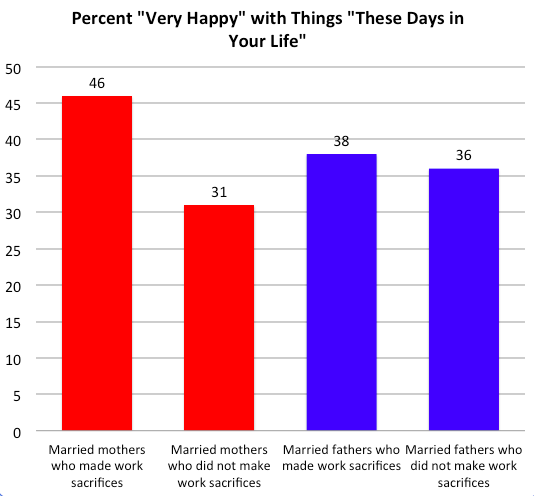
W. Bradford Wilcox points to new Pew data showing that mothers tend to be happier when they scale back their work lives to spend time at home with their kids:
What does this data really tell us? Let’s start with explaining what it doesn’t tell us. These results do not prove that spending less time at work makes women happier. It could be, for instance, that happier women are more likely to make work sacrifices, in the first place. Or it could be that more affluent mothers, who are more likely to be happy above a certain level of income, can spend more time with their families than poorer moms.
But these results are consistent with a pattern found regularly in research on women’s work and family preferences: Most (married) mothers would prefer not to work full-time, and the most popular option for women, when it comes to juggling work and family, is part-time work. … This data suggests that one reason married mothers who make work sacrifices are happier is that they would prefer to scale back at work—at least for some portion of their lives as mothers—and are happier when they can do so.
The View From Your Window

Inman, Georgia, 3.10 pm
The Fundamental Divide Between Left And Right?
Yuval Levin discusses his new book:
The debates about the welfare state or the entitlement state are second-order debates. The egalitarian ideal of justice advanced through certain applications of technical expertise is a progressive ideal Paine would’ve recognized. And the more conservative idea about addressing social problems through the application of social knowledge using social institutions like the family and civil society and markets is something Burke would’ve recognized. They represent different ideals about what kinds of information are available to us.
Paine makes a very powerful case that giving a lot of power to institution between the individual and the state is illegitimate in a society because those institutions are not democratically elected. You live in a place where the Catholic Church has always held power — why should your health care be dependent on them? Just because it’s always been done that way? The debate about the welfare state is a debate over a set of institutions that clearly embody certain definitions of liberal society. I don’t think that quite scrambles left and right. I think the vision you find in the Ryan budget is a pretty recognizably conservative vision, even though it’s being pursued rather aggressively.
If It Exists, There Is Porn Of It

That’s Internet rule #34. Garance Franke-Ruta passes along more proof, in the form of some seriously NSFW fan-fiction:
Over the weekend, an anonymous writer launched a Tumblr imagining an X-rated tryst between congressional fitness buffs Aaron Schock and Paul Ryan. “Paul Ryan XXX“— subhed: “Things are getting steamy on Ways and Means …”—is not appropriate work reading, and it’s clearly intended as satire of a certain kind of fawning journalism both men have tended to attract (as well as, you know, as porn).
“He was obsessive about his personal fitness. He cared deeply about those close to him. He had an outstanding sense of humor, but he never resorted to jokes about others. His laugh could make any room come alive,” the author writes of Ryan, in one of the milder passages. “And there was his intellect. His vision. His ability to see how things were possible that no one else could.”
Here the writer gently mocks the conventions of the many thumb-sucking profile of Ryan—be sure to mention the vision thing—by using them for different narrative ends.
Queerty imagines how the story might develop:
While this is nothing compared to the Mitt Romney-Paul Ryan fanfiction from that glorious descent into pop culture irrelevancy known as their 2012 Presidential campaign, we can’t wait to see where the subsequent parts lead. Here’s a suggestion: things get complicated when Mitt returns, having left his wife and 12(?) kids to be with Paul, but only over Aaron Schock’s drop dead gorgeous body. This basically writes itself.
(Image via Joe Jervis)

