Making Peace With Violence

TNC defends Mandela’s refusal to denounce necessary bloodshed:

Offered the chance to be free by the avowed white supremacist P.W. Botha if he would renounce violence, Mandela replied, “Let him renounce violence.” Americans should understand this. Violent resistance to tyranny, violent defense of one’s body, is not simply a political strategy in our country, it is taken as a basic human right. Our own revolution was purchased with the blood of 22,000 nascent American dead. Dissenters were tarred and feathered. American independence and American power has never rested on nonviolence, but on the willingness to do great—at times existential—violence.

Perhaps we would argue that Malcolm X, Mandela, and King were wrong, and that states should be immune to ethics of nonviolence. But even our rhetoric toward freedom movements which employ violence is inconsistent. Mandela and the ANC were “terrorists.” The Hungarian revolutionaries of 1956, the Northern Alliance opposing the Taliban, the Libyans opposing Gaddafi were “freedom fighters.” Thomas Friedman hopes for an “Arab Mandela” one moment, while the next telling those same Arabs to “suck on this.” The point here is not that nonviolence is bunk, but that it is is bunk when invoked by those who rule by the gun.

In the shadow of our conversation, one sees a constant, indefatigable specter which has dogged us from birth. For the most of American history, very few of our institutions believed that black people were entitled to the rights of other Americans. Included in this is the right of self-defense. Nonviolence worked because it conceded that right in the pursuit of other rights. But one should never lose sight of the precise reasons why America preaches nonviolence to some people while urging other people to arms.

Chart Of The Day

obamacare-sign-ups

Barro breaks down Obamacare enrollments by state:

The first thing that jumps out is that the nine states with the highest enrollment by share of population all run their own exchanges — which, in general, have been working much better than Healthcare.gov, the federally-run exchange. The 14 states running their own exchanges are indicated in red on the graph.

Vermont has, by far, the highest rate of sign ups as a share of its population: 0.8%. It’s followed by Connecticut, Kentucky and California. Because of its large population, California accounts for about 30% of total Obamacare sign-ups, at 107,087. New York, another state running its own exchange, has provided more than 45,000 enrollments.

Nationally, only 0.12% of Americans signed up for private health insurance made available by the Affordable Care Act between Oct. 1 and Nov. 30; that figure must rise to 2.2% for the Obama Administration to reach its goal of 7 million sign-ups by March 31.

TPM has an interactive graphic comparing enrollments:

[T]here is wide disparity across states — and a lot of that can be traced to HealthCare.gov’s problems. California (107,087) has enrolled almost as many people in private coverage as the 36 states served by the federal site combined. Kentucky (13,145), which built its own site, has enrolled almost as many people as Texas (14,038), which relied on the feds.

She’s Having My Baby … In Bangalore

Jennifer Kirby explores the motivations and challenges of American would-be parents who seek to conceive using surrogates in foreign countries:

India is one of a few countries, though perhaps the most popularized, where commercial surrogacy is legal. The country emerged as a “hotspot” in part because of lower costs and laws passed in 2002 allowing commercial surrogacy. In the U.S., surrogacy can cost between $80,000 and $150,000, while in India it ranges from $20,000 to $60,000, depending on the types of services and the clinic. That amount rarely includes unforeseen expenses like surrogate hospitalizations, or the basic travel costs such as flight and hotel stay. Yet those “savings can be the difference between being a parent and not being a parent for a lot of people,” says Kathryn Kaycoff Manos, founder of Global IVF, a resource for fertility tourists…

Surrogacy in India is largely unregulated, though the Indian Council of Medical Research is moving toward greater control, including the registration of clinics, says Hari Ramasubramanian, a lawyer who founded the Indian Surrogacy Law Centre. An estimated 2,000 foreign babies are born to Indian surrogates each year, according to research in the forthcoming book Patients With Passports: Medical Tourism, Ethics, and Law, by Harvard law professor I. Glenn Cohen. A recent study by Sama, a resource group for women and health in India, concluded about 3,000 clinics offer surrogacy services to foreigners, generating more than $400 million per year for the economy; the Confederation of Indian Industry analyzed data that put India’s commercial surrogacy even higher, at more than $2 billion.

But tighter restrictions may alter the scope of India’s surrogacy tourism. In July 2012, the Indian Ministry of Home Affairs ruled that foreigners needed medical, not tourist, visas to pursue surrogacy. The ministry limited those visas to straight couples who’ve been married at least two years, and who come from countries that also permit surrogacy. The rule change amounted to a bar on singles, gay, and unmarried couples, and on those circumventing their home laws to have children. Though the ministry relaxed regulations so foreigners who had already begun surrogacy in India could complete the process, the Indian government began enforcing the new rules this fall, Ramasubramanian says.

Enter Thailand and the Mexican state of Tabasco, two places where surrogacy clinics now cater to international singles and couples—particularly same-sex couples.

The View From Your Window

Seattle-330pm

Seattle, Washington, 3.30 pm.

Update from a reader:

Today, you posted a view from someone’s window that is actually a view of my window (two floors down from the top of the photo and 8-9 windows in from the left). As luck would have it, I actually took a photo from my window this morning, intending to submit it to view from your window. So, here it is … the view from the opposite side. Seattle, WA 7:40 am:

unnamed

The Economic Roots Of Syria’s Civil War

William R. Polk provides an in-depth explanation of the origins of the crisis, connecting it to the food shortages that preceded it:

Four years of devastating drought beginning in 2006 caused at least 800,000 farmers to lose their entire livelihood and about 200,000 simply abandoned their lands, according to the Center for Climate & Security. In some areas, all agriculture ceased. In others, crop failures reached 75 percent. And generally as much as 85 percent of livestock died of thirst or hunger. Hundreds of thousands of Syria’s farmers gave up, abandoned their farms, and fled to the cities and towns in search of almost non-existent jobs and severely short food supplies. Outside observers including UN experts estimated that between 2 and 3 million of Syria’s 10 million rural inhabitants were reduced to “extreme poverty.”

As they flocked into the cities and towns seeking work and food, the “economic” or “climate” refugees immediately found that they had to compete not only with one another for scarce food, water, and jobs, but also with the existing foreign refugee population. Syria was already a refuge for a quarter of a million Palestinians and about 100,000 Iraqis who had fled the war and occupation. Formerly prosperous farmers were lucky to get jobs as hawkers or street sweepers. And in the desperation of the times, hostilities erupted among groups that were competing just to survive…

And so tens of thousands of frightened, angry, hungry, and impoverished former farmers were jammed into Syria’s towns and cities, where they constituted tinder ready to catch fire. The spark was struck on March 15, 2011, when a relatively small group gathered in the southwestern town of Daraa to protest against government failure to help them. Instead of meeting with the protesters and at least hearing their complaints, the government saw them as subversives.

The lesson of Hama must have been at the front of the mind of every member of the Assad regime. Failure to act decisively, Hama had shown, inevitably led to insurrection. Compromise could come only after order was assured. So Bashar followed the lead of his father. He ordered a crackdown. And the army, long frustrated by inaction and humiliated by its successive defeats in confrontation with Israel, responded violently. Its action backfired. Riots broke out all over the country. As they did, the government attempted to quell them with military force. It failed. So, during the next two years, what had begun as a food and water issue gradually turned into a political and religious cause.

Seeing Hell In Humanity

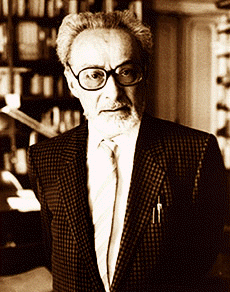
Reviewing a new biography of chemist and writer Primo Levi, William Giraldi attempts to understand how the man could stoically survive the Holocaust yet ultimately cut his own life short:

Levi had a difficult time fully trusting the chrysalis of civilization after Auschwitz. He was a man of PrimoLeviunflinching probity who never succumbed to the cutthroat Hobbesian conception of human striving, or to that toxic strain of bitterness which contaminated and ultimately ended the writer Jean Améry (also a Shoah survivor and suicide). But there is sometimes in Levi’s work the itchy suspicion that the hell could happen again, or that it never really ended. Beneath that unperturbed and almost placid prose creeps a fatalism, a capitulation before the vastitude and depravity of what he named “the demolition of man.” The stupefied silence before this vastitude and depravity is part of why his work remains ever pregnant and never born, because “our language lacks words to express this offense.”

Vivian Gornick reaches a similar conclusion:

What Levi would never understand was the willing remove of the Germans from their fellow humanity. The ability to look—for years on end—at a human being and see not a person but a thing became and remained for Levi the crime of crimes. Yet for this, he very nearly blamed not the Germans but life itself. After all, if thousands upon thousands of people were capable of not seeing themselves in others, could this capacity be anything other than innate? Life itself, he concluded, was to be pronounced guilty for having made possible such a monstrous divide within the human organism. This pronouncement became the unyielding indictment—enlarged upon many times in books, essays and stories—that made Primo Levi one of the greatest of the Holocaust writers.

(Photo via Wikimedia Commons)

Keyboard Consciousness

A recent set of experiments found that a majority of skilled typists failed to “map more than an average of 15 keys on a QWERTY keyboard”:

The basic theory of “automatic learning” … asserts that people learn actions for skill-based work consciously and store the details of why and how in their short-term memory. Eventually the why and how of a certain action fades, but the performative action remains. However, in the case of typing, it appears that we don’t even store the action—that is, we have little to no “explicit knowledge” of the keyboard. In the first experiment conducted, the typists averaging 72 wpm and 94 percent accuracy were given 80 seconds to write letters in the correct places on a QWERTY keyboard. On average, they got 57 percent right and 22.3 percent wrong, and they forgot the rest.

In a second experiment, the researchers showed participants a simulation in which a key on a blank keyboard would be highlighted, and the participant would have to name which letter it was. Participants hardly performed better at this test, getting the keys right only around 55 percent of the time on the first try. Participants who were allowed to mime typing on the picture where the key was did slightly better, with just over 65 percent on the first try.

(Hat tip: Colin Schulz)

Toward A Simpler Score

Alan Zilberman considers that trend in movies:

A generation ago film composers took a different approach when they wanted a score to sound significant. Compared to [composer John] Murphy’s “Adagio [in D Minor],” David Newman’s score from “Hoffa” sounds cloying: at the two-and-a-half minute mark, the orchestra overstates its case with high notes and a cacophony of percussion. Randy Edelman’s corny, relentless “Fire in a Movie Theater” sounds dated—anyone who went to the movies in the 1990s will wince when they hear the opening bars. There are some film scores that still sound fresh—James Horner’s score for “Aliens” is pulverizing, and John Williams’ work will always stand the test of time—yet there has been a sea change in film scores from complexity toward simplicity. This is because composers trust canny audiences to feel an emotional response when abstracted melodies contain an aural space for significance (or what feels like significance).

I talked about the power of simplicity with composer Nicholas Britell, who composed all the musical arrangements performed by Solomon Northup (Chiwetel Ejiofor) in “12 Years a Slave.” … After studying neuromusicology at Harvard, Britell became deeply aware of, “patterns that trigger cascades of feeling.” … I asked Britell to give an illustrative example of powerful music.

He thought for a moment and suggested François Couperin’s “Les Barricades Mysterieuses [embedded above],” a baroque piece for the solo piano Terrence Malick used in “The Tree of Life.” According to Britell, the key to the piece’s power is the dissonance.

“Throughout the piece, there are certain times where the lines continue a little longer (i.e. “suspensions”). The harmony changes yet they’re still holding an old harmony and then they quickly resolve. This process is something I always find very beautiful. It’s the main technique of a lot of music, where something overstays its welcome by a millisecond then resolves.” Listen again and it’s easy to hear what Britell is talking about: as one melody continues, the notes from another evaporate as if the music is breathing.

Where Are The Pro-Death Penalty Converts?

Andrew Cohen contends that “no one who digs deeply into these grim cases ever seems to evolve from being a staunch opponent of capital punishment into being a fervent supporter of the practice.” He discusses three Supreme Court justices who changed from pro- to anti-death penalty:

The systemic problems with capital punishment that Lewis Powell mentioned in 1991, and that Justice Blackmun identified in 1994, had not been cured by the time Justice Stevens identified them in 2008 (and again in 2010, in The New York Review of Books, in a review in which he lamented the Court’s broadened application of capital punishment). Nor has the Supreme Court addressed, let alone resolved, these problems in the years since Justice Stevens retired. Just last month, the justices refused even to hear an Alabama case in which an elected judge overrode a jury’s sentencing verdict and imposed a death sentence.

Three Republican-nominated justices, three men of moderation, among the least ideological the Court has produced in the past 50 years, all came late in life to regret their early doctrinal support for capital punishment. Retired Justice Sandra Day O’Connor, the first woman on the Court, a nominee of President Ronald Reagan, also questioned the use of capital punishment near the end of her tenure on it. She had concerns about the execution of the innocence, she said, and she acknowledged the equal protection implications of the fact that rich capital defendants get better legal representation than poor ones.

Now let’s list the Supreme Court justices of our time, or of our parents’ time, who started out as advocates for the abolition of capital punishment but whose experience with capital cases on the High Court over decades caused them to support the death penalty. Alas, we can’t do it. Not a single justice has ever been so converted. Is that not telling? Exposure to capital cases doesn’t cause these smart and honorable men and women to gain confidence in the neutral and accurate application of the death penalty, because no such confidence is warranted—because no such application exists.

A Star On The Spectrum, Ctd

Commenting on Susan Boyle’s revelation that she has Asperger’s Syndrome, Alyssa notes the proliferation of TV characters with autism spectrum disorders and the misconceptions they reinforce:

Many of these depictions of fictional people with variants of autism paint them as savants. I understand this tendency, because it’s a way to give people on the spectrum both dignity and work that they can do as part of a show’s plot mechanics, whether separately or part of a team. But it’s not as if getting diagnosed as somewhere on the autism spectrum is a one-way ticket to genius with side effects.

I’ve been relieved to see Alphas, for example, which had two characters on the spectrum of the show, with very different levels of social and communications skills, as a counterbalance to The Big Bang Theory, which falls somewhat closer to the tendency I’ve just described. And of course Parenthood is a terrific, ongoing exploration of both what it’s like to be a pre-teen and now a teenager with Asperger syndrome, and to parent someone with Asperger’s, without making an argument that Max (Max Burkholder) [seen above] needs to be a genius to somehow pay back his parents for their love, affection, and patience.

Boyle further complicates the idea that people on the spectrum are all math nerds or computer geniuses. Instead, she’s an artist (like Community‘s Abed). And perceptions of people on the spectrum aren’t all that her success challenges. At 52, Boyle is much older than the average pop star (though not than any number of popular classical singers, or Elaine Paige, who Boyle said she hoped to be like at Britain’s Got Talent). She’s single, and speaks about her father’s decision to break off the main serious relationship of her life when she was in her twenties in a way that’s almost inexpressible in the tabloid language used today to analyze celebrities’ relationships.