Most think Matthew is the bearded man. It appears that he’s pointing to himself as if to say “Me?” in response to Jesus’s call. This theory is supported by two others works of which The Calling is a part, The Inspiration of St. Matthew and The Martyrdom of St. Matthew. In those paintings St. Matthew looks similar to the bearded man who is pointing to himself in The Calling.
And yet, some think Matthew is the young man on the far left of the painting, the one at the table hanging his head. The gesture of the bearded man, if you look at it, is plausibly pointing to the young man with the unspoken question now being “Him?”. If the young man is Matthew the painting is capturing the moment just before Matthew lifts his head from the table to look at Jesus.
Beck goes on to write that he believes Matthew is the bearded man, but prefers the “drama” of imagining it to be the young man, about to look up and meet the eyes of Jesus. Pope Francis’s perspective on the painting, which he discussed in an interview with America in September:
“That finger of Jesus, pointing at Matthew. That’s me. I feel like him. Like Matthew.” Here the pope becomes determined, as if he had finally found the image he was looking for: “It is the gesture of Matthew that strikes me: he holds on to his money as if to say, ‘No, not me! No, this money is mine.’ Here, this is me, a sinner on whom the Lord has turned his gaze. And this is what I said when they asked me if I would accept my election as pontiff.” Then the pope whispers in Latin: “I am a sinner, but I trust in the infinite mercy and patience of our Lord Jesus Christ, and I accept in a spirit of penance.”
(Image of The Calling of St. Matthew by Caravaggio, c. 1600, via Wikimedia Commons)
Your post quoting Francis’s wish for a “bruised, hurting and dirty” Church suddenly sparked a match in my head – the face of the Whiskey Priest, the protagonist from one of my favourite novels, Graham Greene’s The Power and the Glory. And all at once I put my finger on what it is that makes Francis so exciting – he is Greene’s pope. The priest of that novel is drunken, adulterous and self-destructive, weak and self-pitying. He is a “hollow man”, filthy and unshaven. But he is the greatest priest in all fiction because his is the church of the street, the church that will take you however awful or fallen or destitute you are. The church needs to hurt and fail too, if it is to properly care for a fallen people.
“It was too easy to die for what was good or beautiful,” reflects the priest. “It needed a God to die for the half-hearted and corrupt”. Even as an atheist teenager I remember being struck by this radically beautiful idea. I came to see two Catholic Churches in my head: the untouchable hypocritical Ratzingers caught up in that perfect web of procedure, and the repugnant filthy whisky priests seeing pity in all humanity. That Francis sees the ideal of the Church to be poor tells me he’s on the right track.
We will never get a whiskey Pope, I suppose, which is a shame.But something tells me Greene would have liked the idea of a hurting church and a Pope who washes the feet of convicts.
Alice Robb examines some research showing that drinking and drugging in adulthood correlate with higher childhood intelligence:
Drawing on the results of the National Child Development Study, which tracked for 50 years all British babies born during one week in March 1958, [evolutionary psychologist Satoshi] Kanazawa found that kids who scored higher on IQ tests grew up to drink larger quantities of alcohol on a more regular basis than their less intelligent peers. He evaluated other factors, including religion, frequency of church attendance, social class, parents’ education and self-reported satisfaction with life, and found that intelligence before age 16 was second only to gender in predicting alcohol consumption at age 23.
In Kanazawa’s model, illicit drugs constitute another evolutionarily novel experience—and he (and others) have also found a link between high IQ and experimentation with drugs. In Kanazawa’s study, the higher a respondent’s IQ before age 16, the more psychoactive substances he or she had tried by age 42. Another study found that 30-year-old women who had earned high scores on an IQ test at age five were more than twice as likely to have smoked weed or used cocaine in the previous year; men who had scored highly on IQ tests as children were 50 percent more likely to have recently consumed amphetamines or ecstasy.
Gretchen Reynolds examines research on the extent to which sex is exercise:
[Professor of exercise science Antony D.] Karelis and his colleagues recruited 21 young heterosexual committed couples … and had them jog on treadmills for 30 minutes, while researchers monitored their energy expenditure and other metrics, in order to provide a comparison for the physical demands of sex. The scientists next gave their volunteers unobtrusive armband activity monitors that gauge exertion in terms of calories and METs, or metabolic equivalent of task, a physiological measure comparing an activity to sitting perfectly still, which is a 1-MET task. Then the scientists sent the couples home, instructing them to complete at least one sex act a week for a month while wearing the armbands, and to fill out questionnaires about how each session made them feel, physically and psychologically, especially compared with running on the treadmill.
When the researchers analyzed all of the resulting data, it was clear, Karelis said, that sex qualified as “moderate exercise,” a 6-MET activity for men and 5.6-MET activity for women. That’s the equivalent, according to various estimates, of playing doubles tennis or walking uphill. The jogging, by comparison, was more strenuous, an 8.5-MET activity for the men in the study and 8.4 for women. (Though some men, according to their activity monitors, used more energy for brief periods during sex than they did jogging.) The sex also burned four calories per minute for men and three per minute for women, during sessions that ranged from 10 to 57 minutes, including foreplay. (The average was 25 minutes.) Men burned about 9 calories per minute jogging and women about 7.
A former family doctor and recovering morphine addict offers a harrowing account of what it’s like to take and withdraw from the drug:
I am an outcast; I see a father walking along the roadside, holding his children by the hand. It’s like a knife, a small parcel of anguish, why can’t I be like that, be a normal dad, with normal interests and normal concerns. I remember it, I remember walks and family picnics, birthdays, holidays, Christmas. The memories seem to come from a far distance, a long-lost place. I’ve sent this happiness, this contentment, away from me. The normal world is a rainbow of colours, mine is dull and grey. Why can’t I be like that still, how did I lose it?
It’s a selfish ordeal, I’m drowning, too immersed in my own misery to think about the people I am hurting, my wife, my children. “A devil in the house,” my wife calls it, no matter how many times she tries to push it out it keeps on getting back in again. The drug has come between us, has ruptured that bond, that presumption that we were a couple and a family, that we would meet everything together and handle it together. I have betrayed the trust, I have promised her again and again that I would stop, that no, I’m not acting strangely and no, I haven’t used and no, there’s nothing wrong with my voice, and yes, I’m clean, that this was definitely the last time, but I’m like all addicts; you know I’m lying because my lips are moving.
And I get angry when my lies are challenged, when she asks about a blood-stained tissue, or wants to see my arms to check for bruises, or finds a stray needle or empty ampoule. I make up some story, try to explain it away, I had a blood test today, or I banged my arm on the car door, the ampoule must have been there from a few months ago, it sounds stupid even as I’m saying it, but it’s all I’ve got. What about the kids, she asks, supposing Jack or Katie had hurt themselves on that needle, how would you feel, do you not consider them? I have no answer, I think I care, but the drug comes first every time.
Group pictures flatter individual faces more than solo shots, recent research suggests. Cindi May describes a study that “shows that individual faces appear more attractive when presented in a group than when presented alone — a perceptually driven phenomenon known as the cheerleader effect“:
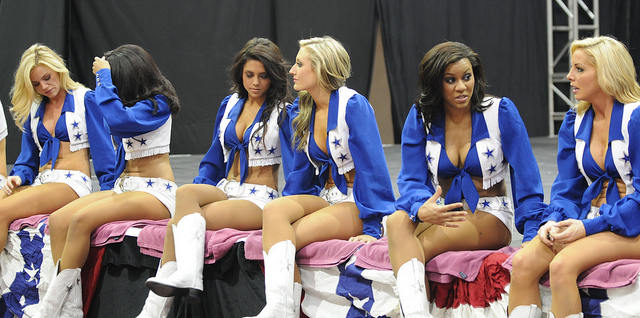
Consider the Laker girls or Dallas Cowboy Cheerleaders. To many, these women are beautiful and sexy. However, their perceived beauty is in part a visual illusion, created by the fact that cheerleaders appear as a group rather than solo operators. Any one cheerleader seems far more attractive when she is with her team than when she is alone. …
[Researchers Drew] Walker and [Edward] Vul posit that the cheerleader effect arises from the interplay of three different visuo-cognitive processes.
First, whenever we view a set of objects like an array of dots or a group of faces, our visual system automatically computes general information about the entire set, including average size of group members, their average location, and even the average emotional expression on faces. Thus although the group contains many individual items, we naturally perceive those items as a set, and form our impressions on the basis of the collective whole.
In addition, the impression that we have of the group as a whole influences our perception of any one individual item. We tend to view individual members as being more like the group than they actually are. Thus when we see a face in a crowd, we tend to perceive that face as similar to the average of all the faces in that crowd. As it turns out, we find average faces very attractive. Composite faces, which are generated by averaging individual faces together, are rated as significantly more attractive than the individual faces used to create them. According to Walker and Vul, if presenting a face in a group causes us to perceive that face as more similar to the average, we are likely to find that face more attractive.
(Image of Dallas Cowboys cheerleaders via Flickr user USAG-Humphreys)
Maria Konnikova considers why, “in the current media environment, a list is perfectly designed for our brain”:
Lists … appeal to our general tendency to categorize things—in fact, it’s hard for us not to categorize something the moment we see it—since they chunk information into short, distinct components. This type of organization facilitates both immediate understanding and later recall, as the neuroscientist Walter Kintsch pointed out back in 1968. Because we can process information more easily when it’s in a list than when it’s clustered and undifferentiated, like in standard paragraphs, a list feels more intuitive. In other words, lists simply feel better.
But the list’s deepest appeal, and the source of its staying power, goes beyond the fact that it feels good.
In 2011, the psychologists Claude Messner and Michaela Wänke investigated what, if anything, could alleviate the so-called “paradox of choice”—the phenomenon that the more information and options we have, the worse we feel. They concluded that we feel better when the amount of conscious work we have to do in order to process something is reduced; the faster we decide on something, whether it’s what we’re going to eat or what we’re going to read, the happier we become. Within the context of a Web page or Facebook stream, with their many choices, a list is the easy pick, in part because it promises a definite ending: we think we know what we’re in for, and the certainty is both alluring and reassuring. The more we know about something—including precisely how much time it will consume—the greater the chance we will commit to it.
The process is self-reinforcing: we recall with pleasure that we were able to complete the task (of reading the article) instead of leaving it undone and that satisfaction, in turn, makes us more likely to click on lists again—even ones we hate-read. The social psychologist Robert Zajonc, who made his name studying the connection between emotion and cognition, argued that the positive feeling of completion in and of itself is enough to inform future decisions. Preferences, goes his famous coinage, need no inferences.
Previous Dish on the allure of the list here, here, and here.
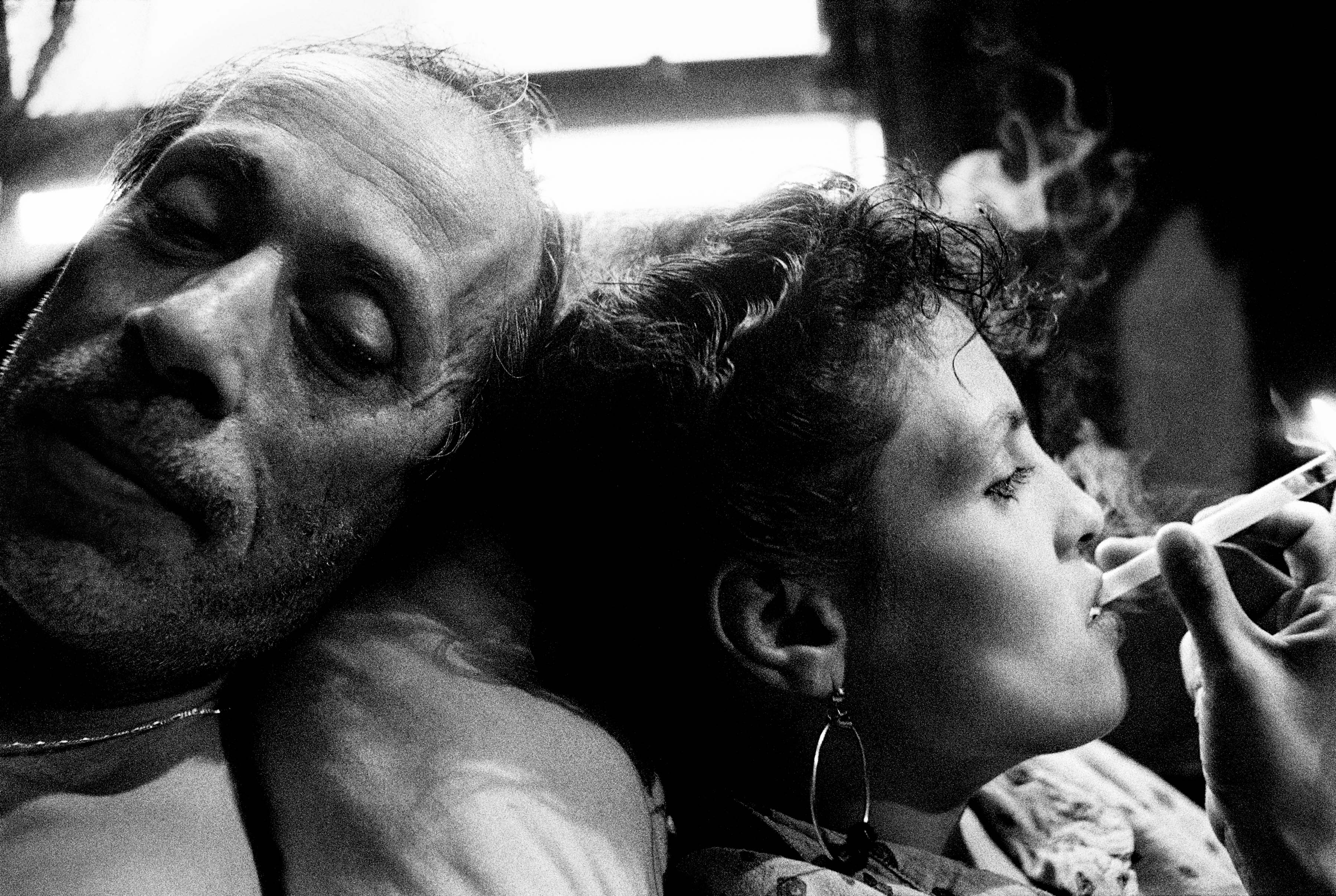
For 31 years, photographer Marc Asnin documented his maternal uncle, Charlie Henschke, creating a raw and unflinching series he edited into a book titled Uncle Charlie, published last year by Contrasto. It’s a journey that began during Asnin’s freshman year of college, when the photographer-nephew still felt hero-worship for his uncle and discovers the many problems his uncle faced.
As a boy, Asnin admired his uncle and his rebellious nature: Henschke was tattooed, kept a gun in his glove compartment, and knew the streets. Although Asnin knew everything wasn’t perfect behind that façade, the complexities behind the image began to emerge as the project advanced. … The book, which features Henschke’s commentary on his own life, is startlingly honest. Although Asnin warned Henschke that he might not want to share specific parts of his life, Henschke refused, saying, “No, that’s how I feel, and I want everyone to know that, including my children.”
(Caption via Behold: “After his second marriage dissolved, Charlie started a new relationship with Blanca, a woman 25 years younger than him. In this photo, Blanca is smoking crack.” Photo by Marc Asnin. More about his book, Uncle Charlie, is here.)
Focusing on the Discovery Channel’s new series Naked and Afraid – which chronicles the experience of “one man and one woman [who] are stranded nude in hostile wilderness without food or water for 21 days” – Joan Marcus examines how she is both drawn in and repulsed by the genre:
Over the years I’ve watched everything from the 2004 makeover show The Swan, in which normal-looking women undergo radical plastic surgery and then compete in a freakish beauty pageant, to Here Comes Honey Boo Boo, that grotesque excuse to mock the taste level and dietary habits of the working poor in rural Georgia. I teach a college pop culture seminar, and I like to write about pop culture, which gives me a handy excuse to indulge in reality dreck ad infinitum.
Shows are always upping the ante — increasing the shock factor, finding new ways to traffic in the risqué, the humiliating, the dangerous and disgusting. The more morally questionable a show is, the more likely I am to tune in on the excuse that anything this excessive has to be examined. I do like to think about how, in affording us the pleasure of judging real people in stressful and potentially humiliating situations, these shows palliate us — situating us comfortably in our own realities, reaffirming our cultural norms and making us more satisfied with our own lot in life. But of course my interest is not just intellectual. I’m as rabid a consumer as anyone, and shows like Naked and Afraid that push the boundaries of ethics and decency are on some primal level just a really, really good time.
Obviously I’m not alone here.
4.15 million viewers tuned in for the series premier of Naked and Afraid. The finale was the number one original cable show among women and men ages 25-54; a new two-hour special episode is set to air on December 8. The success of the first season isn’t surprising considering the provocative premise: a man and a woman who have never met, forced to partner up for survival and companionship without one stitch of clothing other than what they can find or make. They have to sleep in close quarters, in makeshift shelters, perhaps huddled together for warmth. They are survivalists, so most likely superior physical specimens who should make for pleasant TV viewing as they bathe in streams and lagoons, haul wood and tend fire and thrust handmade spears into the vitals of wild animals.
But Naked and Afraid turns out not to be particularly sexy. Those of us who tuned in for the nudity probably stuck around for something more troubling: The experience of seeing people at their most vulnerable under constant risk of bodily harm. It’s cringe-worthy, all that unprotected human flesh exposed to every threat imaginable, from sand flies and leeches to caimans and pit vipers.
“We’re just warm, pink, soft bodies,” Billy Berger complains in episode six as he slogs crotch-deep through the Louisiana bayou. “Everything … wants to take a bite of us.” Pinkness does appear to be a distinct disadvantage on this show. In episode three, filmed on a sun-scorched scrap of land in the middle of the Indian Ocean, Jonathan Klay burns brick red and spends days lying in the sand and moaning. His partner Alison Teal fairs better, suffering only debilitating menstrual cramps and the standard starvation and dehydration routine. I feel for Teal — two days of crippling dysmenorrhea would have me out of the game for sure — but all in all she does well in the Maldives compared to cast members in other episodes. E.J. Snyder steps on an acacia thorn in Tanzania and gets a gruesome infection in the sole of his foot — we see a stomach-churning close-up of the medics slitting the wound and draining the suppuration while he screams his head off. Laura is covered head to toe in sand fly bites, her entire body miserably swollen. Billy and Ky get trench foot. Kim falls deathly ill from bad turtle meat. Puma drinks contaminated water and is carted away on a stretcher. It’s like a live action version of Edward Gorey’s Gashlycrumb Tinies, so macabre it’s hard to believe all of this is really being served up as entertainment.
Meanwhile, the Pulitzer Prize-winning writer Edward P. Jones describes his fascination with reality TV and lurid Internet news stories:
INTERVIEWER: You’ve said that TV was a kind of company for you.
JONES: People pooh-pooh it, but on the court shows there’s something wonderful at times, and also awful. There was one episode, I remember, on Judge Judy. This handsome mother and her teenage daughter were suing another woman over two cell phones. They had seen them on eBay and what the woman ultimately sent them was a page showing two cell phones. The woman’s defense was that that’s what they were looking at, that’s what they got. The utter gall of people in life!
Other things I like to watch are true-crime shows—Dateline, 48 Hours. I’m fascinated by the awful, awful things that human beings do to each other. Just the other day, on Huffington Post—AOL is the page that my computer opens up to—a father took his six-week-old infant, because the child was crying, and he put her in the freezer. Luckily, she was saved.
I have been trying to help a friend of mine with her novel over the past few years, and what I noticed, and told her, is that she was failing to show the awfulness of human beings. I’m just fascinated by that father. Because I’ve never done a thing like that, could never conceive of doing that. To see people do these things—I don’t know, I feel blessed.