Big Data vs The Mob

Alberto Mucci spotlights the activist group Spaghetti Op​en Data, which he describes as “one of the Italy’s most important and determined groups in the 2.0 fight against the country’s organized crime networks”:

Last spring the collective met in Bologna for a four day hackathon the at culminated in the “Conf​iscatiBene” (Italian for “seized goods”) project: a national database able to gather and organize with clarity and in a single place (this might seem obvious, but it’s really not the case in Italy) a list of all goods confiscated by the Italian authorities from the Mafia.

Before Spaghetti Open Data, accessing such information was nearly impossible. I’ll use myself as a case study to demonstrate how demoralizing interacting with the Italian authorities can be.

If, for example, I decided I wanted to know what type of seized goods existed in a certain region of Sicily, I would have quickly discovered that the data I am looking for is dispersed in scattered regional, provincial and ministerial websites that are nearly impossible to read for anyone without the patience of a saint and a degree in IT from Stanford. Let’s say that after a week of scraping, I got fed up with the databases and decided to pick up the phone. The results would be similar. The Italian institutions fighting against the Mafia usually don’t share the database among each other; rather they operate independently (moved at times by petty jealousies, and internal power struggles) and create situations where the work of different departments overlaps and everything ends up becoming more confusing that it should be.

“Sometime you have this paradoxical situation where, for example, the anti-Mafia police (DIA) in Palermo do not have immediate access to the information they need on another part of the country,” Andrea B​orruso, a member of Spaghetti Open Data, tells me during a Skype interview. “It’s ridiculous and totally inefficient.” Why is this so important? Because easy and efficient access to data is key in the fight against the increasingly powerful networks of the Mafia.

And then there’s Mafialeaks.
The Best Of The Dish Today

Is the gang-rape story at UVA credible? We’ve been covering it for a while now – perhaps a little too credulously – but a reader did raise some questions about its credibility in our second post. My old roommate and friend, Rich Bradley, had a ballsy must-read on it last week that raises one obvious question: why did the reporter not even try to talk to any of the alleged rapists? This should set off alarm bells for any editor, and yet the editor insists all due skepticism was applied, even though he never personally spoke with Jackie. I’m sorry but if you’re running a story about such a terrible accusation relying on one key source and do not personally vet that source, you’re not doing your job. Tom Maguire even dug up a comment on the NYT message board for a piece on the rape that claims first hand knowledge that some quotes in the piece were indeed made up. Erik Wemple has also weighed in:

This lapse is inexcusable: Even if the accused aren’t named in the story, Erdely herself acknowledges that “people seem to know who these people are.” If they were being cited in the story for mere drunkenness, boorish frat-boy behavior or similar collegiate misdemeanors, then there’d be no harm in failing to secure their input. The charge in this piece, however, is gang rape, and so requires every possible step to reach out and interview them, including e-mails, phone calls, certified letters, FedEx letters, UPS letters and, if all of that fails, a knock on the door. No effort short of all that qualifies as journalism.

I have to agree. That doesn’t mean the gang-rape didn’t happen; and it doesn’t mean that the university’s response was defensible. It does mean that when you’re reporting on a terribly serious and appalling crime, you talk to as many of those involved as you possibly can. I have a feeling that this story is by no means over.

Today, on the good news fronts (to me, at least): HIV is getting weaker as a virus and the number of abortions is back down to pre-Roe levels; Obama has made slow but real progress in isolating Ebola, ISIS and Putin; and Hillary Clinton is less popular than at any point since 2009. I also made the case that the Schumer critique of Obama putting healthcare reform before economic recovery disintegrates upon inspection. Plus: another awesome fall window; a weed breathalyzer makes its debut; and a comedian tells stories about his gigs on campuses.

The most popular post of the day was Walking While Black (updated here); followed by Listening.

Many of this week’s posts were updated with your emails – read them all here.  You can always leave your unfiltered comments at our Facebook page and @sullydish. 22 more readers became subscribers today. You can join them here – and get access to all the readons and Deep Dish – for a little as $1.99 month. Gift subscriptions are available here. Dish t-shirts are for sale here and our new mugs here.

A reader comments on our latest transparency update:

Congrats on the slow and steady growth.  I’ve been a loyal and daily reader for somewhere around a decade now and subscribed as soon as you started your new model.  Here’s what will lose me faster than anything: if you go the way of so many websites that have to have a massively cluttered webpage with ads here and there, countless articles to link to. Most news sites and blogs have turned into a mess in their efforts to be all things to all people. Besides your varied content, what I love best about your website is the very simple set-up and interface.  Change that and you’ll lose me.

Slow and steady is a beautiful thing, even in the Internet age.

And often especially so. See you in the morning.

Quote For The Day

US-CRIME-POLICE-RACE-UNREST

“After the funeral, while I was downtown desperately celebrating my birthday, a Negro soldier, in the lobby of the Hotel Braddock, got into a fight with a white policeman over a Negro girl. Negro girls, white policemen, in or out of uniform, and Negro males—in or out of uniform—were part of the furniture of the lobby of the Hotel Braddock and this was certainly not the first time such an incident had occurred. It was destined, however, to receive an unprecedented publicity, for the fight between the policeman and the soldier ended with the shooting of the soldier.

Rumor, flowing immediately to the streets outside, stated that the soldier had been shot in the back, an instantaneous and revealing invention, and that the soldier had died protecting a Negro woman. The facts were somewhat different—for example, the soldier had not been shot in the back, and was not dead, and the girl seems to have been as dubious a symbol of womanhood as her white counterpart in Georgia usually is, but no one was interested in the facts. They preferred the invention because this invention expressed and corroborated their hates and fears so perfectly. It is just as well to remember that people are always doing this. Perhaps many of those legends, including Christianity, to which the world clings began their conquest of the world with just some such concerted surrender to distortion. The effect, in Harlem, of this particular legend was like the effect of a lit match in a tin of gasoline. The mob gathered before the doors of the Hotel Braddock simply began to swell and to spread in every direction, and Harlem exploded,” – James Baldwin, “Notes of a Native Son“.

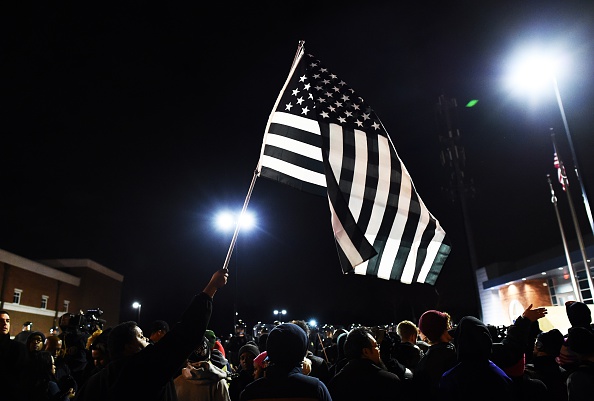
(Photo: A protester waves a “black and white” modified US flag during a march following the grand jury decision in the death of 18-year-old Michael Brown in Ferguson, Missouri, on November 24, 2014. By Jewel Samad/AFP/Getty Images.)

Faces Of The Day

BELGIUM-NATO-FOREIGN-AFFAIRS

From left to right, NATO Secretary General Jens Stoltenberg, Greek Foreign Minister Evangelos Venizelos and US Secretary of State John Kerry as they pose for a group photograph at the Foreign Affairs ministers’ meeting at the NATO headquarters in Brussels, on December 2, 2014. By John Thys/AFP/Getty Images.

The Costs Of Poor Hospital Design

They’re considerable:

Most of us have been lost in a hospital. The corridors all look the same, the signs for the department you want are there one minute and then gone the next. Everybody seems too busy for you to bother them asking for directions. Getting lost is not only a cause of stress to patients and their families, but, when staff have to give directions, it is also a waste of clinical time. One study in a 600-bed hospital estimated that poor wayfaring cost over $220,000 a year. Much of this was due to the 4,500 hours of clinical time a year – approximately two full-time positions – that was spent giving directions to lost patients and even staff.

Nostalgia As The Most Important Special Effect

Responding to the megaviral new teaser for the upcoming Star Wars sequel (seen parodied above), Ian Crouch reflects on George Lucas’ mixed legacy with the franchise, as well was what we might expect now that other creative forces have the reins:

Lucas, having created the “Star Wars” movies, committed the great sin in his prequels (“The Phantom Menace,” “Attack of the Clones,” and “Revenge of the Sith”) of not being much interested in re-creating the original trilogy. He gave up the spit-and-glue aesthetic of those films, whose clunky reminders of real-world physical realities were a key to their charm, in order to explore the early limits of digital filmmaking. Matters such as characterization or narrative (never mind acting) got lost along the way. It turned out that Lucas didn’t have much to say beyond the fact that he had new ways to say things. What resulted were technical marvels and boring, soulless movies. And then Lucas, perhaps chastised by the mass revolt against his new creations or else no longer interested in prolonging the space opera that built his career and maybe, in its way, derailed it, sold “Star Wars” to Disney, in 2012. Even in its low moments, “Star Wars” has been a cash cow, and Disney has promised not only a new trilogy but stand-alone spinoff movies as well. We’re about to get a lot of a galaxy far, far away—and whatever sanctity the franchise possessed in the eyes of its fans will ultimately get sequelled and prequelled out of us in the end.

But it hasn’t happened yet. In [J.J.] Abrams, Disney has chosen not only a director for its new movie but a dedicated librarian of a particular version of the franchise, a curator of the sights and sounds of his own childhood at the movies. (Abrams has performed something similar with his “Star Trek” reboots; here, he is attempting a rehabilitation, if not a resuscitation.) The teaser is less a preview of a movie than an assurance of Abrams’s bona fides as a fan, and his commitment to righting the wrongs of the prequels. By getting the details right, he has shown himself to be a trustworthy protector of the best parts of the original “Star Wars” movies. As to whether or not he has a new story to tell: wait til next year.

Dressed To Diagnose

Anna Reisman explains why doctors’ clothing matters:

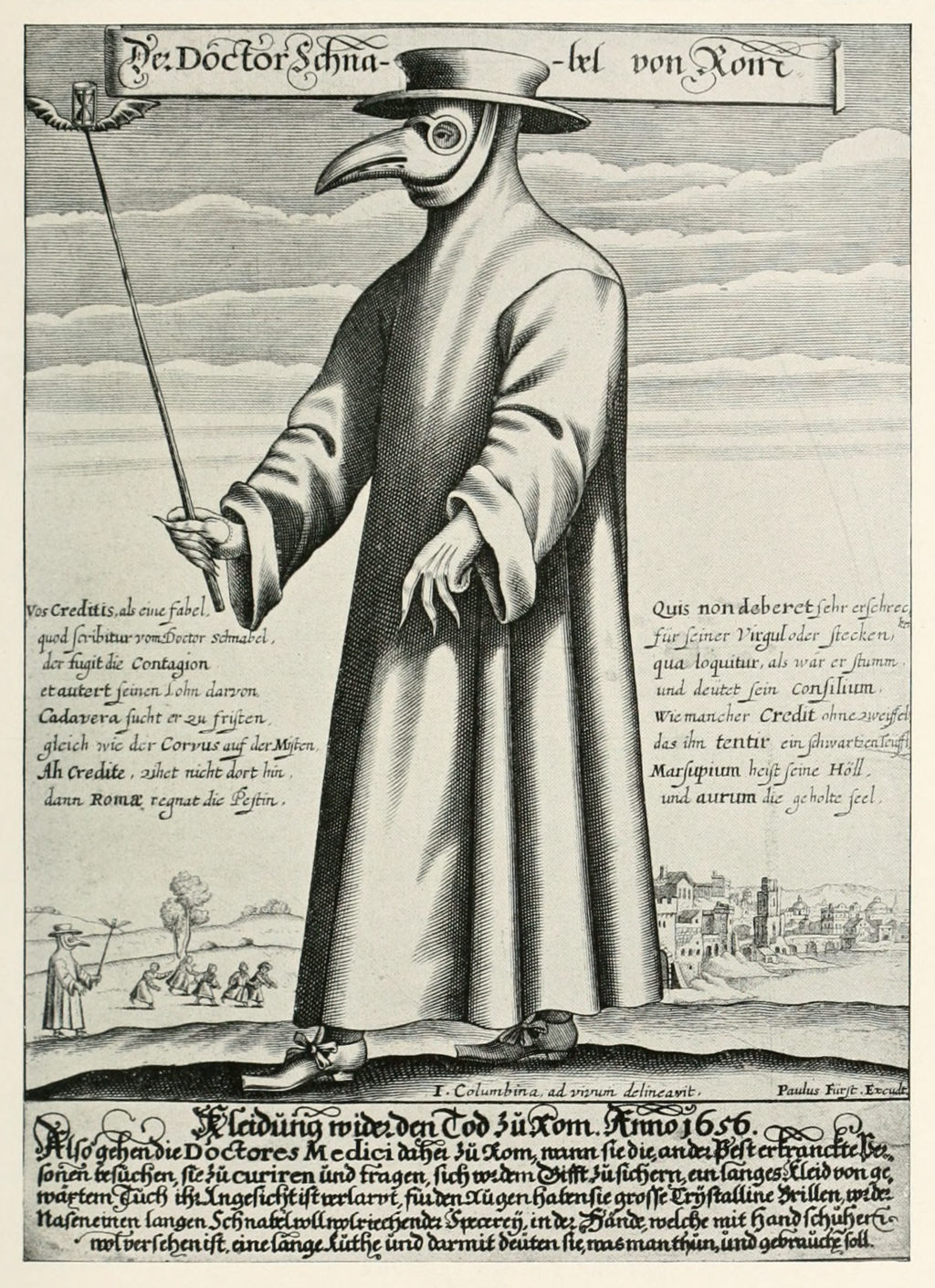
In days of yore, the doctor was clearly identifiable by the white lab coat over shirt and tie, his agreeable nurse counterpart unmistakable in white dress and cap (which, depending on one’s school, 1024px-Paul_Fürst,_Der_Doctor_Schnabel_von_Rom_(Holländer_version)might be shaped like a coffee filter, sailor’s cap, or a hamantaschen).  But in the 21st century, especially in primary-care medicine, much has changed; with more categories of clinicians (nurse practitioners, physician assistants) in every sphere of medicine, the traditional clinical clothing boundaries have blurred.

The definition of what counts as professional clothing is also in flux, thanks to increasing knowledge of infectious risks. Earlier this year, the Society for Healthcare Epidemiology Association (SHEA) published new guidelines for healthcare-personnel attire in hospital settings. Their goal was to balance the need for professional appearance with the obligation to minimize potential germ transmission via clothing and other doodads like ID badges and jewelry and neckties that might touch body parts or bodily fluids. The SHEA investigators’ take-home points regarding infection: White coats should be washed weekly, at the minimum; neckties should be clipped in place (70 percent of doctors in two studies admitted to having never had a tie cleaned); and institutions should strongly consider a “bare below the elbow” (BBE) policy, meaning short sleeves and no wristwatches or jewelry.

(Image via Wiki: “Paul Fürst, engraving, c. 1721, of a plague doctor of Marseilles. The plague doctor’s costume was the clothing worn by a plague doctor to protect him from airborne diseases. The costume consisted of an ankle length overcoat and a bird-like beak mask often filled with sweet or strong smelling substances (commonly lavender), along with gloves, boots, a brim hat, and an outer over-clothing garment.”)

A Marijuana Breathalyzer

It’s in development:

WSU chemistry professor Herbert Hill says that the team is using ion-mobility spectrometry – the same tech used by airport security and custom agents to detect drugs and explosives – and repurposing it for the new device. Unlike an alcohol breathalyzer, the WSU solution won’t determine how stoned a driver is, but instead just detect the presence of THC. After that, police would follow up with a blood test to be used as evidence in court, similar to an alcohol DUI.

David Knowles provides context:

While driving while stoned is against the law in all four states—Washington, Colorado, Alaska, and Oregon—where marijuana has been made legal for recreational use, as well in those where the drug has been given the green light for medical use, police have had to rely on blood tests and traditional standardized field sobriety tests such as walking a straight line. A 2012 studyfound that just 30 percent of those under the influence of THC failed the standard sobriety tests, and the results of blood tests can take up to twenty-four hours.

Samantha Murphy Kelly notes that this “isn’t the first time a product intended to keep marijuana-influenced drivers off the road has introduced”:

Earlier this month, a breathalyzer called Cannabix, which also detects THC in one’s system, was revealed at the National Marijuana Business Conference in Las Vegas. Cannabix is slated to roll out first to law enforcement and businesses, then to consumers; it is scheduled to hit the market next year.