Just let it play:
Putting Government Programs To The Test
The Obama administration has launched a series of evidence-based initiatives that have the potential to revolutionize the way the federal government funds social programs and what program sponsors at the state and local level must do to win and retain federal dollars. Specifically, grantees must show they are spending their federal dollars on programs that have evidence from rigorous evaluations of producing positive impacts on children’s development or achievement as measured by outcomes such as teen pregnancy, educational achievement or graduation rates, performance at community colleges, employment and earnings as young adults, or reducing rates of incarceration. Second, they must evaluate their programs using scientific designs to ensure that they are continuing to have impacts and to reform the programs if they are not.
This strategy requires a pipeline of social programs that have been tested and shown to be effective by rigorous evaluations. However, experience shows that most social programs, including some of the most celebrated such as DARE and Head Start, produce modest or no impacts that last when subjected to rigorous evaluations. An important virtue of focusing on evidence is not simply that the public will have reliable information about whether programs work, but that the evidence places pressure on programs to change and improve when they are not working.
He lists five examples of programs that work. One is a promising early-education initiative:
Success for All is a comprehensive school-wide reform program, primarily for high-poverty elementary schools, with a strong emphasis on early detection and prevention of reading problems before they become serious. Key program elements include daily 90-minute reading classes, each of which is formed by grouping together students of various ages who read at the same performance level; a K-1 reading curriculum that focuses on language development (e.g., reading stories to students and having them re-tell), teaching students the distinct sounds that make up words (i.e. phonemic awareness), blending sounds to form words, and developing reading fluency; daily one-on-one tutoring (in addition to regular classes) for students needing extra help with reading; and cooperative learning activities (in which students work together in teams or pairs) starting in the grade 2 reading classes.
The impact:
On average, 2nd-graders at Success for All schools score approximately 25-30% of a grade level higher in reading ability than their counterparts at the control schools.
Ebola, ISIS, Putin: Meep Meep Watch

Cast your mind back, if you can bear it, to the frenetic last days of the campaign in the mid-terms. The world, the GOP kept insisting, was coming undone – and everything was Obama’s fault. Somehow, Obama had fumbled the response to Ebola, letting infected people into the country, and risking a huge and fatal pandemic. At the same time, ISIS represented a grave threat to American security, was expanding with no limits in sight, proving that Obama had lost Iraq or thrown “victory” away in an act of reckless disengagement. And for good measure, Russia’s Putin was running rings around the president, creating a new world order in the Caucasus, while Obama fecklessly wrung his hands.
As a piece of political performance art, you have to hand it to the Republicans. They rolled up so many base-tingling themes into one hellish, end-times scenario: Obama as Carter, unable to stand up to the Soviets Russians; Obama as secret Muslim terrorist, standing by as Islamists terrorized Iraq and Syria; Obama as a dangerous import from Africa, which is why, we were told, the “O” in Ebola stood for Obama.
Funny, isn’t it, that almost all these themes evaporated after the election. And we now, moreover, have more time and evidence to judge how the president has responded to these different, emergent challenges. There have been no new Ebola cases in the US since the election; and the demon doctor who went bowling is now cured. Today, Obama touted some other measures of progress:
The administration announced Tuesday that it has set up a network of 35
hospitals across the country to deal with Ebola patients. It also said that the number of labs that can test for Ebola has increased from 13 in 13 states in August to 42 labs in 36 states. The White House said the administration has also increased the deployment of civilians and military personnel in West Africa, bumping the U.S. presence to about 200 civilians and 3,000 troops. It said the U.S. has opened three Ebola treatment units and a hospital in Liberia …NIH researchers last week reported that the first safety study of an Ebola vaccine candidate found no serious side effects, and that it triggered signs of immune protection in 20 volunteers. U.S. health officials are planning much larger studies in West Africa – starting in Liberia in early January – to try to determine if the shots really work.

The downside? The GOP is unlikely to apportion enough money to keep the progress up. Concern about Ebola seems to be acutely timed to election campaigns. Afterwards? No longer that worried.
Then the campaign against ISIS. I’m still opposed to what the administration has done. But it behooves me to note today’s key measure of real progress – the new Iraqi prime minister’s deal with the Kurds on oil revenues:
In reaching a deal, Mr. Abadi, who has been prime minister for less than three months, has further distanced his government from a legacy of bitter sectarian and ethnic division under his predecessor, Nuri Kamal al-Maliki. As prime minister, Mr. Maliki deeply alienated the Kurds and enraged Iraq’s Sunni Arab minority with his confrontational personality and policies that were seen as both exclusive and abusive. “The new team, under Abadi, is a cooperative team, a positive team,” said Mr. Zebari, a Kurdish politician who was also Iraq’s foreign minister in the Maliki government.
This is the easy part, compared with an attempt to include the currently revolting Sunnis into a genuinely multi-sectarian government, and to roll back the territorial gains of the Islamic State. But it’s a start. My own skepticism about whether Abadi was truly a unifying figure deserves provisional retirement. And the IS has been rolled back in several key areas. And Kobani has not fallen. If you take Obama’s posture at face value – that he was trying to prevent much worse happening in Iraq and laying out a years-long strategy to nudge Iraq’s democracy along – I can’t see clear evidence that he has failed. Within the very limited goals he set, he has so far succeeded.
Then Putin.
The right was all aglow either with envy of the diminutive tantrum-thrower or with disgust that he had so easily rolled the West on Ukraine. Many found the slow, undramatic unfolding of sanctions as pathetically weak in the face of such unvarnished aggression. But, again, look where Putin is now. I’m with Kevin Drum:
Ukraine is more firmly allied to the West than ever. Finland is wondering if it might not be such a bad idea to join NATO after all. The Baltic states, along with just about every other Russian neighbor, are desperate to reinforce their borders – and their NATO commitments. Russia has been dumped from the G7 and Putin himself was brutally snubbed by practically every other world leader at the G20 meeting in Brisbane. Economic sanctions are wreaking havoc with the Russian economy. China took advantage of all this to drive a harder bargain in negotiations over the long-planned Siberian gas pipeline. Even Angela Merkel has finally turned on Putin.
Russia, meanwhile, is headed for an outright recession next year, hobbled by sanctions and the collapsing oil price (caused in part by America’s shale oil revolution in the Obama years). Now, as with Ebola and ISIS, there are obvious caveats. Obama’s successful cornering of Putin could mean the dictator could get even more reckless; Ukraine remains torn apart in the East. But from the perspective of now, does Putin seem the stronger strategist or does Obama?
I point this out because the conservative media-industrial complex is really about delivering news that can work as political messaging. When the news doesn’t fit that template, they move swiftly on to something else that does. But reality tells us something different: that you should judge a presidency not by short-term panics, but by long term progress in the face of contingent events. Six years after the worst recession since the 1930s, we have accelerating growth, a collapsing deficit, falling healthcare costs and universal health insurance; a decade after the Federal Marriage Amendment, we have over 30 states with marriage equality; six years since Obama took office, we have the toughest new carbon regulations yet on the books and an agreement with China.
I’ll say it again. Meep meep.
(Photo: Win McNamee/Getty)
Ruble Trouble, Ctd
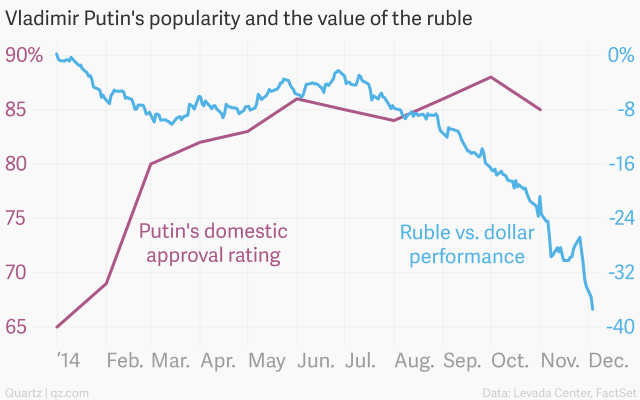
With oil prices on the downslope, Russia’s currency has been losing value for weeks. But yesterday, it suffered its steepest one-day drop in value since the country’s 1998 financial crisis. In most countries, such a precipitous decline would set off alarm bells, but Jason Karaian doubts Putin will do anything about the falling ruble unless or until it starts to cut into his favorables:
Despite the steady economic deterioration—as reflected by the tumbling ruble—Putin’s popularity at home has soared. Granted, the president’s approval rating slipped from 88% in October to 85% last month, but that will hardly ring alarm bells around the Kremlin. Putin says he wants to stay in power for another 10 years, and the recent polls show the he will probably experience little resistance in doing so. A survey yesterday (link in Russian) suggested that he would win more than 80% of the vote if he faced re-election today.
Bershidsky argues that Putin is taking a bigger risk than he thinks:
Putin has explained the government’s strategy this way: The national budget is denominated in rubles, not dollars, and as Russia’s main export, oil, loses dollar value, the currency devaluation offsets the loss. This allows the government to keep its promises for social programs, in nominal terms. As imports drop, the theory goes, domestic producers will pick up the slack, and most Russians aren’t going to feel much of a pinch unless they travel outside the country or buy a lot of imported clothes, electronics and fancy foods. In any case, the people who do such things aren’t Putin’s biggest supporters. He relies on the poorer, older, more nostalgic and less educated electorate, which wouldn’t be hurt by the devaluation.
The problem with these expectations, of course, is that Russia imports a lot of the most basic products. … Even lower middle class Russians will notice when they can no longer afford shoes, cosmetics, medicine or cheap electronics.
Zachary Karabell, on the other hand, sees the falling ruble as giving Putin a chance to double down on his proto-fascist tendencies:
The not-so-veiled chortling in the United States and elsewhere that lower prices will force changes in Russia is, therefore, premature at best. If anything, lower prices could lead to more xenophobia and nationalism, and more Russian aggression over Ukraine and natural gas to Europe as Putin finds other ways to maintain power and prestige at home. It also is leading Russia to attempt to build stronger ties with China, as a way to inoculate itself from vulnerability to Western markets and finance. And Putin surely realizes that commodities are a risky foundation. No one country can control prices and being dependent on commodities means that you are never in control of your own destiny. This recent shock is one more spur for Russia to make more of what it needs itself, if it can.
The Left, The Campus, And The Death Of Humor, Ctd
A reader writes:
I am a comic who, until I got a TV writing job a year ago, made most of my income touring colleges. It’s not as black and white as Chris Rock’s interview suggests. Different types of schools have different crowds, just as clubs in every city differ. Engineering schools have better crowds than even the best clubs. They’re intelligent and earnest. Jesuit schools are great too. Major public universities are like club audiences, but younger. They’re a little bit of everything.
Then you have the worst two: liberal arts colleges and Christian schools. The two political extremes are the worst. But they’re horrible in different ways.
Liberal arts schools are exactly as Rock describes. Christian schools aren’t bothered by political correctness. They just want their comedy to be “nice.” They get uncomfortable when you’re dark. Who wants nice comedy?
My trick for these schools is a “fuck these people” approach. I just do everything I know they won’t like. When they get uncomfortable, I let them know that they’re wrong. At first, they don’t like that. Usually, after 2-3 times of calling them out for being awful, they loosen up, realize no one is getting hurt, and enjoy the rest of the show. The worst thing you can do is pander to them. You have to confront their uptightness. Usually they change. Sometimes the Christian schools never come around, but the liberal arts schools almost always do.
The bookers at these schools are the real problem, much more so than the general student body. Check out this email my comic friend just got from Swarthmore:
I thought I would be the first to take a crack at explaining uptight Swatties to you…
Something I like about Hari Kondabolu is he distinguishes between offensive and hurtful — so, jokes can be offensive or crude, without being hurtful. Things that are hurtful: rape, racism… We can talk about whether funny rape jokes are possible (personally, I think Louis CK pulls it off, because his jokes are about rape culture, instead of the “haha she was raped”). Jokes about race are funny, but I would recommend against relying on racial stereotypes, and I think Swatties would like it better if a racist was the butt of a joke instead of a victim of racism. I also would stay away from things like acting “retarded” or making fun of disabled people for being different. Sorry, I’m not trying to be the PC police here!!
Swatties would laugh if you made a joke about them being uptight/righteous/liberal/whatever, and they would laugh at jokes about how frequently we say “problematic” and “heteronormative”. Swatties are overly intellectual, geeky, and socially awkward. Although we do have significant number of student athletes, religious students, and sorority/fraternity members, they are made fun of more here than you might see elsewhere. We never get enough sleep, study too much, watch too much Netflix, and frequently complain about our dining hall… Typical college kid stuff.
Relevant to the night you are performing: we never have successful Friday night parties (because homework..?). I think a lot of people will come out to this, though, since we never have this kind of campus event, and non-party-Friday-night-things usually go well.
I want you to have the best show you can, so I am just sharing my thoughts on how to keep the crowd with you.
I told him to do whatever he would do if he didn’t get that email. If people don’t like him, fuck them. He did that and had a great set. Sometimes I think young people on the left only want to be uptight and sometimes forget and have fun for a few minutes.
Thanks for covering this subject.
Another continues to:
Regarding humor and political correctness, Paul Cantor, the University of Virginia Shakespeare scholar, wrote a wonderful essay titled, “Cartman Shrugged“, which explores the transgressive humor of South Park. The genius of Parker and Stone is that they are left to defend freedom from the encroachments of both right and left. Both sides have their own versions of political correctness, or cant or pieties. And both need to be skewered, relentlessly, to protect everyone else’s freedom:
This is where libertarianism enters the picture in South Park. The show criticizes political correctness in the name of freedom. That is why Parker and Stone can proclaim themselves equal opportunity satirists: they make fun of the old pieties as well as the new, ridiculing both the right and the left insofar as both seek to restrict freedom.
“Cripple Fight” is an excellent example of the balance and evenhandedness of South Park… The episode deals in typical South Park fashion with a contemporary controversy, one that has even made it into the courts: whether homosexuals should be allowed to lead Boy Scout troops. The episode makes fun of the old-fashioned types in the town who insist on denying a troop leadership to Big Gay Al (a recurrent character whose name says it all). As it frequently does with the groups it satirizes, South Park, even as it stereotypes homosexuals, displays sympathy for them and their right to live their lives as they see fit.
But just as the episode seems to be simply taking the side of those who condemn the Boy Scouts for homophobia, it swerves in an unexpected direction. Standing up for the principle of freedom of association, Big Gay Al himself defends the right of the Boy Scouts to exclude homosexuals. An organization should be able to set up its own rules, and the law should not impose society’s notions of political correctness on a private group.
This episode represents South Park at its best—looking at a complicated issue from both sides and coming up with a judicious resolution of the issue. And the principle on which the issue is resolved is freedom. As the episode shows, Big Gay Al should be free to be homosexual, but the Boy Scouts should also be free as an organization to make their own rules and exclude him from a leadership post if they so desire.
This libertarianism makes South Park offensive to the politically correct, for, if applied consistently, it would dismantle the whole apparatus of speech control and thought manipulation that do-gooders have tried to construct to protect their favored minorities.
Laboring Before Delivery
Claire Zillman provides background on Young v. UPS:
When [Peggy Young] became pregnant and a midwife instructed her not to lift packages over 20 pounds, Young asked to return to UPS to do either light duty or her regular job as a truck driver, which seldom required her to lift heavy boxes. According to Young’s Supreme Court petition, her manager told her that UPS offered light duty to workers who sustained on-the-job injuries, employees with ailments covered by the Americans With Disabilities Act, and those who had lost Department of Transportation certification because of physical aliments like sleep apnea; not—the manager said—to pregnant workers. UPS wouldn’t allow Young to return to her former role either since her lifting restriction made her a liability. As a result, Young was required to go on extended, unpaid leave, during which she lost her medical coverage.
Oral arguments are scheduled for tomorrow. Lyle Denniston explains what is at stake:
For nearly four decades, it has been a form of illegal discrimination in the workplace to treat women workers unequally, just because they become pregnant. But it still is not entirely clear just how much and what kind of equality that provision imposes on businesses.
They clearly cannot treat pregnancy as a reason to fire a worker, or cut her pay, or to deny her health benefits. That is outright discrimination based on sex, under the Pregnancy Discrimination Act, added in 1978 to Title VII of federal civil rights law
But women’s rights advocates, and the U.S. Equal Employment Opportunity Act, take the position that the Act adds another layer of protection for pregnant workers: if an identified group of workers on the payroll gets lighter duty, or easier inside-the-plant assignments such as paperwork or answering phones, because they are temporarily disabled, the same opportunity should be available to workers whose doctors limit the kind of work they can do during pregnancy.
Gillian Thomas remarks that “Young’s story is increasingly typical”:
Women now constitute close to half the workforce, and three-quarters of them will be pregnant at least once during their working lives. Most pregnant women stay on the job right up until their due dates; according to a U.S. Census Bureau study, in the past 50 years, the number of women working into their ninth month more than doubled, with a whopping 82 percent of women who gave birth between 2006 and 2008 working into their final month of pregnancy. Coupled with these demographic realities are pregnancy’s medical realities: Even an uncomplicated pregnancy can cause nausea, migraines, urinary tract infections, carpal tunnel syndrome, back pain, shortness of breath, dizziness, and chronic fatigue while more serious conditions include diabetes, deep vein thrombosis, placenta previa, and pre-eclampsia. For women in jobs that involve prolonged standing (retail clerks, cashiers), are physically strenuous or dangerous (firefighters, law enforcement officers), or include contact with toxic materials (janitors, hotel housekeepers), pregnancy can be in direct conflict with their ability to work. Simply put, in order to continue earning a paycheck while pregnant, many women will need their employers to make some adjustments.
Bryce Covert covered the case back in October. Even if Young’s case fails, progress is being made at the local level:
Nine states have passed Pregnant Worker Fairness Acts that require all employers to give pregnant workers reasonable accommodations, like providing a stool or granting light duty, unless they would impose an undue hardship. The company says the new policy “will aid operational consistency given that a number of States in which UPS operates have relatively recently mandated pregnancy accommodations.”
These state laws may force other employers’ hands. “We see that these state pregnancy accommodation laws enacted recently really have made a tremendous difference,” [director of the ACLU’s Women’s Rights Project Lenora] Lapidus said. “There’s sort of a tipping point that has been reached where now a number of states have passed pregnancy accommodation laws, so companies that operate in multiple states really should…be changing their laws to comply.”
More Bad News For Syrian Refugees

Back in September, the UN’s World Food Program warned that it was running out of money to feed the millions of Syrians both inside and outside the country who now rely on the agency for food. The warning was not heeded, pledged cash never turned up, and sure enough, the WFP announced yesterday that it was suspending a food voucher program that provides badly needed assistance to some 1.7 million Syrian refugees:
Under this programme, poor Syrian refugees in Jordan, Lebanon, Turkey, Iraq and Egypt have used vouchers to buy food in local shops. Without WFP vouchers, many families will go hungry. For refugees already struggling to survive the harsh winter, the consequences of halting this assistance will be devastating.
“A suspension of WFP food assistance will endanger the health and safety of these refugees and will potentially cause further tensions, instability and insecurity in the neighbouring host countries,” said WFP Executive Director Ertharin Cousin, in an appeal to donors. … Cousin said that WFP’s Syria emergency operations are now in critical need of funding. Many donor commitments remain unfulfilled. WFP requires a total of US $64 million immediately to support Syrian refugees in neighbouring countries during the month of December.
Exactly which donor countries are skirting their commitments to the WFP is not entirely clear:
While WFP didn’t name which countries haven’t made good on their commitments, foreign ministers from Germany, Finland and Sweden told reporters in Copenhagen their countries could do more to fill the funding gap. “We have to strengthen our engagement and give humanitarian aid for the refugees and strengthen the structure of those countries who are hosting the refugees,” German Foreign Minister Frank-Walter Steinmeier said. … The United States, which has stumped up more than $3 billion for the Syrian people including some $935 million for the WFP since the start of the conflict, also voiced concern.
For refugees in Jordan the injury is compounded by the government’s announcement that it can no longer afford to provide free healthcare for Syrians. Worse still, Howard LaFranchi adds, Syria isn’t the only place where food aid agencies are being forced to cut corners:
Already last month, the [WFP] said that low supplies were forcing it to cut food rations for the half-million refugees from South Sudan and Somalia it feeds in camps in Kenya. Conflict in the Central African Republic and recent devastating floods in Somalia – which is barely recovering from decades of war – have left millions more with precarious food sources. In West Africa, the Ebola crisis is discouraging farmers in Guinea, Liberia, and Sierra Leone from tending fields and getting produce to markets. More than a million West Africans could soon face food shortages, humanitarian groups working there say.
The prospect of burgeoning food assistance needs is leading international governmental organizations like WFP to issue urgent calls for emergency funding, while non-governmental organizations are revising upward their prognostications for emergency assistance needs next year. As one example, the International Red Cross announced last week that in order to meet “vastly expanding needs” that in some cases are due to “new kinds of crises,” it has set a goal of raising nearly $1.7 billion for emergency assistance in 2015 – a full quarter more than what it sought to raise from donors for 2014.
Murtaza Hussain is furious that the US and our allies are spending millions of dollars a day dropping bombs on ISIS while aid programs fall short:
“Humanitarian intervention” in this context has come to be nothing more than a crude euphemism for the act of bombing. A far more impactful, less morally ambiguous, and incredibly cheaper form of “intervening” would be to provide desperately needed aid to a displaced civilian population facing a true humanitarian emergency. Instead, political and military figures continue to expend huge sums on munitions and military logistics based on the disingenuous claim that they are “helping” the population which is being bombed. Needless to say, if this intervention had anything to do with helping Syrians its overwhelming priority would be providing aid to refugees, and most crucially providing them asylum as well. But on both these counts, the United States and its coalition have been doing poorly.
(Photo: A Syrian refugee woman sells napkins with a disabled relative as she sits on the sidewalk in downtown Beirut on December 2, 2014. Aid workers fear a major humanitarian crisis for millions of Syrian refugees in the Middle East after funding gaps forced the United Nations to cut food assistance for 1.7 million people. The UN’s World Food Programme said it needed $64 million (51 million euros) to fund its food voucher programme for December alone, and that “many donor commitments remain unfulfilled”. By Joseph Eid/AFP/Getty Images)
North Korea Is Not Amused
It appears Kim Jong-Un can’t take a joke:
Sony Pictures Entertainment is exploring the possibility that hackers working on behalf of North Korea, perhaps operating out of China, may be behind a devastating attack that brought the studio’s network to a screeching halt earlier this week, sources familiar with the matter tell Re/code. The timing of the attack coincides with the imminent release of “The Interview,” a Sony film that depicts a CIA plot to assassinate North Korean leader Kim Jong-Un. The nation’s ever-belligerent state propaganda outlets have threatened “merciless retaliation” against the U.S. and other nations if the film is released.
Anna Fifield puts the cyber attack in context:
Although no one but the most elite of the elite has access to the Internet in North Korea, the Kim regime has been building quite a cyber army and it has a record when it comes to devastating cyber attacks. Pyongyang was blamed for a massive hack on South Korean sites – including government, media and banking sites – last year that coincided with the anniversary of the start of the Korean War.
Alan Woodward questions whether North Korea is really to blame:
North Korea quite possibly has motive, means and opportunity to carry out this attack on Sony, but as with any successful prosecution, that isn’t enough. We need evidence. We will have to wait for the detailed forensic work to complete before we stand a realistic chance of knowing for certain.
That may or may not be forthcoming, but in the meantime we should consider what this event tells us about the balance of power in cyberspace. In a world in which major disruption can be caused with scant resources and little skill, all enemies are a threat. North Korea might be the rogue state that everyone loves to hate but there are plenty of others who could have done it.
On the other hand, North Korea isn’t denying that is was responsible. And the WSJ reports that the hackers “used tools very similar to those used last year to attack South Korean television stations and ATMs.” Regardless, the hack could have serious economic consequences for Sony:
So far the biggest tangible result of the hack seems to be the leak of five Sony films. DVD-quality versions of Fury, Annie, Still Alice, Mr. Turner and To Write Love on Her Arms are all now available on file-sharing sites. All of the movies except for Fury have yet to be widely released, so piracy could be a huge blow to their box office take. Over the summer, The Expendables 3 bombed at the box office because a high-quality version of the movie leaked online weeks before it premiered. And a 2011 Carnegie Mellon study found that such pre-release leaks can reduce a movie’s box office take by as much as 19%.
Thoughts On Affirmative Action, Ctd
A reader pushes back a bit:
I feel like you’re talking out of both sides of your mouth here. On the one hand, you say that use oppose affirmative action in the way that it explicitly uses race as a factor in determining admissions as being unfairly discriminatory towards qualified students. Yet, at the same time, you favor California’s 10% policy as a substitute, even though the only reason this works is because it draws on our country’s structural and institutional racism. So you’re against affirmative action if it happens explicitly, but you’re all for it if it’s an implicit part of the system? How do you see those two things as being meaningfully different?
Because one is explicit, racially discriminatory and clearly undermines the principle of equality of opportunity; and the other, while not ignoring racism, is implicit, race-neutral, and geared toward advancing equality of opportunity. From an Asian-American reader and Harvard grad with a JD and MPH:
First, I can’t help but notice that many liberals like Freddie who are quick to say things like “there is no such thing as a meritocracy” are credentialed in squishy academic studies (see his Ph.D. in “Rhetoric and Composition.”) The sad fact is that much of Academia, especially the humanities, has abandoned traditional notions of intellectual rigor in favor of jargon and happy-talk in which nothing you say can ever be wrong so long as you come out on the right side (“microaggressions,” “structural racism,” “patriarchy,” and so on). If this is your academic background, then it really is true that there is no such thing as meritocracy. But anyone who has struggled through calculus-based physics or Bayesian Statistics knows the truth:
not everyone can handle truly trough academic material, and it’s not merely a matter of being privileged. You note that Cal Tech doesn’t use affirmative action and now has a class that is 40% Asian. But the interesting question is why doesn’t Cal Tech practice affirmative action? The answer: because they bloody well can’t. The required core curriculum in Cal Tech includes quantum mechanics for everyone! Cal Tech can’t admit unprepared kids and then shunt them off into African-American Studies or Sociology.
This is a big problem with the illiberal left that isn’t properly acknowledged: they are truly anti-intellectual. There is still a strain of Marxist thought in the liberal humanities that treats science itself as fundamentally Western, patriarchal, and racist. The crowning jewels of humanity (calculus, relativity, quantum mechanics, evolutionary biology) are treated as just another “way of knowing” the world. Although we aren’t there yet, this all reminds of me of the scene in Zhang Yimou’s Ju Dou, where a woman bleeds to death during childbirth in China during Mao’s great leap forward, because the doctors in the hospital were all sent to be “re-educated” and have been replaced with seventeen-year-olds who can spout revolutionary dogma but are completely ignorant of medicine.
Liberals can talk a pretty game, but I wonder how many of them, if their child needed risky brain surgery, would hasten to a hospital whose motto is “We Put Diversity First,” or “We Don’t Believe in Merit?”
Another Harvard grad provides a solid assessment of the overall situation there:
I’ve been fascinated by your thread on the lawsuit alleging anti-Asian discrimination at Harvard. I believe the often-ignored but key issue in these kinds of discussions (flagged by Richard Posner, the eminent judge and author, here) is that Harvard, like all universities, runs itself as a business, and that business is based on maintaining and increasing the scale, power and influence of Harvard, as well as its brand as the gold standard of world universities. The admissions policies of Harvard College should be understood in that light.
To support its academic bona fides, Harvard lavishes unmatched riches on its graduate and professional schools with the aim of ensuring that they’re world-renowned centers of academic and research excellence educating students with the highest potential in their disciplines (I imagine you saw evidence of this when you were a graduate student there).
The role of Harvard College in Harvard’s business is somewhat different. In parceling out the 1,600 or so places for entering undergraduates each year, Harvard College has to assemble a mix of students who, collectively, do the most to satisfy the sometimes-competing business objectives of (i) maintaining Harvard’s academic bona fides; (ii) ensuring that future world leaders in a range of areas – not exclusively academic – choose to attend Harvard College; and (iii) satisfying other institutional priorities critical to the broader business of Harvard.
The first objective is met by admitting a certain number of truly academically superior candidates, as measured by standardized test scores, grades, class rank and other signifiers of academic achievement. Harvard needs to fill a large chunk of the class with candidates of this kind, not only to support Harvard’s academic brand but to avoid damaging it by lowering the range of standardized test scores of admitted students, which is published every year. Accordingly, Harvard makes as many places available for these kinds of candidates as it thinks it can, consistent with meeting objectives (ii) and (iii) above.
The second objective is met by trying to recruit candidates who may be exceptional in other than entirely academic areas (e.g., music, studio art, drama, creative writing, political activism, journalism and athletics) while being academically acceptable. Harvard College alumni who go on to positions of leadership in areas outside academia are powerful assets to Harvard’s brand, implicitly sending a message that attending Harvard College helped them achieve their success, and broadening Harvard’s reach in our society.
The third objective – satisfying other institutional priorities – leads to a variety of admissions behaviors. Historically underrepresented minorities are recruited and offered admission under affirmative action because this is seen to be the right thing to do and, perhaps as importantly, it would tarnish Harvard’s brand with important constituencies if Harvard were seen to be a laggard in this area. Harvard recruits athletes because, rightly or wrongly, sports are an important part of the American university experience (and Harvard’s history) and increase student and alumni loyalty to Harvard while enhancing Harvard’s brand and visibility (in my experience, incidentally, some of the most successful businesspeople are former Ivy League athletes, which suggests that some favoritism in admission to qualified athletes may have merit). Giving some advantage to legacy applicants increases alumni engagement and, implicitly, donations (by the way, legacy applicants tend to compare favorably on academic qualifications to the overall applicant pool – undoubtedly owing in part to the advantages they’ve enjoyed as children of Harvard graduates – but most are rejected anyway). Also, legacies are more likely to accept offers of admission, which also enhances Harvard’s brand (since yield is a well-publicized indicator of desirability, and Harvard’s yield is among the highest in the country).
So who loses in this system? Asians, who are applying in growing numbers but have only a relatively fixed number of slots available to them, because (i) not all are academically exceptional or leaders in other areas; (ii) they are not generally viewed as underrepresented minorities; and (iii) for a variety of reasons, relatively few of them are institutional priorities such as athletes and legacies. The disadvantaging of Asians is a logical (if unfortunate for the Asians) outcome of actions taken by Harvard in what it sees as its own interest. Harvard has never made academic superiority the dispositive criterion for admission to Harvard College, because that would be bad for business.
The View From Your Window Contest: Winner #233
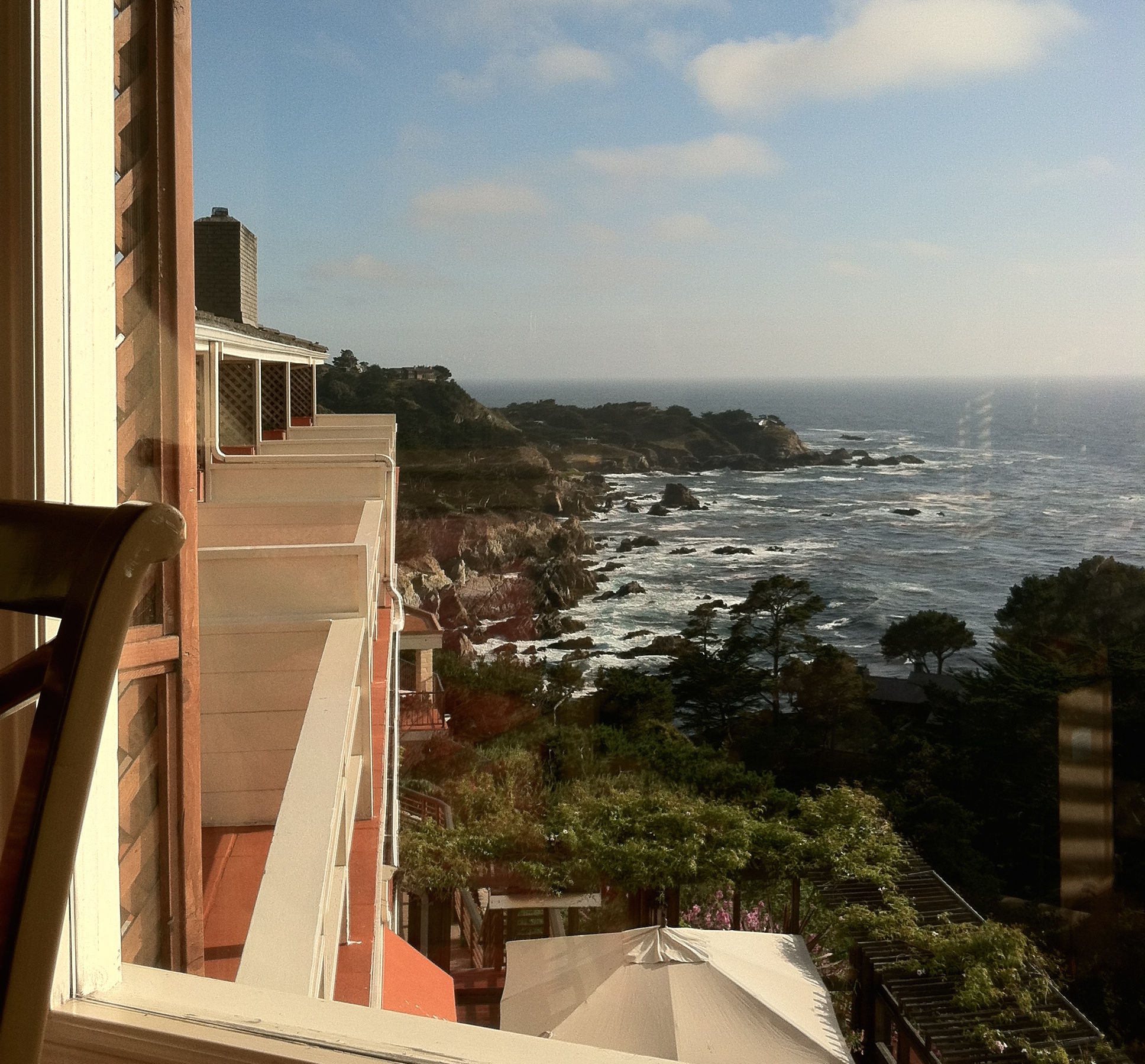
A reader snarks:
Saginaw, Michigan. Come on man, challenge us.
Another air-balls:
Ulcinj, Montenegro. Why not? Could be any bit of rocky, pretty coastline, anywhere in the world. Don’t really have an F’ing clue.
Another sighs:
The picture is a needle in a haystack. The view seems to be an island. The colors seem to be a warm island close to the equator. The rocky coast suggest a volcanic beginning. The lighting seems to be late afternoon with a vantage point on the east coast of an island. The foliage seems more Mediterranean rather than Caribbean. All that leaves a lot of islands. I selected the Canary Islands based on the remote coast no boats. Gran Canaria. To pin down a city, my guess would be las Palmas or Santa Cruz. If I am within 1000 miles, I would consider it a win.
Another gets to the right coast:
Well, you picked a photo without my special helper trick: no satellite dishes in this photo! But the instant I saw this, I thought of southern CA, and my wife, who recognized Jefferson’s house, says San Diego, so we’re going with that.
Another is too far north:
Wow, I will tip my hat to the person who gets this without being a local or stayed here. My best guess is that this is the upper Mendocino County coast line, perhaps going further then that and might even be Oregon, but it’s all too familiar as I have traveled the coast often. There’s no frigging clue that would help me to pinpoint this location and I don’t have time to day to start searching the coast line using Google Earth to hunt for images for this building. I’m going for closeness points today: Elk, California. I imagine I’m within 30 miles.
In only 11 minutes after the contest was posted, our first entrant got the region just right: “Big Sur, CA”. Closer still:
I’ll be damned if that isn’t somewhere around the 17 Mile Drive in Carmel in coastal California. The coastline and sunlight look like dead-ringers for it. It looks like the window is facing south with some late afternoon sun.
This guy nails everything:
FINALLY!!!!
Long time Dish-head here. I’ve entered the VFYW contest several times over the years, but never won (… never really even got close). I’ve followed the contest closely since its inception. And I often have jealously read about those people who know a view instantly. Well – finally – that was me!!
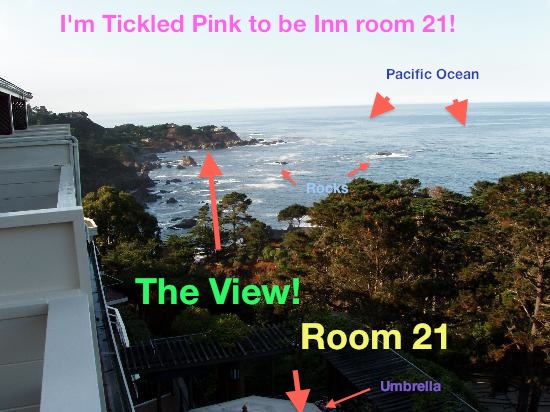
The very moment I saw it I knew right away where it was. I live in Carmel-by-the-Sea and this is right next door – about 10 minutes away. I knew immediately that it was shot somewhere in the Carmel Highlands, looking south into the glory that is Big Sur. I assumed right away that it could only one of two places: either the Carmel Highlands Hyatt or the Tickle Pink Inn right next door. After looking around at a couple maps, I confirmed that it is definitely the Tickle Pink Inn:
The view is looking south out over the stunning Yankee Point. It’s clearly overlooking the row of balcony’s on the top floor (down along the line of them, actually). The umbrella in the bottom of the pic below is on a “cliffside deck” they have that overlooks the Pacific, and further down on the terrace they have a hot tub. Needless to say, it’s an incredible property.
Figuring out exactly which window was somewhat tricky. Actually: I take that back, it’s not tricky; I can point on the map which one it is, but I didn’t know the specific room number, etc. (I live here – so I never stay in these incredible hotels we have!) But … I know VFYW and that I won’t win with just getting the Tickle Pink Inn right. So I decided to take a trip. (Again, it’s about 10 minutes from my house.) After snooping around and bothering the Inn Keepers a bit, I figured it out. The room is at the very end of the building, on the top floor. It is Room 28, also known as the “Crow’s Nest.”:
(I was informed that the December-March rates are: Sunday-Thursday is $327 + tax and Fridays and Saturdays are $469 + tax a night.)
I can’t believe I finally got it right – and got it EXACTLY right – and got it almost instantly. This is so exciting!


Nice job! Our window-guessing neuroscientist takes a less-local approach:
An easy one for this non-native Californian. The photo screams the CA coast: rough surf, cypress, headlands, breaking fog. There are surprisingly few stretches of the coast that accommodate lodging so close to the ocean yet aren’t in beachy SoCal. Thanks to dramatic coastal elevation but also thanks to successful conservation efforts from the Lost Coast in Humboldt/Mendocino counties to the protected Sonoma Marin county coast, and finally to protected Big Sur further south, most of the pacific coast between Oregon and Santa Barbara is more or less intact and free from development, and open to recreation. Without aggressive efforts to maintain these exceptional coastal areas in their relatively natural state, coastline like this photo would look like Atlantic City. Or southern CA.
In any event, the absence of palms and the coastal rockiness indicate this photo is from either the Sonoma coast or near Monterey Bay / Carmel. A quick scan on gmaps IDs Carmel as the source, specifically the Tickle Pink Inn:

Another gets misty:
I was fortunate enough to drive up the central California coast this past summer on a flawless, sunny day, and there are few places more beautiful when not covered by fog. Following the map up the coast and after a quick diversion at the Ragged Point Inn & Resort just south of Los Padres National Forest, I lit on the distinctive headland of Yankee Point, the subject of this week’s photo, located in Carmel Highlands, California. Ansel Adams moved here in 1962, drawn by its natural beauty and local real estate prices are some of the highest in the country, no doubt for the same reason.
Meanwhile, Chini is taken back in time:
The first view I found two years ago in Mendocino felt like a minor miracle. Now, finding a view like this, which is only a few hours away, feels almost routine. A few clicks here, a few clicks there and we’re done:
But one thing did stand out about this week’s location; it has to have the most unbearably cloying hotel name ever featured in the contest. This week’s view comes from room 28 of the, God-help-us-all, “Tickle Pink Inn” in Carmel, California. Yep, just writing it makes me wince.

Well this reader seemed to enjoy it:
But another keeps his distance:
It’s a very discreet place, so I won’t begin to guess the room number.
A former winner explains the perfectly reasonable story behind the inn’s name:
The suggestively named hotel was once owned by California State Senator Edward Tickle and his wife Bess, who loved pink flowers. Originally from England, Senator Tickle represented California’s 25th district from 1933 to 1943 and chaired the state Republican party from 1942 to 1944.
Another reader laments:
Wish I could offer up graphic tales of a Champagned honeymoon or a wet weekend of teenaged debauchery, but the best I can offer is the weekend afternoon I indulged in a little lifestyle envy and followed an Open House sign on Highway 1 to a glass-and-concrete apparition on Spindrift Road, future home of some one-percenter, vertiginously anchored over the foam, almost visible from here. I thought of calling the Inn’s front desk, but I figured they had taken the phone off the hook and were watching in awe as their online bookings rocketed up once a million Dishers started checking out the photos online.
Many among those million sent visual entries:

A reader starts to share the stories:
My parents used to go here once a year starting in the late ’60s; they went here the night of their wedding in June 1968. It has always held a place in my mind as a paragon of ’60s fashion (a’la James Bond or the Pink Panther), at least from their descriptions – they never brought me along. Nonetheless, I have two strong memories of it; my folks made a point of the fact that there were no TVs in the rooms (this, sadly, appears to no longer be true), and the motto, in mock Latin “Restabit; fortis arare placeto restat”, which was on the matchboxes my dad would bring home. From the website, it appears to have been significantly gentrified since those days. It was considerably more humble 40 years ago.
Several have stayed there themselves, of course:
Gotta say it looked familiar, but then a lot of the California coast looks a lot like that, and I’ve visited a lot of it over the years. Still it sure looked Big Surish (not the hauntingly gorgeous parts of Big Sur, to be sure, but Big Surish nonetheless). And why would I imagine there aren’t any number of comparably alluring places in the world sharing similar qualities of not-quite-the-most-gorgeous-parts-of-Big-Sur-but-still-gorgeous-in-their-own-right-ness?
I started a Google Image search for “Big Sur” but, just before hitting return, thought better and went for “Carmel Highlands” because it’s the sort of view I remember from my birthday stay there three summers ago at the Tickle Pink Inn (the northern gateway to Big Sur but not Big Sur itself, gorgeous view but not haunting, if you want haunting continue south another hour or so and stay at Post Ranch Inn or the Esalen Institute, both deep in the heart of Henry Miller country).
Don’t bother to imagine my surprise, therefore, when one of the first image results that appeared was essentially the same view as that of the view window, taken from an ocean view room at the Tickle Pink Inn:
Needless to say I was tickled rosy. It turns out that our view photo was taken in room 28, an ocean view room just above the front office, the other end of the building from where my wife and I had shared room 9, a cove view room, with damn-it just about as fine a view.

Another former guest:
I was raised in Salinas which is about 30 miles from there (and as many income groups lower) and my mom had a friend who worked at the place, so as a kid she would show us around the place because god knows we could never afford to stay there. My husband and I finally stayed there years ago and I considered is a great accomplishment – the “little lettuce seed” had finally made it. (Salinas is the lettuce capital of the world). Thank you for making my day.
A few readers have even honeymooned at the hotel:
I am a Dishhead. My husband, on the other hand, is only an occasional reader. Still, he recognised this one rather than me. It is a view from the Tickle Pink Inn in Carmel, California. We stayed there for our honeymoon.
Last but not least, a two-year veteran picks up the win this week with his 15th correct entry (including last month’s difficult Portugal view):
I first looked at this view as a small image on my phone and groaned in anticipation of a long sojourn around rocky coasts. But when I finally got to sit down with my coffee and laptop, itching for a challenge, I was at the hotel in about 5 minutes.
We are in the Room 28 (the “Crow’s Nest”) of the Tickle Pink Inn. Normally I’d have more to add, but this week I’m not feeling that verbose. Tryptophan?

Nope.
This week’s photo came from the in-tray archives, circa 2012:
Carmel Highlands, 6:29 pm on Friday July 6th. View is from the “Crow’s Nest” room (#28) at the Tickle Pink Inn. Delightful place in every possible way (including the pretty absurd name). My boyfriend and I came here for the first time last year and we’re hooked. There’s an awesome guest book in the room filled with entries from people on their honeymoons, anniversaries, and birthdays, many of whom have returned to the same hotel (and room) many times, or after 25 years of marriage. There’s also a seagull who sits on the railing outside and taps on the window looking for food. It’s utterly charming.
She updates us with some fantastic news:
Wow! This is very exciting! My then-boyfriend in 2012 and I got married just a month ago! Somehow being selected for the VFYW contest at this time feels like a little wink from the universe. We’ve continued to go back to our beloved Tickle Pink Inn every year – so we’re on four years running now. That view never gets old and we hope to keep the tradition going for many (happily married!) years to come. Happy holidays to everyone at the Dish! And thank you!
PS: I finally subscribed to the Dish … I’ve been meaning to do so for a long time and the photo being featured got me to make it happen!
Congrats! We’ll be sending our newly wedded couple a brand new Dish mug as a belated wedding gift, which they will hopefully enjoy for many years to come. Bowie sure will:

For the rest of you, our 234th opportunity for contest-related romance arrives at noon on Saturday. In the meantime, our contest poet returns:
Searchin’ U.S.A.
If everybody had the notion,
Across the USA,
Then everybody’d be searchin’,
On ev’ry Saturday,You’d see ’em stuck in their pee jays,
Fuzzy sandals too,
Bushy bushy bed hairdo,
Searchin’ U. S. A.You’d catch ’em searchin’ Point Lobos,
On down to Yankee Point,
Big Sur, Cabrillo,
Kim Novak’s old joint,
All over the Highlands,
Off Carmel coast highway,Everybody’s gone searchin’
Searchin’ U.S.A.We’ll all be planning that route,
We gotta ID that view,
We’re wearin’ down our mousepads,
Shit, it’s way past noon!
We’re outta touch for the weekend,
We’re on search-fari to stay,
Tell the preacher we’re searchin’,
Searchin’ U. S. A.If I had plenty of money,
I could chuck this iPad,
And drive a woody with my honey,
Down to that state most rad,Off the Number 1 Highway,
They’re havin’ Fun, Fun, Fun,
At the Tickle Pink Inn, babe,
Room Twenty One!Yeah, that’s the Tickle Pink Inn, babe,
Searchin’ U. S. A.!Thank You! ….. Thank You!
 The Dish