No Gold Star For Ron Paul

Kevin Carey tackles the elder statesman’s new book on education:

Paul’s misguided philosophy is rooted in a radically simplistic view of education. To him, education is just a matter of assigning students books to read and papers to write, using an “ideologically safe” curriculum. He deplores educators who “assume that the parents are not competent to be the sole providers of education.” But parents aren’t competent to be the sole providers of many important things. Ron Paul is an Ob-Gyn with an M.D. from DukeUniversity. Does he think babies should be delivered by people who learned everything they know from books and YouTube?

But the Ron Paul school revolution actually does make sense in one particular way.

His plan is explicitly designed to catch students on the cusp of adolescence and direct them toward an isolated learning experience focused exclusively on reading, writing, and debate, with no exposure to heterodox views. He is aiming for the Atlas Shrugged window, when young people have an excess of conviction and a deficit of experience, when they are more clever than wise. His program will shield students from the evils of liberalism and, worse, Keynesianism, and train them to argue their cause with facility and zeal. It is a plan for the mass creation of crackpot autodidacts who are impervious to any evidence that contradicts their simple worldviews.

Communing Through Art

Maria Popova revisits Tolstoy’s thoughts on the sense of unity that true art evokes:

If a man, without exercising effort and without altering his standpoint on reading, hearing, or seeing another man’s work, experiences a mental condition which unites him with that man and with other people who also partake of that work of art, then the object evoking that condition is a work of art. And however poetical, realistic, effectful, or interesting a work may be, it is not a work of art if it does not evoke that feeling (quite distinct from all other feelings) of joy and of spiritual union with another (the author) and with others (those who are also infected by it). …

The chief peculiarity of this feeling is that the receiver of a true artistic impression is so united to the artist that he feels as if the work were his own and not someone else’s — as if what it expresses were just what he had long been wishing to express. A real work of art destroys, in the consciousness of the receiver, the separation between himself and the artist — not that alone, but also between himself and all whose minds receive this work of art. In this freeing of our personality from its separation and isolation, in this uniting of it with others, lies the chief characteristic and the great attractive force of art.

“Disney World Meets The Apprentice”

Adriana Valdez Young visits KidZania, an work-themed amusement park in Kuwait City:

We pass a modeling school, where a line-up of little girls are learning to sashay down the runway; a hospital, where kids in scrubs are escorting patients from the back of an ambulance; and a telemarketing center, where kids in swivel chairs are intensely working the phones. Each storefront in KidZania is backed by a real-world business, which offers 15-30 minute activities for kids to receive training or work for pay. Kids learn to swirl yogurt at Pinkberry, deliver packages at DHL, and fill gas tanks at Exxon Mobil. Each service job requires a uniform and a disposable hair net.

While KidZania was born in Mexico City and has a universal appeal in the 10 additional countries where it is located, the industrious city bears particular resonance in the small oil-rich nation of Kuwait. It is a country with extreme reliance on imported labor—85 percent of the total workforce is made of expats—and it is a social welfare state that guarantees 100 percent employment for Kuwaiti nationals. To counter the imbalance between the national and foreign labor pool and reduce pressure for more state jobs, the government recently introduced a program called ‘Kuwaitization,’ which sets hiring quotas for private companies to employ Kuwaiti nationals. But enticing Kuwaitis to work has been so challenging that many companies are left in a position of simply adding names of Kuwaitis to the payroll to avoid government fines and then scrapping any hope that those citizens will ever show up to work for their pay. Therefore, KidZania could rear a new generation itching to expand the private sector.

Writing Women Well

Ester Bloom claims it is something male authors rarely accomplish. From her list of exceptions:

Ora, To The End of the Land (David Grossman)

Perhaps the ultimate book about a mother, one that deconstructs the myth while at the same time conveying the incomparable intensity of maternal love. The Times’ review of this anti-war novel calls Grossman a “genius” and says, “Ora’s level of self-consciousness, her alertness to the emotional contours of things, her exquisite introspection, give this story the depth and privacy of an Ingmar Bergman film.”

Little Bee, The Other Hand (Chris Cleave)

Raw, vital, vivid, absolutely engrossing—the character and the book both. A necessary story about the post-colonial world as seen by a scarred Nigerian girl who refuses to accept the unfairness of life as she knows it.

Dolores Price, She’s Come Undone (Wally Lamb)

It takes guts to start a 20th-century novel with a pre-teen heroine named Dolores. Lamb pulls off her voice perfectly and creates around it a story that captures the lust and hunger, sadness and confusion of adolescence and its aftermath. Towards the end, when life delivered Dolores yet another setback, I remember throwing the book against my bedroom wall in fury at the unfairness of everything—and then crawling over to retrieve it because I couldn’t stop reading.

Cool Ad Watch

Copyranter proclaims that “New Zealand produces the best PSAs in the world”:

Titled “Blazed — Drug-Driving in Aotearoa” (Aotearoa is the Māori name for New Zealand), this spot is an instant Advertising Hall of Fame Drugs PSA classic. The ad was just launched on Māori Television. These kids are so perfect, so natural — this is how you do a drugs ad, unlike all the laughably ineffective, preachy American drug PSAs. …

Back in 2011, Kiwi ad agency Clemenger BBDO created one of the best drunk-driving ads I’ve ever seen, “Legend.” Watch it [here].

When Free Speech Goes Public

Elias Groll wonders whether a publicly traded Twitter “will have to sacrifice its values, at least somewhat, on the high altar of the quarterly earnings report”:

Twitter has already run into trouble abroad, where governments, both democratic and otherwise, have not taken too kindly to a service that lets anyone and everyone broadcast thoughts onto the web. At the height of the protest movement in Egypt that brought down Hosni Mubarak, the Egyptian government blocked Twitter. During a wave of rioting in Britain in 2011, Prime Minister David Cameron threatened to shut the service down. (He did not.) In July of this year, French courts forced Twitter to hand over user data to help authorities identify the authors of anti-Semitic and racist tweets. In China, the service is blocked entirely.

For a young start-up with private investors, shutdowns like these pose no serious problems. But how will Wall Street react to service outages? Each time the service goes down, Twitter is effectively losing money, and that’s something investors seem unlikely to accept. Thus, there will be an incentive for the company to make concessions to governments for the sake of achieving greater market share.

The Best Of The Dish Today

This morning we linked to an essay with the sentence “What does a person have to do in this country to get a gun taken away?” Almost immediately thereafter, the Navy Yard shootings began. We didn’t cover the story because others can do that much better and because there was so much we didn’t know we felt it best to wait and make sense of it – if any can be made – on the basis of fact. If only the horrible murder of Matthew Shepard had been treated the same way.

I inched out toward a hope that Obama can do with Iran what Reagan did with the Soviet Union, in the wake of the Syria deal. Rouhani – according to one report – may be preparing for a major gamble to engage the West.

Kant did not lead to perpetual peace; pundits still refuse to judge substance rather than style; Bucharest’s stray dogs now number 64,000; and 77 percent of unpaid interns are women.

The most popular post of the day was Meep Meep, Motherfuckers, followed by The Syria Dodge.

In the past month, the Dish has gotten 196,000 visits from Canada and 125,000 from Britain. A shout out to all the Canuck and Brit Dishheads! Thanks for reading. Now how about [tinypass_offer text=”subscribing?”]

Oh, and if you’re wondering why I posted the video above, it’s because tomorrow night, I’m headed to the Beacon Theatre for the Pet Shop Boys tour.

See you in the morning.

Where The Public Is On Obamacare

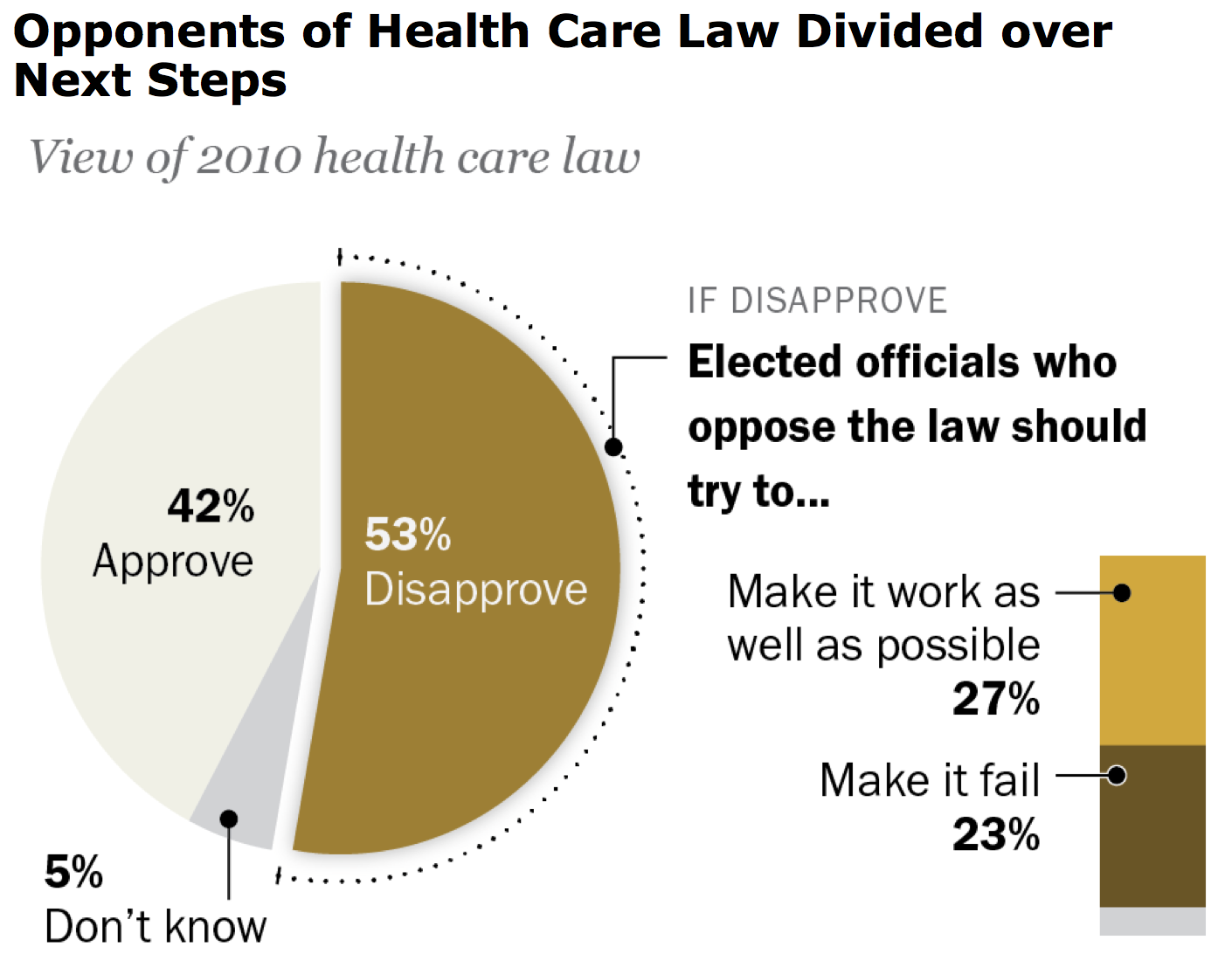
Pew Obamacare

Suderman summarizes recent polling on the ACA:

A USA Today/Pew poll taken last week and released today finds that 53 percent of the public disapproves of the health care law, with 41 percent saying they disapprove strongly. The same percentage of respondents—53—say they disapprove of the way that President Obama is handling health policy. A Reason-Rupe poll published last week finds similar skepticism about the way the law is being handled, with 62 percent of those surveyed saying that implementation of the health law is not going well.

A poll from NBC/WSJ contains similarly bad numbers. But it also finds that increased knowledge of the law correlates with more support for it:

34% say they don’t understand the law very well, and another 35% say they understand it only “some.” That’s compared with 30% who understand it either “very well” or “pretty well.” As it turns out, that 30% has more positive opinions about the health-care law (42% good idea, 45% bad idea), versus the 34% who don’t understand it very well (17% good idea, 44% bad idea). … The White House has tried to start health-care education campaigns a few times, but to no avail. If they could actually sustain one of their campaign-style pushes on health care, these numbers suggest it COULD pay off.

Greg Sargent focuses on the numbers in the above chart from Pew (pdf), which demonstrate that relatively few Americans want the law to fail:

[L]arge majorities overall either support the law or oppose it but want lawmakers to try to make it work. Simply put, the zeal to prevent the law from functioning as well as possible is well outside the American mainstream.

To some degree this mirrors the situation within the House of Representatives itself. A majority of Members would vote tomorrow to fund the government without any defund-Obamacare rider attached, or to raise the debt limit without any Obamacare delay attached. But because House GOP leaders are loathe to allow a vote on anything unless a majority of House Republicans approves of it, the result is that — if today’s Pew poll has it right — the delusional preoccupations of a small minority of the American people are having an outsized impact on, well, our entire political situation, with potential economic chaos looming as a result.

Chait expects the politics of Obamacare to change once the uninsured are in the system:

Any future revision will have to account for them. Anybody who wants to overhaul the health-care system will not merely have to protect insurers and medical providers but Americans in health exchanges, too. It will no longer be possible for Republicans to propose repealing Obamacare and making some vague hand-waving to do something for the uninsured at some future point. Republican health-care reform will have to include everybody. All this is contingent on the law actually getting up and running.

Republicans are afraid of that transformation, and they’re right to be.

Finding The Words Of Seduction

Last week marked the 1885 birth of D.H. Lawrence. To celebrate the occasion, The New Republic pulled Edmund Wilson’s 1929 review of Lady Chatterly’s Lover from their archives, an essay in which Wilson claims Lawrence “has written the best descriptions of sexual experience which have yet been done in English”:

The truth is simply, of course, that in English we have had, since the eighteenth century, no technique—no vocabulary even—for dealing with such subjects. The French have been writing directly about sex, in works of the highest literary dignity, ever since they discarded the proprieties of Louis XIV. They have developed a classical vocabulary for the purpose. And they have even been printing for a long time, in their novels, the coarse colloquial language of the smoking-room and the streets. James Joyce and D. H. Lawrence are the first English-writing writers of our own time to print this language in English; and the effect, in the case of Ulysses at least, has been shocking to English readers to an extent which must seem very strange to a French literary generation who read Zola, Octave Mirbeau and Huysmans in their youth.

But, beyond the question of this coarseness in dialogue, we have, as I have intimated, a special problem in dealing with sexual matters in English.

For we have not the literary vocabulary of the French. We have only the coarse colloquial words, on the one hand, and, on the other, the kind of scientific words appropriate to biological and medical books and neither kind goes particularly well in a love scene which is to maintain any illusion of glamor or romance.

Lawrence has here tried to solve this problem, and he has really been extraordinarily successful. He has, in general, handled his vocabulary well. And his courageous experiment, in Lady Chatterley’s Lover, should make it easier for the English writers of the future to deal more searchingly and plainly, as they are certainly destined to do, with the phenomena of sexual experience.