The Growing Might Of Mayors

New York Commemorates The 12th Anniversary Of The September 11 Terror Attacks

Tod Newcombe sees power shifting from national and state governments toward cities:

As Bruce Katz points out in his new book, The Metropolitan Revolution, several key factors have opened the door to cities. For one, he writes, the Great Recession has disrupted national economies while partisan gridlock has stymied national politics. At the same time, states that are heavily dependent on federal grants to run programs are struggling with decisions of what to keep and what not too. But, he writes, “cities and metros … are responding with pragmatism, energy and ambition to get things done.” …

Mayors are behind a growing political movement that is setting national policy at the local level. Urban experts and scholars are taking note that cities have become an “important breeding ground for new ideas,” because they are far more nimble than states or federal the government.

And less bogged down by partisanship:

Republican and Democratic mayors in metropolitan areas tend to cooperate more than their counterparts at the national level, says Scott Smith, the Republican mayor of Mesa, Ariz., and president of the US Conference of Mayors. Why? “Because they have to solve problems. In Washington they don’t sense this need,” Smith told National Journal. “I still have to pick up the garbage on Thursday. When someone dials 911, I have to make sure the police show up.” Smith adds: “There is no such thing as national economies anymore. That’s why you see the  big business deals done not so much between commerce secretaries any more as between mayors, like the mayor of Shanghai and the mayor of Los Angeles.”

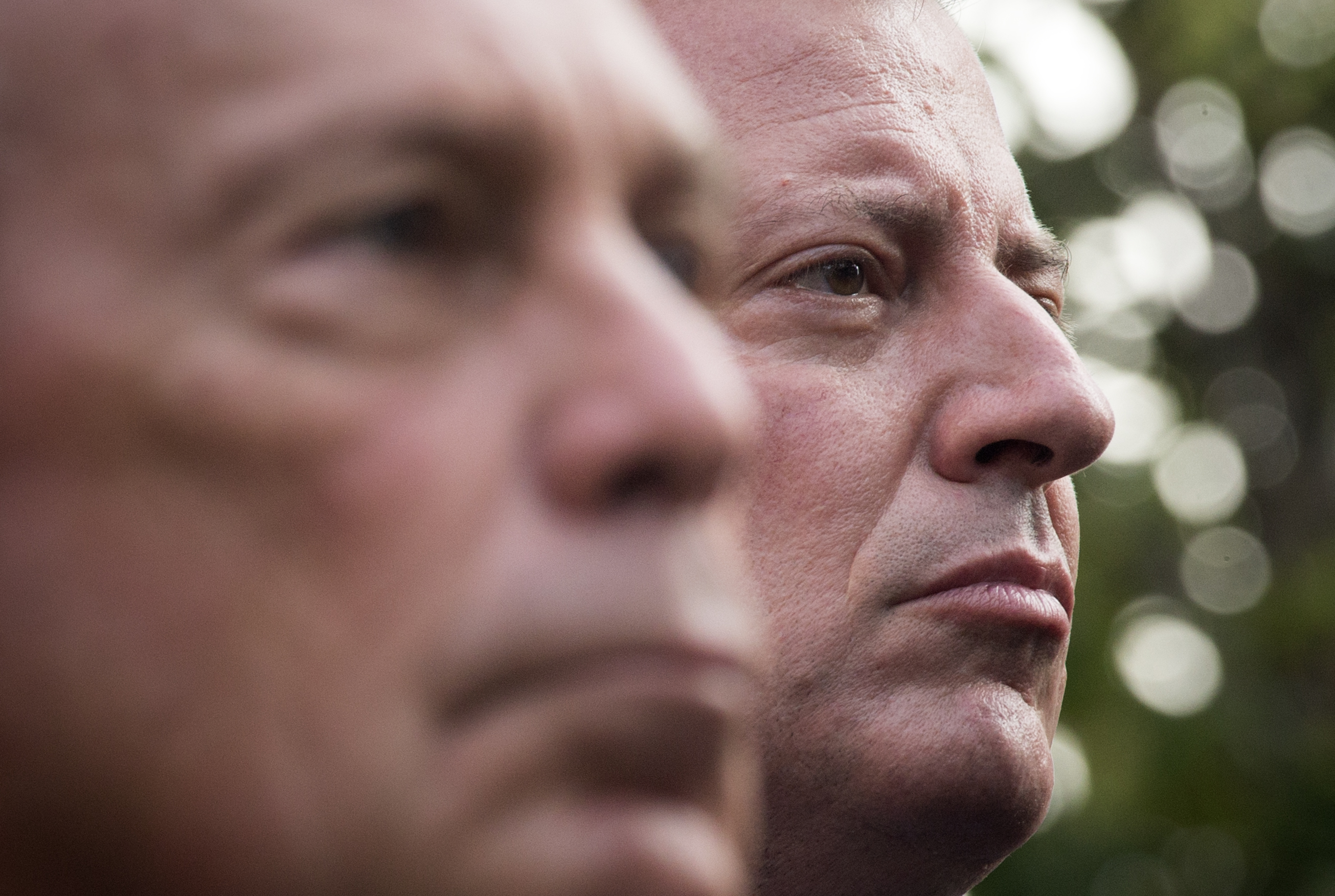
(Photo: New York Mayor Michael Bloomberg stands with his likely successor, Bill de Blasio, during the 9/11 Memorial ceremonies on September 11, 2013. By Adrees Latif-Pool/Getty Images)

That Last Phone You’ll Ever Buy

That’s what the Phoneblok hopes to be:

Ben Richmond is intrigued:

One reason iPhones are rendered steadily and predictably obsolete just months after it debuts heralded as world-changing—is tied intimately to what many like about the iPhone: the attractive and smooth design. Apple’s seamless aesthetic doesn’t leave room for you to customize or upgrade the hardware and once the hardware is worn out, dropped into water or at its limit. When one part goes or is faulty or just doesn’t do what you want it to, the whole phone has to go. How many iPhones have been replaced just for want of an uncracked screen?

Apple is easy to point to, because it’s popular, and if you believe the lawsuits, where Apple goes, so do consumer electronics. But in at least one respect it’s far from unique. As last year’s Apples go to the dump, so too do other electronics. In 2010 the United States generated an estimated 3 million tons of e-waste, and only about a quarter of that is thought to be recycled. The rest is going to the dump or incinerators. Cell phones, while small, are a special problem because they are replaced on average every 12 months.

Brian Heater thinks that “this seems like one of those ideas that’s just too good to be true.” K. T. Bradford points out that Phonebloks isn’t close to coming to market:

Right now, Phonebloks is still in the concept stage. So concept-y that the inventor isn’t even asking for money yet, just attention. He’s gathering people for a crowdspeaking campaign (like a small version of Kony 2012) that will send out a huge burst of social media noise about the phone all at once to prove there is great interest. The thunderclap is scheduled to happen on October 29. The website and YouTube video aren’t too clear on the next steps. Will they try a Kickstarter campaign? Raise venture capitalist money? Bring the idea to an existing manufacturer? Maybe all of the above.

Todd Wasserman wonders how this phone would change the smartphone industry :

While the idea of cutting down on cell phone waste is appealing, such a design would greatly limit design possibilities. The industry also thrives on an upgrade cycle which this design would negate.

Cool Ad Watch

Yglesias, a long-time booster of Chipotle, is impressed with the innovative ad:

The video itself is a promotion not for Chipotle per se but for an iOS game that’s available for free on the app store. This is all part of a larger marketing strategy that depends in part on the idea of essentially never doing television ads. Both the theme of this video—Chipotle’s message that it represents a superior alternative to conventional factory farming—and the lack of television advertising are designed to position the chain as a highbrow and upscale alternative to other quick service restaurants. Then when a video does come out, it’s high-quality high-impact stuff that really gets attention and is designed to be memorable. And if you ask me, it’s working.

The Immigrant Writer’s Dilemma

Edwidge Danticat, a writer from Haiti, explores it:

In the epigraph to Drown, Junot Diaz uses a quote from a Cuban poet, Gustavo Pérez Firmat—“The fact that I am writing to you in English already falsifies what I wanted to tell you.” This is the dilemma of the immigrant writer. If I’d lived in Haiti my whole life, I’d be writing these things in Creole. But these stories I am writing now are coming through me as a person who, though I travel to Haiti often, has lived in the U.S. for more than three decades now.

Often when you’re an immigrant writing in English, people think it’s primarily a commercial choice. But for many of us, it’s a choice that rises out of the circumstances of our lives. These are the tools I have at my disposal, based on my experiences. It’s a constant debate, not just in my community but in other communities as well. Where do you belong? You’re kind of one of us, but you now write in a different language. You’re told you don’t belong to American literature or you’re told you don’t belong to Haitian literature. Maybe there’s a place on the hyphen, as Julia Alvarez so brilliantly wrote in one of her essays. That middle generation, the people whose parents brought them to other countries as small children, or even people who were born to immigrant parents, maybe they can have their own literature too.

For more, check out Danticat’s book on the topic, Create Dangerously: The Immigrant Artist at Work.

The Best Way To Help The Syrian People, Ctd

Morton Abramowitz insists that when it comes to the massive number of Syria refugees, there “is room and need for a greater effort by the U.S. and its friends and allies”:

[T]he West must demonstrate its willingness to bear part of the burden. So far this fiscal year, the U.S. has admitted just 33 Syrian refugees. The new fiscal year will permit President Barack Obama to provide for a significant number of Syrian refugees within the 70,000 total allotted to the U.S. refugee program. In turn, the U.S. willingness to accept more refugees can also help accelerate resettlement efforts by other Western countries. Under normal U.S. procedures, resettlement could take a few years. So as the U.S. has done with Indochinese and other refugee groups, it must expedite processing. …

The refugee burden, not surprisingly, has fallen mostly on four bordering countries: Iraq, Jordan, Lebanon and Turkey. Turkey is managing well and is more capable than its neighbors of taking in more refugees, although an increase would stoke sectarian differences and political tensions. The opening for those allowed by the government to cross the border, however, continues to narrow. The biggest burden falls on a very weak Lebanese state, where the Syrian war has already provoked considerable internal violence. If Damascus were to fall, refugees would inundate Lebanon.

Earlier Dish on the Syrian refugee crisis here.

Assad’s Terms, Ctd

Before destroying Syria’s chemical weapons, Assad wants the US to agree to stop arming Syria’s rebels. Larison wishes the administration would take the deal but suspects it won’t:

It costs the U.S. nothing to agree to these terms, but these terms will likely be viewed as unacceptable in Washington. The administration will want to treat its support for the opposition as separate, and it will always want to reserve the option to attack. That isn’t because either position makes any sense for the U.S., but because the administration has trapped itself into commitments that it won’t easily repudiate. The Syrian government may not truly be willing to give up its chemical weapons, but it is doubtful that the U.S. would be willing to accept the exchange that might be required to make the deal work.

Why Russia Resists American Wars

Michael Crowley gets inside Putin’s head:

Less widely understood than Putin’s concerns about Iraq, Syria and Libya is his anger over U.S. actions closer to his borders. Putin believes America helped defeat a Moscow-backed candidate in Ukraine’s 2004 presidential election, partly by sending millions of dollars to pro-democracy activists there. He hated George W. Bush’s courting of the former Soviet republic of Georgia, where a U.S.-backed president was defying Moscow’s longtime influence. (After a 2008 military clash between Russia and Georgia, McCain declared that “today, we are all Georgians.”) And he surely remembers well the U.S.-led NATO bombing campaign in the 1990s—which Russia also bitterly opposed—that led to the ouster of Serbian leader Slobodan Milosevic.

“If you look at events over the past 20 years from the Kremlin’s perspective, you see a consistent pattern of U.S. and western behavior amounting to a policy of regime change across Eurasia,” says Matthew Rojanksy, director of the Kennan Institute at the Woodrow Wilson Center.

“Putin asks, if Washington can use force to topple regimes in Iraq, Afghanistan, or Libya, and can sponsor regime change by other means in Serbia, Georgia, and Ukraine, why wouldn’t Belarus or Kazakhstan or even Russia itself be next? Putin has to draw his own red line, and Syria is a good place to start doing so.”

Dmitri Trenin makes related points:

I think Putin believes that an inertia can be created that would lead to progressively more and more U.S. actions around the world which might collide at some point with Russia’s core interests, to use a Chinese expression. They want to stop the use of force by the United States outside of the U.N. Security Council framework. They’re trying to keep a hold on the use of force internationally.

Where’s The Line On Intervention?

A reader writes:

I have watched a bit of Anderson’s new show, and I am so excited to see you on as a regular guest. The revelation for me so far (with my limited viewing) is Christiane Ahmanpour. I’ve not known her as an opinion journalist, but she is quite compelling to watch. Might I add that she is not the least bit intimidated by her male counterparts at the table, which I love. I saw a clip of her very emotional appeal for Syrian intervention (which, by the way, I think is perfectly fine as long as it is coupled with the kind of intellectual heft and reflection that someone like Ahmanpour can bring to bear), and I think it raises a legitimate question that I have posed here before. Where is the moral line for humanitarian intervention? Does a situation have to reach Holocaust proportions or are we talking Srebrenica before we act?

America is arguably the world’s only superpower. There are obligations that come with that privilege, and we now live in an era in which that is simply not a welcome burden thanks to the abuses of the Bush/Cheney years. Why am I not hearing this obligation being debated? Isn’t there a line out there that we don’t want crossed for myriad reasons? Where is that line?

Christiane’s passion is admirable and I respect her enormously. But of course, our decision matrix on whether to intervene to stop moral atrocities has to take into account the cost, context, and consequences of such a decision every time we approach it. The impulse to intervene in Somalia was a decent and good one, for example, just as Christiane’s impulse to stop these horrifying attacks is a good and decent one. But it led to a military and strategic disaster which forced us to leave in a hurry. Ditto the moral impulse to save tortured children in Saddam’s Iraq. But does the gravity of the crime matter? Of course it does, as Reuel Marc Gerecht pointed out.

To be honest, as a function of being on vacation when the attack happened, I did not experience the shock that many experienced in real time. That may have made me seem more callous than I am. I also have to say that the images of the slaughter I subsequently watched affected me deeply, as they would anyone with a heart or soul. I shifted a little because of it. But I insist nonetheless that unless there is a way to prevent that kind of horror without intervening in Syria’s civil war, we shouldn’t intervene. Maybe Obama’s “unbelievably small but not a pinprick” strike could do that, and I was open to persuasion. But now that Assad has caved on that specific issue with no missiles fired, the issue for me now is moot. If he attacks with poison gas again, we may have to reassess.

There is no eternal line defining when or when we should not intervene in these circumstances. We have to judge each incident as it occurs. Christiane and I have different judgments about that. It’s up to readers and viewers to decide which one makes the most sense to you. That’s the messy way we do it in democracies – but it’s better than any moral “red lines” without any practical consideration of the costs involved.