A member of an association of Auschwitz concentration camp survivors walks through the infamous entrance gate in Oswiecim, Poland after laying wreaths with other members at the execution wall on January 27, 2015. International heads of state, dignitaries, and over 300 Auschwitz survivors are attending the commemorations for the 70th anniversary of the liberation of Auschwitz by Soviet troops on 27th January, 1945. Auschwitz was among the most notorious of the concentration camps run by the Nazis during WWII, and whilst it is impossible to put an exact figure on the death toll, about a million people lost their lives in the camp, the majority of whom were Jewish. By Sean Gallup/Getty Images.
How Netanyahu Is Harming Israel, Ctd
Goldblog pulls his hair out over Bibi’s absurd decision to treat Obama as an adversary and try to sabotage the Iran deal:
Israeli prime ministers [have] two main tasks. The first is to protect their country from existential threats. The second: To work very hard to stay on the good side of the president and people of the United States. Success in accomplishing this first task is sometimes predicated on achieving this second task.
Israel has been, for several decades, a bipartisan cause in Washington. Bipartisan support accounts for the ease with which Israeli prime ministers have historically been heard in Washington; it accounts for the generous aid packages Israel receives; and it also explains America’s commitment to maintaining Israel’s qualitative military edge. Netanyahu’s management of his relationship with Obama threatens the bipartisan nature of Israel’s American support.
Most of all, Jeffrey insists that
It is immaterial whether an Israeli prime minister finds an American president agreeable or not. A sitting president cannot be written off by a small, dependent ally, without terrible consequences.
Michael Koplow made a similar argument last week. Corn elaborates on the shortsightedness of Bibi’s actions:
Netanyahu is choosing sides and embracing the folks whom most American Jews oppose. He is butting into US politics and enabling the never-ending Republican campaign to undercut a president widely supported by American Jews.
That is not good for Jews in the United States or Israel. Israeli politicians have long counted on Jewish support in the United States—and support from conservative evangelicals. Yet there have been signs that non-Orthodox American Jews are not all that happy with Netanyahu’s policies. A 2013 poll found that only 38 percent of American Jews believed that his government was “making a sincere effort to bring about a peace settlement” with the Palestinians. Close to half believed Israeli settlement construction in the West Bank was a bad idea. (Only 17 percent said it helped Israeli security.) That is, Netanyahu’s right-wing approach—even if supported by AIPAC and other American Jewish establishment outfits—was not popular with many American Jews.
And now Netanyahu is partnering up with Boehner to kick Obama in the teeth and sabotage one of the president’s top diplomatic priorities. He is essentially telling American Jews to get lost: I have no regard for the president you support and no regard for your own political needs and desires.
Larison considers the Iran hawks’ calculations:
Before [Boehner’s] invitation was announced, there was never any realistic chance that the GOP could have rounded up enough Democratic votes to override a presidential veto, so losing a few Democratic votes for a new sanctions bill isn’t that important. The Republicans can still easily pass the bill, Obama will have to veto it, and then they will raise a hue and cry about the terrible “appeasement” that they are trying to prevent. They probably would have preferred to dress up the bill’s passage as a “bipartisan” effort, but that obviously doesn’t matter to them. What matters to them is staking out a maximalist position on Iran so that they can denounce the administration for being “weak,” and having Netanyahu openly taking their side in this fashion helps them do that.
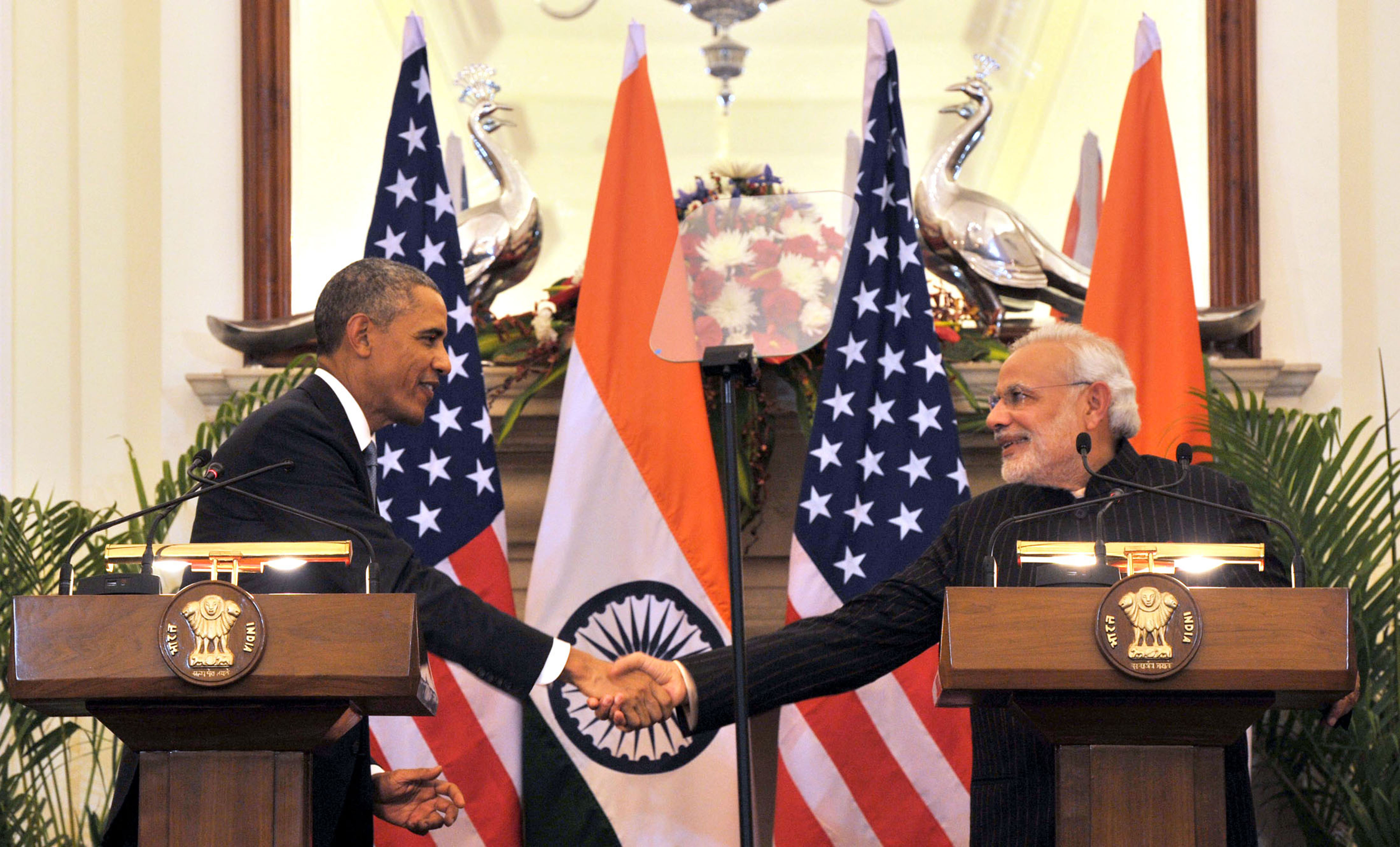
Obama’s Meetup With Modi
Bruce Einhorn checks in on the summit:
The visit is Obama’s second to India as president, and relations are clearly warming. The two leaders on Sunday announced a deal on civilian nuclear projects after years of delays. The U.S. will drop its insistence on tracking nuclear fuel sold to India to ensure it’s not used for military purposes, and in return the Indians will set up an insurance pool (initially funded at $122 million, with more money to come later) to shield from liability nuclear power plant suppliers such as General Electric and Westinghouse Electric.
Howard LaFranchi gets at the mutual importance of the trip Obama and Modi:
[J]ust as India figures prominently in Obama’s “rebalancing” of US interests to Asia, the United States is emerging for Modi as a key partner in his efforts to revitalize a stagnant economy and to reinforce India’s position in the region and on the global stage.
Inviting Obama to be the first US president to participate in India’s Republic Day celebrations “was Modi’s way of signaling the US really looms large in his calculations on where he wants to take India,” Mr. Tellis adds. Still, Modi is not likely to take any steps that compromise India’s tradition of a firmly independent foreign policy. How he builds closer ties with the US while preserving India’s partnership with Russia will offer clues to India’s way forward, regional analysts say.
In addition to Obama’s unprecedented attendance of the Republic Day festivities, there were also bear hugs, the symbolism of which was not lost on Harsh V. Pant:
[What’s] important is how the anti-Americanism of the Indian political class is [now] a thing of the past. Even when the NDA government under Atal Bihari Vajpayee was trying to structure a partnership with the US, and the UPA under Manmohan Singh was trying to take that forward, the anti-western hypocrisy of the Indian establishment was jarringly evident. The BJP’s old guard led the charge to make the passage of the civil nuclear deal difficult, and then worked to bring in a liability law that did so much damage to Indian interests. The Indian Left, Right and Center all colluded in this charade. Washington was needed when it came to Pakistan, Afghanistan, and China, but swords would be out if any Indian leader dared to make a case that a strong partnership was in the interest of India. All in the name of good old-fashioned non-alignment! …
Modi has put an end to that nonsense. His bear hug to Obama is a reflection of the reality that only a minority in India have been able to time and again articulate: there are no real substantive issues dividing the two countries. For sure, there are differences, but they are on tactics.
Sadanand Dhume thinks ahead:
[J]ust because the stars appear to have aligned at the moment for Obama and Modi does not necessarily mean that they will remain permanently aligned. At its core, the US bet on Modi is that he will revive India’s economy, deepen its engagement with fellow democracies, and steer clear of domestic strife. …
Nonetheless, there’s no question that Modi has forced India back on Obama’s foreign policy agenda. He has raised expectations that he is a new kind of Indian leader – unafraid to break some geopolitical crockery while pursuing his goals. If Modi continues to reform the economy and revitalise Indian diplomacy, his honeymoon with Washington will only lengthen. The consequences for India, Asia and the world could be huge.
Neil Bhatiya is impressed with the progress the two leaders made on energy and climate change:
For the U.S., Obama received assurances that India would participate constructively in building consensus toward a strong agreement in Paris later this year (where the global community will try to hammer out a successor to the Kyoto Protocol), though what that would actually look like remains to be seen. What matters is that, in the wake of the U.S.-China agreement, India is responding to shifting norms by trying to appear proactive and refraining from going out of its way to highlight historic divides between developed and developing countries over responsibility for cumulative greenhouse gas emissions. While it maintains its prerogative to place economic development on a higher pedestal that environmental sustainability in the short term (meaning it will still exploit its domestic coal reserves), over the long term it realizes it has a significant role to play in being some kind of a model of de-carbonization.
Rebecca Leber isn’t as impressed:
Obama and Modi’s announcements related mostly to clean energy, with the exception of a “breakthrough” on nuclear energy. India reaffirmed its commitment to phase out hydrofluorocarbons—used in coolants and aeresols—and is seeking private investments to meet a domestic goal of producing 100,000 MW of solar power by 2022, which is 33 times more than its current rate of production. By announcing a flurry of new clean energy and finance task forces and initiatives, Obama and Modi say they are working to reduce the trade barriers between the nations.
It’s notable that, unlike China, India has made no promises to cut its emissions, and Indian officials say they won’t back away from coal. The country is also unlikely to make that promise when it submits a domestic climate plan to the United Nations by June, ahead of the Paris summit.
But Leber also understands Modi’s domestic challenges, like bringing power to 300 million people and dealing with the country’s pollution problems.
(Photo: Indian Prime Minister, Shri Narendra Modi shakes hands with US President Barack Obama. By Prabhat Kumar Verma/Pacific Press/LightRocket via Getty Images)
The View From Your Window
The Humanity In Losing A Pet
In an essay sharing how the death of her cat was easier – and better handled by caregivers – than the death of her parents, Margo Rabb recalls the end of that final trip to the vet’s office:
In Juliet’s office [at the clinic], they let me stay on their couch with Sophie’s body for as long as I wanted. My husband left work and met me there. “How long do you want to stay?” he asked me, staring at her body on my lap. “Forever,” I said. I pictured myself wandering around the city, still holding my dead cat. Maybe my friends wouldn’t notice. Maybe they’d mistake her for a fur stole. When I’d told them about Sophie’s diagnosis, weeping, sometimes I felt ashamed to admit that I felt such deep grief over a cat. I wrote in my diary: “The strange thing is it’s not dissimilar from the grief I felt for Mommy and Daddy — how the grief displaces everything, and nothing feels the same anymore.”
The experience left her looking for answers:
Was it because Sophie was an animal that her loss was easier to bear, and easier for [my veterinarians] to give comfort? Or was it luck and the lack of it, to have encountered gentle care for my cat and harsh care for my parents?
In “A Natural History of Love,” Diane Ackerman writes that pets “help bridge that no-man’s-land between us and Nature.” When I think now of Sophie’s last days, I think that, because she was an animal, her loss felt more a part of the natural order, with its inevitable seasons and cycles of life and death. Humans spend so much of our lives railing against the idea of dying, or pretending that it doesn’t exist, or dreaming of eternal youth, or wishing to prolong our lives — and maybe it’s that fighting that made the experience of my parents’ deaths feel unbearable and inhumane, and made the death of my cat seem exceptionally human.
Meanwhile, a Dish reader wrote recently:
We just had to say goodbye to our 14-year-old golden lab, Honza. The experience reminded me of the wonderful thread you started in the summer of 2013 when you had to say farewell to Dusty. My wife dug out the thread and sent it to me this morning. Having read it again, with tears streaming down my cheeks, I was amazed at how similar the situation we encountered was to those of your readers and I hope by writing this it helps to dispel the grief, because it is intense. I cannot believe how hard this has hit me. I’m a northerner, for goodness sake, and am not supposed to react like this.
Maybe it’s because even her name had deep meaning for us. Honza is a Czech nickname given, seemingly automatically, to anyone named Jan. In 1999 we invited into our home as an au pair a delightful young man called Jan who always introduced himself as “Honza”. He came to befriend our Asperger’s suffering oldest son and provide the companionship he was failing to find among his peers. It worked beyond our wildest expectations, and after 18 months with us he was woven into the fabric of family life. Concurrent with his departure, in September 2000, we had to let go of our first dog, Guido, whom Honza (the man) had helped nurse in his final months. My wife immediately went on the hunt for a replacement and found a golden lab puppy, funnily enough, in my home town in Lancashire. My mum brought her down south in a shoe box on her lap, and because the house seemed lacking somehow without someone calling, “Honza”, every few minutes her name was quickly established – (when Honza, the man, heard we had called a female, Honza, he christened his female cat “Andy”, but that’s another story).
Suffice it to say, Honza (the dog) was a great hit. Our middle son, Alex, rapidly formed a rapport with her that lasted until the end. She was, in his mind anyway, “his dog”, and she always treated him more as a fellow puppy than a human. Once she went wandering and a kindly neighbour took her in but without her collar on (for some reason), she had no idea who Honza belonged to. I’ve never seen my wife so frantic as we all headed into the night to find her. It was Alex’s shouting that she eventually responded to. Her barking led us to the right house and all ended well.
Honza also gave my wife great comfort during my all-too-frequent business trips away. In an all-male household, she felt she could watch “girlie TV” with Honza at her feet, and it was my wife who walked her the most, going for miles along trails and country paths together.
Starting last year, she had increasing trouble walking and her appetite varied. And then a tumour appeared on her left hind leg. In recent weeks, as the tumour grew and the stiffness increased, her spirit stayed buoyant and even, maybe, increased. While I was busy counselling preparedness for the end to everyone, she seemed to contradict me at every turn. We got through Christmas with our usual house full, but by New Year’s I noticed a deterioration. The accidents increased as she found it too difficult to get up. On Friday, Jan 2nd, we went out with friends. On the way back we agreed it was now only a matter of “weeks”. The tumour had grown again and was now weeping.
The boys took their last photos with her and she was fed her favourite snacks. Then
Alex carried her to the car. At the vet’s she was remarkably calm. In fact, once inside the reception area, she looked great and I commented that the vet would probably recommend we keep persevering with her treatments. However, once inside the little surgery, she could barely stand. And after the tube was placed in her veins, she just flopped down. We sat down with her as the vet administered the dose. As Honza was looking up at me and then, finally, Alex, there was a last wag of the tail. Everyone drew comfort from this last act as though she was telling us that “it’s ok”.
Several things struck me about the experience and those posted by your readers. As a bloke, I really didn’t want to be there. I’m glad I was, but my first instinct was to avoid it. One of your readers said that most women stay but only 50% of men. Maybe it’s the fear of breaking down in front of strangers, but I understand why men want to avoid it. Also, the calmness of the whole thing. To me – and I’m no David Attenborough – it was that she was with her pack. In the wild, I guess, when you can’t keep up the pack, it just leaves you behind. But Honza’s pack stayed with her. That’s why she battled on through pain and discomfort, and I’m sure she was comforted by the fact that she wasn’t abandoned at the end.
So farewell then, Honza. Your passing has saddened us all, but you will always be with us.
Mental Health Break
A reader writes, “I’m a professional tutor, and this is how one of the schools I work for let me know it was closed today”:
The Left’s Intensifying War On Liberalism
To say I stood up and cheered as I finished reading Jon Chait’s new essay on the resurgence of a toxic political correctness on the left would be an understatement. There’s some great reporting in it that really helps put into context what the new guardians of the identity politics left are up to. Here’s one nugget:
Last March at University of California–Santa Barbara, in, ironically, a “free-speech zone,” a 16-year-old anti-abortion protester named Thrin Short and her 21-year-old sister Joan displayed a sign arrayed with graphic images of aborted fetuses. They caught the attention of Mireille Miller-Young, a professor of feminist studies. Miller-Young, angered by the sign, demanded that they take it down. When they refused, Miller-Young snatched the sign, took it back to her office to destroy it, and shoved one of the Short sisters on the way.
Speaking to police after the altercation, Miller-Young told them that the images of the fetuses had “triggered” her and violated her “personal right to go to work and not be in harm.” A Facebook group called “UCSB Microaggressions” declared themselves “in solidarity” with Miller-Young and urged the campus “to provide as much support as possible.” By the prevailing standards of the American criminal-justice system, Miller-Young had engaged in vandalism, battery, and robbery. By the logic of the p.c. movement, she was the victim of a trigger and had acted in the righteous cause of social justice.
Chait has lots more where that came from. But the essay really deepens in the comparison between the early 1990s – when political correctness made its first appearance – and now. The difference is that the illiberal policing of speech, the demonizing of dissent, and extreme identity politics have now transcended the academy and arrived in social media with a vengeance. Twitter and Facebook encourage mutually reassuring groupthink, in which individuals are required to “like” anything that isn’t white, male, cisgendered etc., in which an ideology is enforced by un-friending those with other views instead of engaging them, and in which large numbers of Twitter-users can descend on a racist/sexist/homophobic etc miscreant and destroy his or her career and social life in pursuit of racial/gender/orientation “social justice”.
I’m an established blogger with an independent site and have witnessed several such campaigns now – and they cannot but exact a toll. I’m fine with being called a self-hating gay or homophobe or misogynist or racist or anti-Semite, but what of those with much less independence? People with media jobs in which any deviation from the p.c. norm renders them anathema to their peers, those in the academy who are terrified of committing a “micro-aggression”, those in minorities who may actually have a different non-leftist view of reality: what pressure are they being put under right now?
It seems to me they are being intimidated by an ideology that utterly rejects the notion that free speech – including views with which one strongly disagrees – can actually advance social justice, and by a view of the world that sees liberal society entirely in terms of “power” rather than freedom. And if you look across the non-conservative online media, this orthodoxy is now close to absolute. The few brave enough to take on these language and culture police – I think of Emily Yoffe’s superb piece on campus rape in Slate – will get slimed and ostracized or ignored. Once you commit a heresy, you cannot recover. You must, in fact, be air-brushed out of the debate entirely.
The right has its own version of this, of course. Many of us dissenters were purged and rendered anathema years ago. But look where that has actually left today’s GOP. It’s turned into this. And the left’s new absolutism on identity politics – now taken to an absurd degree – should, in my view, worry liberals more. Because it is a direct attack on basic liberal principles. Chait:
Politics in a democracy is still based on getting people to agree with you, not making them afraid to disagree. The historical record of political movements that sought to expand freedom for the oppressed by eliminating it for their enemies is dismal. The historical record of American liberalism, which has extended social freedoms to blacks, Jews, gays, and women, is glorious. And that glory rests in its confidence in the ultimate power of reason, not coercion, to triumph.
And reason is not constrained by gender or race or orientation or anything else.
One tip of this spear is related to sexual orientation, of course, in which some parts of the gay left are back to what they love most of all: “eliminating freedom for their enemies”. And you can see why.
If reason has no chance against the homophobic patriarchy, and one side is always going to be far more powerful in numbers than the other, almost anything short of violence is justified in order to correct the imbalance. The “victim”, after all, is always right. Gay beats straight; but queer beats gay; and trans beats queer. No stone must be unturned in this constant struggle against unrelenting aggression and oppression. In the end, they may even run out of letters to add to LGBTQIA. And all of the “hate”, we are told, is just as brutal as it ever was. And so the struggle must not ease up with success after success, but must instead be ever-more vigiliant against hetero-hegemony. So small businesses who aren’t down with gay marriages have to be sued, rather than let be; religious liberty must be scoffed at or constrained, rather than embraced; individual homophobic sinners must be forced to resign or repent or both, and there is no mercy for those who once might have opposed, say, marriage equality but now don’t. The only “dialogue” much of the p.c. gay left wants with its sinners is a groveling apology for having a different point of view. There are few things in a free society more illiberal than that.
And the paradox of this within the gay rights movement is an astounding one. For the past twenty years, the open, free-wheeling arguments for marriage equality and military service have persuaded, yes, persuaded, Americans with remarkable speed that reform was right and necessary. Yes: the arguments. If you want to argue that no social progress can come without coercion or suppression of free speech, you have to deal with the empirical fact that old-fashioned liberalism brought gay equality to America far, far faster than identity politics leftism. It was liberalism – not leftism – that gave us this breakthrough. And when Alabama is on the verge of issuing marriage licenses to its citizens, it is the kind of breakthrough that is rightly deemed historic. But instead of absorbing that fact and being proud of it and seeking magnanimity and wondering if other social justice movements might learn from this astonishing success for liberalism and social progress, some on the gay left see only further struggle against an eternally repressive heterosexist regime, demanding more and more sensitivity for slighter and slighter transgressions and actually getting more radicalized – and feeling more victimized and aggrieved – in the process.
Which reveals how dismal this kind of politics is, how bitter and rancid it so quickly becomes, how infantilizing it is. Any “success ” for one minority means merely that the oppression has been shifted temporarily elsewhere. Or it means that we dissenters in a minority have internalized our own oppression (by embracing the patriarchy of civil marriage, or structural hegemonic violence in the military) and are blind to even greater oppression beyond the next curtain of social justice consciousness. Or we find out in bitter debates about who is the biggest sinner, that in some cases, are actually more white than we are female; or more black than we are trans; and on and on. This process has no end. And almost as soon as it begins, many people in the gay rights movement or in feminist movement will soon find themselves under attack for not being sufficiently enlightened, and, in fact, for being complicit and even active in others’ oppression. Chait has a great dissection of what Michelle Goldberg has also observed among some contemporary feminists – an acrid, self-defeating, demoralizing and emotionally crippling form of internecine warfare that persuades no one outside the ever tightening circle of true believers.
Someone has to stand up to this, with more credibility with liberals than I will ever have. Freddie has; Yoffe did; Goldberg went there; and now Chait has written the liberal manifesto to fight back. Read it.
(Sidebar thumbnail by Cezary Borysiuk)
What Is Humanity’s Greatest Invention? Ctd
A reader notes that “the movie Donnie Darko included an exchange on this very question“:
Another reader raises his hand: “Uh, what about language?” Another picks “writing, of course”:
Speech is encoded in our DNA as the way we transmit information from one person to another. Writing is not. Yet writing functions as a kind of disembodied DNA. We can transmit any kind of information, from personal to cultural to technological through writing. Writing is what makes it possible for us to know how much is owed or due to thousands of other people, at a glance. It is how we transmit religious traditions, with great fidelity, over generations, and it is how we speak to others long after we are dead. A single person, knowing how to read and armed with just a few basic ideas, could rebuild civilization in a week if he had access to a decent small-town library. Nothing else even comes close.
Another goes with:
Cheese.
Man, I love cheese.
Another recommends a recent book on the subject, How We Got to Here, by Steven Johnson:
It’s an excellent and engaging description of how the “invention” of glass, cold, sound, clean, time and light, and the inventions that flowed from those six items, did more to shape who we are today than other inventions. People can disagree with his list, thinking something more critical was left out, or something less critical was overblown by his descriptions in the book, but I can’t think of a more thoughtful, non-philosophical list of inventions that truly made a difference.
Another reader doesn’t buy the invention put forth by a previous one:
“Double-blind experiment”? Oh, please. It is as rife with problems as religion. Our assumptions that it is better is, in fact, part of the problem. Just think about Lipitor/statins or HRT, to name two high-profile drugs that were run through all the double-blind studies you could think of that both turned out to have issues. And while not exactly double-blind, the Tuskegee experiments show that science is just as fallible as humans generally.
Another reader responds to the one who summarized Yuval Noah Harari’s view that “a company exists because everyone agrees that it does”:
This is a gross over-simplification of an issue involving the difference between abstractions and concretions in reality. To use a different analogy, I can speak of the jar of coins I keep at home. It’s something I’ve had for a while, so everyone agrees about the “imagined reality” of the jar. It’s not necessarily a jar of coins, is it? However, were I to take the jar to the bank, leaving only an empty container, and ask someone how much money I have in my jar of coins, they would quickly reply with “None!”
However, if I had not yet stored any coins in this jar, it being a new construct, something I just decided I would use to store my loose change, and I were to ask the same question, I would be met with quizzical looks. This is because the concretion of the jar was not elevated to my abstraction of it; its reality did not live up to my imagination.
Going back to the given analogy of a company – a company only exists in “imagined reality” because there is a definite concrete reality to back it up. The State of Delaware allows an organization right to a title in so far as there are actual physical, monetary and personnel assets to back up that claim. So we aren’t as much allowing arbitrary definitions to permeate society as much as we are allowing rhetoric to help define that which already exists.
The company already exists; we’ve just applied a definition to it. Not the other way around.
Another gets silly:
As much as I enjoy considering a chemical company as an imaginary structure, as a science nerd I should point out that there are limitations to this view of human activity. Perhaps the best demonstration of the limits of human belief would be a 1970s sketch from Monty Python, regarding an architect who erects tower block apartments by hypnosis. The apartments remain perfectly serviceable as long as the residents continue to believe in them, but when a BBC reporter begins a sustained line of probing questions, all hell breaks loose:
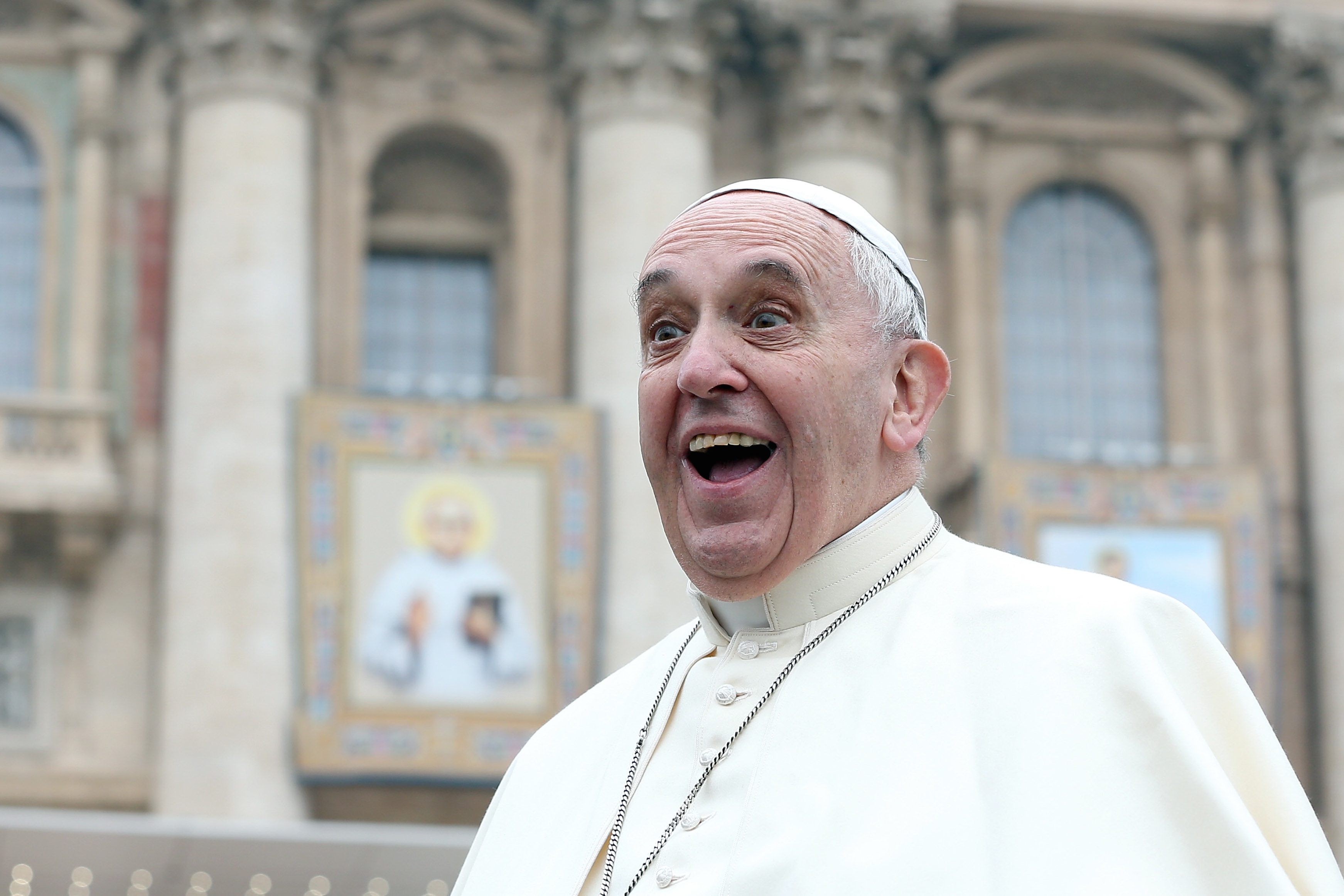
The American Right’s New Target: Pope Francis
This piece in the Federalist by Maureen Mullarkey strikes me as whiff of the future. It’s a full-bore attack on the Pope, and an attempt to define him as a Peronist leftist activist who needs to be “called out”. It comes after various broadsides from the theocons – which we first chronicled here. The anti-Francis position on the environment we also chronicled here and here.
My view is that the real breaking point will be the Pope’s forthcoming Encyclical on climate change, which is rumored to be one of the longest and most emphatic Encyclicals ever issued by the Vatican. The American right – which has been lulled by theocons into believing the absurd notion that Catholicism is completely compatible with capitalism – will go nuts if the Pope calls fracking, for example, a sin against the planet. And this despite the fact that this Pope’s position on the environment is indistinguishable from his predecessor’s, Benedict XVI.
Why are they so exercised when Francis says what Benedict said? Because Francis has captured the hearts of American Catholics, and he will travel here later this year. He will address the UN on climate change. He will make the Republican position – that the planet is merely a resource to be exploited rather than an inheritance to preserve – close to untenable for many American Catholics. He will expose just how fringe the GOP’s current position is.
But notice the new tone. I love the subtitles of the piece: “Let’s Talk About Pope Francis Associating With Marxists”; “The Hashtag Papacy”; “Silence And Appeasement Have Never Been Effective”. Fightin’ words! Money quote from Mullarkey:
Let us be honest. Conservatives are damned if they do, damned if they don’t. While deferential observers are measuring their tones, Francis drives ahead with a demagogic program which makes the state the guardian and enforcer all values. To suppress challenge to a pope’s political biases or erratic behavior is no favor to the Church. It is little more than a failure of nerve that will earn no reward in the press. Silence is a form of collusion.
So the gloves are off. My money’s on Francis.
(Photo: Getty Images)
A Best Guess At Our Future Deficits
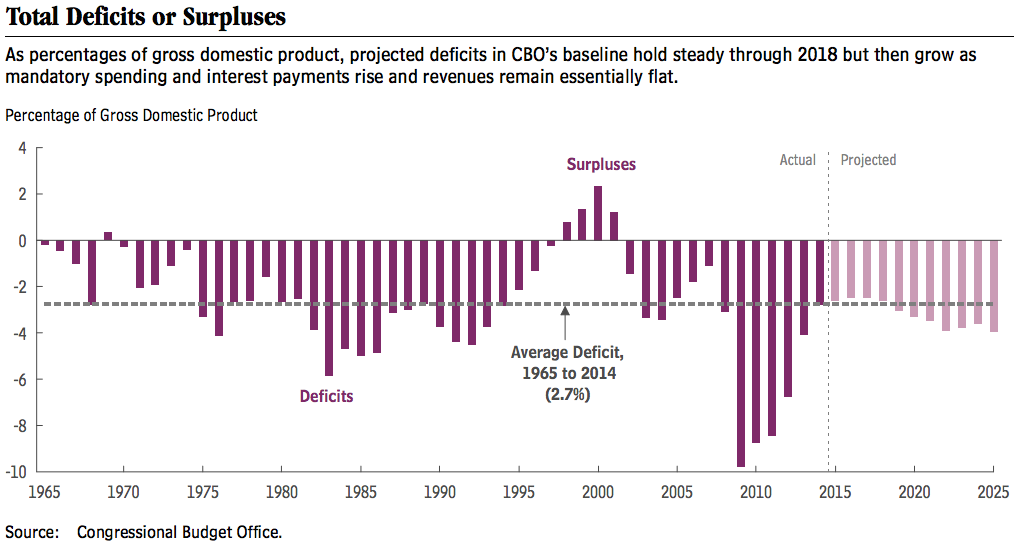
Deficits are predicted to rise somewhat in the near future:
The U.S. deficit will fall to its lowest level since 2007, but it is expected to begin rising quickly after 2018, according to a new report from the Congressional Budget Office. The difference between federal spending and revenue will fall to $468 billion or 2.6% of GDP this fiscal year, which is the lowest level since 2007, the CBO says. The deficit will continue to fall slightly in 2016 and hold steady in 2017. But then it will begin rising once more, reaching 3.0% of GDP in 2019 and 4.0% in 2025.
Matt Klein looks at the causes of those larger deficits:
More than all of the projected increase in the US federal budget deficit between now and 2025 is expected to come from higher interest payments on the existing debt.
He goes on to wonder whether those larger deficits will materialize. Krugman seconds Klein:
CBO shows the ratio of debt to GDP barely rising; just about all the rise in payments comes from an assumption that interest rates will rise. And as both Klein and I have tried to explain, we don’t really know that; there’s a plausible case that it’s wrong.
I’m not attacking CBO, which needs to make some kind of rate assumption. But if you read someone trying to resurrect deficit panic, bear in mind that even the modest rise in the new projections is just an assumption, with nothing solid behind it.
focuses on the uncertainty of Medicare spending. She questions the continuation of the “phenomenally slow growth in Medicare spending in recent years”:
Though some of this slowdown is well understood—reflecting payment cuts under the Affordable Care Act and the expiration of patents of a number of blockbuster drugs—much of the slowdown in Medicare spending is not understood by analysts. CBO’s research suggests that the Medicare slowdown does not appear to be attributable to the recession, and my work, using a variety of data sources, concurs.
CBO has made the not-unreasonable assumption that this slowdown will persist for some time. But, because we don’t understand why Medicare spending has slowed, this assumption must be viewed as highly uncertain. It is possible that, rather than persisting, the slowdown could reverse itself, and spending growth could surprise us on the upside in coming years.
Josh Zumbrun pays attention to the growth estimates:
These small deficits may seem surprising given the ferocity of Congress’s recent budget battles. But perhaps even more noteworthy is the economic forecast underlying it. The CBO currently estimates the recovery will continue through at least the end of 2017. If correct, that will be a 102-month economic recovery: the third-longest in U.S. history. The CBO’s forecasts for growth are not that different from the Federal Reserve’s, where policy makers also forecast at least three more years of economic expansion.
Finally, William Gale keeps in mind that the Great Recession pushed “public debt to all-time peace-time highs relative to the size of the economy”:
The debt-GDP ratio stands at 74 percent currently, up from an average of 37 percent in 1957-2007, the 50 years before the Great Recession, and a value of 35 percent as of 2007. The only time in U.S. history that the debt-GDP ratio has been higher is during and just after World War II, when the massive mobilization effort raised debt to more than 100 percent of GDP. …
The current high level of debt is not a crisis by any means. We are not Greece or even close. We do not need immediate cuts in spending or tax increases; indeed, they would probably be harmful to overall growth, as the economy is still in recovery mode. But the high debt level is not good news, and it is a problem to keep an eye on.