A cinematic stream-of-consciousness from birth to death:
Are We Failing At Grading Schools?
Big education news out of Indiana, where the state’s former schools chief – now Florida’s Commissioner of Education – apparently gamed his own school-rating system:
[Tony Bennett] built his national star by promising to hold “failing” schools accountable. But when it appeared an Indianapolis charter school run by a prominent Republican donor might receive a poor grade, Bennett’s education team frantically overhauled his signature “A-F” school grading system to improve the school’s marks [from an “C” to an “A”].
Bennett, an “Education Reform Idol” winner, has denied any wrongdoing, and Michael Petrilli, who hosted the contest, urges people not to jump to conclusions:
[Bennett] had spent months (and much political capital) building an A–F accountability system for Indiana’s schools. These systems are as much art as science (more akin to baking cookies than designing a computer), and when they tried out the recipe the first time, it flopped. One of Indiana’s brightest stars, a charter school known to be super high performing, ended up with a C. Clearly, the recipe needed fine tuning.
Ed Kilgore rolls his eyes:
The whole point of a “charter” public school is strict accountability for results. A “charter” is nothing other than a performance contract. If, as Bennett now claims, the bad grade for his pet school illustrated problems with the scoring system, it should have been discussed publicly after the results were released. I’m a long-time supporter of public school choice (and a bitter, last-ditch opponent of vouchers). But it’s getting to the point where you have to put “charter” in quotations when you are talking about some of these schools, particularly in states where the underlying commitment to public education is lacking.
Mark Kleiman is even harsher:
Look: I believe in outcomes measurement. I believe in accountability. I even believe in school choice. (After all, I live in the jurisdiction of the LA Mummified School District.) What I don’t believe is that the current testing/accountability/choice con artists and racketeering enterprises are going to make things better rather than worse. The cheating is so pervasive that I now see no basis for believing any claimed good result. That’s why Diane Ravitch has switched sides.
You’d have thought that charter schools, like private prisons, could hardly have done worse than their big, clumsy, bureaucratic, union-dominated public competition. But you would have been wrong, twice.
Andrew Ujifusa says the scandal could reverberate nationwide:
Bennett, in his new role as Florida’s education commissioner, the job he landed after losing his 2012 re-election bid in Indiana, recommended a dramatic change to Florida’s A-F accountability system so that no school’s A-F grade will drop by more than one letter in one year for both the 2013-14 and 2014-15 academic years. That move encountered some resistance, but won the approval of the state board of education earlier this month. The AP story may create a more difficult political environment for A-F school-grading systems in general and provide ammunition for those who believe the whole concept is flawed.
Quote For The Day
“In an alternative universe, the United States might re-intervene in Iraq, redeploying tens of thousands of soldiers to restore everyone’s sense of safety and allowing the political process to heal again. In this universe, the United States is never going to intervene in Iraq again, nor will the Maliki government ever request that we do so,” – Kenneth Pollack, architect of the Iraq catastrophe, wanting another bite at the cherry.
No, I’m not making this up. this is what he still believes. Take it away, Michael Maiello.
What’s So Wrong About Virtual Sex?

I was glad to read Susan Jacoby’s op-ed today, pushing back against the Brown-Quinn thesis that women are somehow victims of sexting culture and not full, eager participants. She makes some of the points I did last week:
There is no force involved here; people of both sexes are able to block unwanted advances. Women are certainly safer on the Web than they would be going home with strangers they meet in bars.
But then she veers off into this diatribe:
The morality of virtual sex, as long as no one is cheating on a real partner, is not what bothers me. What’s truly troubling about the whole business is that it resembles the substitution of texting for extended, face-to-face time with friends. Virtual sex is to sex as virtual food is to food: you can’t taste, touch or smell it, and you don’t have to do any preparation or work. Sex with strangers online amounts to a diminution, close to an absolute negation, of the context that gives human interaction genuine content. Erotic play without context becomes just a form of one-on-one pornography.
Bingo: “one-on-one pornography”. That’s the most concise description of sexting at its best that I have yet read. And it prompts me to ask: what, pray, is so wrong with that? Sex has always been about fantasy and reality and the sometimes ridiculous and sometimes incredibly hot experiences that mix can engender. The most fundamental sexual organ is the brain, as my shrink often points out to me. And masturbation – which is solitary sex based on fantasy (sometimes from pornography, sometimes from real life, sometimes from an Old Spice commercial) – is as old as human beings’ brains.
That’s why virtual sex is not like virtual food. You can have an orgasm in your body as well as your mind without any actual “work” in a way you cannot eat or taste something virtually. In fact, your sexual experiences through masturbatory fantasy can be far more satisfying and intense than the actual thing – you know, when one of you has come and the other hasn’t, when the dog jumps on the bed in the middle of it, when one of you farts or queefs, when the word “ow” occasionally surfaces, or when your mind wanders for a bit and your already sated spouse has to look at the ceiling for a while and think of the skim milk that needs buying, as you plug away to get it over with.
Nothing is as over-rated as bad actual sex or as under-rated as good virtual sex. And, yes, it isn’t real in the way that a loving, physical fuck-fest with a loved partner is real. But so what? Since when is the ideal the enemy of the good? And the fact that it isn’t real – that it’s a fantasy deriving from a sexual avatar – means it’s less perilous. It’s a form of play, the kind of activity that marks intelligent beings from those with less developed frontal cortexes. It’s play between two fantasy partners; it victimizes no-one; it transmits no diseases; it risks no pregnancy; it renders both partners radically more equal than they would be in the actual sack; and, as long as it is kosher with your partner, if you have one, it is much more moral than actual adultery, precisely because it isn’t real.
And women would be the most likely to gain sexual pleasure from this without all the attendant headaches and dangers of an actual physical, real-life sexual encounter.
Men, for their part, love showing off their sexual prowess. There’s a reason why Chatroulette – remember that? – started as a free-wheeling chance for anyone to say anything, and ended up as a dizzying parade of jerking dick pics. Anthony Weiner may be a loser but he is not mentally ill; he is a classic high-testosteroned male of the species, maximizing his sexual pleasure while minimizing the chances of actually having sex with someone other than his wife. His fault was not telling his wife up-front and running for fricking mayor of New York. But single guys and women – or those whose entire sexual needs cannot be completely fulfilled by fucking one person for the rest of their lives (i.e. everyone) – rightly see virtual sex as the best of all possible worlds if you want to get off without getting it on.
All this is is personal, interactive porn. On the web, it’s everywhere. In our national discourse, especially among those who came of age before the web, it is somehow necessarily foul and disgusting. It isn’t. It’s just embarrassing if your sex talk and body pics end up being perused by the whole world (which is why a new sexting app can automatically cause your pics to evaporate after a fixed amount of time).
Instead of ranting about dickmanship, feminists should be cheering this avenue for female sexual liberation on. It isn’t what sex can be at its best. But it sure is victimless, non-coercive, often exciting sexual play. I’m sorry, but that does not equate either with the near-negation of sex, as Jacoby would have it, or with mental illness. As a culture, we’re just not ready to admit that. But soon enough, we will.
(Photo by Mathieu Grac, from a collection of “Amusing and Poignant Photos of Social Media Self-Portraits in Progress.”)
Is The Tide Turning Against FGM?
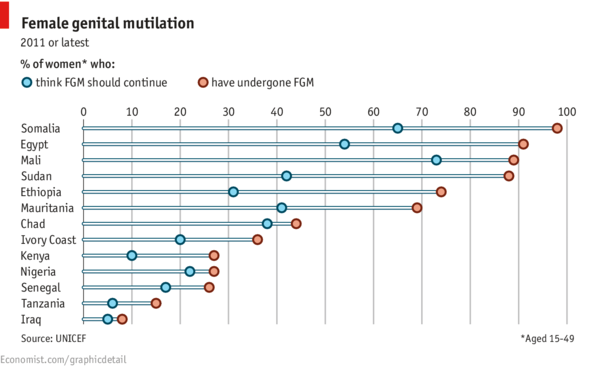
The Economist checks in on the barbaric practice that has affected 125 million girls and puts 30 million more at risk in the coming years:
[Female genital mutilation] has declined in more than half the countries UNICEF looked at, but most dramatically where it was already rarer. In the Central African Republic the share of women in the 15-49 age group who had been mutilated dropped from 43% in 1995 to 24% in 2010. In a few countries new data suggest the practice is all but eliminated. In the countries where it is most common, however, such as Egypt and Sudan, the prevalence has hardly changed. In Kenya it varies by ethnicity: FGM is now rare among the Kalenjin and Kikuyu tribes, and has almost disappeared among the Meru. Yet more than 95% of ethnic Somali and Kisii girls are still being cut.
Support for FGM, among both sexes but especially younger people, seems to be falling, even in countries where the practice is almost universal. Experience elsewhere suggests that this may herald an actual decline in coming years.
Here’s hoping.
A Grand Bargain To Nowhere
Obama’s proposal to cut the corporate tax rate if Republicans get behind his jobs and infrastructure programs seems to be dead in the water. In a truly hackish piece, Paul Ryan opines in USA Today that Obama is “interested in tax reform for corporations but not for families or small businesses,” while John McCormack reminds readers that “Obama’s push to lower the corporate tax rate to 28 percent comes less than a year after he raised the top individual income tax rate, paid by many small businesses, to 39.6 percent.” Meanwhile, business groups like the idea of tax cuts but object to the infrastructure spending.
Jared Bernstein is exasperated by the Republican response:
So, reviewing: we’ve got a big drop in the corporate rate that doesn’t add to the deficit, for which the Republicans have only to swallow a paid-for jobs program in areas they’ve historically supported. And what’s the response? From the spokesman for the House speaker, Representative John Boehner: “This proposal allows President Obama to support President Obama’s position on taxes and President Obama’s position on spending, while leaving small businesses and American families behind.”
I know, we’re in an upside-down world, but given how hard Republicans have fought for a lower corporate rate, the absence of accountability is particularly striking in this example. At this point, I truly wonder that if he finally gave in and offered to repeal Obamacare, they’d fight to implement it tomorrow.
Josh Barro pushes back:
[Obama] ended up proposing what amounts to a small corporate tax increase to pay for a small infrastructure program. This has been missed in much of the news coverage, particularly on television: Obama has called for a corporate tax rate cut, but he says that should come with enough base broadening to fully offset any revenue loss in the long term, and more than offset it in the short term. Liberals are, for some reason, expressing surprise that conservatives aren’t interested in this idea.
But couldn’t they refine it so that it is revenue-neutral? You know: actually negotiate a deal that would give both sides something? Howard Gleckman adds:
We remain stuck in the same Groundhog Day rut that has bedeviled tax reform – individual or corporate – throughout the Obama Administration. Obama and the Democrats won’t support reform unless it produces revenue to fund new spending and/or deficit reduction. Republicans won’t support it if it does increase revenue. So there we are.
But in that equation, the Democrats are clearly more willing to compromise than the GOP is. Alec MacGillis – who just a few weeks ago urged Obama to revamp the corporate tax code – says the administration’s plan is too vague:
As Obama has proposed before, the plan calls for lowering the corporate tax rate from 35 to 28 percent and making up the lost revenue by eliminating or reducing many of the credits and deductions that businesses use to get their rates far below 35 percent today. But the plan does not specify which of those credits and incentives it would target above all, and by how much – whether the depreciation credit for capital investments, the treatment of interest, etc.
It [also] promises simplification and investment incentives for small businesses, but does not reckon explicitly with the biggest objection to this general reform approach that we’ll hear from the executives at the many businesses (including some quite large ones) that now organize themselves as limited liability companies and “S-corps” rather than corporations and are thereby taxed at their owners and partners’ individual tax rates rather than corporate ones: that they’ll get hit with the loss of credits and incentives while not being able to benefit from the lower rates.
Rachel Weiner, who calls the proposal “basically DOA,” says Obama may not have expected the deal to catch on in the first place:
The White House can’t be expecting the House GOP to suddenly cave. They’re trying to do a couple of things. First, expand the idea of a “grand bargain” to mean not just deficit reform but any sort of economic agreement, and challenge Republicans to come up with a counteroffer. Second, try to win support from the business community for a proposal that contains two things they want: tax reform and domestic investments. Most of all, Obama is simply making clear that tax reform is one of his priorities, as Ronald Reagan did in his second term.
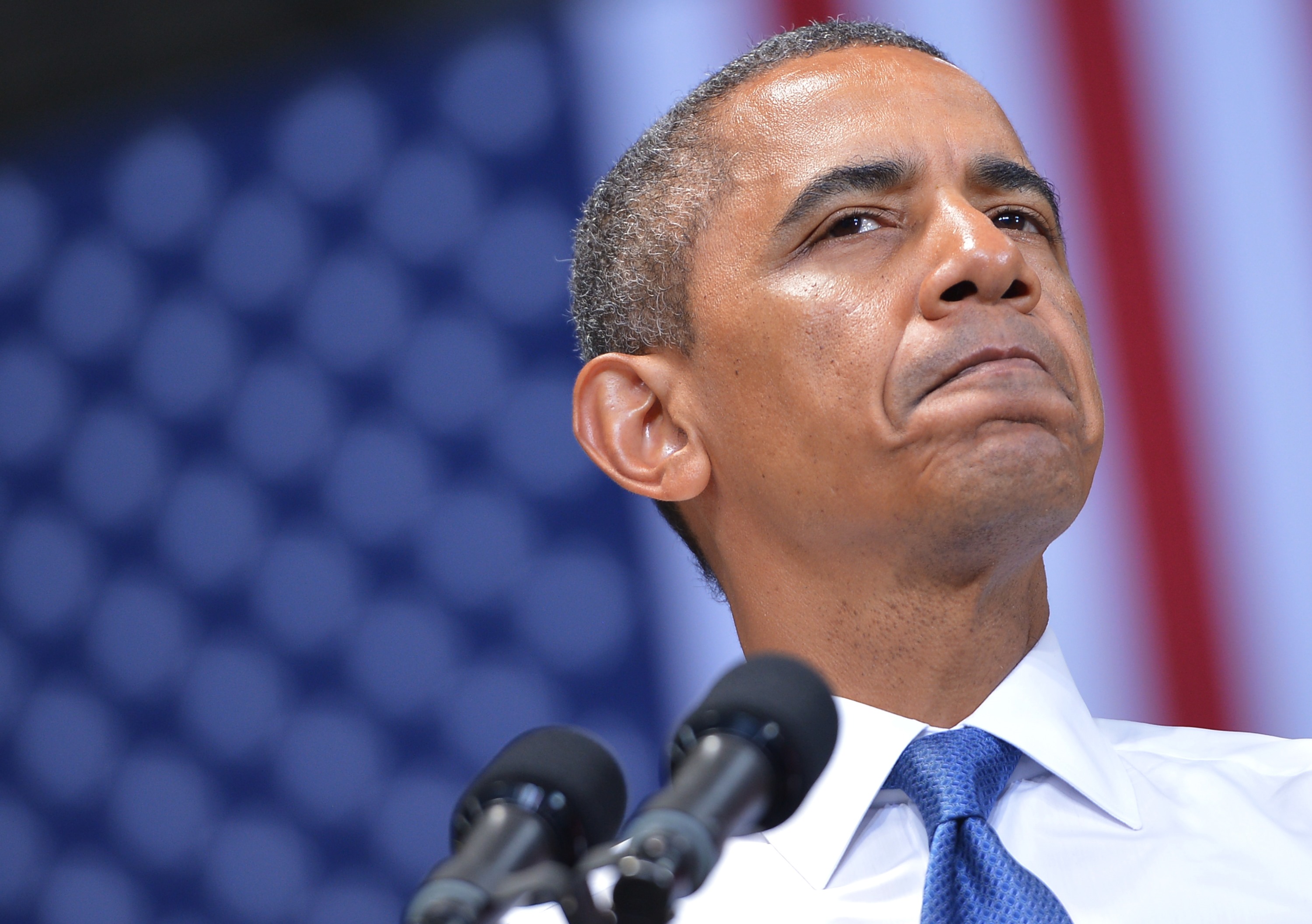
(Photo: US President Barack Obama speaks on job growth following a tour of an Amazon fulfillment center on July 30, 2013 in Chattanooga, Tennessee. By Mandel Ngan/AFP/Getty Images.)
Ask Frederic Rich Anything: President Palin
Fred’s new novel, Christian Nation, is a work of speculative fiction that imagines an America in which John McCain won the 2008 election and subsequently died, making Palin the president and setting the nation on a path to theocracy. In our first video from the author, he sets the scene for something that had me waking up in cold sweats throughout the fall of 2008:
In other former half-term governor turned failed-reality star news, Andrew Kaczynksi flags some recent hathos in which Palin claims that the reason Obama was elected was because the McCain campaign banned her from talking about Jeremiah Wright.
Our full Ask Anything archive is here.
Orcas As Slaves For Entertainment, Ctd
A reader quotes me:
… but, in my view, the captivity and use of any intelligent animal for entertainment will one day be seen as barbaric. It is a violation of the animals’ dignity. While that may not ascend quite to the level of human dignity, it demands that we cease treating our fellow inhabitants of earth as captive slaves.
This is why I have never been comfortable visiting a zoo. No matter how interesting I may find it to see the variety of animal life from diverse locations over the globe, I can’t get past the fact that these animals are imprisoned and forced to live a life in captivity that bears little resemblance to the life they would experience in their natural habitat. Perhaps their lives are easier not having to navigate the world of predators and other threats to life, but who are we to decide what is better for them? It just seems incredibly selfish of the human race to snatch these innocent animals from their normal lives and dump them into one we see fit to create for them, all to give families something to do on weekends.
Another reader:
The NYT’s Dot Earth blog offered a contribution this weekend from animal law Professor David Cassuto, who pretty much nailed the concept of animal personhood and rights. The whole post is worth reading in light of the orcas discussion, but here is the key passage:
Different traits demand different entitlements. Clustering them all beneath the term “personhood” invites imprecision. By contrast, separating the term into components allows the legal system to treat difference differently while still enabling access to the moral community. For example, acknowledging that animals have the right to be free from the grotesque exploitation of the industrial food apparatus does not require that we also grant them the right to vote. “Human” rights are just that. “Animal” rights should be something altogether different. Recognizing species differences need not mean asserting superiority but rather acknowledging and respecting otherness. Thus, replacing personhood with a cluster concept of rights offers a point of embarkation to a more coherent and egalitarian approach to our relationships with the nonhuman world.
Another reader highlights a case in which the captivity of orcas was put to a legal test:
Last year, five orcas sued SeaWorld for holding them as slaves in violation of the 13th Amendment ban on slavery. PETA filed the suit on the orcas behalf; the five orcas were the plaintiffs, claiming they “are held in slavery and involuntary servitude.” Unfortunately, it didn’t end well for the orcas:
Before the ruling, PETA’s attorney Jeffrey Kerr told HuffPost that the animal rights group’s argument was based on the belief that “slavery doesn’t depend upon the species of the slave, any more than it depends upon the race, gender or ethnicity of the slave. SeaWorld’s attempts to deny [orcas] the protection solely based on their species is the same kind of prejudice used to justify any enslavement. And prejudice should not be what determines constitutional rights in this country … Because they can suffer from the prohibitive conduct of being enslaved, the 13th Amendment protection against that conduct should be extended to them. …
[U.S. District Judge Jeffrey] Miller praised PETA attorneys for striving to protect orcas, but still found that the 13th Amendment “affords no relief.”
It certainly is unconscionable that 45 orcas are being held captive around the world. We should also keep in mind that tens of billions of other non-human animals are held as slaves in atrocious conditions by the egg, meat, and dairy industries – and we can all easily do something about that: simply boycott those products.
Another reader dissents, questioning the character of orcas:
I understand the arguments against imprisoning intelligent animals for our entertainment and I think they make a lot of good points. However, if orcas do in fact possess an “emotional life” more complicated than humans and therefore we should consider them as essentially people, then they are the worst kind of people. The series Planet Earth has a sequence in which a gang of orcas separate a whale calf from its mother and murder it in front of her. They eat its jawbone and then let the massive corpse fall to the ocean. Their rationale? It was fun. They are violent, psychotic murderers. If we are imprisoning them by keeping them in aquariums, then maybe they deserve it.
Benedict, Francis, And Gays

Ross contributes to the debate today, making roughly the same argument as I have but stressing more firmly that there is no actual doctrinal change (and even, according to Ross, no change in the blanket discrimination against gay seminarians). Juan Cole is even more dismissive:
[I]t seems to me that Pope Francis is just saying what many evangelicals say– hate the sin, love the sinner, celibate gays are welcome in the congregation, etc. And he’s putting a further precondition on acceptance, that gays not band together as a pressure group. So they have to be celibate and seen but not heard, sort of like children.
But both Cole and Douthat note a very different change in tone from Benedict’s stern strictures about “objective disorders” to Francis’ expansive “They are our brothers.” So the question becomes: does this tone mean something substantive in the life of the church? Or is it just brilliant spin, decontaminating the brand while upholding its Ratzingerian substance?
Here’s what I would argue: the tone is intimately related to the substance, and the one cannot logically be changed without the other. Which is why this recent statement reveals the incoherent tension at the heart of the church’s teaching about homosexuality – a tension that at some point has to be resolved.
Here’s why. Recall Ratzinger’s central innovation in the argument in 1986:
Although the particular inclination of the homosexual person is not a sin, it is a more or less strong tendency ordered toward an intrinsic moral evil; and thus the inclination itself must be seen as an objective disorder.
What Ratzinger was saying is precisely that, in the case of homosexuals, hating the sin but loving the sinner is not a Catholic option. Because in the case of homosexuals, their sin is integrally related to their very nature, which they cannot change. The part of their nature that is objectively disordered and they cannot change is, moreover, that pertaining to love and sex and family, arguably the very things that make most of us happy. So gay people truly are deformed in the most profound way possible – morally crippled and constrained by their very nature.
Why would Ratzinger have taken that huge and painful leap that is so anathema to the spirit of inclusion in the Gospels? Because in Catholic teaching, acts flow from being. It is absurd in Catholic thought to talk of something in nature that is entirely neutral and yet always leads to an intrinsic moral evil if expressed.
 To see why, try and come up with a serious analogy within Catholic theology for the argument that homosexuality as not sinful in itself but is always sinful when expressed. I’ve been trying for twenty years.
Take the sin of envy, for example, which is part of our common human nature and is always a sin when expressed in an act. But it is not a neutral condition, as the 1975 Letter said of homosexuality; it is a sign of our fallen nature. It does not occupy some neutral ground before being expressed. It is part of original sin for all of us.
Or take alcoholism. Some people are alcoholics by nature or genetics, which is why it is hard to describe being an alcoholic as sinful, since it isn’t a choice, like homosexuality. But the choice to drink, like the choice to express love sexually for gay people, is nonetheless a sin for alcoholics. I think this is the best analogy I’ve heard in this long debate. But it falls apart on one obvious ground. Unlike sodomy, drinking itself is not sinful for everyone, according to the Church. For most people, it’s fine. Jesus himself turned water into wine to keep the wedding party going.
But sodomy is barred as sinful for all people, straights as well as gays. The Church does not say, as it does for alcoholism, that it’s fine for  straight people to have non-procreative sex, but not for gays. It says it’s a sin whether committed by a heterosexual or a homosexual. So again, the teaching on homosexuality appears unique, as if it were an argument designed to buttress a pre-existing prejudice, rather than an argument from the center of the church’s teaching.
So maybe being gay is a form of disability for Benedict. But the church’s teachings about the disabled bear no relation to its teachings about homosexuals. The former are embraced, brought to the front of the church, cared for, defended, championed, as any Christian organization must and should. The latter are silenced, pathologized and told not to be all they can be, and specifically to avoid any expression of love, passion, family or relationship with a partner or spouse, i.e. to live a life of unique isolation and suffering, simply because of who they are. Tim Padgett gets the problem:
How can the Catholic church declare homosexuals “disordered” and their lifestyle an “intrinsic moral evil,” yet expect us to applaud its “love” for gays somewhere beneath all that homophobic bigotry? My mother was born in Mississippi and has often told me of Southern whites in the mid-20th century insisting they could love a black person even if they hated the black race. No, you can’t have it both ways. So it makes no more sense to me in the early 21st century to hear Pope Francis claim to love gays while I know that when he was Archbishop of Buenos Aires he called Argentina’s legalization of gay marriage a “grave anthropological regression.” Or to hear celebrity evangelical pastor Rick Warren profess admiration for gay friends but then keep saying that it “might be a sin” for them to sleep with each other.
This is indeed the nub of it. A theologian reader explains why:
What was done by the author(s) of the 1986 document (let us call them Ratzinger, who at least signed it) was to tie a logical knot that could now work greatly in gays’ favor, if only, as you suggest, some in the press were better able to understand it, and so face down spinning Archbishops such as your own. The knot was to point out that in order for it to be the case that all gay sex is sinful (which is what many Bishops would love to be able to maintain without any logical consequences) then you have to maintain that the condition itself is objectively disordered. This, of course, many Catholic spokespersons try to run away from doing, since many of them know it is false, and not all of them are fully accomplished liars.
But what this means is that if, as appears to be the case, being gay is not an objective disorder then according to the logic proper to Catholic faith, which recognizes that acts flow from being, it is also not the case that all gay sex is sinful. Ratzinger was logically correct that the absolute prohibition against loving same-sex acts cannot be maintained if it is accepted that the inclination is “neutral or positive” to use the language rejected by the 1975 document you refer to.
What the 1986 document bequeathed to us (apart from a huge amount of pain, anguish, and despair) was not only a mistaken characterization, but a logical recognition that if the characterization is mistaken, then so is the absolute prohibition. This is the double bind that most Bishops dance around, and are allowed to dance around by a press that imagines “Church teaching” in this area to be a special category, the rules of a private club, and not a matter which depends quite simply on what is true about the human beings in question.
I hope and pray that Papa Bergoglio knows where he’s taking this. Which means I hope and pray that he, unlike so many of his colleagues, is not stuck in the double-bind, and thus will be able to unbind us all into living the truth, which is what Popes are for.
I hope so too. The Catholic faith is one designed to be examined by reason. Yet reason reveals that its core teaching on homosexuality requires it to describe an entire class of people as inherent moral deviants, regardless of what they do or say or how they live their lives. That final assertion is simply incompatible with reason and with Christianity. At some point, it will collapse. And with it, the entire edifice of the tortured teachings on sex that the Catholic hierarchy is so desperate to maintain.
I doubt Pope Francis is doing this consciously or as a means to bring the Church to its senses on this question. But his expression of Christian love and charity toward gay people is a direct rebuke of the doctrines he says he still supports. And at some point, what cannot be logically sustained will fall.
(Photos: Pope Benedict XVI, Franciscans arriving for the inaugural mass for Pope Francis, and the Jacob Epstein’s statue of Lazarus in New College, Oxford. By Getty Images.)
Manning Dodges A Bullet, Ctd
John Judis isn’t celebrating the verdict, despite Manning’s acquittal for the most serious charge of “aiding the enemy”:
The trial itself should never have taken place. The military should have accepted Manning’s admission of guilt last February. In my opinion, he had already served long enough, and suffered sufficiently under brutal conditions, to pay for violating his trust as a soldier in military intelligence. But the military might still have exacted a few more years of confinement in a plea bargain. Instead, they sought to stage a show trial. The case they made that Manning had aided the enemy—replete with doctored quotations from emails—would have made Roger Ailes blush. But perhaps they knew what they were doing all along. By focusing attention on the truly horrific charge, they convinced the judge to support a charge that was merely god awful.
Burt Likko predicts that if Manning was as justified as his supporters claim, he can expect a pardon:
Manning, along with his spiritual cohort Edward Snowden, almost certainly had sober and significant moral and legal concerns about things they saw the government was doing, about the reach of the security state in terms of both its intrusiveness and its lack of meaningful checks and controls. The public may very well benefit from their exposure of what the security state was doing in the form of the creation of some sort of meaningful controls and balancing of individual privacy rights against (or, as I prefer to say, “with”) the need to keep the nation secure and at peace.
So if the public has benefitted from these violation of the law, that is one of the reasons that executives have the power to grant clemency. If Bradley Manning can demonstrate that the nation has tangibly benefitted from his data dump to Wikileaks, then the place to argue that is not in a court-martial, which is charged with determining the truth of whether a particular law was violated. The place to argue that is in a request for a commutation of sentence or a pardon, addressed to the President of the United States.
Like Judis, David Harriss Gershon believes Manning has already served enough prison time:
Seriously, I don’t want to hear any lectures about how Manning deserves this time because he “broke the law.” If he had illegally tortured Guantanamo detainees for the CIA, or even orchestrated such torture programs – illegal per U.S. and international law – he could very well have been promoted, if not left alone. The Manning verdict’s central message, aside from this obvious hypocrisy and the injustices underlying it, is this: if you are a whistleblower in this country, do what Edward Snowden did (and what Daniel Ellsberg suggests): flee America, and fast.
The sentencing for Manning begins today and Kevin Gosztola is live-blogging.

