The Zimmerman Verdict And My Block

I’ve written how, for 20 years, I have lived on a street corner in Washington DC known for its drug activity and one gang, based at 17th and Euclid. I’ve written that I’d never been attacked, never hesitated to walk through a group of young black males, never crossed the street the way Victor Davis Hanson would. So it behooves me to note this story today:

Police say three black men approached a white male from behind in the 1700 block of Euclid Street NW. [DC police spokesman Araz] Alali says two of the men threw the victim to the ground and kicked him. Police say they yelled “This is for Trayvon Martin.” The attackers took the victim’s iPhone and wallet before fleeing.

Will that change my attitude when I manage to return from NYC? No. Does it deeply depress and anger me? Yes.

Francis’ Sunlight

This picture taken 21 March 2007 shows a

How can I describe my response to the following simple words:

“There’s a lot of talk about the gay lobby, but I’ve never seen it on the Vatican ID card … When I meet a gay person, I have to distinguish between their being gay and being part of a lobby. If they accept the Lord and have goodwill, who am I to judge them? They shouldn’t be marginalized. The tendency [to homosexuality] is not the problem … they’re our brothers.”

Let’s parse this as conservatively as we can. What does it mean to be part of a “gay lobby”? In the context of the curia, I think it means that a group of cardinals or Vatican officials saw their sexual orientation as what defined them as a group, and operated as a faction within the Church’s center. I find that as repellent as any other kind of lobby that places a particular human characteristic ahead of the only quality necessary for a church official: dedication to God, God’s people, and the Church. But even then, Francis is making light of the hysteria: “I’ve never seen it on the Vatican ID card.” Not since John XXIII has a Pope deployed humor quite as easily and effectively as this one.

But so far, so banal – if utterly different than the panicked, tightly-wound homophobia of the last Pontiff. Then the revolutionary part:

“When I meet a gay person, I have to distinguish between their being gay and being part of a lobby. If they accept the Lord and have goodwill, who am I to judge them? They shouldn’t be marginalized. The tendency [to homosexuality] is not the problem … they’re our brothers.”

The tendency to homosexuality is not the problem. This is a direct rejection of the last Pope and his predecessor. The key letter was issued in 1986 and the key, horrifying directive issued in 2005 barring all gay men from the priesthood – however they conduct themselves and regardless of their gifts and sincerity. Here’s Ratzinger’s CDF statement on homosexuality, which walked back the previous, much more inclusive, position taken in 1975.

In the discussion which followed the publication of the [1975] Declaration, however, an overly benign interpretation was given to the homosexual condition itself, some going so far as to call it neutral, or even good. Although the particular inclination of the homosexual person is not a sin, it is a more or less strong tendency ordered toward an intrinsic moral evil; and thus the inclination itself must be seen as an objective disorder.

This is the new doctrine Ratzinger introduced into Catholicism: that gay people are uniquely inclined toward an intrinsic moral evil, that there is something inherently immoral about us, that we are in a special class of sub-humans, because our loves – when expressed fully with our bodies as well as souls – are intrinsically evil. This doctrine was so contrary to the Gospels, so callous, and so grotesquely unjust – barring any gay man from entering seminaries solely because of something he cannot change – that it was, for me, one of the low points of my spiritual life in the church. Not only was the Pope attacking the souls of an entire class of human beings, he was deeming them unfit for priestly authority. Child rapists could be tolerated; sincere, celibate gay priests were intrinsically disordered unlike any other group in society. I wrote on this page at the time:

Some of the basic principles of the Catholic faith – treating each individual as equally worthy in God’s eyes, judging people by what they do, not who they are – are being violated by this policy. The astonishing work of gay priests across the centuries and across the globe is being denied and stigmatized and ignored. This is a huge stain on the church – reminiscent of its long, terrible history of anti-Semitism.

And so in a few off-the-cuff remarks, Pope Francis returned the Church’s leadership to the spirit and love of the Gospels. This does not mean a change in the doctrine that all non-procreative non-marital sexual expression – from masturbation to foreplay to homosexual or contracepted sex – is immoral. But what it does is explicitly end the Vatican’s demonization and marginalization of gay people made in the image of God, people who have served the Church from its very beginnings, in ways large and small.

It says a lot about the cramped, fearful, nit-picking dead-end of the last Pontiff that simply asserting human dignity should bring such joy. But it has been clear for a while now that the Holy Spirit and the intercession of Saint Francis are opening the windows of the church again – so that sunlight and transparency and simplicity can flood the previously darkened rooms of a retreating reactionary Vatican.

We have a Pope. By God, we have a Pope.

You Think “Weiner” Is Bad? Ctd

This embed is invalid


Dish readers continue to pool their vast collective knowledge:

I believe I’ve got a name that is even more preposterous than Bill Boner or Harry Baals or Dick Swett. I once worked with a guy from Zimbabwe named Lovemore Dick.

Don’t believe me? There’s several of them from Zimbabwe and Mozambique on Facebook, along with Lovemore Dickson. Look ’em up. And none of them is the one I know. Seems to be a popular name.

Another reader:

I live half an hour from this Air Force base, named after Eastern NC’s own WW2 hero: Seymour Johnson.

Another:

In the ’80s at SUNY Binghamton, a very nice guy named Gil Dickoff ran for office in the Student Association. He ran against someone named Smith. Gill lost the election. And what was the headline in Pipedream, the student newspaper?  “Smith Beats Dickoff Handily”

Another:

There was a family furniture store here in Pasadena named J.H Bigger. You guessed it: The manager’s name was Dick. Dick Bigger.

Another:

In the fine tradition of funny Dick names, I give you: Dick Champion.

Many more contenders after the jump:

I just had to write in.  I’ve had two people in my life who could illicit a laugh whenever I heard their name:

1. Dick Beiter. He was my flag football coach when I was 8-9 years old. I swear to god that was his true name. (He had three sons and one daughter. The oldest son had Down’s syndrome and served as the “lineman” when we played; he would go along the sidelines and mark the first down line after each play.)

2. Dick Burns. He was my high school history teacher. Of course, the yearbook says “Richard” but he went by “Dick” among colleagues. Hilarious. Try not to laugh in class!

Another:

Here’s a photo of a now-extinct New Orleans auto dealership: Dick Bohn Ford. (And yes, you pronounce it “bone”.)

Another:

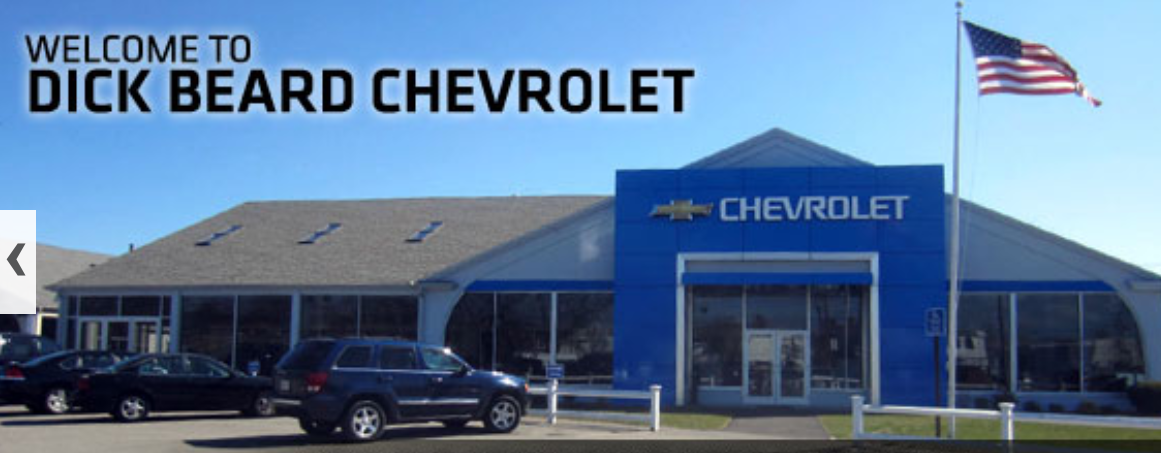
Perhaps you recognize this reputable car dealership from your time on Cape Cod:

Screen Shot 2013-07-28 at 5.38.18 PM

Another:

Back in the early 1980s there was a company in Salt Lake City called Richard Long Erection Company, always referred to as Dick Long Erection Co.

(Though Google has no record of it.) Another reader:

As I see that Northwest Ohio is not yet representin’, let me add these two gems to the thread: Former Ohio state representative from Huron County, Richard “Dick” Rench, and retired Toledo judge Peter Handwork.

Another reader:

I’m actually a little surprised you haven’t gotten this one already, but when I did my freshman orientation at UCLA, the counselors told us a number of ridiculous lies leading up the most ridiculous one of all – except that one happened to be true: The University Research Library has a plaque dedicated to the former campus librarian, Hugh G. Dick.

Another gets off the Dicks:

As long as everyone is contributing their favorite unfortunate names, here’s mine: Gay Hitler, a dentist from Circleville, Ohio (born in 1882).

Another:

When my brother attended Minot (ND) State Teacher’s College in the 1960s, there was a girl’s dorm named after a former Dean of Women, Helen Hoar. Can you imagine sending your 18-year-old daughter to live in Hoar Hall?

The mascot of Minot State is the Beavers, and back then photos of selected girls on campus were sent to celebrities every year (think Jackie Gleason, Johnny Carson, etc) so they could choose “Miss Beaver.”

And at the University of North Dakota, the chair of the Speech Department in the ’70s was Hazel Heiman. Campus lore had it that her son’s name was Buster.

Another:

My ex’s sister was known as Kitten … and the family name was Raper.  The poor girl.

And another:

Can anything top Professor I. Metin Kunt, who was visiting at Yale when I was an undergrad there?  When we saw his name listed in the Blue Book course guide, we were sure it was a joke. But no: here’s a current link to an online sales page for one of his books, with his name on the cover.  Was “Ibrahim” so toxic that he had to shorten it to “I”?

Last but certainly not least:

I’m sure I’m not the only baseball fan reading this thread who thought of the Detroit Tiger pitcher Doug Fister, who was obtained two years ago from Seattle in exchange for another pitcher named Charlie Furbush. It is now referred to, whenever possible, as the Fister-Furbush trade.

Living With Autism, Ctd

Naoki Higashida’s The Reason I Jump is a memoir that offers readers a glimpse into a mind of a boy with autism (he was 13 years old when the book was published).  David Mitchell and his wife, K.A. Yoshida, who have an autistic son, found the book so enlightening that they recently translated it from Japanese.  Mitchell describes what he’s learned:

Living in close contact with autism, you do come to understand that autism is indeed a spectrum inhabited by all of us. The majority of us are on the ‘right’ side of a blurry zone on this spectrum where you don’t get diagnosed and don’t need to, but I’ve often thought about kids I was at school with in the benighted 1980s (which were in turn a cakewalk compared to the 1950s, when you shudder to think) who struggled with autism or Asperger’s before the word and diagnosis existed. Same thing with people I’ve met between then and now whom I dismissed as weird-in-a-bad way or selfish or as anal jobsworths or incommunicative beyond the point of rudeness, and now I think, You too, huh? Sorry I didn’t understand at the time.

Like a speech disfluency—I stammer—autism isn’t a disease but an architectural/electronic feature of your brain. The nature of this feature is still a mystery to science and the bad news is, there’s no cure—at best, there are treatments that make autism more liveable-with. The good news is that the brain is a mystery and its potential for plasticity, and for evolving new pathways, has been consistently underrated. Ask recoverers from strokes. I’m not saying you should live in hope for a miraculous cure—I don’t believe in ’em, especially if there’s a trademark or copyright symbol in the neighbourhood—but I am saying you should never underestimate an autistic person’s talent for discovering a key to a lock you never expected to see being opened, from the inside.

Previous Dish on autism here, here, and here.

Our Surgical Fountain Of Youth

FILE PHOTO:  Soap Stars To Hollywood Stars

In a long post on the cosmetic surgery industry, Alex Mayyasi considers the clientele:

Rumors of young celebrities going under the knife draw headlines, but the middle-aged dominate the market. Patients 40-54 years old account for 48% of procedures and those above 55 another 26%. Teens and twentysomethings represent under 10% of procedures. While the number of procedures are increasing across all age ranges, they are increasing most quickly among older individuals. The growth of plastic surgery is fueled by the 76 million Baby Boomers. At ages 49 to 68, they already spend over $80 billion on anti-aging products.

The industry will continue to grow as Americans live longer and seek out youthful looks to match their longevity. But these trends suggests that the American cosmetic surgery market is still mostly about making older individuals look like their younger selves, not crafting a new look for young people.

(Left photo: Actress Meg Ryan appears in the role of Betsy Stewart with actor Frank Runyeon, in the role of Steve Andropoulos, as they pose for their wedding photo on the CBS soap opera ‘As The World Turns’ on March 3, 1982 in New York City. By CBS via Getty Images. Right photo: Ryan attends the Biutiful premiere at the Palais des Festivals during the 63rd Annual Cannes Film Festival on May 17, 2010. By Sean Gallup/Getty Images)

Cannabis In Canada

A reader updates us:

I’m aware that Canadian political news doesn’t make much of a dent in the American news cycle, so I thought that you’d enjoy knowing the position taken by the leader of the federal Liberal Party. Justin Trudeau just came out in favour of legalization, going further than the party’s existing stance in favour of decriminalization.

Trudeau won the Liberal leadership in May. He’s the son of former Prime Minister Pierre Trudeau and he’s been doing surprisingly well since taking the reins of the party. He’s a relative newcomer to politics (first won his seat in the 2008 election) and there’s been much speculation about his ability to lead a party given his youth and lack of experience. But he’s been leading in most polls since May, helped out majorly by the fact that the current PM, Conservative Stephen Harper, has been in power since 2006 and has now found himself in the midst of a few scandals that go right to his office, most prominently a spending scandal involving Conservative senators and the PM’s chief of staff secretly paying $90,000 that one senator was order to repay. But that’s another story.

The experience of Colorado and Washington will probably inform the debate up here, and if it looks like a positive experience, Trudeau’s position will likely only gain more traction in a country that’s already pretty pot-friendly. The Conservatives, on the other hand, have made “tough on crime” one of their central positions (despite all evidence that crime in Canada has been going down – even today, Statistics Canada announced that crime is at the lowest level since 1972). They already suffer from the perception that they’re a bunch of angry old assholes, and being rock-solid against softening marijuana laws will only harden that perception, in my opinion.

The Ultimate Hard Drive

dish_dna

Scientists Ewan Birney and Nick Goldman selected five cultural artifacts, including the complete sonnets of Shakespeare in ASCII text and an mp3 of Martin Luther King Jr.’s “I Have a Dream” speech, to encode into DNA. When their approach worked, they began thinking about “a fanciful application: using DNA to apocalypse-proof human culture”:

“I describe this project as being on just this side of crazy,” says Birney. “It works but isn’t commercially feasible now.” The exorbitant cost of making DNA is the biggest hold-up. For the moment, you need $220 to read each megabyte of DNA data but $12,400 to write it in the first place; however, these costs are likely to fall 100-fold within the next decade. They are also one-off investments; once data is written as DNA, it never needs to be re-written into new-fangled formats. Birney and Goldman predict that soon, DNA will be the ideal medium for storing data that you want to keep for a long time but not regularly revisit, such as wedding videos or the archives of huge science projects like the Large Hadron Collider at Cern.

Or, perhaps, all of human knowledge? Besides being universal, dense and easily copied, DNA is also incredibly stable. A recent study showed that DNA has a half-life of 521 years – that’s how long it takes for half the chemical bonds in its double helix to break. This estimate was based on DNA recovered from the 8,000-year-old leg bones of giant extinct birds called moas. But that’s nothing – these bones were preserved at 13C in New Zealand. Under gentler conditions, DNA’s shelf life last can stretch to tens of thousands of years. “For perspective, that’s all of modern human evolution,” says Birney.

(Photo by Flickr user kyz)

Coffee Cartography

dish_starbucks

Chris Kirk developed a nifty quiz:

First World problem: There are four Starbucks locations around my house, and I never know which one to go to because the coffee-deprived slog to each is the same half-mile length. If you get the sense, like I do, that Starbucks is everywhere, it’s because there are 13,279 of them in the U.S. alone, and they’re so crammed into highly trafficked areas that sometimes, as Lewis Black famously bemoaned, there’s a Starbucks directly across the street from a Starbucks. You can recognize a city by its streets or population patterns. Can you recognize it by its Starbucks locations?

Debating Diabetes

A reader writes:

I was so glad to see the letter from your reader who protested the constant equation by the media of “diabetes” with “obesity”. I myself am a 40-year-old Type-1 diabetic, diagnosed at 15 with the highest blood sugar on record at that particular Baltimore hospital (I’d apparently been insulin-deficient for more than a month). The most interesting thing to me about this terminology trend is that it’s pretty recent in the US, coming into regular practice with the obesity epidemic, and, especially, the juvenile obesity epidemic.

I lived in Japan for two years from 1999 to 2001, and I taught English at a language school in Tokyo. We teachers had to do a lot of mundane back-and-forths, and we ended up talking about ourselves a lot, just to get students out of their shells. Whenever I let people know that I was diabetic, all the students – to a person – laughed. Japan is a country of very few diabetics, and the ones it had were, typically, old and fat. So when I – a tall, slender, young American guy in the prime of life, or whatever – divulged that I was diabetic, it was just so absurd to my students on its face that they could only assume I was making a weird joke, like saying “I eat with my feet” or “I’m married to a man.” I remember marveling at how weird that reaction seemed at the time.

Fast-forward to a decade later, and the stereotype of the fat unhealthy diabetic who brought the disease on himself is in full bloom in the US.

This stereotype didn’t exist when I was diagnosed in 1988. If you’d said to me the word “diabetic” before the disease landed on me, I’d have thought, “Oh, that’s that tragic disease that keeps you from eating all the sugar you want and forces you to prick your finger and jab yourself with syringes all day, all night, forever” – not “Oh, that’s that hilarious disease that fat people get after too many deep-fried bacon double cheesesteaks.”

The diabetics I met in the wake of my diagnosis were all plucky kids who put me to shame with their easy, breezy approach to what I saw as a horrific daily regimen of sharp objects, blood, and boring food. And the very first diabetic I ever met, a boy in my second grade class, was one of the best soccer players in my school.

But it feels that, over the last decade – ever since the word “obesity” started being regularly used in teevee news stories – accompanied by the obligatory B-reel of faceless fat people walking – diabetes has become a disease that folks are more comfortable pointing and laughing at. In my formative years as a diabetic, I became very comfortable with being pitied for my disease – “you have to give yourself shot?! Four times a day?! I could never do that!” – but being a joke? Irritating. The letter from your reader reminded me of the good old days.

In conclusion, thanks a lot, Paula Deen.