The Value Of Visual Literacy

Martin Scorsese underscores it:

We’re face to face with images all the time in a way that we never have been before. And that’s why I believe we need to stress visual literacy in our schools. Young people need to understand that not all images are there to be consumed like fast food and then forgotten—we need to educate them to understand the difference between moving images that engage their humanity and their intelligence, and moving images that are just selling them something.

As Steve Apkon, the film producer and founder of the Jacob Burns Film Center in Pleasantville, New York, points out in his new book The Age of the Image, the distinction between verbal and visual literacy needs to be done away with, along with the tired old arguments about the word and the image and which is more important. They’re both important. They’re both fundamental. Both take us back to the core of who we are.

When you look at ancient writing, words and images are almost indistinguishable. In fact, words are images, they’re symbols. Written Chinese and Japanese still seem like pictographic languages. And at a certain point—exactly when is “unfathomable”—words and images diverged, like two rivers, or two different paths to understanding.

Faces Of The Day

dish_portraitlandia

For his series Portraitlandia, photographer Kirk Crippens took to the streets of Portland, Oregon to snap pictures of residents.  Says the artist of naming the series:

At the end of my Newspace [Center for Photography in Portland, Oregon] residency, I had the pleasure of presenting the images during an artist talk. I posed a question to the audience before showing the work: “What’s the worst title you can think of for a portrait project made in Portland?” My answer was Portraitlandia. Ironically, after my slideshow a group of Portlanders began insisting I name the project Portraitlandia; I resisted (hadn’t I just proclaimed this to be the worst title?) But they were quite insistent! They told me it was what I had created. I had created Portraitlandia.

A gallery is here.

(Photo by Kirk Crippens)

Yglesias Award Nominee

“I’d be leading the charge [for defunding Obamacare] if I thought this would work. But it will not work … You’re going to set an expectation among the conservatives in our party that we can achieve something that we’re not able to achieve. It’s not an achievable strategy. It’s creating the false impression that you can do something when you can’t. And it’s dishonest … You’re not going to stop the funding, but what you will do is shut down the government. Among that group of senators that has been considering this, I was the only one who was here for that. The president is never going to sign a bill defunding Obamacare. Do you think he’s going to cave? The strategy that has been laid out is a good way for Republicans to lose the House,” – Tom Coburn.

Bonus:

There’s some small shred of sanity left, it seems. Combined with Behner’s slapdown of Steve King, lets hope it gains more steam.

The Good E-book

Nir Eyal samples a Bible app, complete with reading programs and special notifications intended to keep believers chaste and sober:

The Bible app is designed to make absorbing the Word as frictionless as possible. For example, to make the Bible app habit easier to adopt, a user who prefers to not read at all can simply tap a small icon, which plays a professionally produced audio track, read with all the dramatic bravado of Charlton Heston himself.

[Pastor Bobby] Gruenewald says his data also revealed that changing the order of the Bible, placing the more interesting sections up front and saving the boring bits for later, increased completion rates. Furthermore, daily reading plans are kept to a simple inspirational thought and a few short verses for newcomers. The idea is to get neophytes into the ritual for a few minutes each day until the routine becomes a facet of their everyday lives.

Egypt Erupts Again

More than 100 people were killed and countless injured early this morning when Egyptian security forces opened fire on a pro-Morsi sit-in demonstration in the Nasr City district of Cairo. Mosa’ab Elshamy was on the scene:

His comprehensive report:

I went to Rabaa at 2 am last night after I heard the [pro-Morsi] sit-in might be dispersed. When I got there, the shooting had already started. It was unclear to me who ‘started’ the attack. But the clashes were at the beginning of Tayaran street, 100 metres away from the sit-in. There was a non-stop sound of gunshots.

The dark meant it was suicide to stay there. So I went to Rabaa’s makeshift hospital. Most of the cases I saw where people shot in the leg and chest with live bullets. Hours later, I counted 24 dead bodies at the morgue. I saw at least 3 men who were shot in the head. Some claimed snipers were on October bridge, which would make sense.

After dawn I went to the frontlines. Next to the police there were armed civilians who seemed to be a mix of residents and thugs. I was on Morsi-supporters’ side of the clashes for about 5 hours and honestly saw no arms with them. Pro-Morsis mostly just took cover, threw rocks, fireworks and gas canisters back until they got shot at & carried away. Then repeat.

I didn’t see any military involvement. Except when soldiers at Manasa shot in the air and caused both sides to back away for a while. My conclusion is that this was, undoubtedly, a horrific assault by MOI + ‘civilians’ with tear gas, rubber bullets and live fire.

Elshamy also took a series of harrowing photos, which can be seen here. More tweets on the carnage:

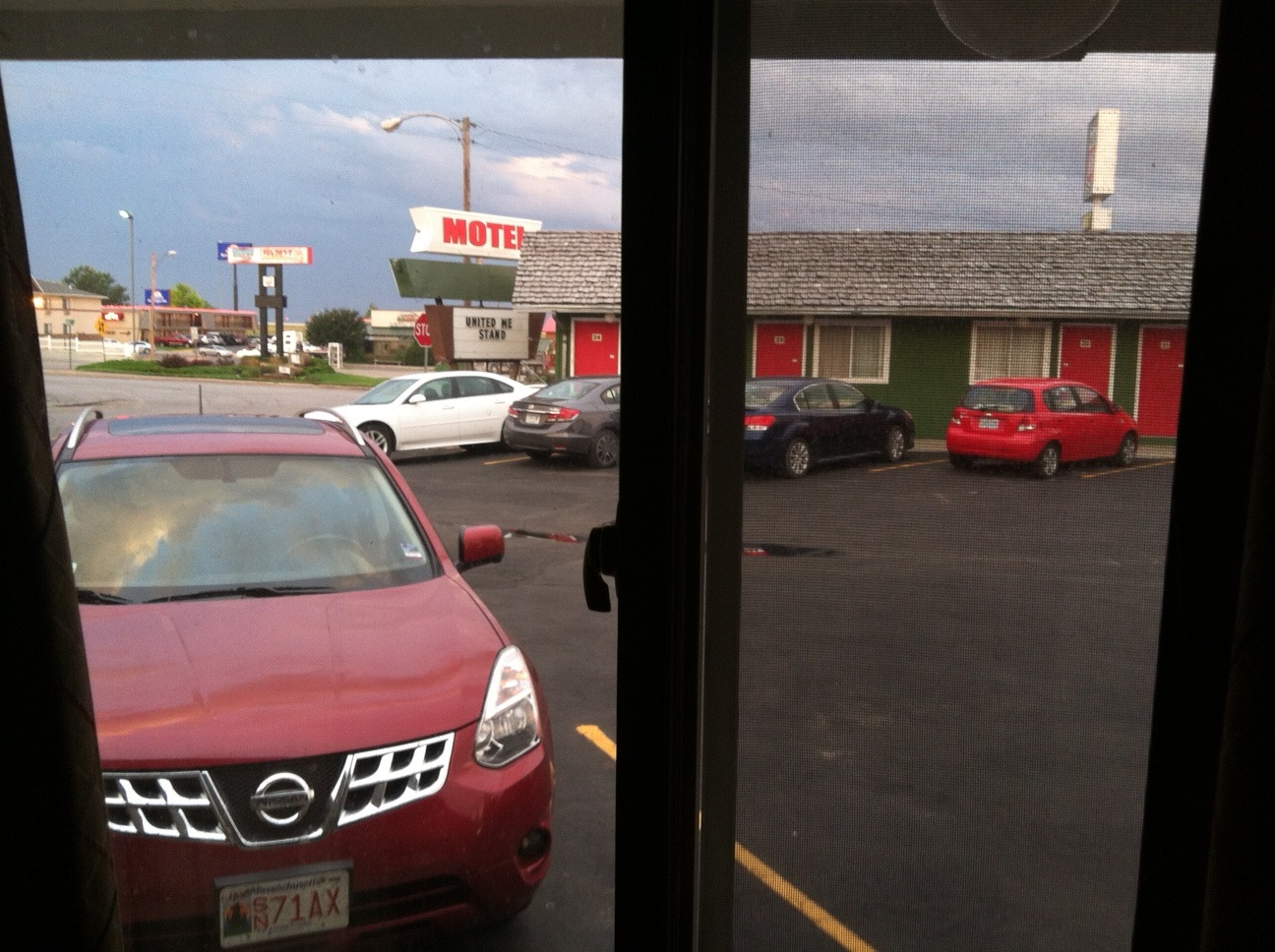
The View From Your Window Contest

Screen Shot 2013-07-27 at 5.09.01 AM

You have until noon on Tuesday to guess it. City and/or state first, then country. Please put the location in the subject heading, along with any description within the email. If no one guesses the exact location, proximity counts.  Be sure to email entries to contest@andrewsullivan.com. Winner gets a free The View From Your Window book or two free gift subscriptions to the Dish. Have at it.

The Illusion Delusion

Daniel Fincke urges his fellow atheists to reconsider dogmatic dismissal of “techniques that the religious use to create strong value feelings or feelings of community between people”:

The overly skeptical atheist mistakenly thinks that if she can understand the physiological processes that make an experience happen that somehow that experience is not only demystified as not supernatural, but is even proven to be an “illusion”. So if oxytocin is the chemical that causes me to feel trust then my feeling of trust is an illusion; it’s not really trust but a chemical tricking my brain! If participating in a ritualistic behavior in a group creates a feeling of psychological bond between me and my group then this feeling of closeness is an illusion. If lovers staring into each others’ eyes feel closer, they are tricking themselves into feeling an illusory closeness, etc., etc. …

They think these are irrational ways of creating attachments between people or between people and their ideas. But things can go the other way. Without an emotional oomph various truths are harder for our brains to realize and internalize. Sometimes we need to communicate to our brains through our bodies because they’re bodily. Talking to them through bodily cues and training them through training our bodies to feel and move in different ways is working with the non-dualistic, naturalistic truths that we are our bodies and that our minds are functions of our entirely physical brains. These are truths that atheists should know and embrace better than anyone.

A Poem For Saturday

Monica A. Hand’s “dear Nina”:

I want vengeance
an eye for an eye
a dish served cold
two wrongs
a tale of two cities
contrapasso
ill will
a settling

not with a grain of salt
with a heavy hand

a slow burn
boiling point
a huff and a puff
blow the mother-fucking house down

no cage forestalls
no age forgets
no gene forgives
I cane those who give me
this fury

a hundred lashes
acrimony and dander
needle and tizzy
umbrage
ruckus

(From me and Nina. Copyright © 2012 by Monica C.Hand. Used by kind permission of Alice James Books. Video: Nina Simone sings “Ain’t Got No/I Got Life”:)

What Poetry Can Learn From Pop Music, Ctd

Continuing her arguments about bringing poetry to the public, Tasha Golden takes on the myth that “wanting readers isn’t a noble enough desire for ‘real’ poets—that we should instead write strictly ‘because we must,’ or because ‘the muse has us'”:

[A]s George Orwell has famously illustrated, there are (valid!) motivations for writing that actually require a readership. And if our work is driven to any degree by its potential human impact, as Orwell’s was, it’s irresponsible to eschew the work of reaching out. This was what I wanted us to translate from pop music: Its gritty determination. Its insistence on being heard. Its put-our-stuff-where-folks-will-find-it creativity. Its refusal of insularity.

It’s time for writers to stop feeling shallow or guilty for wanting what only makes sense: to be read. It’s time we stop policing each other’s motives and frowning on self-promotion, and instead empower each other to explore where our poetry can go. Why? Because if readers are required to want and seek poetry in order to find it, we’ll never get beyond each other. If the wider world’s not reading poetry, it’s at least in part because it rarely encounters it. That’s what we can change.