The Last Lesson We Learn From Our Pets, Ctd

Redding(2)-3-29-13

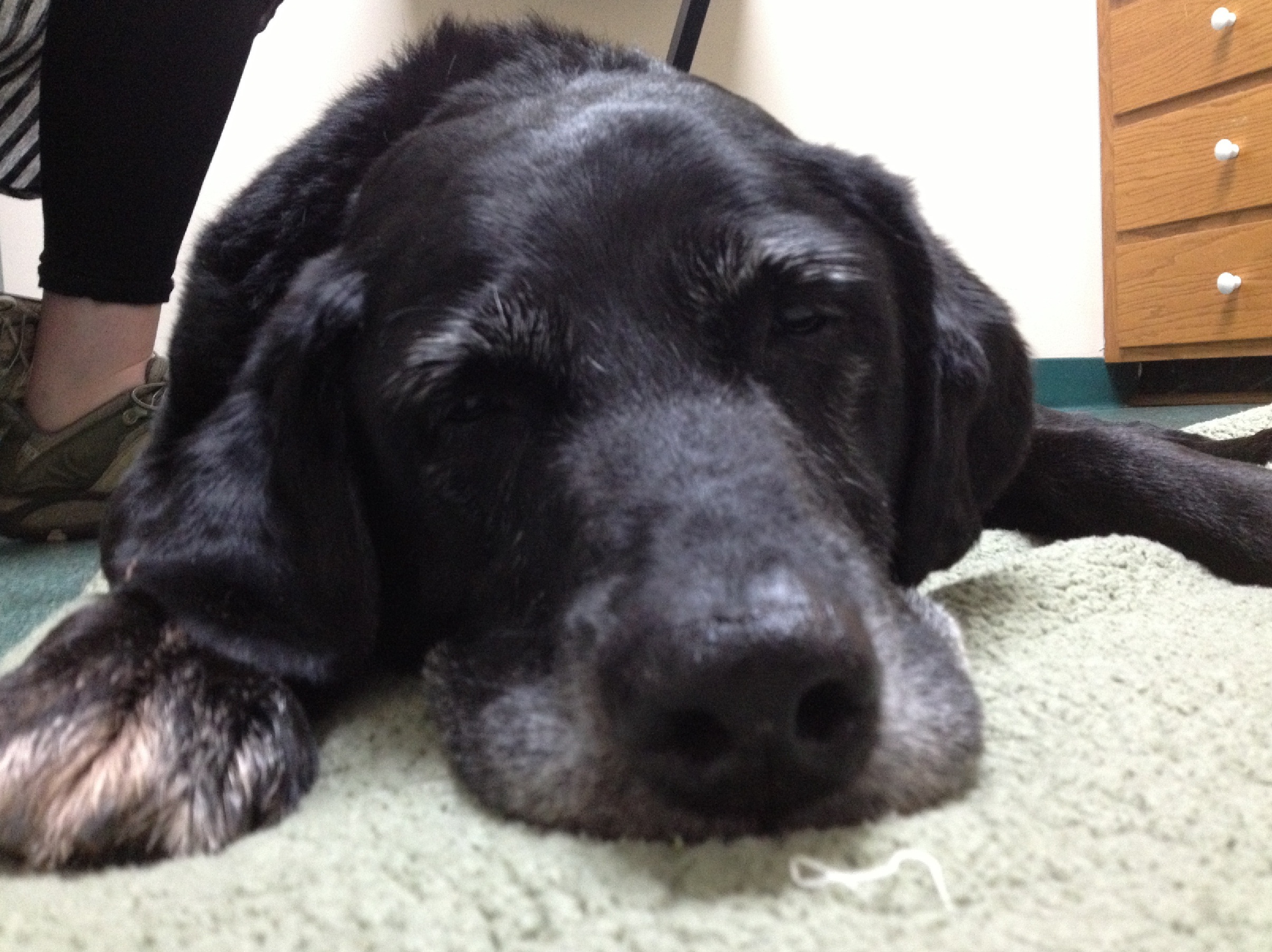
A reader sends the above photo:

I don’t know you from Adam, but I do subscribe to your blog.  My wife and I just put our dog down yesterday. I attached a picture of him sedated. The vet tech gave him a shot and he went from panting in pain to this peaceful rest.  They gave us 10 or 20 minutes alone with him and then came in and administered the overdose of anesthesia.  We petted him while he passed on.

I often look to your blog to try and find comfort when things happen in the world.  I guess now I am looking for something on a personal level.  Thanks for listening.

Another reader:

I just read your post about Dusty and twice you used the phrase “put down” (the first time without quotes). For the love of God and all that’s holy – I’m an atheist – can we please start a movement to change that horrible phrase? Put down? That’s something you do to a phone or a bottle or a piece of luggage. It’s absolutely NOT what you do with a companion who’s been there through thick and thin; who’s been loved and loved in return. I very recently had to let go of my big Endymion, a gorgeous, amazing, friendly and loving cat of many years and I cry whilst writing this. I most certainly did not “put him down.” I let him go. Let go > put down.

Good luck with Dusty, you have my love and support.

Another:

I’m sure mine will be one hundreds of notes you get on this topic.  It’s one I have been thinking about for many 1044795_10201205134237952_1267167286_nmonths now.  My dog, my very first dog, was diagnosed with incurable cancer last October.  With treatment, we were told he would like have a year.  And so treatment it was. It’s been nine months, and I have fought through an extended grieving process.  Beyond the medical treatments, the dog has suffered longbouts of anxiety that we have struggled to manage.  I have often found myself thinking that if it is this much of a struggle with the dog, what will happen when my now 60-year-old parents start to wind down their lives?  My dog, through his illness and eventual death, is teaching me how to plug ahead, and to love, cherish and find grace in a friend whose time is limited.

At the moment, things have normalized.  And we are loving the hell out of our buddy while we can.  His personality is back for the most part, as you can see in the included photo.

Another was better able to cope with the death of her 92-year-old grandmother after the loss of her pets:

In the last four years, we have had to put three pets to sleep.

Our first was our 12-year-old lab, Max, who suffered from severe hip dysplasia and then got cancer.  We opted not to do chemo because he was already feeble.  We tried some natural remedies that I do believe gave us a few more good months with him.  When we made the decision to put him down, he had stopped eating and could not pick himself up to walk outside.

Our cat got a cancer diagnosis about two years after Max was put down.  He was almost 19 years old and the cancer was in his nasal passage, which caused him to not be able to breathe very well.  We tried some medications to reduce the size of the tumor, but ultimately we had to put him down about a month after diagnosis, when his reduced oxygen intake made him disoriented and very weak.  His kidneys also started failing.

Our second lab, Cooper, who was our first “child” together (Max having come into our marriage from my husband and kitty from me) got a cancer diagnosis about a year after Max was put down, which resulted in us having to amputate one of his hind legs.  He rebounded from that almost immediately and enjoyed life as a tripod until last fall.  I had noticed that it was taking him some extra time to pull himself up to standing position and that he seemed to lose his balance more often.  He was 11, so I did not give it to much thought.  We had not noticed any new tumors in our check-ups.  Cooper always acted like a puppy and was so happy to be around us.  His behavior did not change as he got older; he was always a happy dog and, for some reason, chose me as his favorite person.  I liked to call him my 85-pound lapdog.

When he stopped eating for a few days, I immediately took him to the vet.  It was cancer again, but this time a different, more aggressive form than what led to the earlier amputation.  Hemangiosarcoma.   Cooper had tumors on most of his major organs.  These types of tumors were filled with blood vessels in danger of rupturing at any moment and causing massive internal bleeding.  In fact, it appeared that some of the tumors may have already ruptured, as his abdomen was partially filled with blood (which is why he would not eat). During the time these tumors were growing and spreading, he never act like he was in pain, he just appeared weaker than normal.  I would have to help him into our bed at night (where he normally slept) because he could no longer make the jump.  He needed a little assistance walking up steps.  He never stopped being the most loving dog, furiously wagging his tail anytime one of us was around.

When the vet confirmed the nature of the cancer and the risks of massive internal bleeding if one of the larger tumors ruptured, we made the decision that very day to put Cooper down.  While it had been difficult with Max and the kitty, because they both had seemed so physically and mentally ready to go, the grief in making the choice to end their suffering was somewhat manageable.  With Cooper, his overall personality remained fairly unchanged.  He was still so happy and loving at the time of his last diagnosis.  The staff at the vet hospital even remarked on what a happy tail-wagger he was.  That made it a much more difficult decision because I wanted to take him home and spend more time with him.

Knowing that the tumors on his organs could rupture at any moment and cause him to have a terrible, painful death, however, helped us make our decision.  We could not allow that to happen when we had a chance to ease him into wherever he would next be going.  We brought our kids to the hospital and we spent a good hour just hanging out with Cooper in a room by ourselves and saying our goodbyes.  When it was time, my husband took my kids out, and I laid down next to Cooper and held him and talked to him while the injections were made and for some time thereafter.

I miss him so much, and even though deep down I know we made the right decision for Cooper, I wonder if he could have comfortably lived a few more months.  On the other hand, I also wonder and fear that he had been in pain much longer than we ever knew, and his sweet, loving disposition just masked his pain and discomfort.

All of this is to say that the lives and deaths of Max, kitty, and Cooper have helped me get through other things in my life.  After we had put down Max and kitty, my grandmother was diagnosed with pancreatic cancer at age 92.  She was at home with hospice care for several months.  I think having gone through the passing of Max and kitty helped me through the passing of my grandmother.  I had not previously lost any human member of my family that I was especially close to.  My grandmother’s passing in some ways helped me through Cooper’s death (she died about three months before he did), and his passing likewise helped me with accepting my grandmother’s death.

I wish the best for you and Dusty and just wanted to relay that, based on my experience with the four (or three)-legged loved ones in our lives, it is true that you will know when it is the right time to let them go.

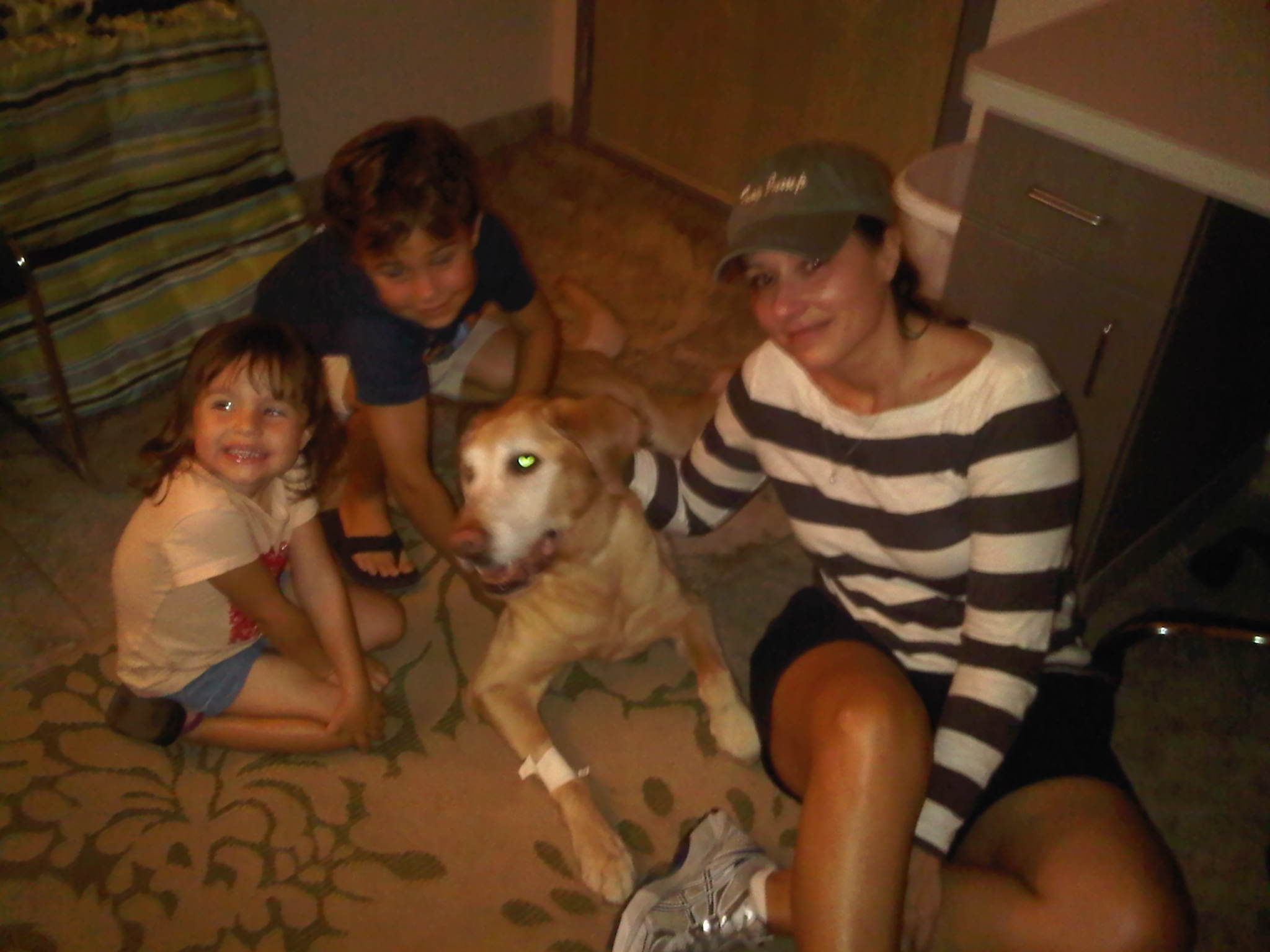
The real reason I wanted to write to you, though, was to share a picture with you.  During our last moments with Cooper, my husband took a picture of the kids and me with him.  I was so torn up after putting him down that it took me two weeks to even look at the picture:

cooper2012

While the photo is a bit fuzzy, I hope you can see the extra-special twinkle in Cooper’s eye.  This was his last gift to me and so typical of who he was.
Previous reader stories here.

Buzzfeed’s New Low

Yesterday, Buzzfeed published “The Story of Egypt’s Revolution in ‘Jurassic Park’ Gifs.” L.V. Anderson feels that “there is something wrong with treating a political crisis as though it occupies the same moral realm as kittens and frosted tips”:

“The Story of Egypt’s Revolution in ‘Jurassic Park’ Gifs.” The democratic yearnings of an oppressed people reduced to 20-year-old catchphrases. A bloody, tumultuous, ongoing political conflict filtered through moving screen shots from one of Spielberg’s most popcorn-ready blockbusters. The deaths of hundreds of Egyptians—including more than 40 allegedly peaceful protestors who were shot just yesterday—metaphorically reenacted via computer-generated dinosaur maulings.

Oy.

Clearly, Anderson doesn’t understand the sheer brilliance of the business model.

Globalized Indifference, Ctd

A 2007 study in The Quarterly Journal of Economics found that 40,000 people must die in a drought to receive the same amount of US news coverage as a single person who dies in a volcano-related incident. Similarly, a disaster is 5 percent less likely to make American news and 6 percent less likely to receive relief if it occurs during the Olympic Games. Beth McMurtrie highlights new research on how causes break into the public eye:

[N]ongovernmental organizations, government agencies, and others who work in human rights and development—what [political scientist R. Charli] Carpenter refers to as global issue networks—are performing a deliberate calculus when they decide where to spend their energies. What matters isn’t necessarily the urgency of the cause, but whether they think they can sell it to the public and muster the resources to run an effective campaign.

Carpenter used surveys and focus groups to ask leaders of advocacy groups about the factors that come into play in deciding whether to turn problems into causes.

Responses were blunt: There needs to be a victim and a perpetrator. Some issues are “too complex” to advocate for. And if no clear solution is in sight, the problem is that much harder to rally around. “People need to be able to feel like they can make a difference,” said one participant.

Understanding Inhumanity

A trauma studies scholar who interviewed members of the Chukiren, a group of war criminals, describes the difficulties of his work:

I recently wrote a piece for CNN about a Syrian rebel who carved out a man’s heart and began to eat it. The editor had asked me to explain what could make a man do such a thing. I tried to explain, and many people were outraged by what I wrote. In one way or another, they were all saying: You think when you try to understand why men do evil things, you are going to learn something that might help prevent atrocities in the future. But really you are just excusing the perpetrators, justifying unjustifiable actions. The only thing you need to understand about evil is how to punish it.

Many of the Chukiren have died since I last spoke with them. The others are failing rapidly. I’m not sure I ever really came to understand them. But that is not because what they did is beyond understanding, not because evil is some kind of mystery. In some ways, it is all quite simple. If I had been a 19-year-old when my country entered into a genocidal war, I would have done the same thing everybody else did. That’s true for most of us. Making monsters is a straightforward process, and ­nation-states are expert at it.

Why the war criminals did what they did—in the end, that is not what I find hard to understand. What I find hard to understand is what must it be like to be the person who did those things. When we imagine getting perpetrators into our hands, the first thing we think about is punishment, what we as a society are going to do to them. But I think the real and final punishment is having to be the person you are.

Blame It On Obamacare

Sarah Kliff answers the questions posed by the anti-Obamacare ad seen above. Waldman sees the ad as evidence that, over the next couple years, Obamacare will be blamed for any and all healthcare problems:

The ad mentions not being able to choose your doctor, which would be bad. If you chose an insurance plan in an exchange established by Obamacare, that plan will probably have a network of doctors from which you have to choose if you want your care paid for, and if your doctor isn’t on it, then you’ve been prevented from choosing your own doctor.

Of course, that isn’t because of Obamacare, it’s because of the way insurance works in America; it’s how it worked before Obamacare, and it’s how it’ll work after Obamacare. But it’s a lot simpler to say, “Now that we’re under Obamacare, I didn’t get to choose my doctor!” And did you know that under Obamacare, medications could come with dangerous side effects? Or that under Obamacare, kids who get shots will cry? Not only that, under Obamacare, you could get cancer and die—even if your doctor wanted to save you. In fact, under Obamacare, we’re all going to die one day. Thanks for all the misery, pain, and death, Obama.

What’s The Endgame In Egypt?

Shadi Hamid is unsure:

I think there are two options. First is the Algeria or eradication scenario, in which the military and old-regime elements simply try to destroy the Muslim Brotherhood. That’s the repression option. Then you have the referendum option. I don’t know how you would do it, exactly. The military has dug in so deep to its position, and it’s already calling the Muslim Brotherhood terrorists, so I don’t know if this is realistic. But typically what you’d do is have some vote where both sides agree to abide by the will of the people.

At least in the near term, though, I think we could just be in a continuation of this low-level civil conflict, this war of attrition between the two sides. A stalemate with violence, if you will. The short-term outlook is very dark now.

Larison expects more violence:

It is likely that incidents such as these will keep happening, because the Brotherhood has a great deal to gain from continued clashes with the military. These will result in excesses and abuses that can be used to discredit the coup leaders in Egypt and internationally, and over time the coup government will lose the popular support that has been invoked so many times as its justification.

The Power Of Maps

dish_bungedetroitmap

Cartographer Denis Wood considers his craft:

I’ve seen maps that I find completing terrifying. Maps of uranium mining and of various illnesses in the Navajo reservations—they’re just insane. They just make you furious. Bill Bunge’s map—which I still think is one of the great maps, the map of where white commuters in Detroit killed black children while going home from work—that’s a terrifying map, and that’s an amazing map.

He knew that. They had to fight to get the data from the city. They had to use political pressure to get the time and the exact location of the accidents that killed these kids. They knew what they were looking for. I didn’t have anything to do with that project, so when I saw the map for the first time, it was like, “Oh my god.” It’s so powerful to see maps like that. That’s the power of maps, or one of the powers of maps: to make graphic—and at some level unarguable—some correlative truth. We all knew that people go to and from work. But to lay the two things together reveals something horrible.

Update from a reader:

The Curbed LA blog posted a map yesterday showing human life expectancy in the different communities in the Los Angeles area. Of note, residents of Watts live an average of 11.9 fewer years than residents of Bel Air.

Recent Dish on maps here, here, and here.

Health Insurance On The Honor System

At least until 2015, Obamacare’s healthcare exchanges won’t verify the income or health insurance status of individuals seeking health insurance subsidies. Suderman expects this to make the law more expensive:

[The exchanges will] rely on “self-reported” information. And then subsidies will be available to anyone who simply attests that they do not get qualifying, affordable health insurance from work, and that their household income is low enough to be eligible for subsidies.

As Ben Domenech writes in this morning’s Transom, what this means is that “the most significant entitlement increase since the Great Society will be operating on the honor system.” And as Yuval Levin says, it may turn out to be “an open invitation to fraud.” Even if outright fraud does not become a major issue, the combination of the delays may increase the cost of the law relative to what it would have been: No employer penalty, and no health status or income verification, means that more people will end up on the exchanges, receiving subsidies. And more subsidies means a more expensive law. The deficit reduction it was supposed to have achieved, already significantly reduced, is almost certainly reduced further—and perhaps gone entirely.

Ezra believes that Obamacare “just got easier to implement”:

Obamacare’s critics appear to be enjoying something of a Pyrrhic victory right now: They get to (rightly) criticize the administration for unilaterally delaying unpopular and ill-drafted elements of the law. But they seem to be assuming that the bad media coverage now can be extrapolated into bad implementation next year.

That misses the choice the White House actually made: Bad press now, and higher costs in 2014, in return for an easier roll out. Whether you think the White House is making the right policy call will depend on whether you prefer slightly lower costs to a smoother rollout. But so far as Obamacare’s implementation goes, it just got easier, not harder.

Reihan suggests an alternative to the exchange subsidies:

The most straightforward way to address the ACA’s growing pains is to abandon both the existing tax preference for employer-sponsored insurance and the sliding-scale exchange subsidies and replace them with a dead-simple fixed-sum tax credit. John Goodman of the conservative National Center for Policy Analysis has called for a refundable tax credit of $2500 for individuals and $8000 for a family of four to help finance insurance payments. The beauty of this approach is that it would level the playing field between employer-sponsored insurance and the exchanges, and it would be relatively easy for the federal government to implement. Moreover, it wouldn’t create a work disincentive, as working longer hours or for higher pay wouldn’t lead to a cut in your subsidy. Not everyone will embrace Goodman’s idea. Liberals might argue that it’s not generous enough and conservatives might argue that it costs too much. Yet it has a virtue that the ACA as currently conceived does not, namely that we actually have some hope of getting it up and running.

Worse Than Peak Oil?

Lester Brown warns that “peak water” could threaten the global food supply:

Tapping underground water resources, which got seriously underway in the mid-20th century, helped expand world food production, but as the demand for grain continued climbing the amount of water pumped continued to grow. Eventually the extraction of water began to exceed the recharge rate of aquifers from precipitation, and water tables began to fall. In effect, overpumping creates a water-based food bubble, one that will burst when the aquifer is depleted and the rate of pumping is necessarily reduced to the rate of recharge from precipitation. …

[I]n the Arab Middle East, the world is seeing the collision between population growth and water supply at the regional level. For the first time in history, grain production is dropping in a geographic region with nothing in sight to arrest the decline. Because of the failure of governments in the region to mesh population and water policies, each day now brings 10,000 more people to feed and less irrigation water with which to feed them.