America Can’t Control Egypt

Jeffrey Goldberg wishes the US had put more pressure on Morsi:

The crisis of the past few days, which may end in a military coup (which would then start the next crisis), might have been avoided had the Obama administration used its leverage — the $1.5 billion in aid the U.S. is giving Egypt this year, for starters — to force Mursi to include the opposition in his government from the outset. It didn’t. And the Egyptian masses noticed.

Charles P. Pierce is puzzled:

The argument seems to be that the administration didn’t bring sufficient pressure to bear on the current Egyptian government to diversify its governing coalition. Withholding military aid seems to be the suggested technique, although how that would have made Mursi and his government less autocratic will have to be explained to me better than Goldberg does here. Mursi is, after all, the elected president, no matter how badly he may have turned. Withholding arms from him would have given him his own special piece of anti-Americanism to use among his followers.

Marc Herman flags research showing that the “seemingly intuitive move to use aid as a carrot to encourage democratic reforms—and as a stick when those reforms disappear—may cause more instability than it prevents.” Larison thinks Egyptians will hate the US no matter what we say or who rules Egypt:

As long as the U.S. provides aid to the Egyptian military, the U.S. is bound to be resented by whichever political groups do not control the government. That isn’t going to change even when the government is a genuinely elected one. If the protesters are successful in driving the extremely unpopular Morsi out, there will always be an incentive for the forces defeated at the last election to stage mass protests demanding the early resignation of the incumbent. There will also be an incentive for those protesters to identify the U.S. as the incumbent’s supporter in order to blame Washington and to vilify the current leader. Because the U.S. will presumably continue to provide aid to the Egyptian military for reasons that have little to do with internal Egyptian politics, there is no way that Washington can “fix” this by throwing its support to the “right” people.

Using Elections To Thwart Democracy

Koplow looks at how Morsi has subverted the will of the people:

In Egypt, which is not yet a democracy no matter how many people would like to believe otherwise, Morsi became president following democratic elections, and has ever since pursued a narrow, sectarian policy in which he has made clear that he believes he is the president of the Muslim Brotherhood rather than all Egyptians. He too has fallen back on the fact that there were elections to justify all sorts of policies that rankle most Egyptians, and the fact that Egypt this week saw what were likely the largest demonstrations in human history makes no difference to him. He cloaked himself in the mantle of elections in order to shunt aside Egypt’s courts and force through a new constitution six months ago, and during the crisis of the last two days, he has refused to acknowledge having made mistakes or grant that changes need to be made because he his policies have the ultimate legitimacy emanating from the fact that he was elected. Morsi is using elections not only to justify his position, but to justify any actions that he takes.

Much like Bush after the ’04 election. The Big Pharaoh explains why Egyptians are in the streets:

The failure of Westerners to understand why Egyptians revolted against an elected regime is stemming from the fact that they, the Westerners, are secured in their inclusive constitutions, bills of rights and rule of law. We have nothing of these. We only had one facet of democracy – election – which brought a cultic organization with a fascist twist that decided to cancel the other facets.

Is Egypt About To Erupt?

https://twitter.com/evanchill/status/352472608442290176

Eric Trager believes that, at this point, violence won’t do the Muslim Brotherhood any good:

[T]he Muslim Brotherhood has suggested it might organize its cadres into formations, and equip them with clubs and helmets. On Tuesday, these makeshift units ran laps around the Brotherhood’s main protest site at Rabaa El-Adawiya chanting, “Strength, determination, faith, Morsi’s men are everywhere!”

Yet far from projecting strength, the existence of these units only reinforces Morsi’s utter powerlessness. Moreover, the fact that some of the would-be combatants are armed with tree branches gives the entire operation a certain Lord of the Flies quality. But more importantly, these units—and the Brotherhood’s protests more broadly—are completely outnumbered given the massiveness of the opposition’s outpouring. So while violence is inevitable given what’s at stake for the Brotherhood, it will be hard for Morsi’s allies to leverage the kind of violence that ends the protests and thereby saves his presidency.

Shiraz Maher compares Egypt to Pakistan:

In many respects the country is beginning to resemble the failures of Pakistan. Its civic institutions are weak and, where functioning, are threadworn and riddled with corruption. The country itself is also deeply divided, fractured between urban elites and the rural poor, divided between secularists and religious fanatics.

Transcending all this is the army. Seen as a truly national institution that protects both the country and its people, the armed forces operate beyond the law, are unaccountable, and exercise greater power than the civilian administrations they ostensibly serve. A Zogby poll conducted in May revealed that the Egyptian army’s approval rating stood at 94 percent while Mursi’s had slumped to just 28.

Dalia Ziad comes out in favor of the military:

The people trust the military more than they trust any other institution in the country. This is partly because of the military’s historical legacy that has left it as the strongest in the region. Another important reason is that military officers, who are very much part of the fabric of the country, are very patriotic and loyal to no one but Egypt. Much of this is because the military has sustained a professionalism that has allowed it to be independent in making its own decisions. The interests of the military are not dependent on the interests of the regime or any supreme authority in Egypt.

That is why it was easy for the military to abandon Mubarak in 2011 in favor of the people, something that the police, for example, could not do because their existence relied heavily on the existence of the then regime. Mubarak’s Egypt was not a military state: rather it was a police state that abused the armed power of the police to fasten the regime’s grip on the neck of the opposition.

The Lede is live-blogging the situation. Recent updates on the Dish here and here.

The Most Influential Public Intellectual Of The Past 25 Years?

Tyler Cowen thinks it might be me:

Doesn’t Andrew Sullivan have a reasonably strong claim to that title, especially after the recent Supreme Court decisions on gay marriage?  Sullivan was the dominant intellectual influence on this issue, from the late 1980s on, and that is from a time where other major civil liberties figures didn’t give gay marriage much of a second thought, one way or the other, or they wished to run away from the issue.  Here is his classic 1989 New Republic essay.  Here is a current map of where gay marriage is legal and very likely there is more to come.

Ross generously expands on Cowen’s argument:

I think the case of his work on gay marriage is distinctive. No doubt there would have been a major push for same-sex wedlock without Sullivan: Deep trends favored its adoption, other eloquent writers made the case, and other countries and cultures have taken different routes to a similar destination. But no writer of comparable gifts was on the issue earlier, pushed harder against what seemed at the time like an unassailable consensus, engaged as many critics (left and right, gay and straight) and addressed himself to as many audiences as Sullivan. No intellectual did as much to weave together the mix of arguments and intuitions that defines today’s emerging consensus on the issue — in which gay marriage is simultaneously an expression of bourgeois conservatism and the fulfillment of the 1960s’ liberative promise, the civil rights revolution of our time and a natural, Burkean outgrowth of the way that straights already live. And no intellectual that I can think of, writing on a fraught and controversial topic, has seen their once-crankish, outlandish-seeming idea become the conventional wisdom so quickly, and be instantantiated so rapidly in law and custom.

Again, it’s awfully hard to separate ideas from tectonic shifts in culture and economics, and I have enough of a determinist streak to doubt John Maynard Keynes’s famous maxim that “the power of vested interests is vastly exaggerated compared with the gradual encroachment of ideas.” But just as Keynes heard clear echoes of “academic scribblers” and “defunct economists” in the rhetoric of his era’s politicians, so I hear echoes of arguments that Andrew Sullivan, and often Andrew Sullivan alone, was making thirty years ago in almost every conversation and argument I’ve had about gay marriage in the last ten years. There’s no other issue and no other writer where the connection between things I read as a teenager and lines I hear today is as clear and direct and obvious. And if that isn’t evidence of distinctive, far-reaching influence then I don’t know what is.

Dreher nods:

What Sullivan did — and he wasn’t alone, but as Douthat says, he was there first, and most effectively — was build off the ground cleared by the Sexual Revolution — the bourgeoisification of what were, within living memory, outlaw sexual values — and claim it for the ultimate outlaws in the traditional Christian vision of sex and sexuality: gays and lesbians. What Sullivan and those he helped lead did was radical — and he achieved it by making a kind of conservative case for a revolution, by forcing what people in the post-Christian West already believed about sex, religion, and individual liberty to its natural conclusion. That’s something. That’s something huge.

What’s Left Of The Left? Ctd

Several left-liberal readers tackle the question:

I live in Texas, and believe me, there is plenty left to fight for that is noble and righteous and shouldn’t be left-only but is, if only for the same Christianist factionalism you Protesters In Texas Statehouse Block Texas Lawmakers From Passing Abortion Billdescribe as regards marriage equality. Voting rights? Women’s health care? Any healthcare at all? Sitting here in Texas I can celebrate a special Pride weekend (as did 400,000 Houstonians and our openly lesbian mayor) but all other kinds of shit is about to rain down on us.
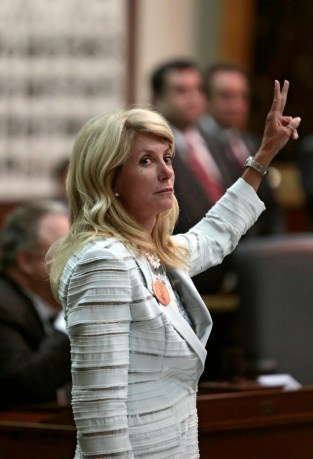
It is possibly just a matter of days before photo IDs for voters become required in Texas, that the unfair Texas redistricting that under-represents Hispanics was sent back to the drawing board by the courts will simply become fact, and our state of 26 million will have but five clinics where abortions are available?

The Democrats’ new sweetheart, Wendy Davis, was almost redistricted out of office before – perhaps she will be now! Perry is refusing to add folks to Medicare and Planned Parenthood clinics (not just the ones that provide abortions) are shutting down everywhere. Studies show that last year Texas had about 11,000 additional unplanned and unwanted pregnancies that bore live children thanks to reduced access to birth control. We have one of the lowest rates of health insurance, highest child poverty rates, and our governor has CUT education, CUT healthcare funding, and refuses federal funds for the latter. Andrew, there is PLENTY left to fight for.

Another reader:

Short answer: Climate change.  Long answer:

Preventing or slowing climate change is the biggest social, economic, geo-political issue that will define the left. Through action or inaction, this will be the defining issue. If the left has any sense or courage, they’ll make this their defining issue of the early 21st century.

The goal, I think, is not solely to prevent climate change from changing our planet for the worse. Rather it is to change our culture and economy to reflect the sober reality of how gravely human activity impacts the rest of the planet and thus protect the delicate balance amongst complex natural ecosystems and contrived systems surrounding human activity. Industries, ingrained behaviors, and our collective expectations of what economic progress looks like will need to change. The notion of an “entitlement generation” as you’ve spoken of recently, neatly applies to our current cultural expectations regarding consumption and economic enfranchisement.

While abortion, the death penalty, gun control, and numerous other causes heralded by the left spark the passions of both sides, these issues exist in disparate microcosms of American life which only seldom overlap (which may explain the inability of the left to secure lasting progress in these areas). Letting climate change stampede onward however, whether through total inaction or impotent half-measures, will touch each and every corner of American life.

I don’t mean to write these other issues or those who fight for them off, and I do feel strongly about each of these, but they seem to be legacy issues of the current left. Those struggles will continue, no doubt. But what can really be said of the struggle to stop climate change and secure this abstraction “sustainability”? It is only just beginning and its importance will only become more pronounced as time goes on.

Another:

You basically thread-jacked yourself. You posed a question – a very good question – and then instead of considering it you ended up talking about how (a) gay marriage is not solved and (b) gay marriage isn’t even left. I agree on both points.

I also agree with Friedman and Lithwick that the left in this country has effectively lost its way, and I think that it’s been like this since Carter left office in ignominy. Clinton was no leftist; Obama is clearly no leftist. In the last five years, which might as well be the last 20, I find it very difficult to find even a single issue where I – a dyed in the wool, Greenpeace-supporting, union-dues-paying leftist – can look at the actions of the Democratic party and applaud.

What is Clinton famous for? Welfare reform; intervention in Bosnia; NAFTA (and Lewinsky and DOMA). What has Obama done? A healthcare reform that left every progressive idea off the table; a fiscal policy that just gave the biggest government spending cut in history to the Tea Party on a platter; tremendous latitude given to banks and finance; militant foreign and domestic justice policy; and continual cold water thrown on environmental concerns. Moreover: an unconscionably high incarceration rate, an unconscionably high deportation rate, targeting whistleblowers, an escalation of the surveillance state, a blind eye to war crimes.

His singular “progressive” achievement is that he was willing to change a few executive branch policies on gay marriage that, apologies to you and your readership (and my Facebook feed), is just not a significant issue when millions of people are being thrown in jail unjustly and destroying their families, when millions are falling into abject poverty, when a seven-figure balance sheet is a prerequisite to pursuing national office, when 121% of the increase in wealth over the recovery accrued to the top 1% (pdf), when infrastructure is failing and when our collective inaction on climate change is now materializing in violent and costly ways (which, of course, affect primarily the poor). This is a profoundly conservative era in this country, and gay marriage is just the cherry on the top of it.

Another:

Excuse me, but what?  Corporations and banks run roughshod over the government on all manner of issues, particularly with a Supreme Court that nearly always puts their rights over the lives of working people.  The amount of long-term unemployed continues to grow as companies take subsidies and tax breaks and ship whatever jobs they “create” overseas.  That we have to fight so hard just so that two people who care for each other can begrudgingly get official recognition of their status shows how remarkably ignorant and backwards we continue to be.

And one thing we’ve definitely seen is that the right never stops fighting, never sleeps, and given an inch, they’ll take a mile.  Ever watch an old rerun of All In The Family?  That show aired 40 years ago but you’d think it was current, because we’re still fighting those same tired old battles we thought we’d won.  Because the rich and powerful true conservatives will always want a government that protects their interests at the expense of everyone else.

That gay people are freer to get married today than they were a few days ago is a good thing, but it’s a drop in the ocean compared to the work that needs to be done, that will always need to be done, to create a more perfect union.  In every age and under all circumstances, as Teddy Roosevelt said.  The fight goes on.

(Photo: State Senator Wendy Davis (D-Ft. Worth) holds up two fingers against the anti-abortion bill SB5, which was up for a vote on the last day of the legislative special session on June 25, 2013. A combination of Sen. Davis’ 13-hour filibuster and protests by reproductive rights advocates helped to ultimately defeat the controversial abortion legislation at midnight. By Erich Schlegel/Getty Images)

Can The GOP Double-Down On The White Vote?

Brit Hume recently downplayed the importance of the Hispanic vote:

Weigel explains why continuing to focus on white voters is attractive to many Republican politicians:

As they contemplate 2014 and 2016, Republicans are looking at elections where the white share of the vote may increase compared with 2012. They compare elections when Barack Obama was on the ballot against elections when he wasn’t. The white shares of the vote in 2008, 2010, and 2012 were, respectively, 74 percent, 77 percent, and 72 percent.

But Waldman thinks that winning a larger share of the white vote requires attempting to win minority votes:

[I]f you decide that you’re going to focus your efforts on turning out the white vote, you won’t only be sending a message to Latinos (and African Americans, and the fast-growing Asian American population) that you’re not interested in them, you’ll also be sending a message to moderate whites that your party might not be the kind of place they’d feel comfortable. This goes double for young white voters, who have grown up in a much more diverse culture than their parents and grandparents, and aren’t going to be so hot on joining the Party of White People.

Relatedly, Drum argues that the GOP should stop worrying about who gets “credit” for immigration reform:

Democrats get tremendous mileage by demonizing Republicans and winning ever greater shares of the Hispanic vote. Once immigration reform passes, they can’t do that. There will always be smaller issues out there, but they just won’t have the same impact as immigration reform. Taking that off the table sucks the air out of the Dem balloon and gives Republicans a better chance of setting the terms of the political debate, both within and without the Hispanic community. That’s why it’s a net winner for them, not because they’ll get “credit” for allowing it to pass.

The question is whether their ideology allows them to tolerate anything that might also get support from Democrats and Independents, let alone president Obama. These next couple of months will tell us a lot about whether we are watching a nose dive they can pull out of in time. So far, sadly, the omens are not good.

What Just Happened To Obamacare?

The ACA’s employer mandate is being delayed by a year. Ezra advocates repealing the mandate entirely:

It’s a bad bit of policy. In fact, when it first emerged during the Senate’s negotiations, I called it “one of the worst ideas in recent memory.” … By tying the penalties to how many full-time workers an employer has, and how many of them qualify for subsidies, the mandate gives employers a reason to have fewer full-time workers, and fewer low-income workers.

Cowen thinks that the administration wants to kill the mandate outright:

My view is you don’t serve up a delay and PR disaster like this, on such a sensitive political issue, unless you really wish to derail the entire provision.

Evan Soltas adds:

[T]here is a strong case for getting rid of the employer mandate. Employers shouldn’t sponsor insurance in the first place, as it masks the true cost of care to employees and creates incentives for over-insurance. It also increases the cost of hiring, locks employees into their jobs, and splits the market for insurance into one for individuals and one for employers, which impedes risk-sharing in the individual market.

If that’s where this heads, I’m all for it. Breaking the employer-healthcare connection would help generate competition and make consumers more aware of costs. Beutler notes that the employer mandate was expected to lower the deficit:

Back in 2012, CBO estimated that the employer penalty would reduce the deficit by about $4 billion in fiscal year 2014. But by zeroing out the penalty, the administration will not only forfeit the revenue it would have collected, but it will have removed an incentive for employers to provide coverage themselves. That probably means more workers than expected will land in the exchanges, many of whom will receive subsidies to purchase insurance themselves, which will increase spending under the law and diminish its deficit reducing potential.

Josh Barro also focuses on the budgetary consequences:

One of his key selling points for the law was that it would cut the deficit. Now that the law has passed, his administration is freer to pursue changes that will raise Obamacare’s cost to taxpayers but improve its effects on the economy. Delaying the employer mandate, perhaps indefinitely, is one way to do that. It’s a better reason than “we couldn’t figure out how to do the reporting.” But it’s not one you can say out loud.

Jeffrey Anderson claims that the delay is “a naked display of lawlessness”:

By law, Obamacare’s employer mandate — its requirement that businesses with 50 or more workers provide federally sanctioned health insurance — should go into effect next year.  By executive fiat, it won’t go into effect until 2015.

Chait counters such accusations:

It is true that the law calls for the mandate to take effect in January. On the other hand, administrative delays push back deadlines like this all the time. The Supreme Court ordered the Environmental Protection Agency to regulate carbon emissions in 2007, and the Bush White House evaded that order by refusing to open an e-mail from the agency. Obama’s EPA has delayed its carbon regulation for years now, and no conservatives have demanded that Obama act faster.

The question becomes what happens after the delay is up. Ideally, we could just repeal the employer mandate. Major laws are routinely followed by legislative corrections to smooth out their glitches. But conservatives have steadfastly followed a strategy of the worse, the better, refusing to accept any changes to Obamacare short of repeal. The employer mandate was one of the few aspects of the law that seemed likely to produce real, rather than imagined, economic damage, and thus conservatives invested a lot of their train-wreck hopes in this aspect of it.

And Cohn expects Republicans to use the news to pummel other aspects of healthcare reform:

Employers might quiet down a bit, but the law’s doubters will use this as proof the administration doesn’t know what it’s doing. As Sarah Kliff puts it, it’s trading one headache for another. Or maybe two. Already, conservatives like Erick Erickson are saying it’s unfair to delay the mandate on employers without also delaying the mandate on individuals. Erickson won’t be the last to make this argument, just as he already has plenty of company citing this news as proof that Obamacare is a disaster.

Ask Dan Savage Anything: Wrong About Iraq

In our final video from Dan, he joins the “I Was Wrong” club:

Fareed Zakaria detailed his own similar misjudgment on Iraq in a recent AA here. Our discussion thread marking the 10th anniversary of the Iraq invasion is here. My recent AAs on the subject here and here.

Dan’s new book, American Savage: Insights, Slights, and Fights on Faith, Sex, Love, and Politics, is in bookstores now. My recent conversation with him at the New York Public Library is here. Dan’s previous answers are here. Our full Ask Anything archive is here.

The Liberal Case Against Immigration Reform

T.A. Frank recently made it:

Oddly enough, an early important realization came to me in Hong Kong during the SARS crisis of 2003. I thought about how Hong Kong had created a flawed but remarkable city in which even low-skilled laborers such as these men and women, who were wearing masks and wiping down railings, lived far better than similar laborers on the other side of the border. I also realized that only a wall (and I didn’t much like walls) prevented millions of people on the People’s Republic of China side of the border from coming over to take these lowly jobs for a fraction of the current wage. (Hong Kong had no minimum wage at the time.) I knew I wouldn’t want these unskilled street cleaners to lose their adequate standard of living to such unbridled competition.

But if that was how I felt about protecting Hong Kong’s working class, why shouldn’t I feel that way about America’s?

Dreher replies:

This reminds me of the arguments we used to have in Dallas about immigration reform.

I would make the point that none of us middle-class people had to use public hospitals, or had our kids in public schools that were overwhelmed by illegal immigrants and the problems that come with them (e.g., children who can’t speak English). Nor were our neighborhoods being colonized by illegal immigrants from a Third World country, men living 15 or more to a house, with very different standards of how to live in a community than many Americans do. It’s easy to be in favor of immigration reform when people like you only get benefits from it, and people not like you pay the cost — and to assume that the only real reason anybody could oppose it is because they’re racist.

Charles Kenny, on the other hand, argues that “the evidence keeps mounting that more immigration is somewhere between a benefit for the considerable majority of native-born people to a benefit for the vast, vast majority”:

Perhaps U.S. citizens will start realizing that more people aspiring to become Americans is no threat to the institutions of America, just as they have come to accept that more people wanting to get married—some to people of the same sex—is no threat to the institution of marriage.

Ultimately, immigration reform’s greatest positive impact is on migrants themselves and the developing countries they come from. The CBO estimates that undocumented workers who obtained legal residency would see a 12 percent wage hike. Harvard economist Lant Pritchett has estimated that if all rich countries increased their labor force through migration on a slightly smaller scale than that suggested by the Senate bill, it would add $300 billion to the welfare of citizens of poor countries—give or take, that’s a little more than twice the value of annual global aid flows. So if cultural attitudes change from viewing immigrants as aliens to be fenced out to seeing them as fellow human beings to be welcomed, the impact on both American and global quality of life will be immense.

The latest Dish on the immigration bill here, here, and here.