World Poverty: There Isn’t An App For That

Charles Kenny and Justin Sandefur say that Silicon Valley can’t save the world:

The tech gurus, like so many evangelists of earlier eras, are wildly overoptimistic about what their gadgets can accomplish in the world’s poorest places. In this they share a rich history of failure. No less than Marx and Engels were sure the locomotive was going to unite the proletariat into a national force for social revolution, and the world would be a worker’s paradise in short order as a result. More recently, in the midst of the Arab Spring protests, columnist Thomas Friedman and many fellow pundits gushed about the power of tools like Twitter and Facebook to overthrow dictators and promote democracy. The Internet, declared the State Department’s in-house tech guru, Alec Ross, had become “the Che Guevara of the 21st century.” (Given that Che failed in three of the four revolutions in which he participated, that might actually be about right.)

Not only that, but Joshua Keating flags a study in Africa correlating cell phone expansion with violent conflict:

[Researches] found that from 2007 to 2009, areas with 2G network coverage were 50 percent more likely to have experienced incidents of armed conflict than those without. The clearest overlaps between cell coverage and violence were observed in Algeria, the Democratic Republic of the Congo, Kenya, Nigeria, Uganda, and Zimbabwe.

The authors think that improved cell-phone coverage helps insurgent leaders overcome what’s called the “collective-action problem” — that people are reluctant to join group endeavors when there’s a high level of personal risk. But better communication helps leaders recruit reluctant followers, whether they’re demonstrating for higher wages or killing people in the next town.

Hathos Alert

A reader writes:

The comments section on Glenn Beck’s “The Blaze” website is so disturbing right now it has actually become hilarious.  Be careful, the sheer amount of facepalming this evokes might leave a permanent mark. These people are experiencing so much cognitive dissonance over what America means and represents in the modern world that you can almost hear their heads exploding trying to make sense of it all by grasping onto the most ridiculous of explanations.

Normally I’m not one to revel in victory; or rather, I try to enjoy winning but not revel in the loss of others. I mean hell, we’re all going to be on the losing side sometimes.  But sweet Jesus, it’s hard today. Here is a link to the comments section along with a few choice excerpts I’ve excerpted below (cue Cartman’s “tears of insufferable sadness“):

“It is your kind that is intolerant of our religion. You refuse to accept that we feel strongly about this.”

“We never hated gays – we just didn’t want them to use the word marriage. But your kind will never be satisfied until marriage is done away with and all churches are bankrupted and driven underground.”

“My wish for this once fine country is for it to be destroyed utterly. To be erased from the pages of history and never to be remembered by any who come after us unless it is to be compared to Sodom and Gomorrah in reference to the completeness of our depravity and moral collapse and our destruction at the hand of God.”

“For the first time in my life I despise my country.”

“The Gay president knows that homosexuals are easily controlled……Once you give up morals….You will give up guns you will give up everything……Property…..Jobs……You will be Government property…….Trade in you gun rights for a marriage certificate…….I watch gay women on TV……They are not commited and never will be…….My advice for men…….Do not be a sperm donor…..Do not…!!”

“I wouldn’t get too happy there, because once muslim laws take over here in America and before you say it won’t…maybe you should read about how CAIR and other muslim organizations are infiltrating our government. Plus, Obama is meeting with radical islamists in the WH (he just had a meeting with one, matter of fact there is a story on it here on the Blaze. Once the muslim laws take effect, homosexuals will be killed (just read the Quran)….but hey keep celebrating and think that light you see is the light at the end of the tunnel instead of the oncoming train.”

Sweet Jesus …

How A Dish Goes Global

Cowen explains why certain countries’ cuisines have spread worldwide while others haven’t:

Consider how cooking evolves: It starts in the home and then eventually spreads to restaurants and on to cookbooks, along the way transforming a recipe from oral tradition to commercialized product. In the home, recipes are often transmitted from grandmother to mother, or from father to son, or simply by watching and participating. I’ve seen this in rural Mexico, for instance, when an older daughter teaches her younger sister how to pat tortillas the right way. When societies get richer, you start to see restaurants, a form of specialization like auto mechanics or tailors (see: Adam Smith on the division of labor). Restaurants require that strangers — other cooks — be taught the process. That means simplifying or standardizing ingredients so they’re easier to work with and, in many cases, available year-round. This, of course, means writing down the recipe. Once a dish reaches these commercial milestones, cookbooks will follow.

Thai cuisine hit U.S. shores in the late 1960s, thanks to American troops on R&R in Bangkok during the Vietnam War who brought the taste home, and it wasn’t long before restaurants followed. Soon, a booming economy and international trade made it a whole lot easier to find galangal and lemongrass, which allowed Thai restaurants to thrive. Today, any major U.S. city has at least a half-dozen places where you can find a decent green chicken curry. And once a cuisine proliferates, people want to be able to cook it at home.

Meanwhile, In Texas …

A reader writes:

First, I hope you’re enjoying a well-deserved celebration of the DOMA ruling. Dignity, indeed.

Second, as I’m sure many other readers have told you, something important happened in Texas [Tuesday] night.  On one level it was the defeat of a bill (that was questionably constitutional) designed to limit women’s access to abortion.  The defeat came, as I’m sure you’ve heard, on the heels of an 11-hour filibuster – the good ole fashioned kind.  On another, it viscerally demonstrated several themes you cover on the blog.

First, the new media coverage of this was amazing: the Texas Tribune, with its live stream/blog and Twitter, was about the only place to get news, since the cable networks were silent.  Second, the epistemic closure of the Texas GOP is well-known and documented, but here it was live-streamed to almost 200,000 people – and the Republican senators still lied, obfuscated, and ignored the rules in an attempt to get their bill passed.  This defeat is a huge punch in the gut for Perry, Dewhurst (the lieutenant governor pondering a run for Cornyn’s seat after losing to Cruz in the primaries), and the GOP more generally.  Texas turning purple, indeed.

It was also a moment for several Democratic senators to get their names and stories out there, not the least of whom is Wendy Davis, who spoke for 11 hours.  Third, thousands of people showed up in support of the filibuster and those in the gallery are responsible for actually making the final vote impossible by screaming for 15 minutes.  While that may insult the rules of order, Dewhurst and Duncan (who had taken the chair after an appeal of one of Dewhurst’s decisions) had long gone down that road.  And those thousands of people dwarfed those who showed up in support of the bill.  Coming on the heels of 10,000 marching in March to return funding to schools, people showing up in the capitol to participate in democracy is amazingly powerful.

On a personal note, it was amazing to watch the last three hours of the special session.  As a Catholic, the hypocrisy of the pro-life GOP (in a state that will execute its 500th prisoner since 1976 tonight; 261 of those under Rick Perry) is galling and this bill is just one more way they were trying to make it impossible to be a poor, pregnant woman while wrapping themselves in the rhetoric of life.  So much for the preferential option for the poor.  To see their bill picked apart by Sen. Davis, their misogynist perspective revealed by Sen. Van de Putt, and their epistemic closure on display to the public was so heartening.

I hope after the high of the DOMA ruling wears off you’ll throw a little attention toward Texas.

Update from a reader, who clarifies:

The bill was not “defeated”. Instead, a vote was prevented from happening before time was up on a special session. Perry called a second special session to open on July 1st to try again.

The Best Of The Dish Today

sully-wedding-aisle-thumb

 
Well, tonight I really am too plastered to write this. You will, I hope, forgive me. So let me end today with a quote that has long inspired me. It’s from Hannah Arendt, in Dissent, in 1959:

“The right to marry whoever one wishes is an elementary human right compared to which ‘the right to attend an integrated school, the right to sit where one pleases on a bus, the right to go into any hotel or recreation area or place of amusement, regardless of one’s skin or color or race’ are minor indeed. Even political rights, like the right to vote, and nearly all other rights enumerated in the Constitution, are secondary to the inalienable human rights to ‘life, liberty and the pursuit of happiness’ proclaimed in the Declaration of Independence; and to this category the right to home and marriage unquestionably belongs.”

And as of today, the pursuit of happiness enlarged its scope.

I Believe

US-JUSTICE-GAY-MARRIAGE

[Re-posted from earlier today]

Some final thoughts after so many years of so many thoughts. Marriage is not a political act; it’s a human one. It is based on love, before it is rooted in law. Same-sex marriages have always existed because the human heart has always existed in complicated, beautiful and strange ways. But to have them recognized by the wider community, protected from vengeful relatives, preserved in times of illness and death, and elevated as a responsible, adult and equal contribution to our common good is a huge moment in human consciousness. It has happened elsewhere. But here in America, the debate was the most profound, lengthy and impassioned. This country’s democratic institutions made this a tough road but thereby also gave us the chance and time to persuade the country, which we did. I understand and respect those who in good conscience fought this tooth and nail. I am saddened by how many failed to see past elaborate, ancient codes of conduct toward the ultimate good of equal human dignity. I am reminded of the courage of a man like Evan Wolfson who had the vision and determination to change the world.

But this happened the right way – from the ground up, with argument, with lawsuits, with cultural change, with individual courage. I remember being told in the very early 1990s that America was far too bigoted a place to allow marriage equality – just as I was told in 2007 that America was far too bigoted a place to elect a black president. I believed neither proposition, perhaps because I love this country so much I knew it would eventually get there. I trusted the system. And it worked. From 1989 (when I wrote the first case for this on the cover of a national magazine) to today is less than a quarter century. Amazing, when you think of how long it took for humanity to even think about this deep wound in the human psyche.

So to those who are often tempted to write off America’s ability to perfect its union still further, to lead the world in the clarity of its moral and political discourse, and to resist the pull of fundamentalism when it conflicts with human dignity, let me just say: I believe.

Because I have seen.

(Photo: Michael Knaapen and his husband John Becker react outside the US Supreme Court in Washington DC on June 26, 2013. By Mladen Antonov/AFP/Getty.)

The Political Climate

Nate Cohn downplays the political danger that climate policy poses for Democrats:

[T]he electoral consequences of Obama’s climate policy will probably be overstated. That’s not because climate policy doesn’t have big electoral consequences, but mainly because Democrats have already incurred the huge, if localized costs of pursuing regulations on carbon emissions. The 2009-2010 era fights over Cap and Trade and EPA regulations on new power plants solidified Democrats as the party of the so-called “war on coal,” which resulted in cataclysmic Democratic losses in traditionally Democratic stretches of eastern Kentucky, West Virginia, western Pennsylvania, and western Virginia. Maybe memories of the “war on coal” would have faded without the president’s newest climate push, allowing Democrats to recover in 2014. That’s possible, but unlikely. After all, Republicans were already favored to takeover West Virginia’s open Senate seat.

Barro, meanwhile, worries that Republicans will respond to Obama’s climate policies with “maximum political and legal resistance:

[I]t’s not likely to be an effective strategy for shaping policy. Obama is acting under legal authority he already has and a Supreme Court decision that forces the EPA to regulate carbon. Republicans should instead do something they’re not used to: Work with Obama to come up with a better alternative to his plan. Obama has only taken a heavy-handed regulatory approach because that’s what he can do without congressional action; if Republicans would agree to a carbon tax or a cap-and-trade system, he’d gladly take that over the plan he laid out [yesterday].

What’s A Bisexual Anyway? Ctd

Screen Shot 2013-06-26 at 3.10.33 AM

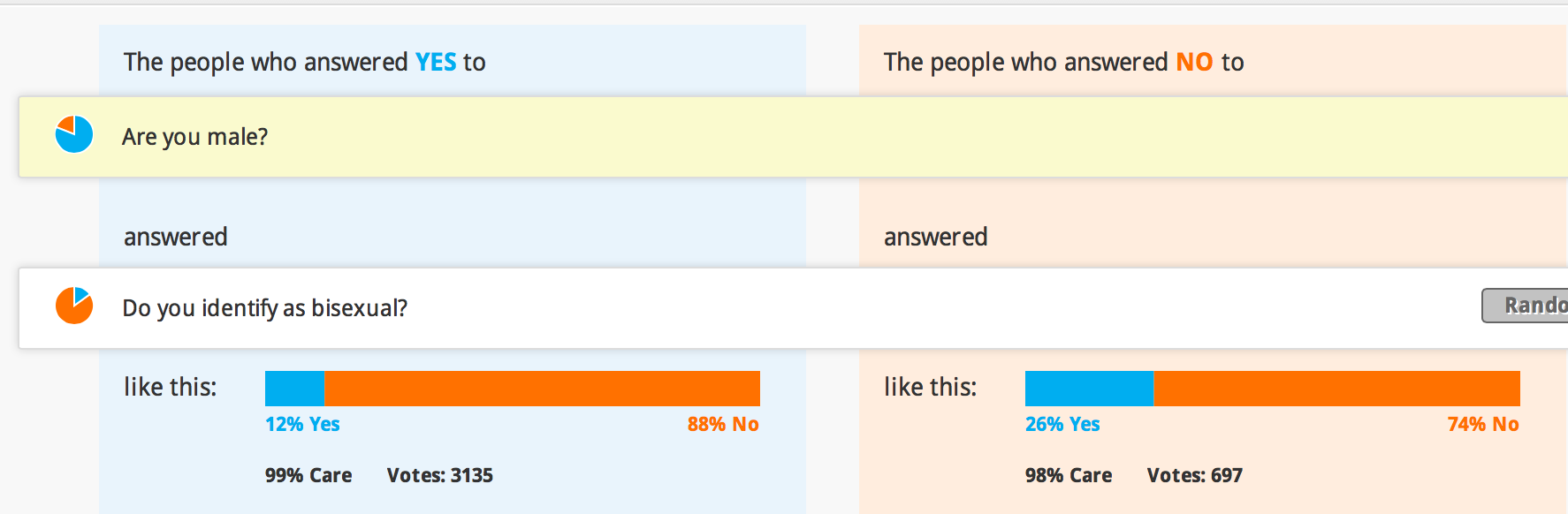
The above screenshot from our unscientific poll shows that 12 percent of male respondents identify as bisexual while 26 percent of female respondents are bi. Of all the straight-identified respondents, 21 percent say they have had a pleasurable sexual experience with someone of the same gender. And 26 percent of respondents do not believe that bisexuality is a sexual identity of its own. Read all of the results here. Below are more stories and observations from bisexual men who bristled at the previous readers who doubted their existence:

When I was about 13 or 14, I realized I was attracted to men.  I had many deep crushes on girls as children, and no real attraction to men until I hit puberty.  I liked fantasizing about both, and I had two significant relationships in that period of bisexuality, one with a boy and another with a girl.  They were both pretty good.  Throughout this time, it was drilled into me by coming out stories and adults both gay and straight that bisexuality was a stopping point on the way to being gay.  I still had crushes on girls, but my awkwardness and general unattractiveness mostly kept them from becoming relationships.  I also had crushes on (mostly straight) boys.

At 16, as one of the few juniors at a debate camp full of seniors, there was a group of friends I really wanted to be part of – a clique led by a smart, good-looking girl with a gaggle of male followers.  At first she thought I was hitting on her; that’s when I made my move and came out as gay.  If I’m looking back and being totally honest, I think my shift from bisexual to gay at 16 was actually based on my attraction to a woman.  This is a pattern that would hold for the next four years or so: I would develop close friendships with females I was actually attracted to while having sexual and romantic relationships exclusively with men.  There was one exception: one of my female idols and I got so drunk and a hotel room that we attempted to have sex, but booze and marijuana and sexual confusion are not kind to the erection of any man.

At 20, I met the woman I would eventually marry.  She is amazing, beautiful, smart, and we are infinitely compatible.  During the early phase of our relationship, I spent a lot of time thinking about what it meant that I now had the most significant relationship of my life so far with a woman.  Mostly it was just awkward.  Coming out as gay to everyone you know was hard, and occasionally painful.  Coming out to everyone you know again as bi just confuses them.  I still am attracted to men, but I absolutely love my wife.

What I’ve concluded from all of this is that a lot of people’s confusion is based in two assumptions about bisexuality: for men it’s a phase before gay and for women it’s a phase before straight.  I think this is often true, but man is it irritating to have all of those cases used against your identity.

Or as another reader puts it:

In most of these cases, a bisexual woman is perceived as a straight woman faking it to be edgy – a poser trying to attract men with a hot fantasy – and a bisexual man is perceived as a gay man in denial. In both these instances, society seems to be saying that if you’re going to deviate from the sexual norm, the only valid choice is the cock.

Another:

In my early teen years, I periodically developed powerful crushes on other boys in my classes. I’d worry that I was gay (I’m the son of a devoutly Catholic mother and was devout at that age as well), but then I’d think “but I also have a crush on all these girls.” In fact, I’d had crushes on girls from an early age. Since I’d never heard of bisexuality and figured a person was either one or the other, I figured “well, if I like girls, I must be straight, regardless of what I feel for these other boys.” Even then, when one of those boys dropped me in favor of “cooler” friends, I moped for a whole school year.

The lightning bolt didn’t really hit until a few months later when I was out hiking with my best friend and one of our old high-school buddies.

My friend had joined the rowing team at his college and had become extraordinarily fit in just a couple of months. We were hiking back to the car and my two friends challenged each other to a race. As they ran off, I caught myself admiring my friend’s ass. And not just in a “hey, he looks good” kind of way. The things I wanted to do with that ass would have shocked him. I was so surprised that I had to sit down. Soon after, I told my other best friend from high school (an ex-girlfriend) that “I think I might be bisexual.”

Her response? “Duh.”

She told me that the way I’d been around certain men had aroused her suspicions years previously. She rattled off a list of names and at each one I felt a flutter. A litany of handsome, gorgeous, or just cute young men, any one of whom I’d have eagerly …

This was all about 25 years ago. In the intervening years, I’ve dated more women than men and I have no trouble admitting that I’m more often attracted to women. My taste in men frequently surprises me; I don’t have a single type; I’m not usually attracted to tremendously masculine men or to particularly effeminate men (for that matter, my taste in women is similarly androgynous). And in the last few years my social circumstances have moved me away from “traditional” gay culture. However, the two real passions I’ve had in my life were for a simply beautiful man and a gorgeous woman. And in neither case was it because I was “turned on by ‘dirty'”, as your reader put it. I was madly in love with both of them and was crushed when those relationships ended.

So, do we exist? Yes. Are there more of us than anyone else? Well, it’s true that we have that choice and in the prevailing social climate in this country, is it any surprise that most men who are occasionally attracted to other men chose to simply “be straight”? Some of us don’t, however, and telling us that we don’t exist is, honestly, deeply insulting.

Another:

I’m just catching up on this thread and feel the need to weigh in, particularly to your reader’s comment, “What I haven’t ever encountered was a guy claiming to be bi, but apparently exclusively interested in men.” I could be the guy your reader is looking for. I openly self-identify as a gay man primarily for the sake of simplicity, and I have only had long-term relationships with other men. My friends and family all know. However, I have had sex with women, I enjoy it, and I actively seek it out on occasion. I had several legitimate “crushes” on women in my high school/college days, though nothing became of them. My romantic interest in women largely ended when I started dating guys in college (I’m 28 now). At the same time, I don’t think many women would enter a relationship with a guy who was openly bisexual, for whatever reason – fear of being his showpiece to appear straight or to satisfy his parents, or she may find it unmasculine, etc.

Starting in college, however, I’ve had a string of female partner’s I’ve hooked up with regularly, as well as a few one-off hookups. I guess that makes me the reverse of the stereotypical bisexual guy, who will have relationships with a woman and only dabble in sex with other men.

As I said before, I quite openly self-identify as gay because it’s easy, and it’s mostly true – I am more inclined toward sex with men, and I think I’m probably more compatible with men for relationships. I could probably give up sex with women if I had to. However, if I’m with gay friends and the topic of sex with women arises, I don’t mind sharing my experience. The usual response is, “Wait, you’re bi?” as if a guy who can swing both ways is a mythical creature. I just reply, “Yeah, sort of.” Then come the follow-up questions, and all I can really say is that I occasionally like sex with women. Apparently bisexuality confuses people, and initially telling someone that I’m gay just allows me to skip having to explain myself.

Another:

I am the reader who posted that I “don’t believe” in bisexuals.  Of course I posted that to be inflammatory (like almost everything else I do).  However, the responses don’t take into consideration my experiences.  I was married to a woman for over ten years and I have two children.  I had an incredibly fulfilling sex life.  I had been flipping back and forth between men and women my whole life and I’ve had four long-term relationships; two men and two women.  I loved my wife more than words can express and I still do.

My point only was that over time EVERYONE will find that they are better off with one or the other, whether or not they are sexually attracted, emotionally attracted, etc. to varying degrees.  Unfortunately for my wife and children I didn’t realize this until it was too late to avoid causing a great deal of pain.  So yes, I don’t deny that some of your male readers might be capable of relationships with both genders and that they might be fulfilling in both directions but I truly believe that for each person there will be one that will make them whole in the way the other cannot.  I don’t think many of your readers who responded to me have reached this point in their lives yet.  I was almost 40 when I figured it out.  I wish them luck.  It’s not an easy road.

Does The Road To Recovery Start At Rock Bottom?

This embed is invalid


After watching the season finale of Mad Men, Tom Jacobs considers Don Draper’s chances for self-improvement:

Draper’s self-destructive behavior—including serial philandering, arrogance bordering on contempt for his colleagues and clients, and propensity to self-medicate to avoid feeling shame—has finally caught up with him. He has reluctantly admitted to himself that surreptitiously adding alcohol to one’s morning orange juice is not sustainable behavior. So now he’s ready to get help. Right? Maybe not. A 2007 study published in the journal Drug and Alcohol Dependence questions the commonly held notion that “hitting bottom” is a potent catalyst for getting one’s act together. …

They found “negative associations between motivation to change and current distress,” suggesting that addicts who are in the depths of despair are often unable to summon the will to make the necessary changes in their lives. “The notion of bottoming out implies that intervention should not interfere with the disease process in that experiencing negative consequences leads to increased motivation to change,” they note. “In contrast, these data suggest that early intervention and reduction of problems associated with substance use may increase motivation to change.”