For Jose Antonio Vargas, the executive action Obama took last night was personal:
Of all the questions I get asked as an undocumented immigrant in the United States, there are two—asked in various permutations via email, social media or in person—that chill me to the bone: “Why don’t you just make yourself legal?”
And: “Why don’t you get in the back of the line?”
The questions underscore the depth of misunderstanding about how the immigration process works, and doesn’t work. They imply that, short of self-deportation, there is a process for undocumented people like me to follow, a way to rectify the situation and adjust our status. Just show up at an office, fill out a form, and get in the back of a line. Somewhere. Anywhere.
I’ve gotten asked these questions so many times that I decided to walk viewers through the process—or lack thereof—in a scene in my film “Documented,” where I chronicle a broken and inhumane immigration system that, among other things, has kept my mother and I apart for 21 years. Barring any executive action, I can’t leave the U.S.; there’s no guarantee that I’d be allowed back.
Flavelle also dismantles the Republicans’ moral argument:
[S]ay you’re a Mexican citizen with no special skills, no money for an investor’s visa and no relatives living legally in the U.S. You can’t apply for the green-card lottery, and you have no grounds for asylum. Your only hope to move to the U.S. is to be one of the few thousand unskilled workers who squeak in each year — or to enter illegally. …
Yes, people living here without authorization are breaking the law. Pretending that they had a viable legal alternative just makes it easier to demonize them, by viewing those immigrants as wrongly taking something that might have been theirs had they only followed the rules. The annual green-card figures show that for most of the people affected by Obama’s order, that probably wasn’t the case.
Ruben Navarrette Jr., on the other hand, worries about how the executive action will play out:
Looking ahead, it’s unclear how many of the estimated 4 to 5 million illegal immigrants who might be eligible for relief under the guidelines spelled out by Obama will actually apply for the dispensation. Another unknown is how many from that pool will eventually qualify. In the case of the Deferred Action for Childhood Arrivals program that served as a model for what the president intends to do with, for instance, the undocumented parents of U.S.-born children, only about a third of those who were eligible were willing to risk going through the process to be awarded deferred action. This includes walking into a Immigration and Customs Enforcement office, turning yourself in, getting fingerprinted, handling over your home address and all your personal information, all in return for the promise not to deport you—at least for now. Expect many of those who are eligible for relief under the new program to say, “Thanks but no thanks” and go on their way.
Meanwhile, the Obama deportation machine will continue to run 24/7 and enforcement might be even more aggressive than it has been up to now in order to overcompensate for what many Americans perceive as a giveaway for illegal immigrants.
Along those lines, Hayley Munguia looks closely at the undocumented immigrants still under threat of deportation:
Obama said Thursday that his plan prioritizes “deporting felons, not families.” And the percentage of deportations that involved undocumented immigrants convicted of a crime has increased significantly from 35 percent in 2007 to 59 percent last year, according to the Department of Homeland Security. But those numbers include minor infractions like traffic violations. Since 2003, there have been 433,000 removals of undocumented immigrants convicted exclusively of nonviolent crimes, the MPI has reported.
The administration “erroneously” over-counted Obamacare enrollments by “incorrectly adding 380,000 dental subscribers to raise the total above 7 million.” Jonathan Cohn calls the error “inexcusable.” McArdle face palms:
Adding in a bunch of unrelated plans, with all the attendant risk of being exposed and embarrassed, seems flatly insane. In fact, this is the most compelling reason to believe that it was a mistake. If it was a mistake, however, I’m not sure how much better that is supposed to make us feel. For the administration to have this poor a handle on its own data while attempting to make over almost one-fifth of the U.S. economy is a lot more frightening than some rather pedestrian lies.
380,000 sounds like a large number, and it did conveniently push Obamacare’s enrollment figures over the Congressional Budget Office’s projection of 7 million sign-ups. However, 380,000 also only amounts to 5.6 percent of the real tally, and the 7 million figure was never particularly meaningful to begin with (nothing particularly magical happened if Obamacare reached that milestone, and nothing tragic will happen because the program missed it). And, as Charles Gaba of ACASignups.net told Bloomberg, even with the lower total, Obamacare’s attrition rate was still in line with what experts like him predicted. This new news shouldn’t especially change anybody’s opinion about whether the exchanges have succeeded or not.
But Suderman recalls that, at “the end of the first open enrollment period, the administration repeatedly touted its success at getting 8 million sign-ups during the first year”:
What the new figures reveal, then, is the fragility and instability of that initial figure. Not only did the number of enrollments continue to drop during and after the summer, the figure wasn’t as high as reported in post-open-enrollment updates. This is probably at least one reason why enrollment targets for the second enrollment period were recently slashed by about 50 percent.
And Erik Wemple points out how “the pursuit of Obamacare data is a dicey matter for health-care reporters”:
Following the October 2013 launch of the dysfunctional HealthCare.gov, determining enrollment numbers called on investigative journalism skills. As the numbers improved, so did the willingness of HHS to dish them out. And even as states furnish all kinds of health-care metrics, HHS just cannot provide a compelling explanation as to why it cannot provide running enrollment figures.
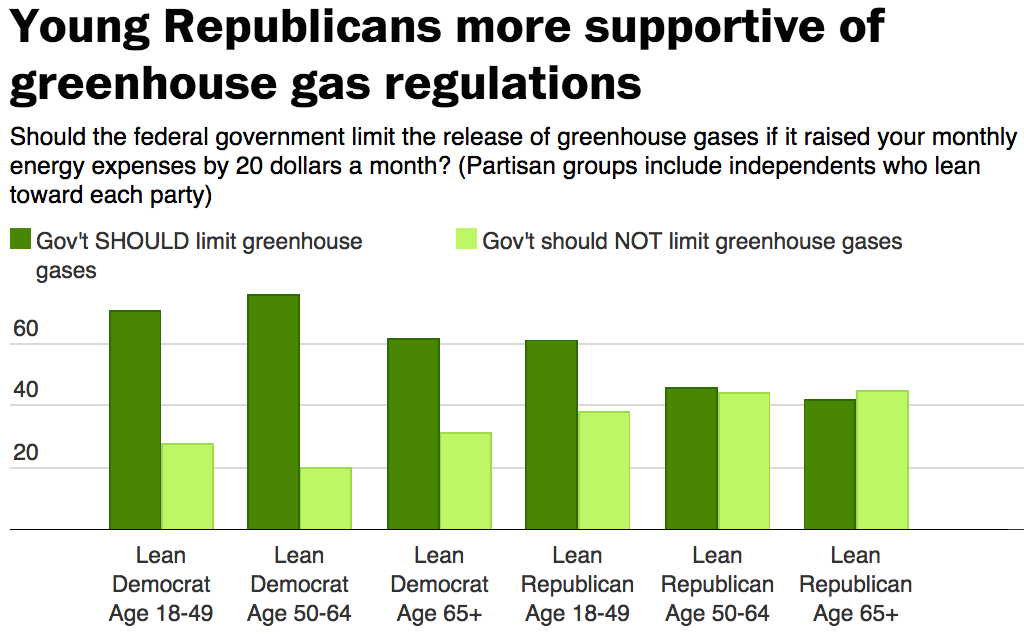
The key question, though, is whether even within the GOP, there is a split between younger and older voters on climate change. Sure enough, our poll suggests that this is the case … What this shows is that age matters above and beyond partisanship in how people think about the climate issue.
Roughly six in 10 Republicans and GOP-leaning independents under age 50 think the government should limit greenhouse gases even if it causes a $20 increase in their monthly bill; fewer than half of Republicans ages 50-64 or over 65 support this policy. Support is only slightly higher among Democrats under age 50 than those over age 65, which is statistically insignificant. Support does rise to 78 percent among Democrats under age 40.
Despite both issues having major generational divides, Loomis is skeptical that climate change will follow the path of marriage equality:
Gay marriage has a simple solution: making gay marriage legal. But climate change is far more complicated with no clear situation. Polling showing young people would pay $20 extra a month in home heating have some value but let’s be clear, that ain’t solving climate change. So what happens then? And the mechanism for change is much murkier. Ballot measures mean people can vote to legalize gay marriage. Lawsuits can force states to do the same. There isn’t really a similar mechanism for climate change.
Watching Obama last night, I really felt that the quotation from scripture was the most powerful part of his speech. For too long the GOP base has wanted to have it both ways on immigration and Christianity. On the one hand, they consider themselves the true guardians of Christian orthodoxy and scriptural truth. On the other hand, they’re all for the inhumane deportation of human beings and the splitting apart of families. You simply can’t be a “Bible believing” Christian and support mass deportation. A conservative interpretation of scripture doesn’t allow that. I think Obama subtly drove that home with the quotation.
Of course, scripture itself cuts across conservative and liberal politics, which is why we shouldn’t base government policy exclusively on scripture. But the Christianists have been living dangerously picking and choosing from scripture for a long time. Last night, Obama reminded them that two can play that game and revealed the house of cards on which the entire Christianist position has been constructed.
How another puts it:
One president declares war on the wrong country, killing 100,000+, and he’s lauded. The next president allows American children to continue living with their parents and he’s the lawless one?
Wait, what are family values again?
And another questions the party’s supposed conservatism:
Can you imagine anyone shutting down the government or impeaching a president over such a limited, reasonable, small-c conservative plan as Obama announced last night?
Funny, I don’t seem to remember the federal government shutting down even at wrenching national moments like when President Eisenhower federalized the Arkansas national guard to protect (and enforce) African-American kids being allowed to desegregate public schools. Yet, this is going to “poison the well” and blow up governing for (another) two years? Please.
Voters and the press have to stop giving Republicans a free pass on nihilism. While complaining about violating “political norms,” Ross Douthat and David Brooks are defending a new, dangerous norm: that Republicans can secede, nullify, and sabotage as a routine political tool.
Another is also sick of the GOP:
Reince Prebus said after the Republican victory that they would only consider immigration after signing a border security bill (i.e. “Immigration is dead until we remove all incentives for our party to pass it”). And remember, after the 2012 elections, it was considered an inevitable fact that Republicans had the move on immigration, and they didn’t. Now they feel none of the pressure they did after the 2012 loss and we’re supposed to think that there is a greater than 0 chance they’ll do it?
This is why I ultimately support Obama’s action. We’ve delayed and delayed and delayed, and I think everything you’ve said about why he should wait a bit more will be just as true when the six-month period you favor ends. As a result, I see no political benefit to waiting. Do it now because it’s the right thing to do and let Congress decide when it wants to do its job again.
Another adds a lot of context:
Your question of “how many immigrants will Obama let stay,” or “allow to stay,” perpetuates an important misconception in this debate. As Greg Sargent helpfully explains, Obama is not proposing to deport less people, and the same number (roughly 400,000) will continue to be deported, with or without executive action. Why? Because Congress only appropriates enough money to deport that number, or roughly 3.5% of the approximate 12 million undocumented aliens. As there is an existing, bipartisan agreement that some 96.5% of the undocumented population will be allowed to remain here (i.e., the “how many” question), Obama’s executive action asks only: which undocumented immigrants should populate the 400,000 who are deported?
That is a crucial distinction. The question is not whether Obama should increase the number of undocumented immigrants (he isn’t), but whether he should apply severely limited resources in a targeted fashion (e.g., new arrivals, criminals, etc.) or indiscriminately (e.g., a law abiding mother of a U.S. citizen-child)? And, is Obama plausibly “tearing up the Constitution” if he deports the only number of people he can (about 400,000), but prioritizes who should be deported within such Congressionally imposed constraints?
Notably, Republicans are not proposing to increase such spending/deportations. Characteristically, they are threatening only to further defund the government. Aside from raw politics, the Republican position is largely: (i) don’t inform our base that we agree that less than 1 out of 10 undocumented immigrants should be deported, (ii) apply the meager 3% budget indiscriminately to terrorize the wider immigrant population, and (iii) most of all, don’t do anything that would remove the pejorative, crippling “illegal” designation from this disadvantaged labor supply.
One more reader “shares a personal anecdote related to the president’s looming executive action”:
Nearly 10 years ago, my aunt and uncle left behind a comfortable, middle-class life in Mexico after receiving death threats from a drug cartel. My aunt months pregnant, they respectively abandoned a successful small business and a professional career to seek refuge in the U.S. from a drug war that has claimed the lives of at least 85,000 people. (A war, I should add, fueled by American drug consumption habits and lax gun restrictions.) They’ve lived here without legal status since.
I’m couldn’t be happier for them, their daughter, and millions of others expected to benefit from the executive action. And I’m grateful for a president who has concluded that we are neither safer nor more prosperous tearing families apart, relegating productive members of society to lives of constant fear and abuse.
Chris Cillizza thought the speech “fit more neatly into the Obama of the 2008 campaign and the first term of his presidency — heavy on inspiration and imagery, relatively light on details and depth”:
It’s the sort of address Obama is both best at and most comfortable giving. The idea of what makes America America — particularly in the face of the unique challenges that the 21st century poses for the country on the domestic and international fronts — is something he has quite clearly spent significant time thinking about. The 2008 edition Obama we saw tonight is also, not coincidentally, the version most beloved by the base of the Democratic party. And, in truth, that’s who the speech was really aimed at. The politics of immigration are such that there were no words Obama could (or would be willing to) utter that would drastically reshape the coming fight over the issue.
Beinart argues that Obama “decided once again to trigger the hatred of defenders of the status quo because, I suspect, he knows American history well enough to know that real moral progress doesn’t happen any other way”:
Yes, Obama is a pragmatist. Yes, he is professorial. Yes, he wants to be liked by his ideological opponents and by the powers that be. But he also knows that were he in his twenties today—a young man of color with a foreign parent and a foreign-sounding name—he might be among those activists challenging the vicious injustice of America’s immigration system. When Obama talked about “the courage of students who, except for the circumstances of their birth, are as American as Malia or Sasha; students who bravely come out as undocumented in hopes they could make a difference in a country they love,” he wasn’t only comparing them to his daughters. He was comparing them to himself.
For progressives, this was always the real promise of Barack Obama. It was the promise that a black man with a Muslim name who had worked in Chicago’s ghettos—a man who had tasted what it means to a stranger in America—would bring that memory with him when he entered the White House. It’s a promise he fulfilled tonight.
Ramesh Ponnuru feels that, in Obama’s speech, the “policy and the rhetoric are at war with each other”:
I imagine that most left-wingers will rally behind the president’s immigration policy, especially since it appears to be a minority position. But some of them will be complaining that the president didn’t go far enough. And we should take a moment to appreciate that they have a point. The moralizing language Obama used, which essentially cast attempts to enforce the immigration laws as acts of indecency, are hard to square with the limits that he set.
Simply put, the president offers no explanation for why he is ordering these changes only for 5 million of the nearly 12 million illegals in the United States. Everything he said in his speech about the value of immigrants, and the need to show kindness to the stranger, ought in theory to apply to any illegal but a criminal. But Obama has limited its reach to people who have been here for several years and have children who are American citizens. This means either his arguments are disingenuous, or he doesn’t have the courage of his convictions, or he’s calibrating his responses to satisfy a political constituency without causing a wholesale eruption inside the country. Or all three.
This is the way this president and his fans always sell his policies. They mock, ridicule, snark, smirk, wink and guffaw at any notion he’s a radical or an ideologue when the action he wants to take is under debate. It’s just a modest This, a pragmatic That, an incremental The Other Thing. But, once it’s a fait accompli, it’s a Big F’ing Deal — to borrow a phrase from the Vice President. Right now, what Obama wants to do is par far for the course for every president Why, it would be weird if he didn’t give 5 million people amnesty. But I have no doubt that in the minutes, days, or, at the most, weeks to come I will be getting emails from the DNC telling me this a bold, historic, revolutionary piece of legislation executive action.
Dara Lind wonders how many undocumented immigrants will actually take advantage of the new policy:
In order for the program to be effective when it officially launches (which is expected to be in spring of 2015), people are going to have to apply. And that could be tricky. After all, these are people who’ve been living in the shadows for years — and have learned that any interaction with government officials could lead to their deportation.
The good news is that the administration, and community groups, have done something of a test run on the new program — via the DACA program in 2012. The push to get unauthorized immigrants to apply for DACA has created an existing infrastructure that can now be built on for the new, expanded relief programs. But in order to build on that, they’re going to need more money and more lawyers. And the government agency running the program, US Citizenship and Immigration Services, doesn’t have much money to spend on outreach.
Claire Groden expects that “Obama’s deportation order will affect fewer people than you’ve heard”:
[E]ven among those who will apply, not all will receive protection. Undocumented parents of legal residents and citizens will have to pass the same kind of background checks as those applying for visas, [the Migration Policy Institute’s Marc] Rosenblum said. People who will qualify under the expanded umbrella of DACA can’t have any felonies or significant misdemeanors on their track record. Protection is far from automatic: undocumented people will have to not only fit the eligibility requirements, but prove it.
Obama’s action is not about winning broad support now. It’s a long-term effort to increase the number of Hispanic voters, who chose Obama over Mitt Romney by 71 percent to 27 percent in 2012. If that support can be cast in cement, and the number of Hispanic voters increased even beyond current demographic trends — well, that would be very good news for the future health of the Obama coalition.
Jamelle Bouie is unsure “how much the Democrats gain” from the executive order itself:
At most, the president’s immigration order might strengthen the short-term bonds among Latinos, Asians, and the Democratic Party. More significant, I think, is the Republican reaction. If the GOP reacts to the immigration order with unhinged hysteria and anti-immigrant animus … it could further estrange itself from these groups. And that, more than anything, could shift the long-term shape of our politics.
Ed Morrissey is puzzled by the “rather large gap between his speech tonight and the actual action Obama promises to take”:
Section 2 is titled in bold font, You Cannot Apply For Several Months. The start of the program is nebulously given as “early 2015,” which could mean anything from January 2 to, say, June 29th. Why not start now if Obama is so tired of waiting? One has to wonder whether this is a bluff of sorts, intended to scare House Republicans into passing the Senate bill in the waning days of the lame-duck session. If Obama’s willing to wait “several months” to take action, why not just wait and at least attempt negotiation with incoming Republican leadership?
Ambinder expects that “immigration politics will become nastier in the near-term”:
You think you’ve heard the last of talk radio hosts bloviating about Ebola-carrying migrants sneaking across the southern border? It’s about to get much worse, and much more toxic. By singling out certain classes of undocumented immigrants, Obama puts a bullseye on the backs of those who do not qualify for documented status. Add the idea that the president is acting like a dictator and — kaboom: the act of granting amnesty becomes even more associated with one political party.
And Suderman fears that real immigration reform just got harder:
Unprecedented, unpopular, large-scale, unilateral policy changes are nearly certain to produce a backlash—against the president, against his party, and against the ideas at the heart of the policy change itself.
To me, this is the most significant risk of Obama’s plan—that it will create a backlash, not only amongst congressional Republicans, but within the public at large, a backlash that makes it more difficult to achieve a stable, legal, and politically viable system of expanded and simplified immigration, one that is not dependent on a sympathetic executive or enforcement discretion, but that is codified in law and agreed upon by enough of the country’s residents and legislators.
Well, I should confess something up-front. I found the president’s peroration deeply moving as an immigrant myself who has experienced a little of the fear and insecurity that being in some way on the wrong side of the immigration services can incur. The paradox of living somewhere and building a life and knowing that it can all be suddenly swept away; the thought of being separated from those you love – for ever; the stresses within families and marriages that such a shadowy existence can create. We need a full-throated defense of immigration in these cramped and narrow times, and the president was more than eloquent on that tonight – and made his case with a calm assurance and intensity. I’m gladdened by it – and I can only begin to appreciate how his words will have felt to millions of others.
Did he make the case that a mass deferral of deportations was the only option for him? Not so effectively. His strongest point was simply the phrase: “pass a bill.” Saying he is doing this as a temporary measure, that it will be superseded as soon as a law reaches his desk, gives him a stronger position than some suppose. There is more than one actor in our system. The president and the Senate have done their part; the House has resolutely refused to do its – by failing even to take a vote on the matter. Why, many will ask, can’t the Congress come up with a compromise that would forestall and over-rule this maneuver? What prevents the Republicans from acting in return to forestall this?
At the same time, he did not press the Reagan and Bush precedents. And his description of the current mess as a de facto amnesty was not as effective as he might have hoped. His early backing of even more spending on the border, his initial citing of the need for the undocumented to “get right with the law” by coming out of the shadows to pay back taxes, among other responsibilities, was a way to disarm conservative critics. It almost certainly won’t. But it remains a fact that the speech – in classic Obama style – blended conservative stringency with liberal empathy in equal parts.
Objectively, this is surely the moderate middle. Obama’s position on immigration – as on healthcare – has always been that. It’s utterly in line with his predecessor and with the Reagan era when many conservatives were eager for maximal immigration. His political isolation now is a function, first and foremost, of unrelenting Republican opposition and obstructionism. From time to time, then, it is more than good to see him openly challenge the box others want to put him in, to reassert that he has long been the reasonable figure on many of these debates, and to remind us that we have a president whose substantive proposals should, in any sane polity, be the basis for a way forward, for a compromise.
They are not, of course. And this act of presidential doggedness, after so long a wait, may well inflame the divisions further. I still have doubts about the wisdom of this strategy. But I see why this president refuses to give in, to cast his future to fate, to disappoint again a constituency he has pledged to in the past, and why he is re-stating his right as president to be a prime actor rather than a passive observer in the last two years of his term. That’s who many of us voted for. And we do not believe that the election of a Republican Senate in 2014 makes his presidency moot. Au contraire.
The branches are designed to clash and to jostle over public policy. And the Congress has one thing it can do now that it has for so long refused to do. It can act. And it should. The sooner the better.
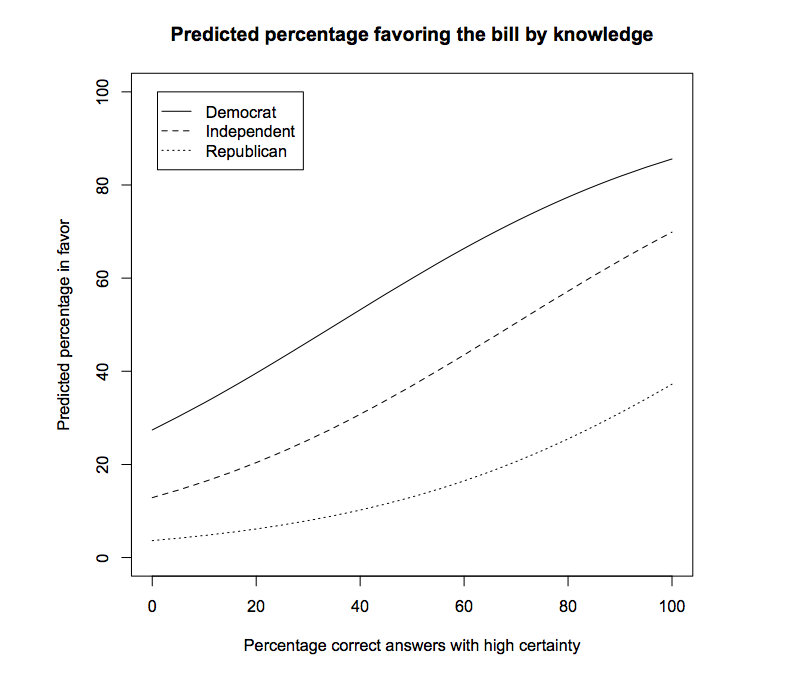
Jon Krosnick, Wendy Gross, and colleagues at Stanford and Kaiser ran large surveys to measure public understanding of the ACA and how it was associated with approval of the law. They found that accurate knowledge about what’s in the bill varied with party identification: Democrats understood the most and liked the law the most, independents less, and Republicans understood still less and liked the law the least.
However, attitudes were not just tribal. Within each party, the more accurate your knowledge of the law, the more you liked it.
Krosnick and colleagues found that most people favor most of the elements of the ACA, but not everyone recognized that these elements were all in the plan. Many people also have false beliefs about the plan. For example, only 42% of Americans correctly understood that the law does not provide free treatment for illegal aliens. Only 21% of Americans approve of this imaginary feature of the plan.
This suggests that if the public understood the ACA perfectly, support for the law would be higher. Based on their model for how knowledge about the ACA is associated with approval for the law, Krosnick and colleagues project that in the unlikely case in which the public had perfect understanding of the law,
the proportion of Americans who favor the bill might increase from the current level of 32% to 70%.
Keep in mind, however, that Krosnick’s survey can’t show us that change in knowledge would cause change in approval. Perhaps causality runs the other way and it is approval of the law that drives people to seek information about what is in it.
But all of this is a huge indictment of the president’s and the Democrats’ approach to talking about the law. In my view, they should have been using every single opportunity to explain what the law actually does, compared with the system it replaced. Yes, there has been a mountain of propaganda against it. But that doesn’t excuse political malpractice in defending it. This is the Democrats’ most significant piece of domestic legislation in decades. And yet they cannot manage to make the case for it. That tells you so much about why that party remains such a shit-show, rescued temporarily by this president, but still wallowing in its own dysfunction, inability to communicate and pusillanimity.
Compared to most other GOP presidential contenders, Christie isn’t well liked by Republicans:
Despite such numbers, Mark Leibovich sees the logic of a Christie run:
There is a theory in presidential politics that electorates will gravitate to the candidate who represents the biggest departure from the incumbent, especially if they have grown weary of that incumbent. “That’s the argument people make to me about why I should run,” Christie told me during one of our conversations. “They’re like: ‘No one could be more the opposite of Barack Obama from a personality standpoint than you. Therefore, you’re perfect.’ ” Yet one of the more compelling aspects of a Christie candidacy would be his ability to start an overdue fight within his own party.
In 2012, Mitt Romney never took on the G.O.P.’s far right, which has more than its own fair share of bullies. He was content to run right in the primaries, tout his “severe conservative” stripes and hope it would not end up costing him with swing voters in the general election. (It did.) In a brief period of reckoning after the 2012 election, Republican leaders spoke of their need to expand their shrinking base and appeal to Hispanics, African-Americans, women and younger voters rather than bow to unrelenting hard-liners. Christie could be the candidate with the best shot of pulling this off. “Christie’s strength is that people think he is being straight with them,” said Tom Kean, a former New Jersey governor and one of Christie’s political mentors. “If he kowtows to anyone, and people stop believing that he’s saying what he means, he’s going to kill the brand.”
Kean told me that Christie “is the best politician I’ve seen since Bill Clinton.” [Haley] Barbour said he “has a strong starting place in 2016.” But for all of the noise he has made, there is a difference between being an operative and being a national politician. Christie’s positions on immigration reform, foreign policy and certain social issues remain very much a black hole, not to mention an object of great suspicion, on the right. Running in a Republican presidential-primary campaign would be considerably harder than showering cash on his fellow governors and being dubbed by the media as a “winner” of this cycle. On some level, Christie might be just the latest intriguing moderate for the small media-obsessed wing of the Republican Party that gave us Presidents Giuliani and Huntsman.
Ben Guefrache Fatma of Tunisia, a contestant of the Miss World Muslimah 2014, during a practice session before the final round at Prambanan temple in Yogyakarta, Indonesia on November 20, 2014. Around 25 finalists take a part in the 4th Muslim World contest. By Ulet Ifansasti/Getty Images.
Jacob Berlove, 30, of Queens, is the best human Supreme Court predictor in the world. Actually, forget the qualifier. He’s the best Supreme Court predictor in the world. He won FantasySCOTUS three years running. He correctly predicts cases more than 80 percent of the time. … I told [law professor Theodore] Ruger about Berlove. He said it made a certain amount of sense that the best Supreme Court predictor in the world should be some random guy in Queens. “It’s possible that too much thinking or knowledge about the law could hurt you. If you make your career writing law review articles, like we do, you come up with your own normative baggage and your own preconceptions,” Ruger said. “We can’t be as dispassionate as this guy.”


 The Dish