We Might Be Over Ebola, But Ebola Isn’t Over, Ctd

kathy1

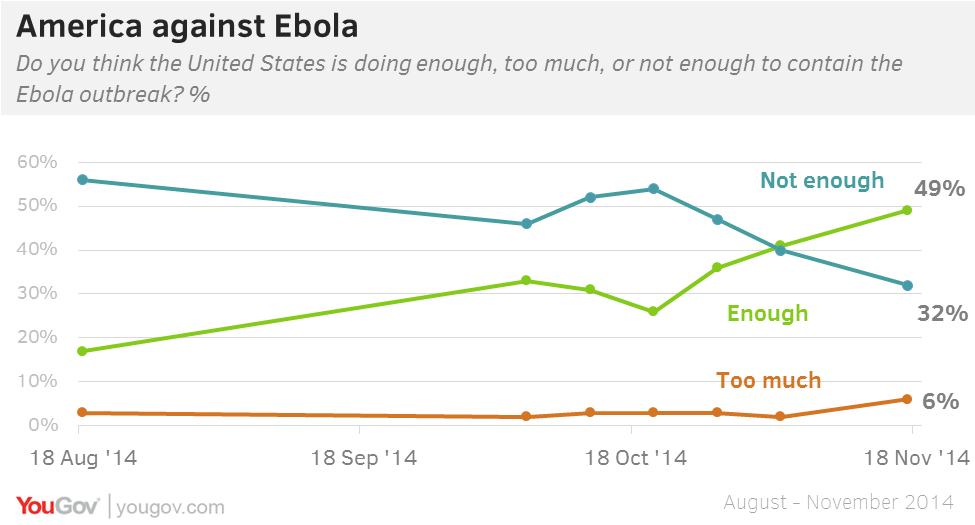
The latest YouGov poll illustrates how quickly Americans have moved on from freaking out about the disease and the government’s response to it, indicating that media sensationalism and partisan politics infected far more Americans than Ebola ever will:

Republicans have exhibited the greatest change.  At the end of October, 67% of Republicans said the government wasn’t doing enough to contain the Ebola outbreak.  That percentage has dropped 28 points.  Just 39% of Republicans now say the government isn’t doing enough. There is also less interest in increasing government spending to deal with the outbreak.  Just one in four today would increase government spending on Ebola research, down from 36% at the end of October.

But perhaps the most striking example of public satisfaction with the government’s performance is the change in the way Americans evaluate the President’s performance.  For the first time in two months, more Americans approve of the way Barack Obama is handling this situation than disapprove.

Josh Marshall even suspects that Christie has quietly retired his draconian quarantine policy for health workers returning from West Africa, though he can’t seem to get a straight answer out of the state of New Jersey. There’s also some good news on the international front:

the World Health Organization reports that the number of Ebola cases has stopped increasing in Guinea and Liberia, though they are still on the rise in Sierra Leone, while Mali seems to be keeping its second minor outbreak under control.

But even if outbreaks have peaked, that doesn’t mean these countries’ troubles are over. Last week, Abby Haglage called attention to warning signs of an “Ebola famine” in Liberia:

[Last] Tuesday, Mercy Corps published (PDF) a shocking finding: 90 percent of Liberian households are reducing the amount of food they eat at each meal, and 85 percent are actually eating fewer meals than they were before the health crisis. In a country where food was already scarce, slimmed-down portions could be the difference between life and death. A vendor in Monrovia told Mercy Corps investigators that she and her eight children can no longer afford to eat 10 cups of rice a day. They’ve cut rations down to eight. Simultaneously on Tuesday, the UN Human Rights campaign released a statement warning that West Africa may be “on the brink of a major food crisis” due to Ebola.

A new World Bank report confirms just how much damage the epidemic has done to Liberians’ livelihoods:

To measure the economic impact of that devastation, the World Bank, Liberian Institute of Statistics and Geo-Information Services and the Gallup Organization conducted phone surveys and found that not only is a massive part of the country’s work force out of job, but food insecurity is worsening. Wage workers and the self-employed have taken the biggest hit, the report finds. Prior to the epidemic, more than 30% of working household breadwinners were self-employed, but now that rate is just above 10%. Many people lost jobs because their business or government offices closed.

Quotes For The Day

“The framers of our Constitution, wary of the dangers of monarchy, gave the Congress tools to rein in abuses of power. They believed if the president wants to change the law, he cannot act alone; he must work with Congress.   He may not get everything he wants, but the Constitution requires compromise between the branches. A monarch, however, does not compromise …” – Ted Cruz, 2014.

“I don’t think what Washington needs is more compromise, I think what Washington needs is more common sense and more principle,” – Ted Cruz, 2012.

Yglesias Award Nominee

“The reasons for rethinking the intervention go beyond Libya itself. I had placed a great deal of emphasis on the demonstration effects of an intervention. My hope had been that the intervention would act to restrain other autocrats from unleashing deadly force against protesters and encourage wavering activists to push forward in their demands for change. Unfortunately, this only partially panned out and had unintended negative effects. U.S. cooperation with the Gulf Cooperation Council states in Libya compelled it to turn a blind eye to the simultaneous crushing of Bahrain’s uprising.

The worst effects were on Syria. The Libya intervention may have imposed a certain level of caution on Syrian President Bashar al-Assad, leading him to search for just the right level of repression to stay beneath the threshold for international action. But that didn’t last for long and his violence quickly escalated,” – Marc Lynch, in a bracing reflection on his misjudgments in the fast-moving era of the Arab Spring.

I await the other advocates of the Libya debacle to approach this kind of intellectual honesty. Larison, meanwhile, notes that

the demonstration effect and deterring-dictators arguments never made much sense, as I said many times back in 2011.

What I found the most troubling was the argument that such a major move, with unforeseeable consequences, was justified urgently to avoid a potential massacre. In other words, a humanitarian emergency was used to brush away all the usual weighing of the pros and cons of such a grave decision as to go to war. Which, to my mind, only underlines the necessity of restoring the Congress’s full control of war powers.

The Dish Mug Is Here!

bowie-mug

A reader wrote recently:

I haven’t bought a t-shirt because that’s not so much my thing. I eagerly await a coffee mug though. A mug with a beagle on it would make my mornings brighter.

We looked and labored over a dozen different mug options and chose what we think is the perfect one:

mugs

This navy-colored coffee mug is very high quality, holds a generous 15oz, and, during our caffeine-addled test phase, it proved very durable. So the sturdy mug should last a long time in any Dishhead’s kitchen or office (and yes, it’s microwave and dishwasher safe – we tested that too). As a serious coffee-addict, I love it.

The Dish mug can be yours for $15 plus shipping and handling. Just click here [sold out] and follow the simple prompts to order yours today. We only have a limited number of mugs for sale, so get yours before someone else does. And send us a photo when it arrives; you might see it on the blog.

Update from a reader:

Hubby has been told that it better be going in my stocking this year.  Thank you!

The Tweet That Backfired

It’s a very big day in British politics, as the polls close in the Rochester by-election, where the anti-immigrant and anti-EU party, UKIP, is poised to score another huge victory over the Tories in what should be a supremely safe Conservative seat. But the news today is about the Labour Party MP’s tweet seen above. It feeds into a popular shorthand for working/middle class white voters who are turned off by the metropolitan elites. They’re known as “white van” men, for their unprepossessing vehicular choices. And, in this case, as you can see, they’re also patriotic. Hence the massive gaffe from Labour today – which will also intensify the doubts about party leader Ed Miliband’s leadership as the next election approaches.

Think of the flap as similar to the “cling to their guns and religion” kerfuffle, a sign for some that the British left has long since lost an appeal to white non-college-educated men, and now reflexively mocks them and their view of the world. Hence this tweet:

These are combustible, populist times in which political elites are under immense pressure. If UKIP win this one tonight, the divide between Westminster and much of England outside London will only grow; and the chances of a sharp turn to the anti-immigrant, anti-European right more likely.

Ferguson On Edge

Protest Outside Ferguson Police Department

Protesters were arrested last night. And a court decision could drop tomorrow:

The grand jury hearing evidence on the Michael Brown shooting is preparing to meet Friday for what might be its final session, and a decision on whether to charge Officer Darren Wilson could come the same day, law enforcement officials briefed on the plans said.

On Monday, Governor Jay Nixon declared a state of emergency and activated the National Guard. Jamelle Bouie disapproves of such actions:

[W]hile many Ferguson residents were disturbed by the damage done during the earliest protests, there’s anger over the choice to declare a state of emergency, and rightfully so.

Remember, the initial Ferguson protests—which began the afternoon Brown was killed—weren’t violent. Instead, at first dozens, then hundreds of people gathered to peacefully protest the shooting and demand answers for why Brown’s body was allowed to lie in the sun for four hours before police took action. If there was unrest that day, it was less because of the protesters and more because of police.

As soon as residents met to protest Brown’s death that day, police brought scores of reinforcements. The Ferguson Police Department called in more than 100 officers from other jurisdictions, with some officers wielding dogs and shotguns. Given the circumstances—an angry community that wanted answers over the death of a teenager—it was an overreaction that engendered mistrust and worsened the situation.

Amy Davidson argues along the same lines:

The grand jury may surprise those who expect it to let Officer Wilson walk away. Those who are watching the people of Ferguson with such worry now may be asked to comprehend them in ways they haven’t before. It is treated as somehow exceptional that there were no riots after the acquittal of George Zimmerman in the shooting death of Trayvon Martin, in Florida. But what is often forgotten there is that what Martin’s parents asked for, first and foremost, was simply a trial of some kind, a chance for their son’s story to be heard in open court—at first, it looked as if it never would be. They got that, if not the full measure of accountability they hoped for. The fearfulness of the authorities in Missouri has been seen as an insult to the black community and a preëmptive strike against perfectly legal peaceful protests. Both of those elements are there, and both, counterproductively, increase tensions and reduce trust.

Paul Cassell hopes for transparency from the grand jury:

Several weeks ago, Bob McCulloch (the St. Louis County prosecuting attorney supervising the grand jury) issued a little-discussed news release, promising that if the grand jury decides not to charge, he will then seek to have the grand jury’s information made publicly available: “If the grand jury does not return an indictment, then I will ask the court to order that the evidence be released to the public as soon as possible if not immediately.”  (McCulloch has also pointed out that if the grand jury makes a decision to return charges, no such motion will be required because the facts will naturally emerge during the criminal trial.)

… It is hard to imagine a court turning down McCulloch’s request to release the grand jury information.  This will make the Michael Brown shooting investigation far more “transparent” than just about any other high-profile criminal investigation.

(Photo: A protestor in a Guy Fawkes mask, raises his hands in front of a line of police outside the Ferguson Police Department as part of continued demonstrations in regards to the shooting death of Michael Brown by police officer Darren Wilson in Ferguson, Missouri on November 19, 2014. By Samuel Corum/Anadolu Agency/Getty Images)

The Payoff Of Amnesty

Alex Nowrasteh claims that the “economic impact of this legalization will be positive”:

In the wake of the 1986 Reagan amnesty, wages for legalized immigrants increased – sometimes by as much as 15 percent – because legal workers are more productive and can command higher wages than illegal workers.[i]  Being legal also allows these immigrants to invest in U.S.-specific human capital, like learning English, which will increase their productivity and wages.  Unlawful immigrants are less likely to make these investments in human capital because they could be deported, thus wiping out such investment.  We will likely see a similar increase in the wages of many of the unlawful immigrants legalized today.  This benefit would likely accrue to all of the working unlawful immigrants who would be legalized under this executive order.

Professor Raul Hinojosa-Ojeda of UCLA wrote a paper for Cato in 2012 in which he employed a dynamic model called the GMig2 to study comprehensive immigration reform’s impact on the U.S. economy.  He found that a full legalization of unlawful immigrants will increase U.S. GDP by about $700 billion dollars over the next ten years, primarily by allowing the legalized workers to be more productive.  Any impact of legalizations on GDP would be smaller under an executive order because many of them would be temporary and it would not cover the entire unlawful immigrant population, but it would still produce hundreds of billions of dollars of more GDP within ten years.

In a piece we cited earlier today, Carl Hampe outlined other potential economic benefits:

Many U.S. companies provide goods and services that are purchased by the estimated 11 million undocumented. If half of them obtain work authorization, their purchasing power should increase, and this would benefit the U.S. economy generally. Many U.S. companies hire unskilled workers, and some of these companies expend significant resources ensuring that they do not knowingly hire undocumented immigrants when doing so. If the pool of authorized workers were expanded by 5 million people, some U.S. companies would have a larger pool of authorized labor from which to recruit, and their liability concerns would be diminished. Indeed, the president’s proposal would benefit compliance-minded U.S. companies that would now be able to attract newly work-authorized individuals away from companies that paid less competitive wages and were not as mindful of the hiring rules. This should benefit all unskilled U.S. workers, not merely those who are undocumented.

Marriage Equality Update

Screen Shot 2014-11-20 at 2.43.26 PM

It comes from a reader this time:

I just thought I’d pass a note that earlier today, the Supreme Court blocked a final effort by South Carolina’s Attorney General in requesting a delay in the issuance of marriage licenses for same-sex couples.  Today at noon, South Carolina became the first state in the Deep South to not only recognize same-sex unions in other states, but allow its courts to issue certificates to same-sex couples. Charleston – which is like Austin, a blue spot in a red state – naturally lead the way, with their judge issuing certificates a day ahead of schedule.

However, today’s rejection of the stay means that all counties in the state can no longer withhold their objections.  Of course, this can be deeply unpopular in this conservative state, but a growing number of Lowcountry-based Republicans, including my state senator Tom Davis (R-Beaufort), have begun to realize that this is as much of interest to libertarian sensibilities, and have thus given up their objections on principles of governance, despite their personal convictions. Wishful thinking for the Bob Jones-inspired “conservatives” that dominate in the Upstate. No matter… they have now lost.

When Harvey Gantt integrated Clemson University peacefully in 1963, he had a great quote: “If one cannot appeal to the morals of South Carolinians, one should appeal to their manners.” In the ensuing months and years ahead, you will find the angry attitudes found by many who oppose this gradually wash away as their co-workers, friends, and, yes, family members earn dignity in the ability to marry the one they love.

South Carolina’s state motto is Dum Spiro Spero – “while I breath, I hope.” Today, we can know hope in the Palmetto State.

A Democrat Finally Steps Up

Senate Holds Cloture Vote On Immigration Bill

Jim Webb just launched a presidential exploratory committee, the first Dem to do so. Tim Murphy quips that Webb’s announcement video “looks like it was filmed by the people who make commercials for personal-injury attorneys.” Regardless, Larison is pleased by the news:

Assuming that Webb is able to drum up some substantial support in the coming months, his entry into the race should be very good and healthy for the Democratic Party and the country. There had to be someone in the primaries ready and able to hold Clinton accountable for her poor judgments on policy, and there needed to be someone qualified to make her earn a nomination that has so far been treated as her dynastic inheritance. Even an unsuccessful challenge will force Clinton to face up to the mistakes on her record, and it will offer Democratic voters a serious alternative to the establishment favorite.

Kos dismisses Webb’s talk of bipartisanship:

He was a great candidate for us in Virginia in a different time. Talk of “bringing America together” rings hollow given the realities of the modern GOP. And it’s unnecessary given the realities of America’s modern demographics.

Kilgore also isn’t taking Webb seriously:

I really, really don’t think the average potential primary supporter of Webb against Clinton is going to kick out the jams for a candidate who thinks the real problem in Washington is insufficient bipartisanship. Been there, done that, with Obama, and even Obama struggles to pay lip service to the idea, particularly now on the eve of an intensely partisan fight over immigration policy.

But Enten argues that running to center is a smart play:

Clinton has less support among moderate and conservative Democrats than she does among liberal Democrats. Additionally, three CNN surveys have asked Democratic primary voters whether they prefer Clinton, a “more conservative Democrat” or a “more liberal Democrat.” Clinton has averaged 67 percent in these surveys. The more liberal Democrat has averaged just 11 percent. The more conservative Democrat, on the other hand, has averaged 18 percent. Again, Clinton is the heavy favorite, but anti-Clinton voters prefer a more conservative option.

Morrissey finds it “difficult to figure how seriously to take this bid”:

He doesn’t have much of a following any longer, having been all but absent for the last two years. He didn’t campaign significantly for Barack Obama in 2012, if at all, nor did he do anything for Democrats in this cycle — even though Webb tried grabbing attentiona couple of times this year about his 2016 aspirations. Webb seems to think that it’s still 2006 and the Left will draft him again without having to do any of the party-building work necessary for most serious contenders, such as Hillary Clinton. She may not have been effective in this cycle, but she and Bill hit the campaign trail and tried to get Democrats elected, as did Warren, Joe Biden, Martin O’Malley, and other Democrats who might be looking at a bid. Webb’s sat out campaigning since the 2008 election for Obama.

Philip Klein expects Webb’s opposition to women in combat to doom him:

In the 2016 context, given the Democratic Party’s recent emphasis on pushing the “war on women” narrative and the fact that Clinton has a good chance to become the first female president, Webb will be skewered as a fossil for having held these sorts of views.

But Michael Tracey insisted last week that Webb is Hillary’s most formidable challenger:

During his 2006 Virginia Senate run — back when Clinton and Obama still fervently insisted that marriage was “between one man and one woman” — Webb opposed a state constitutional amendment on the ballot that banned all same-sex unions. The measure still passed by 14 percentage points, which means that many social conservatives voted for both the victorious Webband the ban, indicating his unique ability to garner support from non-conventional Democratic constituencies.

Democrats who are seeking a better way forward — and who want to avoid the dangerous “Clinton inevitability trap” — should turn their gazes to Webb.

(Photo by Jamie Rose/Getty Images)