Paying Off Arrested Development’s Mortgage


Matthew Ball conducts a lengthy analysis of the economics of Netflix’s recent season of Arrested Development:

I’d argue that it is unlikely that Arrested Development will convince millions of users to stay an extra month in 2014 and 2015. If this is the case, the show would need to achieve its return in the immediate future. Therefore, if we don’t see Netflix adding four to five million new subscribers during the quarter, one of two things are true. One, the show was a poor investment whose draw was a fraction of those anticipated, or two, the show is instead intended to convince many of the million subscribers currently churning away each month to defer their cancellation. This would be telling.

He concludes that Netflix’s original content is less about attracting subscribers, and more about buffering against rising licensing fees for their other content. Felix thinks Ball misunderstands Netflix’s strategy:

[W]hat Ball misses, I think, is that Netflix is playing a very, very long game here — not one measured in months or quarters, and certainly not one where original content pays for itself within a year. Netflix doesn’t particularly want or need the content it produces in-house to make a profit on a short-term basis. Instead, it wants “to become HBO faster than HBO can become Netflix,” in the words of its chief content officer Ted Sarandos.

Most importantly, the thing that Netflix aspires to, and which HBO already has, is an exclusive library of shows. If everything goes according to plan, then the Netflix of the future will be something people feel that they have to subscribe to, on the grounds that it’s the only place where they can find shows A, B, C, and D. That’s what it means to become HBO — and Netflix is fully cognizant that this is a process which takes many years and billions of dollars.

The Plight Of The Mentally Ill

Harold Pollack feels that deinstitutionalization, “the broad set of policies designed to move individuals with disabilities out of large institutions into family- or community-based settings,” was a mixed bag:

On the whole, deinstitutionalization improved the lives of millions of Americans living with intellectual and developmental disabilities (I/DD) — albeit with many exceptions.  These policies allowed people to live with proper support, on a human scale, within their own communities. Second, deinstitutionalization was far less successful in serving the needs of Americans suffering from severe mental illness (SMI) — again, with many exceptions.

He also considers the political power of these groups:

[T]he disparities that prove most damaging for public policy reflect disparities in political standing and social stigma between the two groups. People with intellectual disabilities rank among the most appealing constituencies in America. Their well-organized caregivers — people like me — cross every economic, social, and ideological boundary. I cannot imagine, for example, that a policy akin to the IMD exclusion could be imposed on the intellectually disabled.

Similar differences arise in everyday life, as is obvious to any caregiver. Group homes for the intellectually disabled do not face the same “Not in my backyard” problems that beset similar group homes for people with SMI.  Constrained by stigma and fear, housing facilities for individuals with psychiatric disorders tend to be larger, more clustered within less-desirable neighborhoods. It’s much harder to attract required funds or public acceptance for best-practice SMI interventions.

Keith Humphreys adds “one gloss about the standard by which we judge the effects of deinstitutionalization on people with SMI”:

If we assume that the pitiable man with schizophrenia on the corner would be in a high-quality, safe, well-staffed state mental hospital if only the country hadn’t deinstitutionalized, we are inventing a past that rarely existed. Granted, it may bother the rest of us more that someone is sleeping in their own waste on the street than when the same thing happens in a back ward of an institution, but that’s because only in the former case do we have to look at such suffering, not because the person themselves is necessarily worse off.

Television As Birth Control?

India Fertility TV

Gwynn Guilford spots a connection between television watching in India and the country’s fertility rate:

Over a three-year period, academics Robert Jensen and Emily Oster researched rural villages in five Indian states. They found that once the village got cable TV access, fertility declined within a year (pdf). This has happened elsewhere too. Fertility dropped markedly as more and more Brazilian villages got on the cable grid from 1970 to 1999, according to research by academics Eliana La Ferrara, Alberto Chong, and Suzanne Duryea. …

Though Jensen and Oster’s research in India didn’t focus on the impact of a single type of program, they too conclude that Indian soap operas, which tend to feature independent urban women, might be the critical factor in driving down birth rates. Exposure to TV also tended to accompany a shift in values—fewer rural women who had TV said they found domestic violence acceptable or expressed a preference for male children.

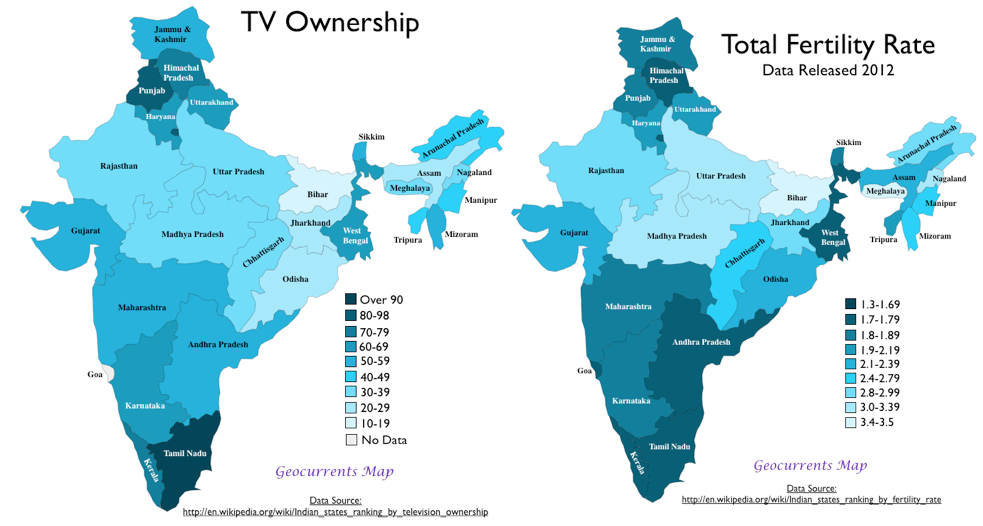
Martin Lewis, who provides the above image, tackled this issue a couple months ago:

As it turns out, the map of television ownership in India does bear a particularly close resemblance to the fertility map. Two anomalously low-fertility states with low levels of female education, Andhra Pradesh and Jammu and Kashmir, score relatively high on TV penetration, as does West Bengal, which lags on several other important socio-economic indicators.

The correlation is far from perfect: Mizoram ranks higher on the TV chart than its fertility figures would indicate, whereas Odisha and Assam rank lower. Odisha and Assam turn out to be a bit less exceptional in a related but broader and more gender-focused metric, that of “female exposure to media.” These figures, which include a television component, seem to provide the best overall correlation with the spatial patterns of Indian fertility

Putting Fear To Work

Waldman bets that this ad against drunk driving will prove ineffective:

The anti-drunk-driving campaign of the 1980s was successful in large part because it joined the message about the dangers of drunk driving with a way people could avoid it, by introducing the concept of the designated driver, which ended up becoming a cultural norm. And this, it turns out, is central to the success of public health communication campaigns on topics like this one. Research has shown (here’s a meta-analysis on this topic if you want to read more) that fear is actually quite useful, the more the better. But the message also needs to increase people’s sense of efficacy, so that they have a way to resolve the fear through their actions. There are actually two kinds of efficacy that matter: self-efficacy, which is whether you believe you can successfully do whatever is being recommended (“Will I remember to bring a condom?”) and response efficacy, which is whether you believe the recommended action is going to work (“Do condoms prevent transmission of HIV?”).

If you succeed in making people afraid of something, like catching a terrible disease, they’ll look for a way to handle the threat. But if you don’t give them something they can do to alleviate the threat itself, they’ll deal just with the fear they’re feeling, by denying that they’re vulnerable (“That’ll never happen to me”) or just trying not to think about it.

Obama’s Betrayal On Syria

SYRIA-CONFLICT

This was a president elected to get us out of conflict in the Middle East, not to enmesh us even further in a cycle of sectarian conflict and metastasizing warfare. This was a president who said he didn’t oppose all wars, just dumb ones. Is there a conceivably dumber war to intervene in than Syria’s current civil one? I can’t see one.

You can forgive a president once – even though his misguided, counter-productive and destabilizing war in Libya was almost as nuts as this latest foray. But by deciding to arm the Sunni radicals fighting the Shiites in Syria and Lebanon, the president has caved to the usual establishment subjects who still want to run or control the entire world. I don’t buy the small arms qualifier. You know that’s the foot in the door to dragging the United States into the middle of a civil war we do not understand and cannot control. If it has any effect, it will be to draw out the conflict still longer and kill more people. More staggeringly, he is planning to put arms into the hands of forces that are increasingly indistinguishable from hardcore Jihadists and al Qaeda – another brutal betrayal of this country’s interests, and his core campaign promise not to start dumb wars. Yep: he is intending to provide arms to elements close to al Qaeda. This isn’t just unwise; it’s close to insane.

What to do when a president just reverses course like this? It comes after verification that the Syrian regime has used chemical weapons against civilians. This is, apparently, the “red line”. Indiscriminate shelling that kills tens of thousands wasn’t enough. Of course, I’m not in any way defending the horrifying use of these weapons against civilians – but I am asking what on earth is the American national interest in taking sides militarily? I see precisely none. Do we really want to hand over Syria’s chemical arsenal to al Qaeda? Do we really want to pour fuel on the brushfire in the sectarian bloodbath in the larger Middle East? And can you imagine the anger and bitterness against the US that this will entail regardless? We are not just in danger of arming al Qaeda, we are painting a bulls-eye on every city in this country, for some party in that religious struggle to target.

I understand why the Saudis and Jordanians, Sunni bigots and theocrats, want to leverage us into their own sectarian warfare against the Shiites and Alawites. But why should America take sides in such an ancient sectarian conflict? What interest do we possibly have in who wins a Sunni-Shiite war in Arabia?

I hate to say it but this president looks as if he is worse than weak here. He is being dragged around by events and pressures like a rag doll. And this news that we are entering the war with military supplies is provided by Ben Rhodes, not the president. That’s nothing against Ben, but when a president is effectively declaring war, don’t you think he has a duty to tell the American people why and what he intends to achieve?

But nada. You voted twice for Obama? You’re getting the policies of McCain and the Clintons, the candidates he defeated. I wish I could understand this – but, of course, my worry is that the pincer movement of Rice and Power is already pushing us into a war we do not need, and cannot win.

This is worse than a mistake. It’s a betrayal – delivered casually. Maybe he thinks his supporters will treat this declaration of war just as casually. In which case, he’s in for a big surprise.

(Photo: Syrian rebel fighters belonging to the “Martyrs of Maaret al-Numan” battalion leave their position after a range of shootings on June 13, 2013 in the northwestern town of Maaret al-Numan in front of the army base of Wadi Deif, down in the valley. By Daniel Leal-Olivas/AFP/Getty Images)

The Best Of The Dish Today

dish-giftsub-hz03

Today, we unveiled our gifting program – in time for Father’s Day, but for a long time after that. My pitch is here.

I argued for a one-pill anti-HIV prophylaxis to be routine care for HIV-negative sexually active gay men, and over the counter if necessary, while wondering why the gay civil rights movement has to be named after a town in Croatia, LGBT.

Glenn Greenwald has some ‘splaining to do after holes emerged in Snowden’s story while Roger Ailes bemoaned the state of Americans’ historical knowledge as he hired a pundit who didn’t know who Paul Revere was or what he did. Yes, she’s baaaack!

The most popular post of the day remained my take on the new Pope’s latest off-the-cuff Christianity (it’s so great to have a Pope who isn’t positively creepy); and my take on the Pew poll of bisexuals, and a few others.

Give your dad the gift of the Dish for Father’s Day and I’ll see you in the morning when, inshallah, I will be back in the English countryside to visit my family for a few days.

How Can We Convey Mass Killings?

dish_onemillionbones

Last weekend, volunteers laid handmade replicas of 1,018,260 human bones across the National Mall:

The visually impactful piece features one million bone-shaped structures that are made out of clay, plaster, paper, and other sculpting materials as a symbolic mass grave, referencing the lives that have been lost at the hand of violent atrocities. The project, led by artist Naomi Natale, is a collaborative effort amongst artists, activists, and students from around the globe. Thousands of volunteers have made it possible and the project proudly states that “over 250,000 people in all 50 states and the District of Colombia as well as over 30 countries have participated.”

From a recent interview with the artist:

[W]e’ve gotten a lot of pushback because it’s ultimately pretty out there to have kids making bones to address such an intense issue. But when we were able to explain the project to educators, walk them through it, and talk them through how these bones are ultimately about why we should take care of each other, they were able to embrace it. It’s very provocative, having a lot of children ultimately creating a mass grave on the National Mall. But it sends a message that’s much higher than that.

(Photo: Fred Dunn / Flickr)

A Scientist And A Gentleman

Charles Darwin, notes David Askew in a review of Paul Johnson’s Darwin: Portrait of a Genius, was not insensitive to the mores of his time:

Darwin’s mechanism [of natural selection] was self-regulating: it could explain the birth of new and the death of old species without having to turn to supernatural causes. It constituted a thorough rejection of the dominant natural theology of the day. Rather than publishing his ideas on the origin of species and the theory of natural selection, however, he sat on them – and maintained a public silence for two decades. This is not surprising. Evolution, [biographers Adrian] Desmond and [James] Moore remind us, was seen by the gentry to be “morally filthy and politically foul”, and Darwin himself acknowledged that to admit to the belief that species are mutable was akin to “confessing a murder”. Desmond and Moore also notice that he was happier “hunting with the urban gentry, rather than running with the radical hounds”.

Darwin did not seek publication until another researcher threatened to eclipse his own findings:

On June 18th, 1858, potential disaster struck. Another reader of [scholar T.R.] Malthus, Alfred Russel Wallace, submitted to Darwin a manuscript describing what Darwin thought was his theory of natural selection: “if Wallace had my M.S. sketch written out in 1842 he could not have made a better short abstract!” he moaned in a letter to Lyell. If published, it threatened to deprive him of any claim to originality. He turned to his friends for advice. Lyell proposed a joint publication of Wallace’s paper and extracts from Darwin’s work: both men would share the honour of priority. Darwin himself was reluctant to act dishonourably, but was persuaded that this was a gentlemanly solution. The papers were presented to the Linnean Society in July 1858, and met with silence: as Desmond and Moore say, “no fireworks exploded, only a damp squib”. …

Darwin became serious about publicising his theory: Wallace had finally goaded him into print. [On] The Origin [Of Species], an abstract of the ideas he had been pursuing at leisure, was published by John Murray in November 1859. In many ways the book marks the beginning of a new era in Western history. His ideas had been anathema in Victorian Britain but by the time he died were mainstream opinion: he had transformed long-accepted notions about nature and humanity. One of the remarkable aspects of the Origin is not only how revolutionary the work was, but how quickly its ideas about natural selection and evolution were accepted: here, we see a true paradigm shift. This acceptance is symbolised in the decision to bury the agnostic Darwin in Westminster Abbey.

A Floating Forest

dish_SSayrfield

The SS Ayrfield is an industrial relic transformed by new growth:

Homebush Bay in Sydney, Australia is home to the remnants of a ship-breaking yard that operated during the mid 20th-century. Large watercraft that outlived their usefulness were towed to Homebush Bay and dismantled to salvage any components that could be reused or sold for scrap.

One such ship was the SS Ayrfield, a 1,140-tonne behemoth built in 1911 as a steam collier that was later used during WWII as a transport ship. In 1972 it was brought to Homebush Bay to be dismantled, but fate would decide differently. Operations at the ship-breaking yard subsequently ceased and parts of several large vessels including the Ayrfield were left behind, the largest objects in an area now infamous for decades of chemical dumping and pollution. But only this century-old transport ship would be transformed by time into a floating forest, a peculiar home for trees and other vegetation that have since sprouted over the last few decades. …

As the forest has grown inside the SS Ayrfield, the bay is now a popular place for photographers who wish to capture the uncanny sight of this strangely beautiful relic of the bay’s industrial past, not to mention nature’s resiliency.

(Photo: Flickr user Bruce Hood)

Something Is Happening In Iran?

https://twitter.com/jetpack/status/345074584078405632

An Iranian reader writes in with an argument as to why the Green Movement should get out the vote tomorrow:

I’m trying to convince absolutely everyone I know to vote. I know there is a lot of discouragement and people think their vote won’t make any difference, but I think that’s the wrong mentality. First off, every one of the more than 20 million of us who voted for Mousavi in 2009 should be equally committed to voting again, as the reasons why we voted in 2009 remain just as important today: we don’t want our country in the hands of some clown who embarrasses us all, we still hate Khamenei, and we still want Iran to be free. We must think logically and keep trying in every way we can until we have finished what we started. The worst thing we can do is nothing.

Furthermore, if more than 20 million of us vote for a single candidate like [reformist Hassan] Rouhani, there is only one way the regime can win: to cheat ever bigger and dirtier than they did the last time. It’s unlikely that this is even possible as there isn’t as much solidarity in the regime as there was in 2009, nor are they as organized as they were then when the President was one of the candidates. Even Khamenei doesn’t seem like he has the energy or courage to pull off that big of a cheat. He says he’s not for any of the candidates; I think that means he’s afraid to say who he is for, in case they don’t end up winning.

Support may indeed be surging for Rowhani, who now has the backing of the reformists and centrists:

[Rouhani’s campaign] received a boost on Tuesday when Mohammad Reza Aref, Khatami’s senior vice-president, bowed out of the race. Later in the day Rouhani received explicit endorsements from both Khatami and Rafsanjani. Of the popular mood swing that followed, the Tehran journalist said, “I never saw this coming. Everyone was so without hope and talking about not ever voting again, and this morning things have changed 180 degrees. It’s like someone put something in the water last night and this morning people are just different.” According to another source in Tehran, “The atmosphere just completely changed after Khatami and Hashemi put their support behind Rouhani. People are really excited. Wherever Rouhani speaks there’s a frenzy. Today in Mashhad it was like four years ago with the appearance of Mousavi.” [a video of that rally is embedded above]

Looking at the rest of the field, it still seems as though Tehran mayor Mohammad Bagher Ghalibaf is attracting significant support.  Meanwhile, Thomas Erdbrink notes (NYT) a major difference between 2009 and now:

Wary of the raucous street demonstrations that erupted [four years ago], the government decreed that this year’s presidential campaign would consist of rallies in predetermined spaces and a series of tedious, four-hour debates that many Iranians dismissed as more like a pointless quiz show than a discussion of real issues. “Where are all the leaflets, the posters?” asked Roghaye Heydari, 55, who had come to the capital from her hometown, Dowlatabad, where most people see voting as a national duty. “Why are they not trying to create a proper atmosphere?”

Now, instead of election posters coloring the streets, plainclothes police officers hang around at major crossings, making sure there are no spontaneous gatherings. “I have never seen so much secret police in my life,” a shopper could be overheard telling her friend near the central Haft-e Tir Square on Saturday, nodding at groups of men wearing fashionable clothes that did not suit them.

Iranwire points out how important the rural vote may be:

Hossein, a photographer who travels frequently around the country for work, says that outside Tehran few know Rowhani well at all, and is skpetical of his chances. “[Ghalibaf] has the vote in towns and provincial cities, the villagers will vote for Jalili,” he says.

Voter participation in Iran’s provinces is likely to be high, given the presidential vote being held simultaneously with city council elections, which traditionally draw voters keen to influence local matters. Saeed, a civil servant who has just visited his hometown in northeastern Iran, says turnout will be high in the provinces for the city council vote. He himself says he doesn’t plan to vote. “They have already decided who will be the president,” he says. “I need to make sure we have a friendly mayor, though”. As for Rowhani, he does not have high expectations “Yes, the urban middle class might want him, but he does not have the majority of vote where people have the highest participation rate”.

Zooming out, don’t expect the same kind of foreign media access that we saw in 2009:

Reporters Without Borders, a Paris-based organisation, said on Wednesday that the Iranian authorities had not issued visas to the vast majority of foreign journalists who requested them. Iranian media were subject to “harassment, restrictions and censorship”. Journalists who have obtained visas have been prevented from moving freely in Tehran, banned from meetings of candidates supported by reformers and from contacting government opponents or the families of political prisoners, RWB added.

Yasmin Alem pushes back on the predictions of many observers that hardliner Saeed Jalili is the favorite to win:

[I]t may well be more that Jalili has been successful in portraying himself as the Supreme Leader’s ideal candidate, rather than Khamenei singling out Jalili. After all, Jalili has fashioned his campaign platform around Khamenei’s preferred topic of “resistance.” … [Also,] traditional and moderate conservatives actually dislike Jalili. Indeed, prominent members of parliament have been openly critical of Jalili, accusing him of inexperience and dogmatism.

She nonetheless cautions:

[D]espite the odds being against him, Jalili could still come out on top. He is unlikely to be able to muster enough votes in the first round, but he might be able to triumph in a run-off (especially if a little election “engineering” takes place). Frontrunner or not, a Jalili victory would have important implications for the course of politics in the Islamic Republic. By propping up Jalili, the Supreme Leader would inevitably alienate traditional conservatives and even some segments of the revolutionary guards who support Mohammed Baqer Qalibaf, leaving Khamenei even lonelier at the top. But Jalili winning would also signal that loyalty to the Supreme Leader would trump competence.

Finally, Saeed Kamali Dehghan reminds us that the anticipation of violence, as well as the spectre of of Neda Agha-Soltan, loom large over this week’s vote:

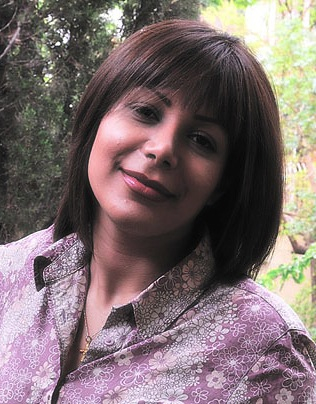
“These days, her image keeps coming back to my mind,” a Tehrani citizen said via online chat on Facebook. “Am I betraying her if I neda-agha-soltanvote? I don’t know, but many of my friends are saying we won’t achieve anything by simply boycotting the election.”

To vote or not to vote for Hassan Rouhani, the sole reformist-backed candidate standing in the race, is the dilemma shared by hundreds of thousands of people who lost faith in the fairness of Iranian polls. For families who lost loved ones in the aftermath of the 2009 election, the buildup to the vote is adding salt to the wounds. At least 100 protesters are believed to have been killed in the protests.