Peter Beinart takes us on a trip through Corey Booker’s Jewish soul-mates – and a very strange trip it is.
Patriot Or Traitor?
My view has long been neither – but now that Snowden is handing over materials to the Chinese media, busting the US program and playing directly into Beijing’s hands on the accusations and counter-accusations of hacking, I’m not so sure:
In an interview with the South China Morning Post newspaper, Snowden claims the U.S. has long been attacking a Hong Kong university that routes all Internet traffic in and out of the semi-autonomous Chinese region. Snowden said the National Security Agency’s 61,000 hacking targets around the world include hundreds in Hong Kong and mainland China, the paper reported late Wednesday. The Post, Hong Kong’s main English-language newspaper, said Snowden had presented documents to support those claims, but it did not describe the documents and said it could not verify them.
Maybe the Chinese will give him asylum in return for his documentation.
The View From Your Window Contest: Winner #157

A reader writes:
Oh, sure, tease us with Glencoe, Scotland – easy enough that even I got it – and then whip-snap us back with a could-be-just-about-anywhere photo. Well, it’s pretty much assuredly Africa someplace. So I’m guessing Freetown, Sierra Leone, mostly because I know it rains there a lot and when I first looked at the photo what first appeared to be open parachutes I now realize are raindrops.
Another:
You tricksters!! It’s from the same place in Scotland but from the back of the B&B rather than the front.
Heh. Another:
Well this is a fair bit harder than the Scottish inn. Not much to go off of here. Let’s see, the climate and palm trees seem very Caribbean. A new Dodge pickup, with the corrugated roofs mean this probably isn’t a tourist area, but neither is it one of the poorest. The most likely countries seem to be either Jamaica or the Dominican Republic. Santo Domingo is the choice, but without good ground level views of the area it’s mostly a blind guess.
Another:
With so little to go on, I’ll go with a place that I’ve been that this most reminds me of: Bissau, Guine-Bissau, a place I spent some time in the mid-1980s and somewhere I can say that no one else I’ve ever met has visited. It was under Marxist rule at the time and foreign visitors were very rare. The country had wrestled its independence from the Portuguese and the outcome of the separation was a country as lacking in basic necessities as any I’d ever seen. This photo gives me the same feeling.
Another:
This appears to be taken from the South African embassy to Equitorial Guinea. The concrete wall
with the barbed wire strongly indicates some kind of embassy or consulate, and the lushness implies something near the equator. Initially I thought it might be in Africa somewhere, because of what appears to be a woman carrying something on her head, so I did a few Google searches with “embassy” and “africa” and quickly hit the web page for the South African embassy. Same type of construction in the wall, same barbed wire on top, and the locale fits. Here is the website to the embassy. On their page was the attached image.

Another:
Russian Embassy D 27, Abidjan, Côte d’Ivoire? This is just a guess as it seems possible given the view on Google maps. I give myself about a 1/250 shot of being right.
Another:
This one is nearly impossible unless you’ve been there. The taxi style rules out a lot of West and Central African countries, assuming this one is representative of typical taxis in the country. There are a few options that come to mind, but I’ll just take a stab in the dark and claim this to be the outskirts of Douala, Cameroon.
Another nails the right African city:
I’m going to guess that this is Monrovia, Liberia, adding to your recent series of VFYW contests that include some West African cities (such as Abuja, Nigeria last year and more recently Accra, Ghana). A couple of things give this away: first the walls, which take a lashing this time of year due to the rainy season and are therefore quite waterlogged and stained – not for nothing that Monrovia is one of the rainiest capitals on earth. Second, the yellow taxi in the picture – they are ubiquitous in the city but are quite hard to get during rush hour. I could zoom in enough, I would bet that is a Liberian license plate. Finally, the women carrying their goods from the market. Am I right?
Yep, along with a half-dozen other readers:
No obvious geological or architectural features to go on. The flora and dress of the people lead me to Western Africa (Sierra Leone, Liberia, Ghana, Nigeria) although I wouldn’t be completely surprised if it were Haiti or the Dominican Republic. After studying pictures from Liberia, it seems that walls with barbed-wire tops are common in Monrovia, Liberia. Also of note is the yellow car, which I assume is a taxi. Images of Monrovia are filled with them. Without Google Street View (and lack of time given the non-weekend days) this is as close as I can get. I’m going to throw out the Cape Hotel because I see a communications tower in one of the pictures of it, but I know it’s wrong. The reader who finds this window is far better than I am at this.
Another:
Ok – so it’s been 30 years since I was in Liberia as a college student, so it’s a long shot. The white-washed cinder block walls topped with barbed wire with a woman walking along the road carrying a bundle on her head looks exactly as it might have looked in Monrovia circa 1983! I still have some tie-dyed fabric in the same orange color that she’s wearing. Honestly! What appears to be a microwave tower in the background might place the scene closer to the old Voice of America antenna farm in Careysburg, outside the capital city Monrovia. However, the Dodge Ram pickup (an expensive truck anywhere, but especially for West Africa) might place the scene in Sinkor, Monrovia’s poshest neighborhood.
Another:
This is my first time entering one of these contests, and it’s probably spurred by wishful thinking on my part. but I think this is a view of one of the transmitter towers at Radio Station ELWA in Paynesville, a suburb of Monrovia, most likely viewed from the other side of Robertsfield Highway and looking towards the Atlantic. It’s rainy season there now, and the black mold on the walls is typical. The yellow taxi driving on the right side of the road is another pointer for me, as is the brick-making operation in the compound across the street.
I lived on the ELWA compound for some time as a teenager, in the late ’80s/early ’90s, before my missionary family was evacuated in the face of the Liberian civil war. My father stayed behind, with a dozen other missionaries, and oversaw the transformation of the radio station campus into a refugee camp providing tenuous safety to ~25,000 displaced people. I did eventually return to Liberia, but it was 15 years later, in 2005. It’s still a breathtakingly beautiful country, even as it remains heartbreaking in its poverty and brokenness.
The winner this week is the only reader to guess Monrovia who has also gotten a difficult view in the past without winning:
I could spend the rest of the week pointlessly circling around central Africa, to which I’ve never
travelled. Then I found the true awesomeness that is the Hotel Provident in Monrovia, Liberia. The photographs and comments are a delight. This is quite possibly the Worst Hotel In The World. “This government needs to shut this hotel down … DO NOT STAY IN THIS HOTEL!!!” screams the first review. It’s all there, the barbed wire, the rain soaked concrete. Yellow cabs and endless, endless rain. ” Rooms are run down and dirty and the food was cold and bad.”. Incredibly this is only number 10 out of 14 hotels in Monrovia, Liberia. I feel as if I’ve lived a life in the Hotel Provident. :)
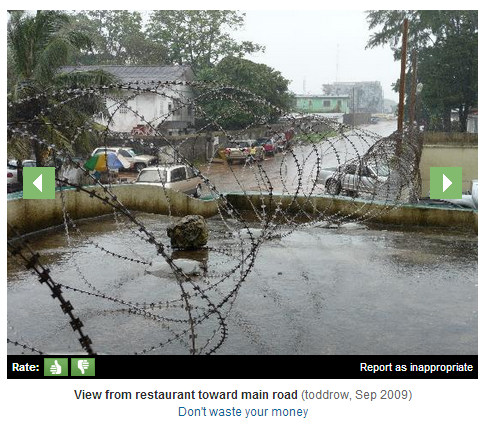
(Archive)
Give The Gift Of The Dish!

From the very beginning of this experiment in reader-supported online journalism, you asked us (in droves) if you could give a Dish subscription as a gift.
We couldn’t at first, but our partner Tinypass, our young, pioneering online meter partner, has now made it not just possible but very easy. We thought we’d launch the option just before Father’s Day because … well, we just got it finished (I’m not gonna lie) and we know Dishheads love sharing Dish posts with their ornery dads, or dads who think conservatism only means Fox News, or dads who keep emailing the latest conspiracy theory they got from their old high-school buddy, or dads who’d never dream of getting an online subscription to anything but might get addicted to the Dish on their iPad.
So don’t wait till Thanksgiving dinner to realize (again) that your dad still takes Sean Hannity seriously; get him reading the Dish and engaged in the real back and forth that goes on here every day. Then at least when he defends Hannity this fall, you’ll know Roger Ailes isn’t his only source of information about the world, and that he might even have seen another kind of conservatism worth thinking about. Give him one by clicking here.
 The reason we’re focusing on dads this week, of course, is because of Sunday. We know that many of you, like me, haven’t gotten around to a gift yet – and this is one you can give in a matter of seconds, and has a lot more meaning than a new tie.
But the gifting option is here for ever and is meant for everyone and anyone you’d like to invite to the Dish’s conversation. That co-worker you keep forwarding posts to? The atheist friend who wants to read an honest debate about faith? The sibling who’d love the Window View contest – if only she were given a chance to get into it? The roommate who thinks gays are icky? Or just a friend you’d love to chat with about stuff in the Dish but who doesn’t read it yet?
Invite them into the debate – by giving them a gift.
We also know – because you’ve told us – that many of you would like to support the Dish more than you have. By far the best way to do that – apart from buying a subscription for yourself – is by helping us expand our reader base. After all, we have a fantastic marketing department, with a staff of 27,000, i.e. you. You know why you love the Dish better than any professional marketer, and you work for free, so give a gift to someone you care about and pen your own personal message to your friend/father/sibling/mom/son/daughter/co-worker, and see what happens. Give us a year and we’re confident we can addict your invitees to stay. But only you really know who’d get it, who’d love it, and who you’d like to share it with.
The reason this place is different is its passionate, devoted readership – and your willingness to share your ideas and experiences and perspectives every day. We’re asking you to think of a friend you’d like to be a part of this adventure. And welcome them aboard.
Do Millennials Give A Damn About PRISM?
A young reader suggests not-so-much:
I have to disagree with the outrage of your readers (and the general Internet masses) on the impact of the NSA data collection. I think everyone needs to come to grips with the realities of the Internet. It is an enormously useful tool and information exchange that is kept free and open, as it should be. It is not an extension of your private space. The government collects data on what you do and say on the Internet? No shit. Private companies do too, as do hackers, foreign governments, and basically anyone who is good at googling.
Several months ago I googled a Boston hotel to get the address of where my girlfriend’s parents were staying. For months adverts for the hotel popped up on most sites I visited. When I google addresses with generic street names the one in my city always comes up first, probably because of the location of my IP address. Information on the Internet is open and there for the taking, and if you are worried about your emails being read maybe all the examples of leaked emails by persons who received them, hackers, etc. should send a jolt of reality through your system.
Look, using technology and the Internet is ingrained in our lives but remains completely optional and discretionary. And if you say “Wrong, I need this to live” then you should be worried about more than just having your metadata mined. We have fought hard (and rightfully, I think) to keep the Internet as an open and free forum. If you say or do something in an open and free forum, it is out there for the taking. Plan your actions accordingly. You don’t NEED to tweet, google, email, instant message, or post anything you don’t want to be known. And quite frankly if you are over-sharing your life and secrets on the Internet, I feel sorry for you.
By the way, I am 26 and far from the only millennial who I know feels this way. So we should not assume that the proliferation of private information available for the taking is going to be permanent.
Another adds:
Like you, I’ve been a bit underwhelmed with Snowden. I’ve been trying to figure out why it doesn’t bother me, but I suppose it’s because this is just the latest in a long line of surveillance activity colliding with modern technology. I’m sure you remember the big deal that was the ECHELON program, right? There was a right-wing kerfuffle on this being an invasion of privacy during the Clinton administration. What set it apart from Bush’s warrantless wiretapping was that it adhered to FISA. But ECHELON was still “capable of interception and content inspection of telephone calls, fax, e-mail and other data traffic globally through the interception of communication bearers including satellite transmission, public switched telephone networks (which once carried most Internet traffic) and microwave links.”
PRISM is just a step further out from ECHELON. It’s using anonymous data collection (just like Google, Yahoo, Amazon or any other place that monitors your internet searching activities) before going to get a warrant for suspicious activity. You can think of this as an invasion of privacy, or that there’s a camera on you in any grocery store, one from which the feds can ask for footage, if so inclined.
I grok the concerns of civil libertarians like Greenwald. It’s just a creepy feeling (if the federal government really wanted to, they could connect a few dots and find out my taste in internet porn). It may be lawful, but imagine how easy it would be to abuse. That’s worth discussing. But it’s not worth pretending to be shocked (shocked!) that your Internet searches don’t just disappear into the ether. They call it “being on the grid” for a reason.
Focusing On The Leaker, Not The Leak
Waldman is tired of hearing about Snowden’s personal life:
We all know that the news runs on personalities; a “story” without protagonists and antagonists isn’t a story at all, it’s just an “issue,” and that’s dullsville. But I’m sure the White House couldn’t be happier that the NSA story is quickly becoming dominated by a discussion of Edward Snowden himself, which naturally crowds out discussion of the substance of his leak and whether we want to make adjustments to the policies and programs he revealed. So now we’ll be treated to endless “investigations” of who Snowden was friends with in grade school, what kind of food he likes to eat, and any other details that can be known about him.
James Poniewozik likewise thinks the fixation on Snowden is wrongheaded:
A Snowden or Assange could be a not-so-great person advocating a worthy position, or vice versa. It’s also possible to argue, say, to condemn the government Hoovering up phone records yet question whether people with access to state secrets should be able to declassify them unilaterally. Or it should be, anyway. Dividing the debate between Team Snowden and Team NSA, though, crowds out the room for the arguments in between both poles.
Alyssa sees the issue differently:
Calling Edward Snowden “the ultimate unmediated man,” or speculating about whether or not he’s a terrible boyfriend to the live-in girlfriend he appears to have left behind in Hawaii isn’t really about the morality, efficacy, or lackthereof in his decision to leak material to Glenn Greenwald and the Washington Post. It’s a combination of prurience and a decision about whether we should invest in him in a larger sense. And whether that’s right or not, it’s not without consequence.
Ask Dan Savage Anything: I’m No Bully
In our second video from Dan, he bets that if his conservative critics actually read his new book, they will find out he isn’t the anti-Christian bigot they try to paint him as:
Dan goes into more detail on this subject in another recent interview, noting how Christians are best equipped to defend their faith from the bigotry within. His new book, American Savage: Insights, Slights, and Fights on Faith, Sex, Love, and Politics, came out a few weeks ago. My recent conversation with him at the New York Public Library is here. Our full Ask Anything archive is here.
Is Iran Winning The Syrian Civil War?
Max Fisher worries that “it’s increasingly plausible that Iran will emerge as the big winner”:
How did it happen? The answer may be both simple and complex. For all the twists and turns in regional politics, sectarian divisions and even great-power politics, it might come down to something really simple: Iran just has a bigger stake in Syria than the U.S. does. …
A rebel-held Syria, whether those rebels were the Islamists favored by Saudi Arabia and Qatar or the moderates hoped for in Washington, would shut out Iran from its only major Arab ally and and make it much tougher for Iran to reach its proxies in Lebanon and the Palestinian territories. It would leave Iran less able to reach the outside world or to threaten Israel, which Tehran sees, rightly or wrongly, as an imminent threat to Iranian security that must be deterred.
Martin Longman questions the framing:
This makes it appear like we are openly aligned with the rebels, but that is not the case.
We are formally opposed to the continued rule of the Assad regime, and we are working with some rebel groups, but we are just as opposed to some of the rebels (probably the majority of them) as we are to the Iran-backed regime. As [Liz Sly’s WaPo article] notes, the war in Syria has morphed into a sectarian conflict that pits Sunnis against Shiities and Alawites. It is neither advisable nor possible for us to take the side of the Sunnis in a sectarian religious war. That would pit us not only against Iran, but against Iraq. Plus, it’s the wrong thing to do. …
It is a gigantic failure of analysis to look at Syria as a proxy war between Iran and the United States of America. We would like to diminish Iran’s power and influence, it’s true. But not at the expense of taking sides in a sectarian fight where the most effective fighters on our side are indistinguishable from al-Qaeda.
A Little Girl Gets Her Lungs
After being placed on an adult wait organ list, 10-year-old Sarah Murnaghan received her new lungs yesterday. Michael Fitzgerald ponders the case:
The data is murky, but according to one transplant expert I spoke to who has applied for pediatric patients like Sarah to receive adult lungs, outcomes for children who receive a lung transplant from an adult might be worse than in adult-to-adult transplants cases. Adult-to-child transplants can be complicated by size differences between an adult organ and a child’s organ cavity, among other factors. According to the same expert, it could be three to five years until the medical community has enough data to accurately rank kids next to adults based on the complex algorithms used to place people in an order that is considered most fair. Experts are divided as to whether a patient like Sarah would have a longer, healthier life than the adult recipients Judge Baylson has pushed behind her.
Barro uses the story to argue that we should be able to buy and sell organs:
People are morally squeamish about the idea of paying for organs. They fear that a legal market in organs would exploit the poor and only benefit people wealthy enough to pay market prices. A well-designed market should overcome these concerns.
One such option is a proposal from Matas. Under his plan for kidneys, organs would not be traded person-to-person; insurance companies or the government would set prices and buy them like any other medical supply. Combined with a system of universal coverage, this would ensure that transplanted organs would not be a luxury for the rich.
It is highly likely that live organ sellers would tend to be poor. But the prognosis for donors giving in the legal market is good: A mortality rate of just 0.03% for kidney donations. That is still a risk, but people make all sorts of life choices that entail added risk for added money, including entering dangerous occupations; legal organ sales would simply make one more such option available.
He also praises Singapore, which has “a system of ‘presumed consent’ where all people are organ donors unless they affirmatively choose to opt out.”
Hathos Alert
You thought the Scientology-inspired After Earth looks bad? Try Superman IV:

