Bouie thinks that the American public’s attitude toward NSA surveillance shows that “there isn’t a large constituency for civil libertarian ideas”:
We have concrete examples of what happens when the federal government doesn’t make anti-terrorism a priority. The United States isn’t a stranger to civil liberties violations, but overwhelmingly, they’ve targeted the more marginal members of our society: Political dissidents, and racial and religious minorities. For the large majority of Americans, the surveillance state is an abstraction, and insofar that it would lead to abuses, they don’t perceive themselves as a target. And, in general, it’s hard to get people motivated when there isn’t a threat. Which is why it’s not a surprise to find that most Americans support the National Security Agency’s program of mass data collection. …
For civil libertarians to make surveillance into a political issue that will move votes, they’ll have to turn the abstract issue into something more concrete, cut through partisanship, and grab the attention of ordinary voters. It’s a tough challenge, which is why—in the short-term at least—I don’t expect much in the way of substantive change.
But what if they cannot? What if it is precisely the sheer scale of anonymous data that makes the surveillance less individually invasive than previous methods?
My hunch is that the biggest headache for the administration will be allies – whose foreign nationals do not have the protections that Americans have, but who are caught up in the same mass data. The Germans are getting very edgy, as are the Brits. Mataconis, meanwhile, analyzes a new poll on the NSA snooping that shows less support than the Pew one, with a 58 percent majority disapproving metadata collection when it is used on ordinary Americans:
When you break the issue down the way the CBS poll does, you find that people are opposed to the idea of the Federal Government monitoring the activity of “ordinary Americans,” but not similarly opposed to using those tactics against “suspected terrorists.” Quite honestly that makes more sense than the Post/Pew poll does, and it shows us how much more insightful a poll can be when the questions are less general and more specific.
[I]nformed Americans who vehemently dissent haven’t had an opportunity to mount legal challenges on the merits — rather, they’ve been thwarted from having their day in court by arguably illegitimate invocations of the state-secrets privilege. Relatedly, a lawsuit challenging the FISA Amendments Act was thrown out by the Supreme Court because, according to the reasoning in the ruling, none of the plaintiffs could prove they had standing. At the very least, this would suggest the troubling possibility that the national-security state’s behavior could be both unconstitutional and impervious to judicial challenge. To me, that seems like the sort of circumstance in which civil disobedience is defensible, especially if the act of civil disobedience obviates the state secret or standing obstacle.
A New Laptop
It doesn’t happen often in a blogger’s life but my MacBook Air, weighed down by way too much crap, gave up the ghost Monday night around 11 pm. So – don’t get too jealous – I’m typing now on a brand new MacBook Air – the version that was announced Monday. So far so great – my productivity just leapt a notch the thing is so much faster. If I didn’t live in Manhattan and have Time Warner cable, it would be a dream. Update from a reader:
Your post sounded very much like a letter to Grandma. “Dear Grandma, thank you for the new pen. I am using it to write to you right now. It will help me a lot with my homework.”
“Dear Dish subscribers, thank you for the new laptop. I’m writing on it right now. It will help me a lot with my blogging.”
Well, you’re very welcome, dear. :)
A Dwindling War On Pot?
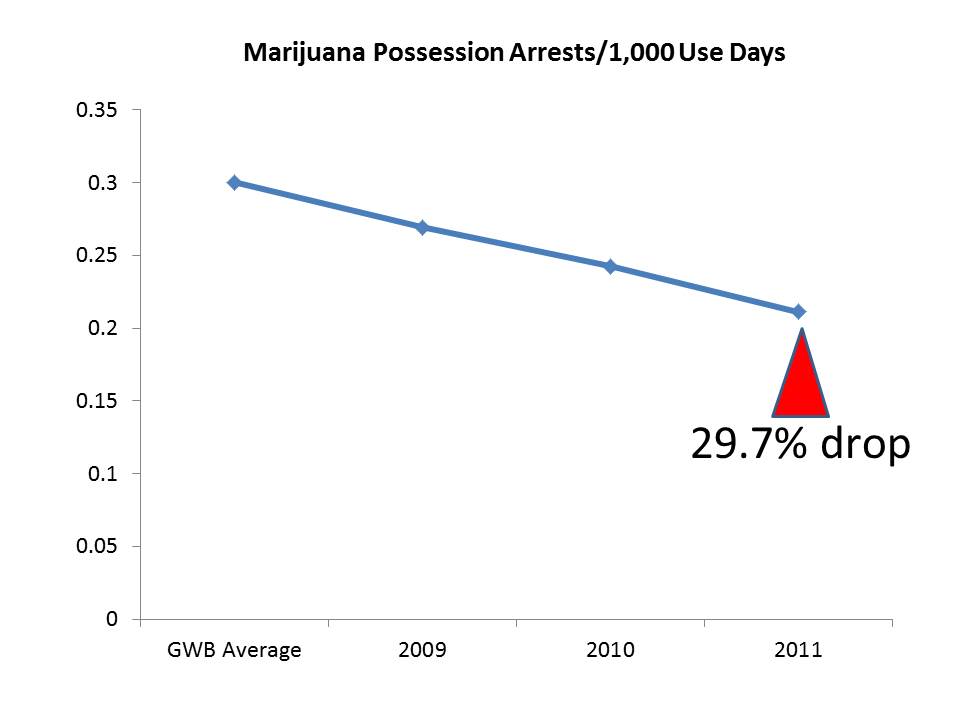
Keith Humphreys, focusing on the rate of marijuana arrests rather than the absolute number, finds that enforcement of marijuana possession laws is down under Obama:
As disappointed marijuana legalization advocates complained at the time, the first year of President Obama’s Administration saw an almost identical number of simple possession arrests (758,600) as did the last year of the George W. Bush Administration (754,200). But this represented a significant drop in enforcement intensity because Americans’ marijuana use increased by 10.6% that same year, from 2.55 Billion to 2.82 Billion aggregate days. As a result, in the first year of the Obama Administration, enforcement intensity was already lower than at any point in the GWB data. … For the last available year of Obama era data, 2011, enforcement intensity is down a remarkable 29.7% relative to the standard under the prior administration.
Pete Guither protests:
The first very obvious objection: the notion that arrests as a percentage of use is a statistic that has any relevance. There’s no evidence that law enforcement, all other things being equal, would actually arrest more people for marijuana possession if marijuana use goes up. So the fact that they didn’t isn’t evidence of some kind of lessening of enforcement emphasis.
Meanwhile, Doug Fine busts myths about marijuana legalization. He argues that legalization won’t lead to a major increase in marijuana use:
A 2011 University of California at Berkeley study, for example, showed a slight increase in adult use with de facto legalization in the Netherlands (though the rate was still lower than in the United States). Yet that study and one in 2009 found Dutch rates to be slightly lower than the European average. When the United States’ 40-year-long war on marijuana ends, the country is not going to turn into a Cheech and Chong movie. It is, however, going to see the transfer of as much as 50 percent of cartel profits to the taxable economy.
Kleiman thinks Fine is blind to the harms of legalization:
If admitting that cannabis in some form has medical utility makes it harder to persuade 14-year-olds not to get stoned all the time, I can make sense of parts the reluctance of parts of the prevention community to acknowledge the obvious, along with the reluctance of some enthusiastic anti-prohibitionists to admit that commercial availability and aggressive marketing will inevitably translate into higher rates of abuse.
Here’s what you tell 14-year-olds: yes, this is a legitimate and wonderfully relaxing drug, just like alcohol. But it really can harm the developing brain if you overdo it, and you’d be better waiting for adulthood before you try it. And look: I like it. As soon as parents admit their own pot use and talk rationally about it with their children, it will become infinitely less cool. I’m not blind to the possible problems, but the 14 year-old already has ways to find pot and every reason not to discuss it with parents. My view is that regulated legalization will make things safer for kids, not riskier.
(Image from Keith Humphreys)
Did Manning Leak Because He Was Gay?
Well, it’s a little more complicated than that. He may even be transgender. Alex Gibney explores the nuances, especially the impact of enforced silence through DADT:
Did Burke Support The American Revolution Or Just Americans?
A reader writes:
In your post on Josh Barro, you again claimed that Edmund Burke supported American Independence. This is simply not true. While he was opposed to British policies and sympathetic to the colonists’ grievances, he never supported either independence or full representation for the colonies in Parliament. His proposals for conciliation with the colonies were always premised on their embrace of a subordinate status.
My reader is technically right. Let’s not miss that. But the reader fails, in my view, to grasp how deeply Burke believed that it was Britain, not America, which was at fault here; that he saw the revolution as justified under the circumstances; that he opposed the new taxes; and wanted to find some way to give the Americans a constitutional stake in the mother country. These were not popular sentiments, to say the least and were cited to note how complicated a “conservative” can be. And in retrospect, he saw the American revolution as different in kind from the French because it was based on concrete grievances, spoke to a shared cultural and political tradition, and was, in his eyes, an attempt to conserve a way of life he treasured, rather than an attempt to change the path of humanity overnight.
And yes, he was frustratingly nuanced on the question. Whig Tories can be – and that’s a strength, Freddie, not a weakness. But the core sentiment is clear:
“I do not know how to wish success to those whose Victory is to separate from us a large and noble part of our Empire. Still less do I wish success to injustice, oppression and absurdity.”
To repeat a phrase we’ve been debating recently: A hero or a traitor? Or something in between?
Standing Your Caucasian Ground
Like this was not predictable.
Beard Playoff Season
It’s back with an early mutton-chop, but I may just have a soft spot for someone whose last name is Jagr.
One great thing about the mutton chop? You get to shave the whitest bit of your beard, on your chin. But I think I may be finally accepting mine. I’m off to see my folks soon and my mum so hates the beard I’ve trimmed it right down for her (all moms, I’ve come to learn, want their sons to look permanently 14). The white – don’t let anyone tell you it’s gray – is now staring others in the face. And they say I look younger. I guess I should always listen to Aaron. And all of you.
Cool Ad Watch
And creepy as well, intentionally so:
Rusty Blazenhoff captions:
Think! is a driving safety campaign created by Leo Burnett London for UK’s Department for Transport. “Pub Loo Shocker” is the latest ad in the campaign and it aims to bring light to the problem of drunk driving, in a very shocking way. In the ad, young men (actors) are shown going to a pub’s bathroom and washing their hands, only to be startled when the bathroom’s mirror smashes in front of them and woman’s bloody (mannequin) head smashes through (as if she was involved in a car accident).
Cyclists Are Lazy
A clever argument from James D. Schwartz:
I step outside my front door and hop on my bike because I’m too lazy to go downstairs in the parking garage to get the car. I pull my bike up to the front door at my destination because I’m too lazy to drive around looking for a parking spot then having to walk from the car to the building. … Instead of walking 15 minutes to my destination, I ride my bicycle there in 5. Yes, I ride there because I am too lazy to walk. I ride my bicycle past dozens of cars at rush hour because I’m too lazy to be stressed out sitting in traffic and too lazy to explain why I’m late all the time. I sold the last car I owned in 2010 and bought a couple solid bicycles because I was too lazy to maintain the car*. I was too lazy to renew my license plates each year, too lazy to fill up the gas tank, too lazy to shop around for insurance rates, and too lazy to take it to the car wash.
Greening The Tubes
Kendra Tupper summarizes Google’s recent conference on the environmental impact of the Internet:
[K]eynote speaker and former Vice President of the United States Al Gore frame[d] the importance of the problem: the ICT sector and its associated energy use are growing at an unprecedented rate. Within the next seven years, there will be 50 billion smart devices connected to the Internet. Researchers estimate this could account for around 10 percent of current U.S. electricity consumption. Really, no one knows; not even Google. But the number will be significant. With that staggering energy consumption in mind, Gore stressed the urgency of the climate crisis we are facing, referring to the recent news reports of climate-related weather disasters as “a nature hike through the Book of Revelation.” …
Eric Schmidt, executive director of Google, kicked off the afternoon breakouts with an inspirational talk that really got to the heart of the matter—the growth in this sector is going to continue. And it’s adding immeasurable societal value in ways that we never could have dreamed of. The Internet has provided consumers with information to make more sustainable consumer purchases and enabled telecommuting and teleconferencing as alternatives to carbon-intensive travel. In some societies, the Internet provides people with their only access to medical treatment, politics, education, and socialization outside of their culture. “You think the Internet matters?” he asked. “It matters a lot.” He stressed that the solution shouldn’t be to use the Internet less, and certainly not to limit the global reach of these services. Instead, we must make the system components more efficient; power the sector with clean renewable energy; and leverage the Internet to help solve the climate crisis.

