Fabergé Fractals

dish_fabergefractal

A series by artist and former physicist Tom Beddard:

Like an ornate Fabergé egg, Beddard’s creations boast brilliant and intricate design patterns. The English artist uses a formulaic method to create his digitally rendered three-dimensional models.

Beddard explains: “The 3D fractals are generated by iterative formulas whereby the output of one iteration forms the input for the next. The formulas effectively fold, scale, rotate or flip space. They are truly fractal in the fact that more and more detail can be revealed the closer to the surface you travel. The fascinating aspect is where combinations of parameters can combine to create structural ‘resonances’ of extraordinary detail and beauty—sometimes naturally organic and other times perfectly geometric. But then like a chaotic system it can completely disappear with the smallest perturbation.”

For more of Beddard’s work, see here.  Below the jump, a video visualization by Beddard:

(Image: courtesy Tom Beddard, subBlue)

E-Reading Comprehension

In 2010, a study indicated no difference in recall after reading electronic text vs the printed page. A new study backs up these findings:

[Researcher Sara] Margolin’s team invited 90 student participants (average age 19 years) to read ten short passages of text. One third of them read on paper (A4 size, Times New Roman font), 30 of them read on a second gen. Kindle (6 inch screen), and the remainder read via a pdf reader on a computer monitor. Five of the passages were factual (biographies) and five were excerpts from literary fiction. After each passage, the students answered five to six multiple-choice comprehension questions. They could take as long as they wanted to read each passage, but there was no going back to the text once they started answering the questions.

Overall accuracy was at around 75 per cent and, crucially, there was no difference in comprehension performance across the three conditions. This was true whether reading factual or narrative passages of text. “From an educational and classroom perspective, these results are comforting,” the researchers concluded. “While new technologies have sometimes been seen as disruptive, these results indicate that students’ comprehension does not necessarily suffer, regardless of the format from which they read their text.”

But the experiment could have been more comprehensive:

Unfortunately the study didn’t look at the participants’ familiarity with e-reader devices. It remains to be seen whether the same results would hold with an older sample and/or with readers who may be less experienced with digital devices. Also the text passages were only around 500 words long. Future research needs to examine comprehension for entire chapters and books. Devices like iPads, which are back-lit and have more potentially distracting functionality, also need to be tested.

Recent Dish on e-readers here, here and here.

The Maps In Our Minds

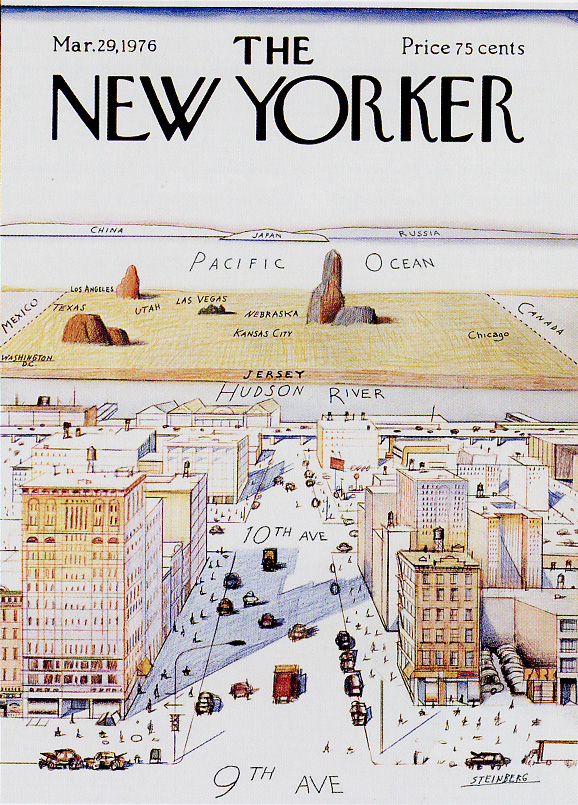
David Banks posts a belated reply to Evgeny Morozov, who recently cautioned against the dangers of personalized Google maps. Banks counters that personalized maps are nothing new:

In the late 50s, MIT urban planner and architect Kevin Lynch asked residences of Boston, Los Angeles, and newyorkview4Jersey City to draw a map of their city. He found that while individual maps were distorted, the distortions almost disappeared in the aggregate. One person might forget the existence of an entire boulevard or transpose the order of churches going North to South, but overall the maps were fairly accurate. Lynch, while acknowledging that his sample sizes weren’t very representative or large (30 in Boston, 15 in Los Angeles and Jersey City, all of middle and upper income) couldn’t help but comment on how strong and predictable the trends were. People with cars would see highways as smaller than they actually were (the speed of the car tends to reduce perceived distance), while pedestrians tended to exaggerate the size of the highway (because it was a nuisance and an obstacle, rather than a useful path).

Lynch concluded that we all have an “image of the city” in our minds that exaggerate salient features and actively delete places that do not serve a purpose in our daily lives. We’ve always had personalized maps, but up until recently, lacked the tools to effectively share them with each other on a consistent basis or in useful ways. Personalized Google maps, so long as they provide an opportunity for sharing, could provide some of the richest, most evocative maps to date. The over-lapping of millions of personal maps will illuminate hot public spaces and identify emerging new ones. The key here is whether or not Google lets us compare our maps. It seems like a killer social media function so there’s no reason not to.

The Science Of Stuffing Your Face

Among many observations on the junk food industry, Paul McFedries offers an explanation of why food makers don’t simply add more sugar, salt, and fat:

Why not just crank these ingredients up to 11 if we crave them so much? It turns out that although we generally do like more of them, when you go past a certain amount, we like the result less. That optimum amount of salt, sugar, or fat is called the bliss point. Scientists also adjust these ingredients as well as factors such as crunchiness to produce a mouthfeel—that is, the way the food feels inside a person’s mouth—that causes consumers to crave more. Technologists can also induce a flavor burst by altering the size and shape of the salt crystals themselves so that they basically assault the taste buds into submission.

The holy grail of junk-food science is vanishing caloric density, where the food melts in your mouth so quickly that the brain is fooled into thinking it’s hardly consuming any calories at all, so it just keeps snacking.

In the process, packaged-food scientists want to avoid triggering sensory-specific satiety, the brain mechanism that tells you to stop eating when it has become overwhelmed by big, bold flavors. Instead, the real goals are either passive overeating, which is the excessive eating of foods that are high in fat because the human body is slow to recognize the caloric content of rich foods, or auto-eating: that is, eating without thinking or without even being hungry. (The opposite problem is being overhungry, where you’re so ravenous that you’ll basically eat anything that’s put in front of you.) Either way, if you end up with a food baby, a distended stomach caused by excessive overeating, you’ve made a fast-food executive somewhere very happy.

The Best Of The Dish This Weekend


Ira Glass attacked the way Christians are portrayed in the mass media – “too many Christianists, too few pageviews” is my basic explanation. And we pondered the eternal questions: does masturbation draw you away from or toward others? And can we help ourselves anyway? Dennett posited language as the core human experience; and we got a glimpse into the life of one GTMO inmate – trapped for eight years with no one who could speak his language.

I discussed the new NSA revelations and the proud leaker, Edward Snowden and the post-patriarchal manliness of Jesus.

The most popular posts of the weekend was this update on Peak Faggot on Reddit, and DFW on the surveillance state.

See you in the morning.

Face Of The Day

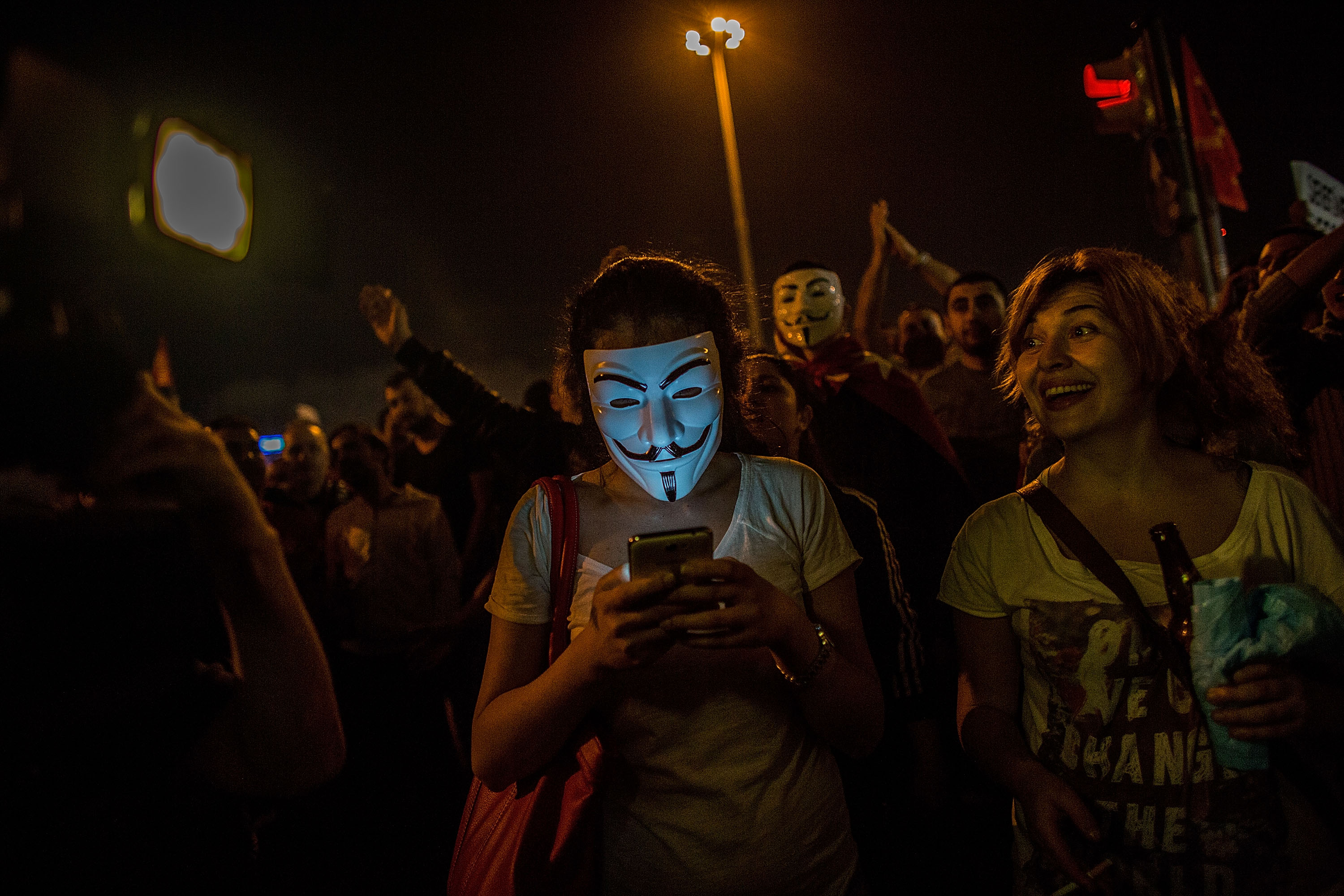
Unrest Continues In Turkey With Anti Government Protests

Thousands of demonstrators attend the demonstration in Taksim Square on the ninth day of the nationwide protests on June 8, 2013 in Istanbul, Turkey. Istanbul has seen protests rage on for more than a week, with two protesters and one police officer killed. Initially a protest over the fate of Taksim Gezi Park it has broadened into anger over what has been seen as a heavy-handed response of the police and Prime Minister Recep Tayyip Erdogan and his government’s increasingly authoritarian agenda. By Lam Yik Fei/Getty Images.

Enter The Leaker

“I understand that I will be made to suffer for my actions … I will be satisfied if the federation of secret law, unequal pardon and irresistible executive powers that rule the world that I love are revealed even for an instant,” – Edward Snowden, the leaker of the NSA surveillance program. Video interview with Glenn Greenwald here.

Some helpful perspective (polling in April of this year) as to the broader impact of these revelations:

Only 20 percent of people said they believed the government had gone too far in restricting civil liberties in the fight against terrorism, while 26 percent said it had not gone far enough and 49 percent said the balance was about right. In 2011, the share of those worried about losing civil liberties (25 percent) was larger than that favoring more intrusive government approach (17 percent).

Mulling this over as the facts have come in, I remain underwhelmed. Big Data is a core tool for terror prevention and is less dangerous, it seems to me, than many other counter-terrorist programs (like occupying foreign countries, killing people with drones, etc.). Of course, you may believe that we need to end counter-terrorism altogether, because it is a hyped and over-blown threat. But say that in that case – and make the argument that we will be better off without this kind of data-gathering being allowed, and safer. Or that our freedom is worth a few terror incidents.

I’m sympathetic to the latter point of view (see Imaginationland). But then I’m not the president of a country targeted by such religious mass murderers. But what seems inescapable to me are two related things: this data is out there, and the private sector has it. It’s the first real data of its kind to be seeking computer algorithms, not necessarily content of phone conversations. It works, which is partly how Obama got re-elected. And any system of such surveillance is inherently much easier to expose than ever before. There are more Edward Snowdens out there. And they have real power – just a different and asymmetric kind. In the end, the potential for disruption is as great as the potential for knowledge.

What’s Cool About Classical

Mary Sydnor makes the case for opening up to classical music:

Many people shy away from classical music the same way they do fine art or quality wine. It seems an art form that you need to know something about in advance to enjoy it. I admit I have a hard time understanding this sentiment. To me, classical music is a simple experience — just sit back, listen, and take in your emotional response. Where, when appreciating abstract painting, for example, it helps to know painters were attempting to better depict reality by trading in traditional images for abstract, there’s no similar historical detail anyone really needs to enjoy any form of music.

She urges us to think about the variety found in classical music the same way we obsess about different covers of pop songs:

With most of our famous composers no longer around, it’s up to each orchestra and conductor to decide exactly how a piece is played. The differences between a performance of the same work by the New York Philharmonic as compared to the London Symphony Orchestra can be tantamount to Nirvana’s cover of “The Man Who Sold the World” versus David Bowie’s original.

Above is Poulenc’s Double Piano Concerto, which has been Sydnor’s “favorite piece of music since childhood.”

The Silent Mistreatment

David Berreby chronicles the plight of Sunnat, an Uzbek captured in Afghanistan at age 16 who was taken to Guantanamo Bay in 2002 – a situation made especially harrowing by his near total linguistic isolation:

Sunnat was, in many ways, simply unlucky. He spoke a language that was rare at Guantánamo. The camp had only six Uzbek speakers; none were housed near him. He was held for eight years not because he was dangerous but because no country, not even his native Uzbekistan, would accept him as a Guantánamo deportee. (The military was required to hold him until a nation agreed to take him.) In fact, his innocence isolated him further: once he was no longer deemed a threat, he ceased meeting with an Uzbek interpreter and an interrogator. Then he was denied materials to learn English or Arabic, because the detention center has a policy against helping the presumed-dangerous detainees communicate with one another.

Depriving a prisoner of linguistic company can be a strategy: it can increase a prisoner’s dependence on an interrogator, making him more likely to talk, or it can prevent prisoners from organizing resistance. More typically, cases like Sunnat’s are unfortunate consequences of policy and circumstance. Whatever the cause, Honigsberg argues in his paper, “Alone in a Sea of Voices: Recognizing a New Form of Isolation by Language Barriers, or Linguistic Isolation,” the psychological effects of solitary confinement through linguistic isolation are largely the same as those via lock and key: impaired impulse control, an inability to concentrate or think clearly, confusion, obsessive behaviors, paranoia, and even a state resembling catatonia. A growing body of evidence suggests that a few weeks of solitary confinement for a prisoner amounts to torture. “Isolation by language barriers,” Honigsberg writes, “should be recognized as a distinct human rights abuse.”

Quote For The Day

Dark Light

“Do we know what it means to be struck by grace? It does not mean that we suddenly believe that God exists, or that Jesus is the Saviour, or that the Bible contains the truth. To believe that something is, is almost contrary to the meaning of grace. Furthermore, grace does not mean simply that we are making progress in our moral self-control, in our fight against special faults, and in our relationships to men and to society. Moral progress may be a fruit of grace; but it is not grace itself, and it can even prevent us from receiving grace. For there is too often a graceless acceptance of Christian doctrines and a graceless battle against the structures of evil in our personalities. Such a graceless relation to God may lead us by necessity either to arrogance or to despair. It would be better to refuse God and the Christ and the Bible than to accept them without grace. For if we accept without grace, we do so in the state of separation, and can only succeed in deepening the separation. We cannot transform our lives, unless we allow them to be transformed by that stroke of grace. It happens; or it does not happen. And certainly it does not happen if we try to force it upon ourselves, just as it shall not happen so long as we think, in our self-complacency, that we have no need of it.

Grace strikes us when we are in great pain and restlessness. It strikes us when we walk through the dark valley of a meaningless and empty life. It strikes us when we feel that our separation is deeper than usual, because we have violated another life, a life which we loved, or from which we were estranged. It strikes us when our disgust for our own being, our indifference, our weakness, our hostility, and our lack of direction and composure have become intolerable to us. It strikes us when, year after year, the longed-for perfection of life does not appear, when the old compulsions reign within us as they have for decades, when despair destroys all joy and courage. Sometimes at that moment a wave of light breaks into our darkness, and it is as though a voice were saying: ‘You are accepted. You are accepted, accepted by that which is greater than you, and the name of which you do not know. Do not ask for the name now; perhaps you will find it later. Do not try to do anything now; perhaps later you will do much. Do not seek for anything; do not perform anything; do not intend anything. Simply accept the fact that you are accepted!’ If that happens to us, we experience grace. After such an experience we may not be better than before, and we may not believe more than before. But everything is transformed. In that moment, grace conquers sin, and reconciliation bridges the gulf of estrangement. And nothing is demanded of this experience, no religious or moral or intellectual presupposition, nothing but acceptance,” – Paul Tillich, The Shaking of the Foundations.

(Photo of Arizona’s Upper Antelope Canyon by Gautam Dogra)