Roy Vey

Last week, Avik Roy, a former Romney healthcare policy advisor, wrote a post titled, “Rate Shock: In California, Obamacare To Increase Individual Health Insurance Premiums By 64-146%.” The post was picked up by large parts of the Republican blogosphere and has racked up over 1.2 million views in under a week. One part of Roy’s piece:

If you’re a 25 year old male non-smoker, buying insurance for yourself, the cheapest plan on Obamacare’s exchanges is the catastrophic plan, which costs an average of $184 a month. (By “average,” I mean the median monthly premium across California’s 19 insurance rating regions.) The next cheapest plan, the “bronze” comprehensive plan, costs $205 a month. But in 2013, on eHealthInsurance.com, the median cost of the five cheapest plans was only $92.

In other words, for the typical 25-year-old male non-smoking Californian, Obamacare will drive premiums up by between 100 and 123 percent.

Ezra Klein did the same searches Roy did. He found a plan for $109:

Click to buy the plan and eventually you’ll have to answer pages and pages of questions about your health history. Ever had cancer? How about an ulcer? How about a headache? Do you feel sad when it rains? When it doesn’t rain? Is there a history of cardiovascular disease in your family? Have you ever known anyone who had the flu? The actual cost of the plan will depend on how you answer those questions.

According to HealthCare.gov, 14 percent of people who try to buy that plan are turned away outright. Another 12 percent are told they’ll have to pay more than $109. So a quarter of the people who try to buy this insurance product for $109 a month are told they can’t. Those are the people who need insurance most — they are sick, or were sick, or are likely to get sick. So, again, is $109 really the price of this plan?

Ezra writes that Roy is not “just comparing apples to oranges,” he is “comparing apples to oranges that the fruit guy may not even let you buy.” Cohn piles on so bad you want to look away:

Insurance bids from eHealthInsurance are for new customers only. Insurers who sell to individuals—that is, insurers who sell in the “non-group market”—frequently raise rates dramatically, and unpredictably, because a particular group of customers have become too expensive to insure. In other words, if you buy on eHealthInsurance, you might get a reasonable rate the first year, only to experience eye-popping increases a year or two later. That won’t happen on the exchanges, because, under Obamacare, insurers can’t charge different prices to new and existing customers.

Roy responds to his critics:

The key thing to remember is that back when Obamacare was being debated in Congress, Democrats claimed that it was right-wing nonsense that premiums would go up under Obamacare. “What we know for sure,” Obamacare architect Jonathan Gruber told Ezra Klein in 2009, “is that [the bill] will lower the cost of buying non-group health insurance.” For sure.

In 2009, was Ezra saying that it’s ok that premiums will double for the average person, because a minority of people will pre-existing conditions will benefit? No.

I think it’s an unfair comparison to take the cheapest insurance program for the healthiest young adults today and compare it to rates in a system which is legally barred from discriminating in that way. So far, the universal rates seem to be coming in under expectations. We’ll see. Maybe there was some flim-flam about there being no trade-offs in Obamacare, especially for the young and healthy, back in 2009. But the real argument will take place when this is actually implemented. And it certainly won’t be fairly resolved by cherry-picking the cheapest plans now for the healthiest individuals and comparing them with predicted future costs.

The Dish will have our own experiment in buying Obamacare for our staff next year. We’ll keep you posted on what we find.
Ask Fareed Zakaria Anything: What’s Up In Turkey?

In our first video from Fareed, he explains why he’s not worried about the ongoing protests:

Henri J. Barkey points out that the country’s only opposition party is a mess:

[T]he Republican People’s Party, [or CHP,] is a party in name only. It has proven incapable of appealing to voters, organizing itself to contest elections; and, most importantly, offering alternative policies to the AKP. Instead, it is in a state of constant turmoil as cadres fight for spoils that can at best be described as crumbs. The hapless state of the opposition propels the demonstrators: people have found out that they cannot count on the opposition to fight for their rights. Hence, the only outlet they have is the street.

He also notes Erdogan’s increasing insularity:

Having surrounded himself with yes-men (and yes, they are all men), he has become a victim of groupthink.

His advisors only reinforce what he has already decided to do. This is not to say that he is always wrong; some of his calls have been gutsy and courageous—and if he listened to his advisors, he would have never risked taking them. The attempt to end the Kurdish uprising is one such bold move.

… When he has found himself in a tight spot, his superb political instincts have always helped him escape or allow him to pivot. …  But the crisis-management skills he’s displayed [in response to these protests] have been abysmal. Rather than defusing the situation, his public pronouncements have further inflamed passions. By blaming foreigners—the most standard Turkish defense mechanism—he has diminished himself. What is particularly worrisome is that by any stretch of the imagination, this was not a major crisis that endangered the very existence of his party or rule or threatened the well being of the republic. It was all about a shopping mall. Erdogan has now suffered a deep and self-inflicted wound.

Steven A. Cook offers explanations for Erdogan’s appeal as well as his paranoia:

Even today, as the tear gas continues to fly, there is no question that Erdogan would win an election. It is hard to see how the moribund opposition can capitalize on Erdogan’s missteps, and although AKP supporters may be watching developments with consternation, they are not ditching their membership cards. This is because, consistent with Erdogan’s record as mayor of Istanbul, he has done many things as prime minister to make the lives of Turks appreciably better. Advances in transportation, health care, and economic opportunity are profoundly important to a growing middle class who returns the favor in the form of votes.

Still, Turkey is decidedly split. Erdogan governs one half the country — his supporters — and intimidates the other. His political lineage and personal background have instilled within him a certain amount of paranoia. Turkey’s Islamists, no matter how powerful they become, are always on the lookout for the next coup or round of repression. (In 1998, for example, Erdogan was jailed for reciting a poem that was allegedly a call to holy war against the Turkish state even though the author is one of the most important theorists in Turkish nationalist pantheon.) For the rising new political and business class that Erdogan represents, correcting the past wrongs of the Kemalist elite — which discriminated and repressed the two bogeymen of the Turkish politics, Kurds and Islamists — has been a priority. They have worked to accomplish it through both democratic and (more often recently) non-democratic means.

Fareed Zakaria GPS airs Sundays on CNN, as well as via podcast.  Zakaria is also an Editor-at-Large of TIME Magazine, a Washington Post columnist, and the author of The Post-American World, The Future of Freedom, and From Wealth to Power: The Unusual Origins of America’s World Role. Our Ask Anything archive is here. Our previous coverage of the protests in Turkey is here.

The Drug War Is A Civil Rights Issue

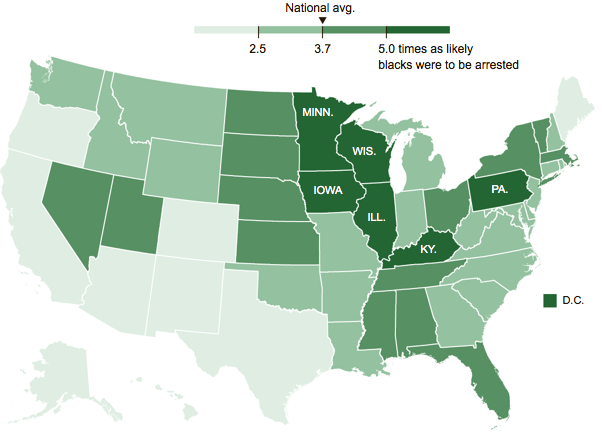
Memo to Mayor Bloomberg: a new ACLU report uncovers “staggering racial bias” in the enforcement of marijuana laws. Minorities are arrested at four times the rate of whites, and in some states, eight times higher, despite equal consumption of the drug. Mike Riggs focuses in on the report’s findings in rural areas:

It’s no secret that in big cities like D.C. and New York blacks are arrested for pot far more often than whites, despite comparable usage rates. But the ACLU is the first group to extrapolate arrest numbers across the country. … [In Morgan County, AL] blacks make up 12 percent of the population and 100 percent of the marijuana arrests.

Here’s the NYT map of the new racial profiling:

Screen shot 2013-06-04 at 11.42.30 AM

More here. Keith Humphreys points to the relative “whiteness” of regions that have loosened marijuana laws to explain why the racial disparity in arrests has worsened over the 10-year period examined in the study:

Why has the softening of marijuana enforcement in the past few years apparently not reduced the African-American arrest rate? The answer may lie in political economy. Until recently, support for legalizing/decriminalizing marijuana has been much higher among Whites among Blacks, which may help account for why enforcement softening spread where it did in the U.S. … [The disproportionately white populations in areas with legalization is] a marked pattern that has thus far meant that White marijuana users are being affected by softening enforcement more than are Black marijuana users. However, some cities with predominantly Black populations (e.g., St. Louis) have recently moved in the decriminalization direction, which may reduce the arrest rate among African-Americans in the coming years.

But not if Mayor Bloomberg has anything to do with it.

Divorce Goes Global

Bamiyan Shelter Cares For Battered Afghan Women

Wendy Paris finds that “the economic and ideological forces that contributed to the breakdown of the extended and the nuclear family model are spreading around the world”:

In Brazil, the divorce rate nearly doubled between 2010 and 2011, after laws changed to make it much easier to divorce. In China, parental control is weakening, arranged child marriages are ending, couples are clamoring for marriages based on romantic love—and the divorce rate is rising. The divorce rate in China doubled between 1990 and 2010; in Beijing, the Chinese divorce capital, it’s nearly 40%. (Caveat: These stats may reflect economic incentives unintentionally encouraging divorce, but still, more Chinese are leaving marriages or staying out of them.) In Japan, people are living together, marrying later and divorcing more often. While the divorce rate is still low compared to the US, it has nearly doubled since 1990.

Globalization is a double-edge cake knife when it comes to marriage. The spread of ideas can also strengthen marriage. As Islamic law has weakened in Egypt, the divorce rate dropped from 25% in 1963 to 14% in the late 1990s.

And I wonder how fulfilling and happy those marriages are – for the women. I believe in marriage – as a way to cement an important bond of mutual responsibility, to create a space to live in that is independent of government, to rear children as well as possible. But if it is merely a prison for women: obviously not-so-much, as Dan Savage and I discussed recently. What we’re seeing is less the decline of marriage than its actual, rather than abstract, remoralization – on the grounds of freedom, equality, communication and love.

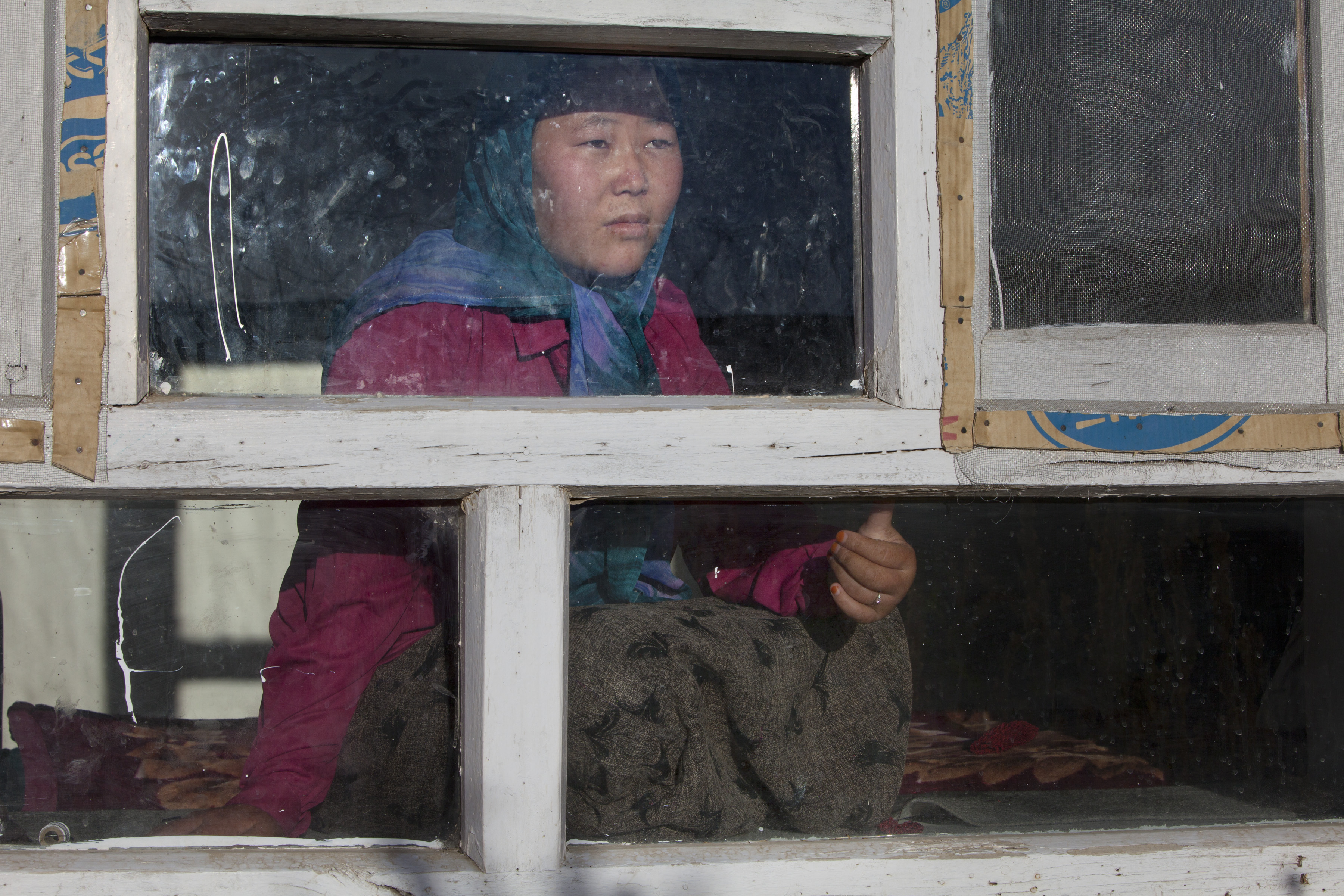
(Photo: A battered 28-year-old Hazara woman hides behind her veil at a women’s shelter October 8, 2010 in Bamiyan, Afghanistan. She came to the shelter after spending five months in prison. She was attempting to divorce her 50-year-old husband. There are 7-10 women currently living at the secret safe house. Until women’s shelters were started, something that was unknown here before 2003, a woman in an abusive marriage usually had no one to go to for protection. The problems many battered and abused women are confronting are deeply ingrained in a culture that has mainly been governed by tribal law. By Paula Bronstein/Getty Images.)

They Died For … China? Ctd

Max Fisher puts a positive spin on China’s interest in Iraq’s oil:

As I’ve written before, China’s increasing investment in foreign markets is actually great news for the U.S., which is finding it harder and harder to be the world’s policeman. Although this sometimes gets portrayed as scary resource competition, it’s also forcing China to act less like a free-rider on a U.S.-enforced international system and more like a responsible stakeholder in global peace and stability. Iraq in particular badly needs outside aid and attention to keep its political system and economy together. The more money and interest China has tied up a stable Iraq, the harder it will work to keep it that way – something that very much benefits the U.S.

My thoughts here. As I said, one good benefit for us is lower oil prices. But, as I’m sure Max would agree, the imbalance between this benefit and the cost in life and treasure remains staggering.

The Manning Effect

As Bradley Manning’s trial begins at Fort Meade, Eli Lake credits him with changing the face of the war on terrorism:

Some commentators have credited Manning’s leak with providing a spark for the revolutions that toppled the governments of Egypt and Tunisia and triggered uprisings in Bahrain, Libya, and Yemen, collectively known as the Arab Spring. Files leaked by Manning disclosed a secret relationship between the U.S. government and President Ali Abdullah Saleh of Yemen, to allow drone strikes inside the country where the United States was not in a declared war. Another cable detailed the private investments and holdings of the Tunisian ruling family. …

“WikiLeaks was an enormous wakeup call for the government,” said Lucy Dalglish, the dean of the University of Maryland’s college of journalism. In the past, she said, reporters from the mainstream media who obtained classified information would negotiate the details they would publish with senior government officials. Manning, she said, “uploads it to an anonymous site and it goes around the world almost instantly. They see that and say, ‘Oh my God, we are screwed.’”

Susan Armitage describes the difficulties of covering the Manning trial:

While the trial is open to the public, journalists covering the pretrial hearings have been frustrated by the military judge’s refusal to release court documents, including the written rulings and a transcript of the proceedings. Through a crowdfunding campaign, Freedom of the Press Foundation raised nearly $60,000 to hire professional court stenographers to create a public transcript, but the stenographers were denied press passes, the foundation announced Saturday.

Function Over Form?

Sam Sacks searches for the definition of classic American literature:

In “Democracy in America,” de Tocqueville observed that Americans esteemed the arts and sciences more for their practical applications than for their abstract value—hence the popularity of newspapers, religious treatises, and self-help books. Reading itself was not done for the purposes of something as perversely theoretical as enlarging one’s soul; it needed to have some tangible function in the here and now: “Democratic nations may amuse themselves for a while with considering the productions of nature; but they are excited in reality only by a survey of themselves.”

A look through the Classics section of bookstores—in America or any of the Western democracies—bears out de Tocqueville’s instincts. The offerings are wide-ranging, tilting toward diversity and inclusion. But, more to the point, artistic brilliance is no longer the most important determining factor. What makes a classic today is cultural significance. Authors are anointed not because they are great (although many of them are) but because they are important.

In other words, the current criteria for classics are more a matter of sociology than of aesthetics.

Chart Of The Day

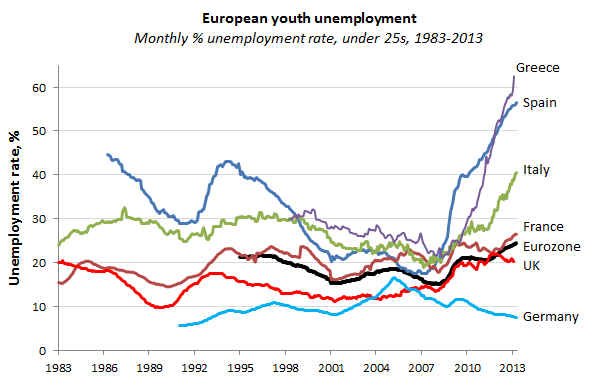
James Plunket passes along what he calls “the scariest chart in the world right now”:

European Youth Unemployment

Derek Thompson comments:

Youth unemployment is bad for all the obvious reasons, including the big loss to future productivity and earnings. But Europe’s youth unemployment is strange, because we’ve never seen a generation *this educated* also be this unemployed. Nearly 40 percent of Spain’s 20-and early-30-somethings are college educated. In Greece, it’s 30 percent. Europe’s crisis — clearly worsened by its austerity obsession — is an absurd waste of the most educated generation in the continent’s history.

Where The Childrens’ Books Aren’t

France, apparently. At least not good ones:

At their worst, French children’s stories are moralistic and heavy-handed, and even at their best, they are often old-fashioned. Many employ the passé simple, a tense too formal for speech, and the type is frequently very small. Engaging narrative tends to be sacrificed to the visual aspect, as though books were purely vehicles for illustrators. In short, French children’s books seem aimed more at adults than children.

Some reasons for the disparity:

“The aim of French books”, says Gilliane Quinn, a Paris-based Irish mother of bilingual children, “is often to get across a moral or an educational perspective. The stories don’t usually have a happy ending like English ones do. Chapters of ‘Les Malheurs de Sophie’, for example [Victorian tales of a little girl’s mischief, published 1858], always end horrifically, with the mother dying, the boat sinking, the horrible stepmother or the child being beaten as punishment for a prank. English or American stories wouldn’t leave their audience in such emotional despair, and yet ‘Les Malheurs’ are one of the big successes of French literature.” An American edition of “Babar”, incidentally, omits the opening scene, in which young Babar’s mother is gruesomely killed by poachers…

As for the lack of fun in the writing, could it be that French, with many words ending in a silent “e”, and a relatively small vocabulary (it is said to contain a fifth as many words as English), is less conducive to rhyme and puns and onomatopoeia?