My take here.
The Nearly Nuclear Summer
It turns out the US and USSR came closer to nuclear conflict than previously thought, according to freshly declassified documents detailing a set of American war games called “Autumn Forge,” launched 30 years ago:
A total of 40,000 U.S. and NATO troops were moved across Western Europe, while 16,044 more U.S. troops were airlifted overseas in 170 missions conducted in radio silence. More ominously, U.S. and NATO officers practiced the procedures they would have to follow to authorize and conduct nuclear strikes in an unpublicized exercise called Able Archer 83, shifting their headquarters as the game escalated toward chemical and nuclear warfare. In communications, they several times referred to non-nuclear B-52 sorties as nuclear “strikes” — slips of the tongue that could have been intercepted by Soviet eavesdroppers. …
Even if his intelligence advisers were sanguine, Reagan himself was worried after the exercise that the Soviets genuinely feared the U.S. was preparing to commit nuclear aggression, writing at one point in his diaries that “I feel the Soviets are so defense minded, so paranoid about being attacked that without being in any way soft on them we ought to tell them that no one here has any intention of doing anything like that. What the h–l have they got that anyone would want.”
I love that last line. The same could be said of Iran. But Reagan’s Republicanism has long gone, replaced by militarism and paranoia.
Making Your Biological Clock Tick Louder
Aviva Shen criticizes a new British ad campaign for deciding that “the solution to the trend of women waiting longer to have children is to criticize them, prey on their fears of aging, and exploit social disgust for even moderately sexual old women”:
The average British woman bears her first child at age 30, 5 years later than American women.
In the name of “provok[ing] a debate about how old is too old to have a baby,” First Response Get Britain Fertile had make-up artists transform 45-year-old British TV presenter Kate Garraway into a cartoonishly ancient-looking pregnant woman.
Yet even as First Response claims there is a lack of awareness about the female biological clock, they tout a survey by YouGov finding 70 percent of British women believe having a baby in her 40s would be too old. Women were also quite clear about their motives to wait: two-fifths said they would delay having a child until they have financial stability, while over a third said the cost of childcare is a deterrent. Another third said they would wait until they found the right partner.
Jessica Grose is no fan of the ad, but she sees reason to encourage discussion of fertility:
[T]here has to be a way to have an honest conversation about how fertility declines with age—and about what having difficulty conceiving feels like—without claims that we’re “shaming” women or ad campaigns that are designed to scare women with images of pregnant old hags. If women don’t want to have kids, that’s great! They should not have them or be made to feel bad for not having them. But when 70 percent of women say they do want kids, and more and more are having them later and later, I don’t see anything wrong with arming them with facts.
A study (pdf) from a couple years ago tested women’s knowledge of fertility. One highlight:
Nearly half (47%) of women participating in the survey correctly recognize that 10–29% of all couples are infertile. However, approximately 9 out of 10 women do not realize that more than 7 out of 10 couples in which the woman is over 40 experience fertility problems.
New Dish, New Media Update
A reader writes:
As a Dish addict, I’m biased. But I’m stunned that you still need to send out the occasional call to action for new subscribers. This post from over the weekend managed to sum up in a throwaway sentence why the Dish is required reading – and it wasn’t even from the entry itself. The delight I experienced seeing there at the bottom, with understated charm: “Previous Dish on the nexus of scholarship and heavy metal here.” If that sentence’s existence isn’t worth $20 (I’m on the “fuck the penny!” side of that reader thread), then we’re all doomed.
I’m usually a doomster myself, but I remain doggedly hopeful about the Dish model. 26,422 of you are now subscribers, which makes us, I think, the most successful subscriber-only purely-online site on the web. More encouraging, there are another 22,000 of you who have already shown you’re true Dishheads, by clicking through the maximum number of free read-ons, but who haven’t yet taken the plunge.
Without you, we’ll have trouble surviving and growing. With all of you, for just $1.99 a month, we’d be financially secure for the indefinite future – an amazing feat without advertizing or corporate subsidies. So please, if you’ve been procrastinating, [tinypass_offer text=”take a moment now”] and take out your credit card and help [tinypass_offer text=”brighten the future”] for independent online media. It takes [tinypass_offer text=”two minutes max”]. Click [tinypass_offer text=”here”].
On the bright side, we have just seen a big up-tick in the percentage of people signing up after hitting the meter. It started over the weekend, with much lower traffic but much higher response rates:
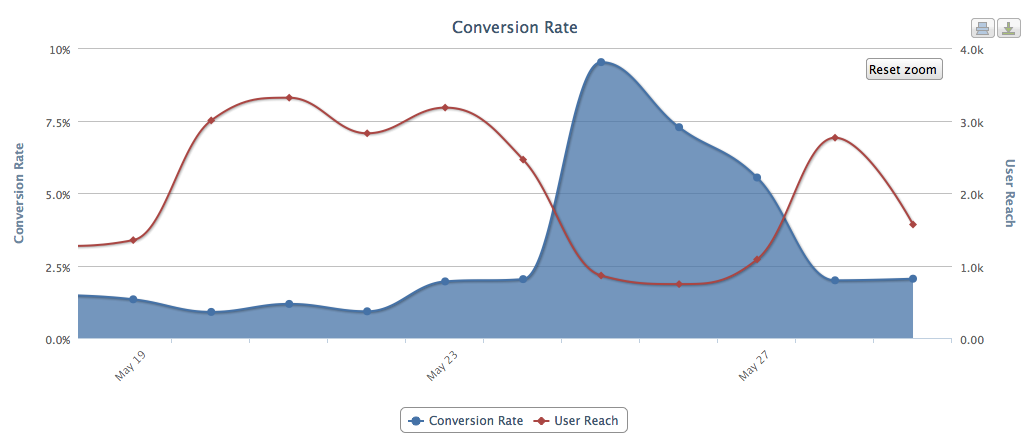
Maybe it’s easier to pay when you’re at home and not rushed at work. Either way, we’re grateful. To continue with full transparency, revenue has slowed but remains reasonably steady, and we’re inching very close toward $700,000 gross revenue (we’re around $696K as of today), with our goal of $900,000 by December 31 looking less likely, given the slowing of the pace.

Another financially strapped reader makes the case for you:
I just subscribed to the Dish for $2.68. It’s the price I pay for coffee every day. I will abstain one day each month to support this innovation.
A few more readers sound off (with a non-metered readon below, so nonsubscribers can go ahead and click without it counting towards your limit):
I’m an avid reader of the Dish and just happily subscribed. But I thought you might be interested in why it took me so long to pay up. My reason is quite mundane, but it may reveal something about the decision-making process other yet-to-subscribe readers are going through.
Years ago I stopped carrying my wallet in my back pocket. Instead, I stick it in the inside pocket of my suit jacket. When I get to work, I hang my jacket up on the back of my office door. Therefore, when I’m sitting at my desk and using my computer I don’t have ready access to my wallet. To get my credit card (since I don’t have a PayPal account), I have to get up and get my wallet. That simple detour away from whatever I’m doing at my desk has been enough to delay my subscription to the Dish.
Today I dressed casual. I didn’t wear a jacket. My wallet was in my back pocket. When I had some time to check out my favorite blogs, it was easy to pull out my wallet and subscribe to the Dish.
Personally, I think my excuse for failing to subscribe sooner is a sad example of human laziness. But I wonder how many other folks have similar reasons for not yet subscribing.
Another:
Longtime reader, never subscribed. Here’s what would get me to subscribe: a digest that never climbed above some fixed number of posts per day – maybe the top ten or twenty. Over time, reading the Dish has become more and more work. A recent business trip underscored this. After two days offline, my RSS feed had two unread posts from Coates, maybe eighteen from Yglesias, and 162 for the Dish. Historically I’ve been a Dish completist, but I can’t persuade myself that an hour frantically skimming those 162 posts (or three hours reading them properly) is a good use of my time.
Please understand I’m writing this from a place of deep admiration for your work. If I didn’t value the Dish, I would happily drop it, instead of agonizing. But honestly, trying to read every post eats into my day. Sampling a random 40% or 20% is no good – what if I’m missing the good stuff? So yeah, even though I don’t pay for the rest of my media diet, I’d easily throw you $20 per year in exchange for some curation, and a feed that only pinged maybe once an hour.
I hope you all will consider this. If you do, I hope you’ll reply to this email, because I’m pondering a Dish fast. And notwithstanding all of the above, thanks for your work.
What we’re going to do is replace the Daily Wrap with my own quick digest of the best posts of the day. We hope that helps.
The Once National Security Party
The GOP keeps demonstrating it’s ready for government:
Best wishes to @senjohnmccain in Syria today. If he doesn’t make it back calling dibs on his office.
— Lindsey Graham (@GrahamBlog) May 27, 2013
Ask Dan Savage Anything
Dan Savage needs little introduction to Dish readers, but here is his Wiki page to peruse. Dan just came out with a new book yesterday, American Savage: Insights, Slights, and Fights on Faith, Sex, Love, and Politics. From a recent interview with Logan Lynn:
Savage: Well, the book is about marriage and family, and is a bit more political. I talk about healthcare and Obamacare, gun control, sex education…it originally started out as just a collection of essays, things I had written other places, just bringing things I had written over the last decade together. Then I started revising them and reworking them. Originally the book was going to be 80% old stuff and 20% new stuff, and now it’s 90% new stuff. There’s basically nothing in there that isn’t reworked or brand new. There is a big chapter about marriage, and where we are at right now…and that’s been changing so rapidly, I want the book to come out ASAP. I wrote about adopting, about becoming parents, about Terry and I getting married; and this book has essays about life and memoir-y stuff about my mother’s death, about my son, now 15, coming out to us as straight when he was 12, which was kind-of bizarro hilarious…
Lynn: Alternate universe!
Savage: Yeah, like, how we were so careful all his life to let him know we loved him whoever he was, and yet somehow still he thought we were going to be disappointed that he wasn’t gay. It really broke my heart. So, I touch on all of that stuff. There’s some humor and comedy in the book as well. I wrote a play – a short play – that’s in the book about Jesus and the huge asshole, which is Jesus talking to a fundamentalist Christian who opposes healthcare reform. I think people will enjoy it.
To submit a question for Dan, simply enter it into the Urtak survey after answering all of the existing questions (ignore the “YES or NO question” aspect and simply enter any open-ended question). To vote, click “Yes” if you have a strong interest in seeing Dan answer the question or “No” if you don’t particularly care.
Planning For Yet Another War?

Cue the Jaws soundtrack. Josh Rogin reports that the administration has asked the Pentagon to draw up plans for a no-fly zone in Syria:
President Obama’s dual-track strategy of continuing to pursue a political solution to the two-year-old uprising in Syria while also preparing for more direct U.S. military involvement includes authorizing the Joint Chiefs of Staff for the first time to plan for multilateral military actions inside Syria, the two officials said. They added that no decisions on actually using force have yet been made.
“The White House is still in contemplation mode but the planning is moving forward and it’s more advanced than it’s ever been,” one administration official told The Daily Beast. “All this effort to pressure the regime is part of the overall effort to find a political solution, but what happens if Geneva fails? It’s only prudent to plan for other options.”
In an update to the story, a Pentagon spokesman claims that there “is no new planning effort underway” and that the “Joint Staff, along with the relevant combatant commanders, continue to conduct prudent planning for a range of possible military options.” Friedersdorf cuts through the pro-war jargon:
The article also quotes Robert Zarate, policy director at the Foreign Policy Initiative, a hawkish organization. His euphemisms of choice: “No doubt, the United States and its like-minded allies and partners are fully capable, without the use of ground troops, of obviating the Assad regime’s degraded, fixed, and mobile air defenses and suppressing the regime’s use of airpower.”
Does anyone think he’d describe Syrian planes bombing a U.S. aircraft carrier as “obviating” our naval assets? The question before us is whether America should wage war in Syria by bombing its weapons, maintaining a presence in its airspace, and shooting at its pilots if they take off. On hearing the phrase “no-fly-zone,” how many Americans would realize all that is involved?
I trust “start a war against Syria” would poll poorly.
Which is why we must be careful that this does not get rushed, especially after the Libya debacle. And yes: debacle. Here’s the actual Benghazi story Republicans are uninterested in, for some reason:
Attacks on police stations and patrols have become frequent in the city, which has been the scene of power struggles among armed Islamist factions.
There’s also a classic power vacuum, as the Libyan parliament bars anyone who was part of the former regime from governing, forcing the resignation of chairman of the Libyan General National Congress. It reminds me of the great error of de-Baathification in post-Saddam Iraq. Allahpundit suspects a no-fly zone (NFZ) over Syria won’t happen:
The only way a (NFZ) will play politically for Obama with American voters is if it’s the same sort of turkey shoot that the Libyan NFZ was — which it won’t be. McCain told the Daily Beast that a realistic plan for a no-fly zone “would include hundreds of planes, and would be most effective if it included destroying Syrian airplanes on runways.” It’d be a huge, aggressive operation, and the presence of those Russian missiles means it might not be without casualties.
I’d say the two most important imperatives for the Obama administration in the next three years are negative ones: not getting involved in wars in Syria or Iran. The more energy-independent we become, the easier it will be to leave this region to its own demons.
(Photo: Men search for their relatives amongst the bodies of Syrian civilians executed and dumped in the Quweiq river, in the grounds of the courtyard of the Yarmouk School, in the Bustan al-Qasr district of Aleppo on January 30, 2013. By J M Lopez/AFP/Getty Images)
Will The Race & IQ Debate Ever Be Resolved?
After digging into the literature on race and genetics, Ta-Nehisi interviews geneticist Neil Risch about race, IQ and other genetics issues. There’s a lot of good stuff TNC has unearthed – among them these papers: “The Importance of Race and Ethnic Background in Biomedical Research” and “Assessing Genetic Contributions to Phenotypic Differences Among ‘Racial’ and ‘Ethnic’ Groups“. Have at them. Here’s the final question and answer:
Your paper on assessing genetic contributions to phenotype, seemed skeptical that we would ever tease out a group-wide genetic component when looking at things like cognitive skills or personality disposition. Am I reading that right? Are “intelligence” and “disposition” just too complicated?
Joanna Mountain and I tried to explain this in our Nature Genetics paper on group differences. It is very challenging to assign causes to group differences. As far as genetics goes, if you have identified a particular gene which clearly influences a trait, and the frequency of that gene differs between populations, that would be pretty good evidence. But traits like “intelligence” or other behaviors (at least in the normal range), to the extent they are genetic, are “polygenic.” That means no single genes have large effects — there are many genes involved, each with a very small effect. Such gene effects are difficult if not impossible to find. The problem in assessing group differences is the confounding between genetic and social/cultural factors. If you had individuals who are genetically one thing but socially another, you might be able to tease it apart, but that is generally not the case.
In our paper, we tried to show that a trait can appear to have high “genetic heritability” in any particular population, but the explanation for a group difference for that trait could be either entirely genetic or entirely environmental or some combination in between.
So, in my view, at this point, any comment about the etiology of group differences, for “intelligence” or anything else, in the absence of specific identified genes (or environmental factors, for that matter), is speculation.
I note that Risch says that “traits like ‘intelligence’ or other behaviors (at least in the normal range), to the extent they are genetic, are ‘polygenic.'” That has to be true. The answer to this question is likely to be extremely complicated – rather like the impact of genetics and environment in the persistent phenomenon of homosexuality. But what if the normal range is where we shouldn’t look for insight. The major ongoing Chinese experiment to find the genetics of intelligence is focusing on extremely high IQ individuals – to see how their DNA is different than the rest of us. Razib praises TNC’s interview. But he thinks that the race, IQ and genetics question “will semi-resolve within the next 10 years”:
Let’s focus on the black-white case in the American context. On intelligence tests the average black American scores a bit less than 1 standard deviation below the average white American. As I’ve observed before the average black American is ~20% European, but there is variation around this value. Because the admixture is relatively recent (median ~150 years before the present) there is a wide range across the population of ancestry. In fact, the admixture is recent enough that siblings may even differ in the amount of European ancestry on a genomic level. An additional issue which is of relevance is that the correlation between ancestry and physical appearance in mixed populations is modest. By this, I mean that there are many individuals who are more European in ancestry in the African American population who have darker skins and more African features than those who have less European ancestry. Obviously on average more European ancestry predicts a more European appearance, but this is true only on average. There are many exceptions to this trend.
At this point many of you should have anticipated where I’m going. If the gap between blacks and whites on psychometric tests is totally driven by genetic differences between Africans and Europeans, then the gap should be obvious between pools of individuals of varying levels of European ancestry within the African American population. It seems unlikely that it would be that simple (i.e., all driven by genes without any sensitivity to environmental inputs or context). Therefore I suspect some design where you compare siblings would be more informative.
I cannot predict scientific findings. But I hope we make empirical progress, with less political drama. The main threat to that, of course, is the political stigmatization of such research. Which is why Jason Richwine’s sweeping political inferences from decent empirical work was actually self-defeating.
No Splooge On A Dress, To Start With
Garance Franke-Ruta compares Obama’s bureaucratic scandals to Clinton’s rivetingly human ones:
The main difference is this: In contrast to the highly personal nature of the Clinton scandals, none of the so-called Obama scandals involve direct actions by the president or his wife, let alone their romantic or financial dealings before or during their time in office. Instead, the controversies swirling around the administration all involve the conduct of individuals within the federal government overseen by Obama as the head of the executive branch.
Well: duh. Meanwhile, Charles Franklin rightly recommends patience when assessing the impact of recent events on Obama’s approval numbers:
In the rush to find instant effects of events, we look at data before there is enough evidence. But more important, the enduring political impact of events, if there are any, are not usually things we see in a week or even two but rather shifts in trends that set approval on a new trajectory, whether up or down. Rare events, such as the killing of bin Laden do produce almost immediate jumps in approval, but those events usually prove fleeting and the trend rapidly returns to its previous track. The real test of the impact of events over the past two weeks will come in six months when we can look back and see if May 8 represented a turning point after which the trend in approval shifted, either up or down, with lasting consequences. Such enduring shifts are the events that reshape presidencies, not short term bounces.
I agree. And, of course, we cannot know if there’s something more there than has yet to meet the eye. But the critical issue will also be the economy – which buoyed Clinton in his darkest hours – and the failure or success of the GOP in actually proposing some solutions to some pressing problems that can actually stand a chance of getting done. In other words, it’s not just Obama and the “scandals”. It’s the general political climate that could make these grow in intensity or peter out.
Just How Gay Are The Boy Scouts?
YouGov finds that a majority of the public agrees with the Boy Scouts’ new policy of accepting gay troops but banning gay troop leaders:
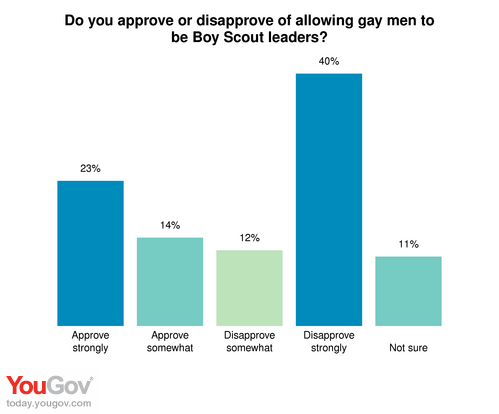
I suspect the issue has been clouded by the impact of the sexual abuse crisis in the Catholic church and understandably greater nervousness about allowing boys to be supervised by grown men away from their parents. But although that’s understandable, it’s irrational. Openly gay scoutmasters are far less likely to abuse boys than closet case “bachelors” – because they are more emotionally and sexually adjusted. And closet-case “bachelors” will remain in the Scouts, while the less damaged ones are purged.
This is not to say that all closet-case bachelors are would-be molesters (many have, for decades, channeled their repressed sexuality into completely ethical and moral leadership for boys, including the Boy Scouts founder, Robert Baden Powell, who is now widely regarded as bisexual, if not gay). He had a decades-long deep friendship with another man he referred to as “The Boy”:
“The available evidence points inexorably to the conclusion that Baden-Powell was a repressed homosexual,” Tim Jeal wrote in The Boy-Man: The Life of Lord Baden Powell. (Long out of print and available only used, Jeal’s book is now also available as Baden-Powell). And Jeal should know; he is a well-respected British biographer and novelist whose work about David Livingstone was chosen when it was published as one of the best books of the year by editors at the New York Times and The Washington Post.
From the very beginning of the Scouts in Britain, their reputation as a homophilic organization was very real:
In Evelyn Waugh’s novel Brideshead Revisited, Lord Sebastian Flyte turns the pages of the News of the
World and sighs, “Another naughty Scoutmaster.” This was 1923, only a few years after the Boy Scouts had been created, but they had already become a source of indelicate mirth… He was obsessed with boys and “boyology.”
The index of Tim Jeal’s excellent biography Baden-Powell speaks of his “aesthetic and sexual interest in men,” “pre-marital celibacy,” “dreams of young men,” and “anxieties over sexuality.” He got married, at 55, to (as Jeal put it) “a sporting girl whose interest in outdoor comradeship seemed at least as great as her desire for sexual fulfillment,” and he even managed to beget three children. But thereafter he always slept out on his balcony (and this in the English climate) rather than in the marriage bed.
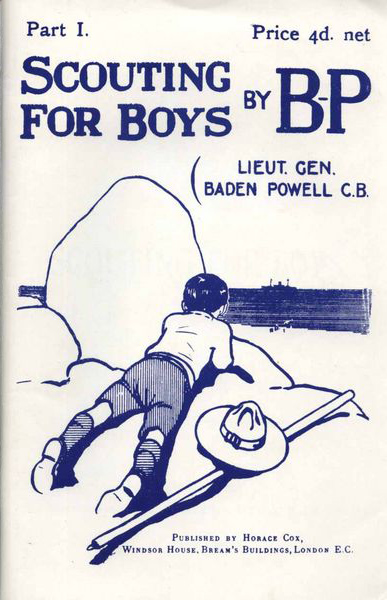
And don’t even ask about his dreams (just look at the drawing on the first cover of “Scouting For Boys”). It’s a fantastic irony that in today’s boy scouts, the very founder of the organization would be deeply suspect.

