When Freedom Threatens Social Stability

George Packer enumerates a long list of “technological advances that make life easier, tastier, more entertaining, healthier, longer; and socio-political changes that have made the [United States] a more tolerant, inclusive place”:

The bottom line in all these improvements is freedom. In America, that’s half the game.

The flip side:

[W]hen the results are distributed as unequally as they are at this moment, when the gap between promise and reality grows so wide, when elites can fail repeatedly and never lose their perches of privilege while ordinary people can never work their way out of debt, equal opportunity becomes a dream. We measure inequality in numbers—quintiles, average and median incomes, percentages of national wealth, unemployment statistics, economic growth rates—but the damage it is doing to our national life today defies quantification. It is killing many Americans’ belief in the democratic promise—their faith that the game is fair, that everyone has a chance. That’s where things have unquestionably deteriorated over the past generation.

Samuel Goldman argues that social equality actually encourages economic inequality:

[I]t is hard for a society characterized by ethnic and cultural pluralism to generate the solidarity required for the redistribution of wealth. People are willing, on the whole, to pay high taxes and forgo luxuries to support those they see as like themselves. They are often unwilling to do so for those who look, sound, or act very differently. In this respect, the affirmations of choice and diversity that now characterize American culture, tend to undermine appeals to collective action or shared responsibility. If we’re all equal in our right to live own lives, why should we do much to help each other?

Which is where my libertarianism cedes to conservatism. At some point, freedom must be tempered if its impact undermines the very social contract that allows it to exist. The inequality we are experiencing as a function of globalization, technology, recession and a tax system so complex it beggars understanding is a real and direct threat to our social coherence and stability as a democratic society. It seems to me conservatives should be among the first to recognize this danger – as Bismarck and Disraeli once did – and forge a public policy to counter it.

This conservatism would embrace universal healthcare as a bulwark of democratic legitimacy in an age of such extremes; it should break up the banks and bring back Glass-Steagall; it should drastically simplify the tax code, ridding it of special interest deductions; it should construct an international agreement to prevent the egregious and disgusting tax avoidance of a company like Apple; and it should seek to invest and innovate in education and infrastructure.

Some of this inequality cannot be stopped, the globalizing forces behind it are so strong. But mitigating its damage is a real challenge. And conservatives who believe that we are one nation should rise to it.

Obama’s War On Terror Speech: Reax II

suspects1and2

From Jane Mayer’s write-up of Obama’s speech:

What kind of solution for indefinite detention can be arrived at, however, Obama left for later. It won’t be easy. As Joseph Margulies, clinical professor at Northwestern University Law School and lead counsel in the first Guantánamo case in the Supreme Court, noted, “The devil is in the details.” Obama’s speech has, at least, put the right questions on the table. Even Margulies, who has been critical of Obama for not doing more to close Guantánamo in the past, admitted he was “excited” by the speech. He said, “All the high-flying rhetoric about values and ‘who we are,’ and national identity is great.” But, he said, “Unless he follows up on it, it’ll all be for naught.” Much of the burden of moving forward, however, is not in Obama’s hands. Within minutes of his speech, conservatives on Capitol Hill had already begun jumping on him for having a “pre-9/11 mindset”—as if, somehow, the 9/11 mindset should last forever.

Daniel Klaidman reports on first steps the administration is taking:

So for many advocates of closing the detention facility, who Obama appoints inside the White House will be a key measure of his commitment [to closing Gitmo]. “The president has the authority to close Guantanamo,” says Thomas Wilner, a prominent Washington lawyer who has argued landmark cases at the Supreme Court on behalf of Gitmo detainees. “What he’s got to do is act and put the full authority of the White House behind getting the prison closed.”

Wilner and his allies may soon get some good news. A White House official confirmed to The Daily Beast that Obama has asked his chief counterterrorism adviser, Lisa Monaco, to handle the day-to-day responsibilities for Guantanamo. Monaco has daily access to the president and clout within the national-security bureaucracy. She also has deep experience dealing with the Guantanamo conundrum. When she first joined the administration in 2009 as a senior Justice Department official, she worked on Gitmo.

Fallows celebrates Obama’s call to wind down the War on Terror:

I am long on record in arguing that, even though America will continue to face threats and endure attacks including from Islamic-motivated extremists, it needs to move off the open-ended, permanent-war footing that was used to justify invasions and constraints on civil liberties. Yes, there will still be attacks, perhaps (I hope not) even as horrific as the recent one in London. But we do not let the tens of thousands of annual highways deaths justify banning cars; nor the toll of alcohol justify a new Prohibition; nor take an absolutist approach to a range of other risks, starting with guns. So too with “terror” risks. We cannot end them, but we don’t have to be driven mad by them.

Mary Ellen O’Connell was unsatisfied by Obama’s defense of the drone program:

The President attempted to defend drone use for several reasons other than legality. He said there are places where it is difficult, expensive, or dangerous to send special operations forces. Yet people everywhere know—as a matter of common sense and decency—that you cannot use military force because the police forces of a state are weak or because it is expensive or dangerous to send your own police or military to act under police rules. The reasons for this are already codified in international law.

Freddie deBoer wants more than words:

We have lived with this “war on terror” for a third of my life. And liberals: speeches do not walk the dog anymore. The time for flowery speeches is over. It’s time for action. Saying “we’re going to end the AUMF eventually” is not enough. Talking about closing Guantanamo is not enough. It has to actually happen. Like Anthony Romero of the ACLU says, actions are more important than words. If Obama actually closes Guantanamo, I promise I will applaud. If Obama actually reduces or ends the drone campaign, I will celebrate. But those specific policies will only be valuable if they are part of a broad attempt to end the hostilities between the United States and the Muslim world. Given that every Muslim terrorist who announces their motives says that they are based on our incursions into the Muslim world, that can only happen if we withdraw.

Yes and yes. My support yesterday for the arguments of the speech is, of course, contingent on actual progress. Friedersdorf is in the same ballpark:

All things considered, Thursday’s developments were an improvement on the status quo. Obama constrained himself rhetorically in ways he hadn’t before, expressed agreement with core civil libertarian critiques, and signalled that future policy will shift in that direction as a result. But talk is cheap, Obama has a history of breaking promises to civil libertarians, and drone strikes remain surrounded in enough secrecy that it will remain difficult to verify what’s going on. Moreover, policies implemented at the president’s prerogative can be changed on his determination too. There remains an urgent need for Congress to step into the breach and constrain the president, even if only in the ways that Obama says that he has constrained himself.

Agreed. But this Congress? Good luck. My thoughts here. Earlier reax here.

Being Master Of Your Own Domain, Ctd

Hugo Schwyzer considers another aspect of the debate over onanism:

Masturbation feels really good. It also can feel really icky, when conditioned feelings of guilt wash over the masturbator as he or she comes down from a post-orgasmic high. That shame may or not be rooted in religion, but it is certainly grounded in the idea that the fundamental sexual unit should always be more than one person. The persistence of that shame serves as a reminder that our culture war isn’t just about who we have sex with, but about why we have it in the first place. Is sex solely about connecting with one other person in intimate relationship, or is it about delighting in something that first and foremost, belongs to us as individuals?

I’d hazard the following ill-advised answer to that question: both, as a matter of pure realism (as that fantastic French video explains). But if sex is never attached to relationship, if it is merely an act rather than an interaction, it will wither eventually in ways not true of all solitary pleasures, and miss something essential about sex. As Malcolm Muggeridge once said in defense of lust: it’s all give-give-give. It suffers in some profound way when there is no one else to give it to.

Chart Of The Day

Screen shot 2013-05-24 at 11.49.14 AM

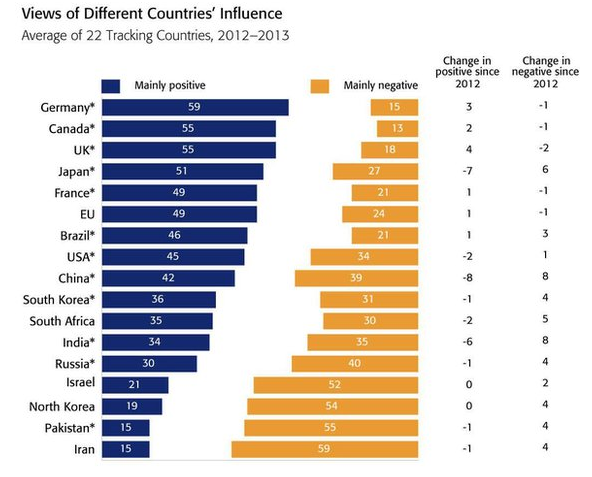
It’s the result of the latest annual Country Ratings Poll for the BBC World Service. Britain has been buoyed by the Olympics; China and India have sunk; Germany has also seen gains in approval, even in France! And then you notice the group of countries Greater Israel is now lumped in with: North Korea, Iran and Pakistan. Good going, Netanyahu! Just keep building those settlements.

Vive La Resistance

Chait profiles Josh Barro:

The brief arc of Barro’s young career—at National Review, then Forbes, and now Bloomberg View—displays a man losing all patience with the Republican Party. Over time, Barro’s writing has fitfully evolved from muted, oblique criticism to polite, persistent criticism to, finally, firm opposition. His alienation crystallized in a widely read post declaring Romney’s infamous “47 percent” video as fatally defining the Republican candidate. Now Barro writes things like “The party’s economic agenda, as embodied in the latest Ryan budget, is simply terrible for the vast majority of Americans.”

I recently sent Barro his 2010 article praising Ryan’s plan. After rereading it, he ticked off its flaws: He had filled in every ambiguity by assuming the best faith on Ryan’s part, while ignoring Ryan’s punishing cuts to Medicaid. The budgetary weaknesses he had identified, he had framed as problems that “need to be fixed,” whereas he now recognizes that Ryan is unwilling to do what’s needed to fix them (primarily, raise taxes).

Dissents Of The Day

US-POLITICS-OBAMA-COUNTERTERRORISM

A reader quotes the president yesterday:

When a U.S. citizen goes abroad to wage war against America – and is actively plotting to kill U.S. citizens; and when neither the United States, nor our partners are in a position to capture him before he carries out a plot – his citizenship should no more serve as a shield than a sniper shooting down on an innocent crowd should be protected from a swat team.

President Obama (and you) may feel that way, but the Constitution says otherwise.  There’s no “unless he’s a terrorist” exception anywhere in that document; if you’re a citizen, you’re entitled to due process.  If you and the president find the Constitution to be inconvenient, I suggest that you petition your respective representatives to Congress and ask them to amend it.  Due process isn’t a luxury; it’s the dividing line between being a nation of laws and a nation of presidential death squads.  We are better than this.

Give me a break. If you have joined up with an army of the enemy and are involved in the planning and execution of mass murder and intimidation of American citizens, and you cowardly choose to launch such attacks from a foreign country where you cannot easily be captured, you have forfeited the rule of law for the rules of war.

When you take up war against your own country, you are a traitor. When you do so on the battlefield itself, and join the enemy’s army, and declare war on your fellow citizens, there is no reason on earth why, after careful sifting of the evidence, the US president shouldn’t fight back by the same means you have chosen. And, look, there is no constitutional question here. Ex parte Quirin (1942) has established the constitutionality of defending this country from traitors who have joined the enemy’s army abroad. Most of the traitors captured in that case were sentenced to death by military commission, as authorized by the executive branch. They were executed outside the civilian justice system. Another reader:

You criticized George W. Bush harshly and appropriately for his suspension of habeas corpus of suspected terrorists (American or not) during his administration and in fact revisited that criticism during the South Carolina Republican Presidential debate when you said, sarcastically, referring to the Republicans,  “Habeas corpus is no big deal because presidents don’t abuse power. Unlike monarchs, I suppose. This is the party of restoring the Constitution?”  And yet, in a jaw dropping show of chutzpah, you defend Obama when he says referring to an American terrorist suspect, “his citizenship should no more serve as a shield than a sniper shooting down on an innocent crowd should be protected from a swat team.”

So in your warped sense of government, it’s unthinkable to imprison a person indefinitely without judicial review under presidential fiat but killing a U.S. citizen without judicial review under presidential fiat is just prudent policy. This from a person who is against the death penalty, for heaven’s sake.  Life imprisonment without judicial review sounds a lot better than getting killed via Hellfire missle.

I just want to know, what unconstitutional act would this president have do in order for you to criticize him?  By my figuring, a limited support role in Libya in violation of the War Power’s act will get some criticism from you but an out-and-out violation of the 5th Amendment that expressly limits the government’s power against its citizens gets support and lauding.  Unbelievable.

It would be if it were true. I have harshly criticized the failure to live up to the Geneva Conventions by initiating prosecutions of war criminals. I have criticized not releasing the Yemeni prisoners. I want GTMO bull-dozed. I have urged more caution on drone warfare. I have called for the release of even the 50 most dangerous suspected terrorists. But my reader tries to make a rhetorical point about a choice between detention without trial or murder by hellfire missile. Those are not the choices. If Awlaki were to turn himself in, he would be given proper due process and a civilian trial. But since he cannot be captured and brought to justice, and since he is at war, trying to kill American citizens, a commander-in-chief has a duty to fight back.

My readers seem to have no grasp of the concept of war, as opposed to peace, or a deliberately distant and unreachable battlefield in a foreign country, as opposed to a citizen at home. I wonder if the word “treason” has any meaning for them at all. They keep acting as if Awlaki is a suspected criminal in the US and just arbitrarily murdered by the government. It just baffles me that the actual context is just absent in their analyses. Another reader:

I’m afraid you’re missing a key point about what the president said in the speech. Drones are NOT about just Awlaki, even if I don’t share your own view on that matter (there’s a difference after all between a police sniper taking an in the moment judgment call and a the pre-meditated murder of an American citizen, however vile, by an executive without judicial oversight). In theory, the President’s case today could have been more convincing if what his administration has consistently done is actually identify targets ahead of time that are worthy of assassination. But by far the most controversial component of the drone program (morally to be sure) is the use of so-called ‘signature strikes’, which requires no prior identification of individuals being targeted.

That ridiculously low standard, coupled with the administration’s own past broad grouping of those who can be targeted (“The definition is a male between the ages of 20 and 40” as former Ambassador to Pakistan, Cameron Munter, said previously), makes any claims to self-policed rigor utterly fatuous.

That is a standard you simply would not have allowed for Bush. Why the crickets now? I say that knowing that you have criticized Obama for not clearing up drone usage before. Well, here was his chance. Where was the legal basis now? Setting up drones as an alternative to Bush’s wars or torture is a straw man, and nothing more.

It is only a straw man if you have no actual responsibility for the security of the country. And the president has clearly signaled a winding down and eventual end to the drone strikes. And he argued for a clearer and more transparent process. He went a great distance in addressing the real concerns of all of us about the endless war, and yet we still get this continued self-righteous obloquy on the man.

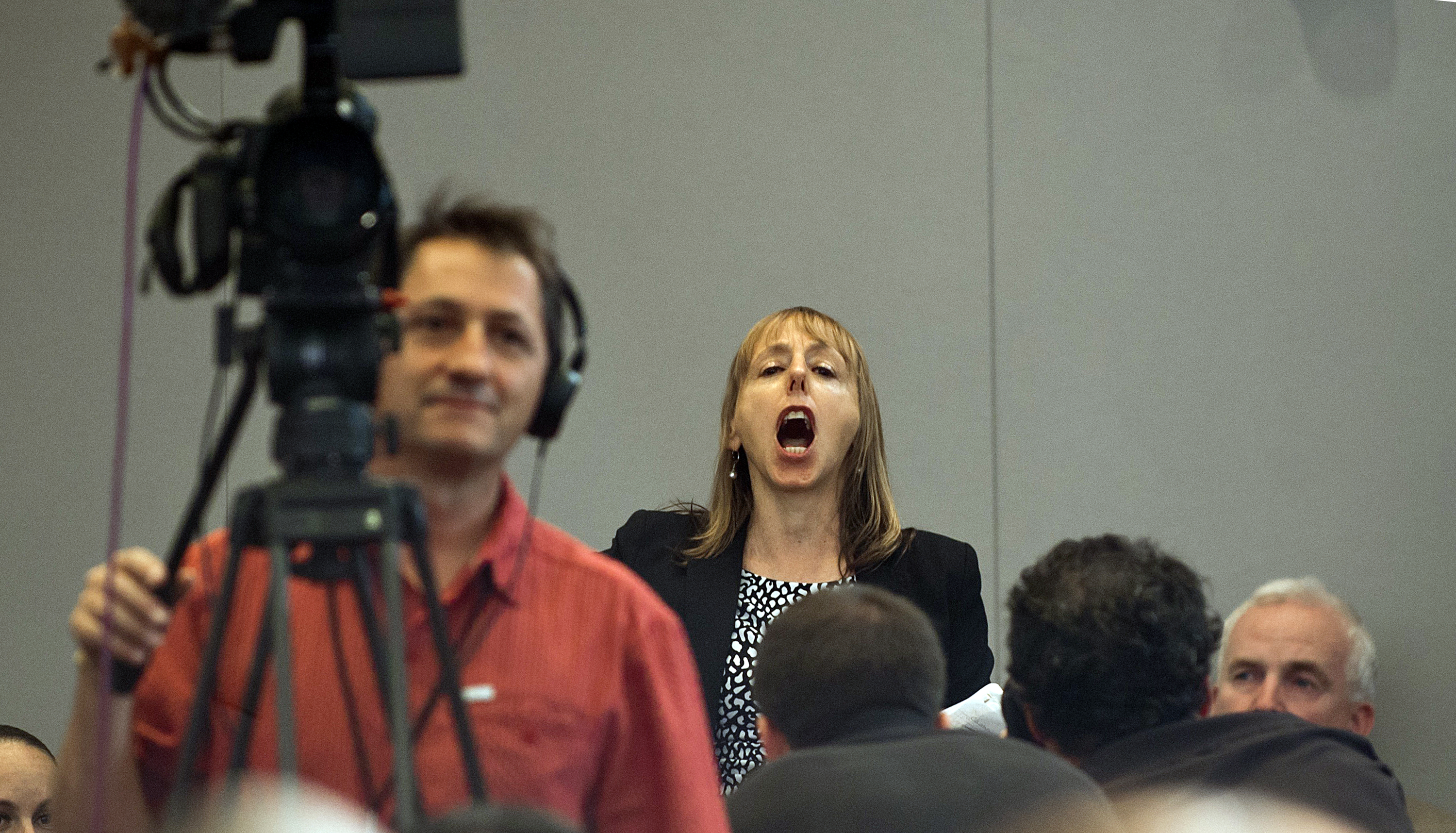
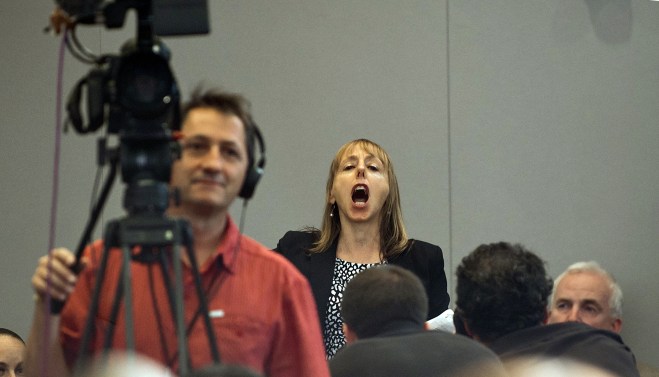
(Photo: Medea Benjamin, a protester and co-founder of Code Pink, shouts as US President Barack Obama speaks about his administration’s drone and counterterrorism policies, as well as the military prison at Guantanamo Bay, at the National Defense University in Washington, DC, May 23, 2013. By Saul Loeb/AFP/Getty Images)

Potbelly Pigs

Of a different variety:

Seattle-based [William] von Schneidau has been feeding marijuana scraps — leaves, stems, and root bulbs — to a stable of pigs. He’s a butcher in newly street-legal Washington; the weed feed comes from a medical marijuana co-op. Von Schneidau’s scheme is an of-the-moment novelty, allowing him to charge $120 for periodic Pot Pig Gig dinners. But he wants you to know: this isn’t about the money, or the PR avalanche (his story has gone semi-viral this week). Pot pigs are simply the latest iteration of his longtime passion — drawing connections between an animal’s diet and its meat. … Like blueberry quails, or the coveted acorn-fed pigs of Spain, von Schneidau believes meat’s flavor can be enhanced through a guided diet. Pot is the most recent of his off-template pig food, which has included spent vodka stillage, microbrew grains, and cantaloupes.

Unfortunately for the pigs, “eating raw marijuana doesn’t give mammals a high.”