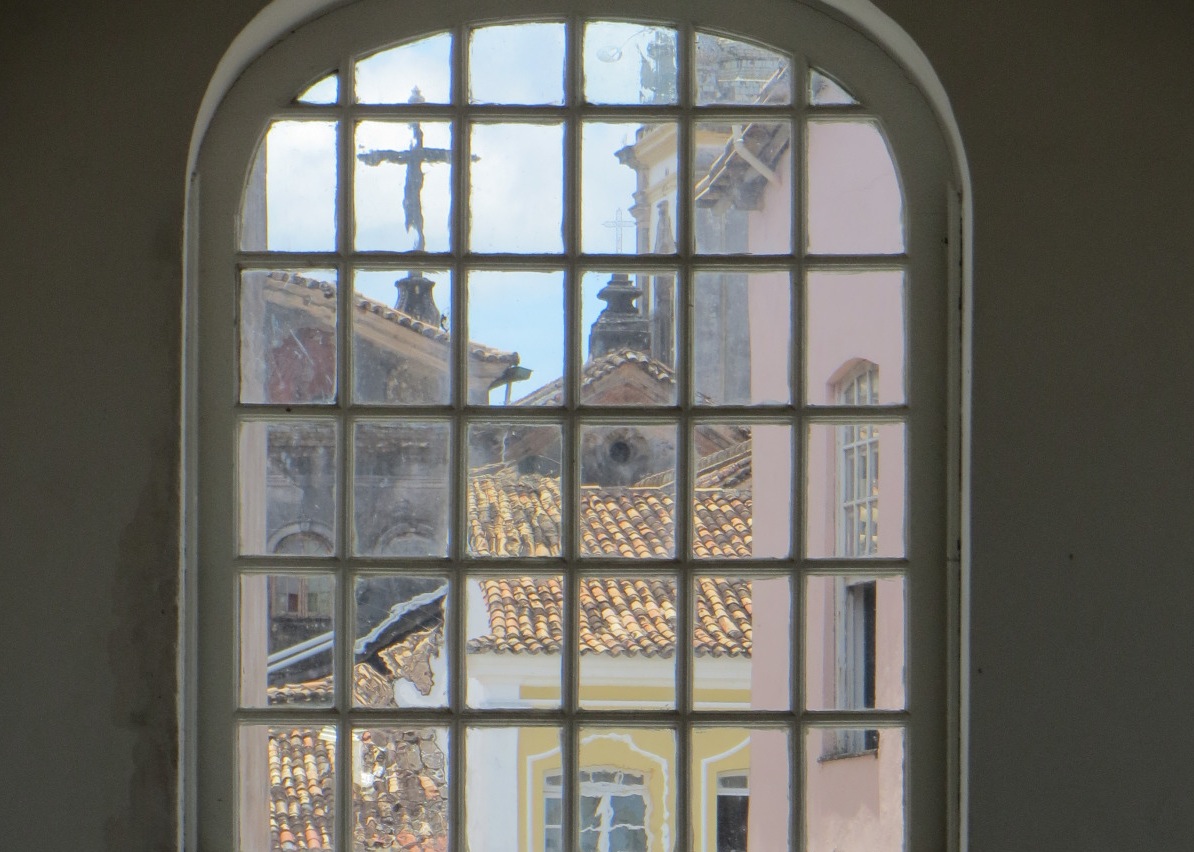
Salvador, Brazil, 12 pm
Salvador, Brazil, 12 pm
Angelo Alaimo O’Donnell leads her students through the work of four American Catholic writers:
One of the joys of teaching is sharing powerful, life-changing books with my students. Each spring semester, I ritually invite the men and women in my American Catholic Studies Seminar to accompany me on this literary pilgrimage. From January to April, we read Seven Storey Mountain, The Long Loneliness, Wise Blood and Love in the Ruins. Together we trace the steps of young Merton as he becomes an accidental pilgrim in Rome, haunting her churches and devouring her art; we sit with Day in the dark of prison and walk beside her through the gritty streets of the Lower East Side; we follow O’Connor from rural Georgia to the literary metropolis of New York, and follow her back to Georgia when illness condemns her to a life of exile; we accompany Percy as he discovers his vocation to be not doctor of the body but physician of the soul, trading his Columbia M.D. for the considerably less prestigious role of Catholic novelist. We conclude the course by reading Paul Elie’s literary biography of the Fabulous Four, The Life You Save May Be Your Own, the narrative of “a journey in which art, life, and religious faith converge.”
The students learn from Elie that the lives of these four contemporaries were interwoven yet never physically intersected. Instead, their moments of connection occurred through acts of imagination. They were all engaged in the same project—the pursuit of meaning in a chaotic and fallen world, and the search for God in a world that denies his existence. Each carried out this search by means of the word, writing the stories of their own lives, both directly, in the form of essays and memoirs, and indirectly, in the form of fiction and poetry.
Kenneth R. Morefield compares Robert Rossellini’s Rome, Open City, which came out shortly after the end of WWII, to contemporary films. He praises Rossellini for framing “his characters’ struggles within a long historical perspective”:
[T]he sweeping historical perspective of Rossellini’s films highlights rather than diminishes their moral questions. They force us to look beyond the scope of one life or one generation. And in so doing, they invite an analysis that is broader than what most current movie narratives provide.
You can find a striking contrast to Rome, Open City in Kathryn Bigelow’s Zero Dark Thirty, which compresses over a decade of action into a single narrative. By doing so, it reduces the breadth of its moral questions (such as the use of torture) from the broadly philosophical or moral (“is it right?”) to the narratively pragmatic (“did it work?”). Ben Affleck’s Argo uses history as merely a backdrop, with the roots of the Iranian revolution covered in a two minute prologue and the coming years of war between Iran and Iraq elided as champagne is served on the plane, accompanied by retrospective pats on the back. But the inability to consider moral questions that stem beyond “the mission” is not unique to Argo – just most pronounced in it.
Responding to Kate Notopoulos’s rant against hugging, Maria Bustillos comes to the gesture’s defense:
The larger solitude to which each of us is ineluctably fated—Wallace’s “skull-sized kingdom“—can sometimes come to feel very like a prison. The difficulty of escape at such times is very, very great; there’s such a vast distance between one soul and another. It’s not guaranteed that a hug will always pierce that veil of solitude, but then again, for some, sometimes, it might.
A hug, then, may even be a reminder that there is more to us than whatever bullshit societal transaction or business nonsense or idiotic role-playing is being forced on us in any given moment. A hug may in fact be a (literally) palpable indicator that we are not alone in the universe. For there is one other at least, right now in this moment, real, warm, breathing like oneself, willing, like oneself, alive, like oneself. Against all the world’s cold calculations, a heart to beat, so improbably, against one’s own.
Reviewing The Annotated Frankenstein, Michael Saler reveals the deeper meaning of Mary Wollstonecraft Shelley’s famous creation:
Wolfson and Levao show that the first edition of Frankenstein of 1818 was packaged as a philosophic novel. Published anonymously, and dedicated to William Godwin, it features more references to the Prometheus legend and Paradise Lost than to such Gothic tropes as perverse sexuality and spectral hauntings. The monster may be
stitched together from human and animal parts, yet he is more memorable for being an autodidact who pleads for affection: “his humanity is the most surprising, most disturbing, and ultimately most moving aspect of his character”. When he is viciously rejected, the monster engages in a murderous rampage – but Shelley blames this on his egotistic creator and an uncaring society that refuses to empathize with a suffering fellow “creature”.
As the editors note, Shelley’s contemporaries would have associated the monster’s terror with the Terror of the French Revolution. Conservatives likened the Revolution to a monster created by Enlightenment rationalism, whereas radicals perceived it as a justified response to a monstrous ancien régime. The novel raised questions about social justice and reciprocal obligations in a modern, secular age, in the process also condemning slavery. In addition, Shelley criticized gender relations, just as her mother had done in A Vindication of the Rights of Women (1792). Frankenstein’s creation of life was not simply an act of scientific hubris, but an exposé of patriarchy. By arrogating the creation of life solely to himself, Frankenstein’s deed of giving birth results in the death of everyone he loved, culminating in his own mortal struggle with his creation in the sterile frigidity of the Arctic.
(Image: the frontispiece to the 1831 edition of Frankenstein, via Wikimedia Commons)
Tarn Wilson found an unexpected benefit from being in an MFA program:
When I started my program, I hoped only that the structure would help me make writing a priority and I’d pick up a few advanced skills. I’d underestimated the power of mentors. I should have guessed: in my work with at-risk teens, I’d researched what fosters resilience in those from disadvantaged backgrounds. The number one predictor of future success? Mentors. The number one way to increase the percentage of underrepresented minorities in top career fields? Mentors. Yes, my MFA mentors were skilled writers generous with their wisdom, but even more, they showed me, in their various creative ways, how to build a writing life—especially in a culture that rewards very few writers financially and that offers constant, bombarding distraction. They modeled how to make a living, prioritize writing, navigate the demands of family and friends, and manage emotions around success and failure.
The critics don’t argue against mentors, but suggest writers should find them organically. Think Hemingway gathered with the expatriates in Gertrude Stein’s Paris salons. But not all of us know where to find a mentor, and even if we did, we’re too polite or shy to impose on their precious time. Critics argue that MFA programs are classist, but I also believe it’s classist to demand writers find their own support. Now that I teach privileged teenagers, I recognize how much easier it is for those raised in well-off families to find mentors. They have spent their lives cultivating an appealing, graceful assurance. They know how to network, have access to people who know people, and have the confidence to ask for what they want. The rest of us need an MFA program.
From a review of Marc Maron’s Attempting Normal:
The comedian knows well… that “real life” can be a real challenge: “If you are alive and awake, sadness is a fluctuating constant.” As Maron explained during a keynote address at a comedy festival in Montreal… humor is one of our greatest analgesics. Growing up, he felt that comics “were the only ones that could make it seem okay. They seemed to cut through bullshit and disarm fears and horror.” At certain key moments, Attempting Normal does so as well. For comics like Maron and his colleague Louis C.K., stand-up is not simply about making people laugh. It is about making people laugh by exposing one’s innermost vulnerability.
Maron’s greatest comedic successes, including his podcast and his self-titled IFC TV show, have come from speaking honestly and emotionally about his life. As C.K. put it in his epic two-part interview on WTF, a portion of which is included in this memoir: “I’ve always [thought] that your progress [came from] taking away more and more layers of your defenses away;” and “I started watching you humiliate yourself more on stage, which is a good thing.” This book reveals that more than ever, Maron’s defenses seem to be down. Despite his tendency for abrasiveness, Attempting Normal is filled with softie remarks like: “I felt my heart open in relief”; “there are beautiful things in the world if you look”; “sometimes you just can’t fight being in love.”
Vincent and Emily are robots designed to behave as a human couple:
In the artists’ words, “Disagreement is preprogrammed.” They elaborate: “Just like in each human relationship, it comes to misunderstandings: If Vincent sends positive signals by up and down movements, it is possible that Emily interprets even those signals as negative.” The result is a bizarre dance that seems highly conflicted and rarely at ease.
It’s up to the viewer to make sense of their relationship, and the instinct is to relate a drama that’s purely informatics in human terms. It’s a clever exploration of the meaning we invest in machines at a time when society is growing increasingly anxious and aware of the quick acceleration of artificial intelligence and the impacts it will have. Smarter, functional robots are poised to take our job–so goes the popular narrative–but they’ll never have the emotional intelligence to approximate the complexity of human relationships.
Gallery of stills from the exhibit here. Recent Dish on robots here and here.
Caitlin O’Neil compares writing to mixing drinks. But:
Mind you, I’m not advising mixing writing and drinking, even if Christopher Hitchens begged to differ. Hemingway and Faulkner, God love them, got away with it, but in my experience the only thing gained when writing while inebriated is confusion (and spelling errors). Drinking and writing are over-romanticized companions. Writing well requires more clarity, rigor and vision, not less. It involves getting closer to uncomfortable truths about ourselves and the world, not anesthetizing ourselves against them. If you find yourself craving a drink to dull the pain while you’re writing, you’re on the right track. But I’d recommend resisting the urge. Save the cocktail for later, when you’ve put down the pen.
After the jump is a portion of the Cocktail Chart of Film & Literature, a “catalog of 49 drinks culled from great works of film and literature”:

Zoom in on the complete chart here.
Melissa Mohr, author of Holy Sh*t: A Brief History of Swearing, discusses profanity with the Boston Globe’s Ideas section:
IDEAS: Are there… old curses that 21st-century people would be surprised to hear about?
MOHR: Because [bad words] were mostly religious in the Middle Ages, any part of God’s body you could curse with. God’s bones, nails, wounds, precious heart, passion, God’s death—that was supposedly one of Queen Elizabeth I’s favorite oaths.
IDEAS: Have religious curses like that lost their power as the culture becomes increasingly secular?
MOHR: We still use them a lot, but we just don’t think of them as bad words. They’re very mild. If you look at lists of the top 25 swear words, I think “Jesus Christ” often makes it in at number 23 or something. … The top bad words slots are all occupied by the racial slurs or obscene—sexually or excrementally—words.
IDEAS: You mentioned Queen Elizabeth cursing. Do all kinds of people swear?
MOHR: Everyone swears. People tend to think lower-class people swear more, and this is an old idea. There are old [expressions] like, “He swears like a tinker.” The Victorians were convinced that the only people who swore were lower class, uneducated, horrible people. Modern studies do bear out that people in the lower working class…swear the most and use the worst words.
But also there’s this idea historically that aristocratic people swear a lot, and that’s also borne out by modern studies: People in the highest social classes [also] tend to swear more and use worse words. Not as bad as the people in the quote-unquote lower classes, but much worse than people in the middle class. There’s this idea that middle-class people are strivers, who really need to differentiate themselves from the lower class. One way they do that is by having very clean, very proper language.
Vaughan Bell adds:
Interesting[ly], there is good evidence that swear words are handled differently by the brain than non-swear words. In global aphasia, a form of almost total language impairment normally caused by brain damage to the left hemisphere, affected people can still usually swear despite being unable to say any other words.