The DOJ’s Press Probe, Ctd

US-POLITICS-OBAMA-POLICE

Ambers adds some vital context to the debate:

Why was this leak so bad, then? Why pursue these leakers so aggressively?

Because Brennan might have been implicated and may have spoken off the cuff or too hastily in his briefing, and because he was slated to be the president’s next CIA director (everyone assumed this in Washington but it hadn’t been confirmed), and because Congress demanded an investigation of this particular leak, and because (I’ll grant) the information released could well have been harmful, a perfect storm arose, and the Justice Department found it had the political backing to aggressive and unflinchingly pursue the leakers.

Hence the GOP’s reluctance to take this one on. They wanted an investigation in the first place. And the question of harming national security in this case was a real one:

On May 7, 2012, the AP ran its story; the perpetrator was in custody over the objections of the White House. Other parts of the national security machine were attempting to pursue the loose ends of the plot to see whom it might ensnare, and that effort was apparently cut short.

Greenwald’s column notes that the investigation was legal, but way too broad:

What makes the DOJ’s actions so stunning here is its breadth. It’s the opposite of a narrowly tailored and limited scope. It’s a massive, sweeping, boundless invasion which enables the US government to learn the identity of every person whom multiple AP journalists and editors have called for a two-month period. Some of the AP journalists involved in the Yemen/CIA story and whose phone records were presumably obtained – including Adam Goldman and Matt Apuzzo – are among the nation’s best and most serious investigative journalists; those two won the Pulitzer Prize last year for their superb work exposing the NYPD’s surveillance program aimed at American Muslim communities. For the DOJ to obtain all of their phone records and those of their editors for a period of two months is just staggering.

Still we have been told that the AP email search came after 500 field interviews, did not include all AP emails from April and May 2012, and was trying to protect future anti-terrorist actions from premature public scrutiny, after being told to by the Congress. I find the whole thing troubling – but not outrageous. There’s a trade-off here, as Ambers fairly notes, that Glenn doesn’t acknowledge. Massimo Calabresi notes that Obama promised more transparency:

Obama came into office offering Americans a deal on secrecy. On the one hand, he promised to shrink the number of secrets created by the government, ending the problem of “overclassification” which produces so many secrets that few are well protected. At the same time, he said he would aggressively defend the secrets the government did need to keep by going after leakers and making them pay. Obama has delivered on the crackdown–he’s prosecuted twice as many leakers as all his predecessors combined–but he hasn’t delivered on the secrecy reduction.

Agreed. The administration’s abuse of the state secret loophole has been off the charts. While I’m at it: release the Senate Intelligence Committee’s report on the Bush-Cheney torture program!

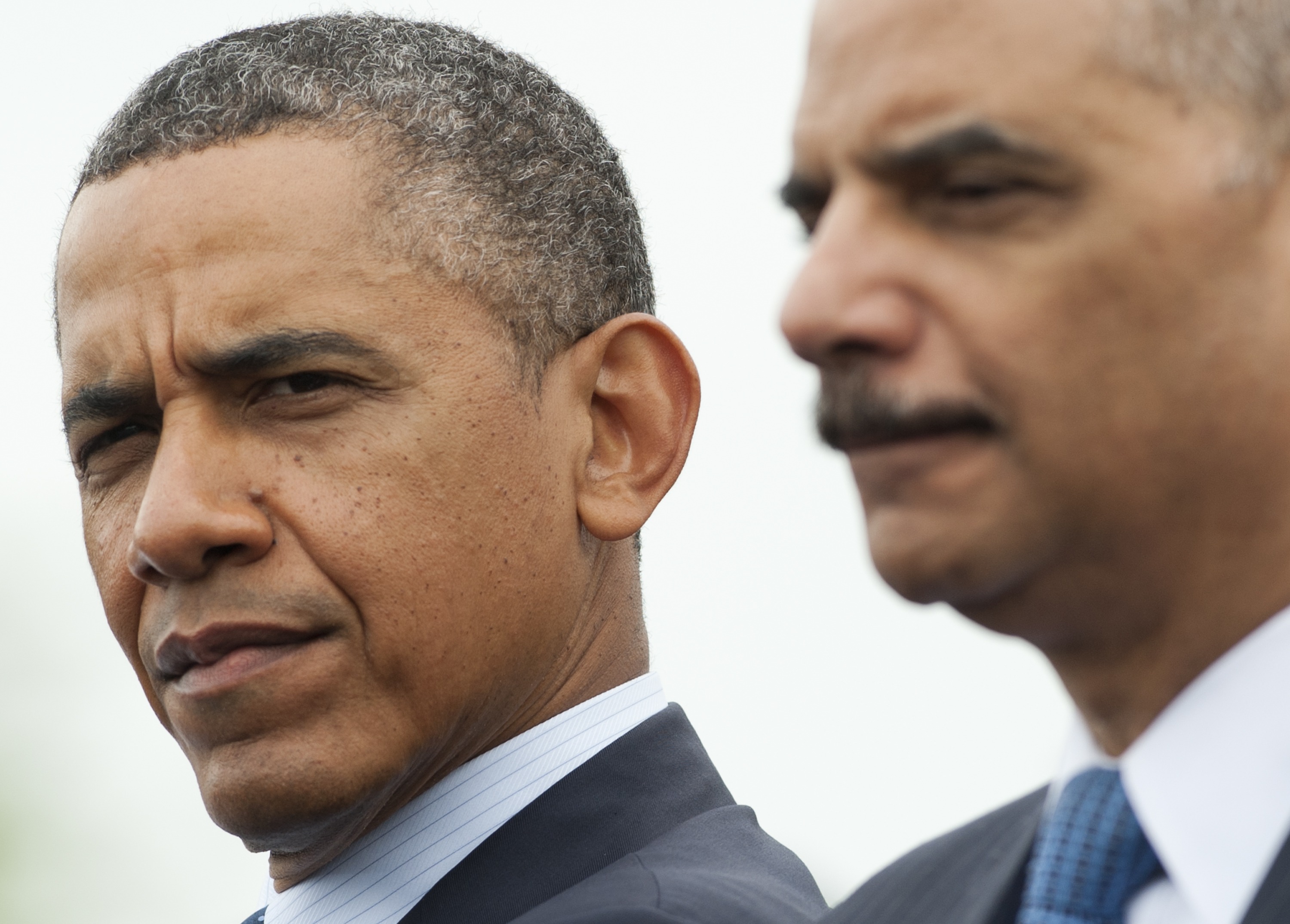
(Photo: US President Barack Obama and Attorney General Eric Holder (R) attend the National Peace Officers Memorial Service, an annual ceremony honoring law enforcement who were killed in the line of duty in the previous year, at the US Capitol in Washington, DC, May 15, 2013. By Saul Loeb/AFP/Getty Images.)
Syria’s Descent Into Hell

From the NYT’s description of the murder scene above:

This graphic video posted online shows 20 members of one family, including nine children, said to have been killed by government forces in al-Bayda, a village in the Baniyas district. Rebels said the government killed at least 322 Sunnis in Baniyas last week, and hundreds are missing. This video shows dead women and children in a darkened room. One woman’s body is surrounded by five children, while another woman’s head slumps back, a baby on her shoulder. The cameraman repeats, “Oh God, oh God.”

Meanwhile, one of the rebel commanders is in another video making the rounds. I’ll let Human Rights Watch describe it:

“The figure in the video cuts the heart and liver out of the body and uses sectarian language to insult Alawites [Assad’s minority sect]. At the end of the video [the man] is filmed putting the corpse’s heart into his mouth, as if he is taking a bite out of it.” Hamad, also known as Abu Sakkar, said he also had video footage of himself using a saw to cut a Shabiha government militiaman into “small and large pieces”.

They are so proud of these atrocities they film them for bragging rights! The indiscriminate violence committed by Assad is more widespread and more lethal than the rebels’. He bears most of the responsibility for this horrifying Hobbesian world. But the opposition forces are degenerating fast as well.

I ask myself of those who committed these atrocities: if I were president, who would I back to be the next ruler of Syria? The question, tragically, answers itself. Neither.

The Tea Party Audit, Ctd

Organization Names

The full Inspector’s General report on the IRS scandal came out late yesterday. Drum peruses it:

I was hoping there might be some interesting tidbits now that we can see the whole thing. Not really, though. Mainly, it paints a drearily predictable picture of bureaucratic FUBARism, with various groups in various places either misunderstanding each other; not responding to each other; or assuming that stuff was getting done that, in fact, wasn’t getting done. Anyone who reads Dilbert regularly gets the picture.

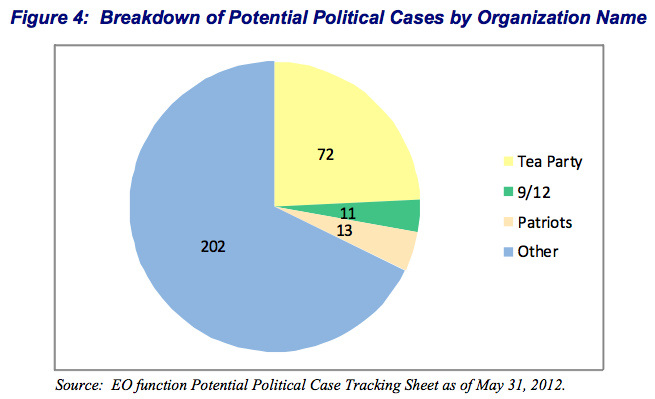
Weigel passes along the above chart from the report. Earlier, he looked at the hoops Tea Party groups had to jump through:

A typical letter looked like the one sent to the Ohio-based Liberty Township Tea Party—35 questions, most of them with multiple sections. Question 3: “Provide details regarding all of your activity on Facebook or Twitter.” Question 5 asked for biographies of “each past or present board member, officer, key employee, and members of their families,” to check whether any of these people might run for office, or might have filed a 501(c)(4) request for somebody else. Question 12 asked for a tally of all activity ever engaged in by the group, by percentage, adding helpfully that the “total of all activities should equal 100 percent.” Question 34 asked for “copies of articles printed or transcripts of items aired” if the Tea Party had been covered by the media.

Yesterday, Josh Marshall pinpointed one reason this story has legs:

If you wanted create a scandal to have maximal appeal to GOP base freakout, this is it. And it has the additional advantage of not creating the same sort of off-putting crazy as hitting other bugaboos beloved by base Republicans. It’s not about Obama’s ties to the Muslim brotherhood or his foreign birth. It’s about taxes, something everyone has an experience with and understands. And it’s at least rooted in something that’s true. Something really did happen. And it’s not good. It shouldn’t happen. It even has unexpected knock-on effects like the IRS’s supposed connection to the dreaded ‘Obamacare’.

That’s why you’re seeing Mitch McConnell go so full bore on this. He’s not particularly well-liked in his state and he’s not particularly well liked by Tea Parties or base Republicans. But now he can bang the drum on something that appeals deeply to these folks. He can now be with them cheek and jowl. And that is a very, very big deal. As can basically every other national Republican elected official.

And Tim Murphy, calling the 2012 IRS audits “depressingly normal,” compiles a list of organizations that have gotten similar treatment under past presidents.

Yglesias Award Nominee

“[T]he one advice I give to Republicans is stop calling [Benghazi] a huge scandal. Stop saying it’s a Watergate. Stop saying it’s Iran Contra. Let the facts speak for themselves. Have a special committee, a select committee. The facts will speak for themselves. Pile them on but don’t exaggerate, don’t run ads about Hillary. It feeds the narrative for the other side that it’s only a political event. It’s not. Just be quiet and present the facts,” – Charles Krauthammer.

OMG! The Deficit Is Shrinking

Deficit

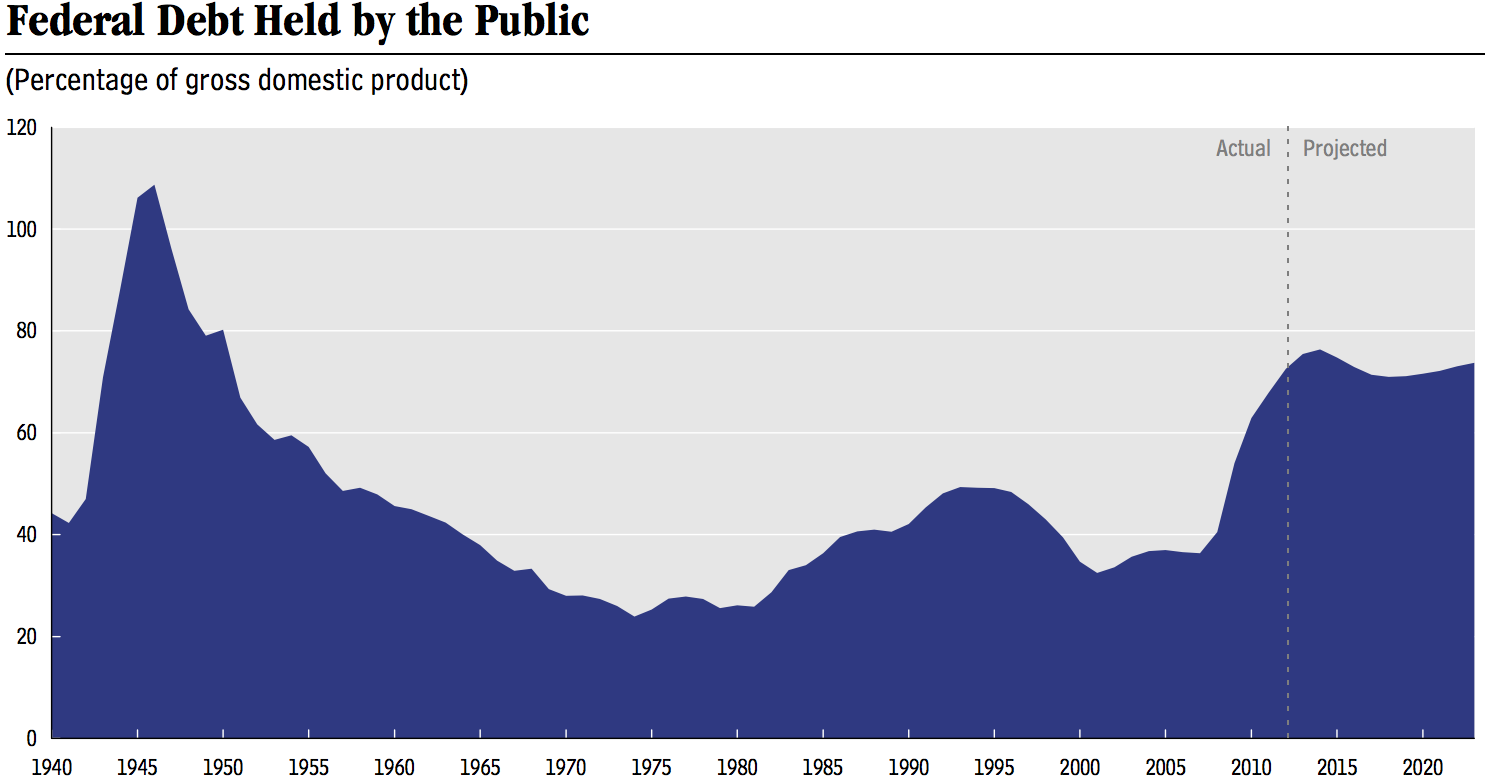
According (pdf) to the CBO – in a truly dramatic turn-around. Barro throws some cold water:

This is great news about this year. But it doesn’t say very much about the long-term fiscal outlook. CBO’s revisions cut this year’s deficit by 1.3 percent of GDP, but they only shrink the next 10 years’ projected deficits by 0.3 percent of GDP.

That’s because the main factors cutting this year’s deficit are one-time effects. Half of this year’s deficit reduction comes from Fannie Mae and Freddie Mac, the mortgage giants that have been under federal conservatorship since 2008. They will make unexpectedly large dividend payments to the government this year, but that won’t happen again. The other half of this year’s change comes from higher-than-expected revenues, which are also mostly a one-time spike.

That’s a teensy bit too much cold water when you see the impact of growth on government revenues which underlies some of the data (growth that would not have happened if the GOP had adopted the premature austerity measures favored in Europe). What all this says to me is that we have a breathing space to move on longer-term spending, i.e. entitlements and defense. My own view is that Republicans are throwing away the chance of a lifetime to get a Democratic president to sign off on real entitlement reform. That would give them more cover for unpopular cuts than they will ever have if they get back into the White House. John Harwood has an excellent summary of the incentives here. Derek Thompson focuses on healthcare spending:

Here’s the story I wish more people would talk about: Our incredible shrinking Medicare projections. Since August, CBO has now revised down its projections of mandatory health care spending by nearly $500 billion, as Michael Linden pointed out. Since the 2010 CBO report, projected Medicare spending between 2013 and 2020 has fallen by just over $1 trillion … or 16%.

Among Ezra’s takeaways:

If this report clarifies anything it’s that our debt problem, insofar as we have one, is a long-term problem, not a short-term problem.

But sequestration disappears in 10 years. The policies in a deficit deal, by contrast, continue to grow. If you care about the long-term debt you should see a world in which sequestration replaces a debt deal to be a disaster. The calm of the Republican Party on this point either bespeaks a disinterest in debt or a misunderstanding about sequestration.

And Yglesias thinks long-term:

The current projection has the deficit shrinking for the next couple of years and then growing again. That leaves us with a very manageable 2024 deficit. The problem is that it’s trending upward. And nothing in this revised projection changes that fact. Under current law, the deficit will bottom out in a few years and then grow and grow forever. The flipside, though, is that there’s really no need to panic or think that there has to be a grand bargain. What we need are more measures to reduce the cost of health care and more measures to boost economic growth.

A Little Perspective On Benghazi

The core question, to my mind, has always been why the diplomatic facility, joined to a CIA facility, was not better prepared for an act of terror. There are plausible reasons – spending cuts at the State Department, more concern about Tripoli, simple incompetence. But this is also true:

In the month before attackers stormed U.S. facilities in Benghazi and killed four Americans, U.S. Ambassador Christopher Stevens twice turned down offers of security assistance made by the senior U.S. military official in the region in response to concerns that Stevens had raised in a still secret memorandum, two government officials told McClatchy.

There’s a real debate about how to balance security and effective diplomacy in dangerous places like Libya after we helped topple the regime. Stevens was a great ambassador in part because he preferred outreach to better security. His courage seems to me to be his real legacy and the thing that really lingers after that horrible attack.

Ask Sue Halpern Anything: Responding To A Therapy Dog

The author explains how she and her therapy dog Pransky have been received while working at a local nursing home (with one awesome anecdote):

John Ensminger recently went through some new research into the effectiveness of therapy dogs, including what the experience is like for the dog:

[My dog] Chloe and I have been a therapy dog team for nearly five years.  Indeed there can be stress for the dog. In a visit to a cerebral palsy facility, one child locked a hand onto Chloe’s back.  I kept her calm while two attendants gradually unlocked the vice grip of fingers. Fran Breitkopf encountered a similar situation in a memory care unit:

“Although [my dog] Casey loved to visit people he was not able to sustain visits to deep dementia sections of Golden Hill. It exhausted him and he was only able to deal with the confusion that he felt for a short time.  I did have to pry a woman away from Casey in one of his visits to that section. She grabbed him and hugged him too hard. His eyes pleaded for help and we did have a nurse come in to help us. He was okay after that, not reluctant. When we left the facility, Casey would fall into a deep sleep by the time we got down the driveway to the main road, probably just 800 to 1,000 feet.  I ended up not taking him to that section after a time. On the other hand he loved going to Ten Broeck Elder Care Facility and was good for at least an hour. He just wanted to deliver kisses and sat on everyone’s laps and gave them many. He did not want to sit on laps of people who had wet themselves. I always thought he didn’t want anyone to think it was he who had peed.”

Nevertheless, negative incidents are rare and [researcher Dr. Dawn A.] Marcus describes a study in which visits to humans “resulted in significant positive changes (P≤0.01) in endorphin, oxytocin, prolactin, phenyl acetic acid, and dopamine levels in dogs.”  Corstisol levels have been shown to rise in dogs, however, indicating that there is a “need to limit visit frequency.”  Although my experience with Chloe has not been monitored for chemical changes in either of us, I do believe that the stress level varies with the assignment and that some assignments are actually fun for the dog.

Mental Floss has put together a gallery of therapy dogs in action. Sue’s new book, A Dog Walks Into a Nursing Home: Lessons in the Good Life from an Unlikely Teacher, comes out tomorrow. Our Ask Anything archive is here.

Politico Turns On Obama

This embed is invalid


Mike Allen (just look how darned sugar-rushy he is today) and Jim Van DeHei live for moments like this. It allows them to do what they do best: talk about their “town” as an entity. They don’t have to grapple with policy or history; they just have to describe the mood among their connected friends. The entire piece is about atmosphere and mood and devoid of any conceivable perspective but the newscycle of the last … what is it now, six hours? When you’re writing about such ephemeral shards of narcissism, you are wont to write sentences like this one:

Republicans have waited five years for the moment to put the screws to Obama — and they have one-third of all congressional committees on the case now.

Yeah, sure, the last five years have been marked by Republican restraint in their attacks on Obama – starting right with the zero votes for his first initiative, the much-needed and now-vindicated stimulus, and their continued total obstructionism to even basic things like executive branch appointments. They waited five years for this … Please.

Notice also the assertion of some facts that are clearly opinions, as in “Obama’s aloof mien and holier-than-thou rhetoric.” I don’t see him that way, although Allen and Van DeHei are entitled to their opinions. I see him as sane in a city full of news-cycle process-driven junkies like Mike Allen. But the insults don’t stop there. We have Obama’s “instinctive petulance, arrogance and defensiveness” – not as a quote from someone else, but from Van DeHei and Allen (who used to work as Dick Cheney’s unofficial spokesperson).

The evidence for their opinion – and it is an opinion piece – comes from the usual Obama-haters who have long resented the arrival of some core principles in the ethical sewer of the official city. And then these other core features of our public discourse: a Maureen Dowd column, Ron Fournier’s ego, and, wait for it, “a rerun of Tuesday’s “Morning Joe,” in which reporters made it sound like Obama is a latter-day Richard Nixon.” Pass me the smelling salts. I’m getting the vapors.

Here’s the one serious point: someone initiated an outrageous abuse of IRS powers. We need to find out who and how and fire those who went over the line. And this genuine scandal is tied to the non-scandal of Benghazi and the genuine debate about how far the DOJ should go in punishing leakers of classified information. Individually, only the IRS affair seems a genuine scandal to me. But drama is the stuff of pageviews. And the chattering classes can only take a no-drama president for so long.