
Toronto Maple Leaf fans show their emotions after the Boston Bruins scored late in the third period, tying the final do-or-die Game 7 at Maple Leaf Square. The Bruins went on to win 5-4. By Vince Talotta/Toronto Star via Getty Images.
Toronto Maple Leaf fans show their emotions after the Boston Bruins scored late in the third period, tying the final do-or-die Game 7 at Maple Leaf Square. The Bruins went on to win 5-4. By Vince Talotta/Toronto Star via Getty Images.
From a new PPP poll:
Of the 41 percent of Republicans who consider Benghazi to be the worst political scandal in American history, 39 percent are unaware that Benghazi is located in Libya. 10 percent said it’s in Egypt, 9 percent in Iran, 6 percent in Cuba, 5 percent in Syria, 4 percent in Iraq, and 1 percent each in North Korea and Liberia, with 4 percent unwilling to venture a guess.
Silver sizes up the IRS scandal:
In a basic sense, scandals that reduce trust in government have the potential to harm those who argue for more government. Mr. Obama has predicated much of his agenda on the idea that Americans can and should trust the government to take action on health care, gun legislation and other issues.
Enten argues along the same lines:
There are reasons to believe that Democrats shouldn’t see major losses [in 2014]. The economy is doing better, and an incumbent president’s party rarely loses big twice in midterms. Still, if trust falls, it may trump these structural factors. The thing to watch over the next days, weeks, and months is how big the scandals become. If they become big news, and that seems quite possible, Obama’s Democratic party may be heading for major losses in 2014.
Nyhan’s research “suggests that the structural conditions are strongly favorable for a major media scandal to emerge.”
A new police drama imagines a world where AI surpasses human intelligence:
Kevin Drum’s new article argues that this kind of technology might not be science fiction much longer. He thinks this will be beneficial in the long-term but worries that such advances will hugely disrupt the labor markets in the short-term:
Unlike humans, an intelligent machine does whatever you want it to do, for as long as you want it to. You want to gossip? It’ll gossip. You want to complain for hours on end about how your children never call? No problem. And as the technology of robotics advances—the Pentagon has developed a fully functional robotic arm that can be controlled by a human mind—they’ll be able to perform ordinary human physical tasks too. They’ll clean the floor, do your nails, diagnose your ailments, and cook your food.
Increasingly, then, robots will take over more and more jobs. And guess who will own all these robots? People with money, of course. As this happens, capital will become ever more powerful and labor will become ever more worthless. Those without money—most of us—will live on whatever crumbs the owners of capital allow us.
In an interview, Drum speculates about what will happen next:
Societies that suffer from mass unemployment, the history of what happens to those societies is not a bright one. At some point you have to respond, and there’s going to be a lot of resistance to responding because of ideology, because of politics, because of pure greed, but eventually we are going to respond to this. It’s going to be obvious what’s happening, that people are unemployed due to no fault of their own, and that we have to respond.
In the meantime, we’re going to resist responding, and we’re probably going to resist responding very very strongly, because rich people don’t like giving up their money. We’re in for a few decades of a really grim fight between the poor, who are losing jobs, and the rich, who don’t want to give up their riches.
Yglesias and Karl Smith chip in their two cents on the subject. Previous Dish on the subject here.
Kevin Roose estimates it, concluding that “Jay Gatsby was probably either living paycheck-to-paycheck or digging himself into debt”:
I ran Gatsby’s estimated cash flows by Rocco A. Carriero, a Southampton-based private wealth advisor. Carriero said that he would never take Gatsby on as a real-life client, given the illegality of his bootlegging business. But after looking at my estimates, he agreed with me that there’s no way a person earning as much as Gatsby did should be spending with such abandon. “He’s got to cut back on the lifestyle expenses,” Carriero told me of a hypothetical Gatsby-like client. “Rather than having fifteen parties at $150,000 apiece [in 2013 dollars], he may want to consider having one party, with maybe half the people.”
Yglesias thinks it’s not so simple:
The problem here is the dread relative price shifts. Over long time horizons not only does the overall price level shift but the relative price of different goods and services shifts. In particular, back in the 1920s labor-intensive services were very cheap. In her autobiography, Agatha Christie writes that when growing up she thought she’d never be so wealthy enough to own a car nor ever be so poor as to be unable to afford servants. And recall that Nick Carraway, who does not earn a lavish salary, has a “demoniac Finn” who cleans his house and cooks him breakfast on a daily basis. But if you were to calculate the 2013 price of a full-time servant and then retroactively attribute that income level to Nick, you’d end up vastly overstating how much he’s making in the bond game. It’s just that cars were expensive back then and unskilled human labor was incredibly cheap. The cost of throwing a giant party is primarily the cost of the labor involved, so huge parties would have been much more affordable in the twenties than today.
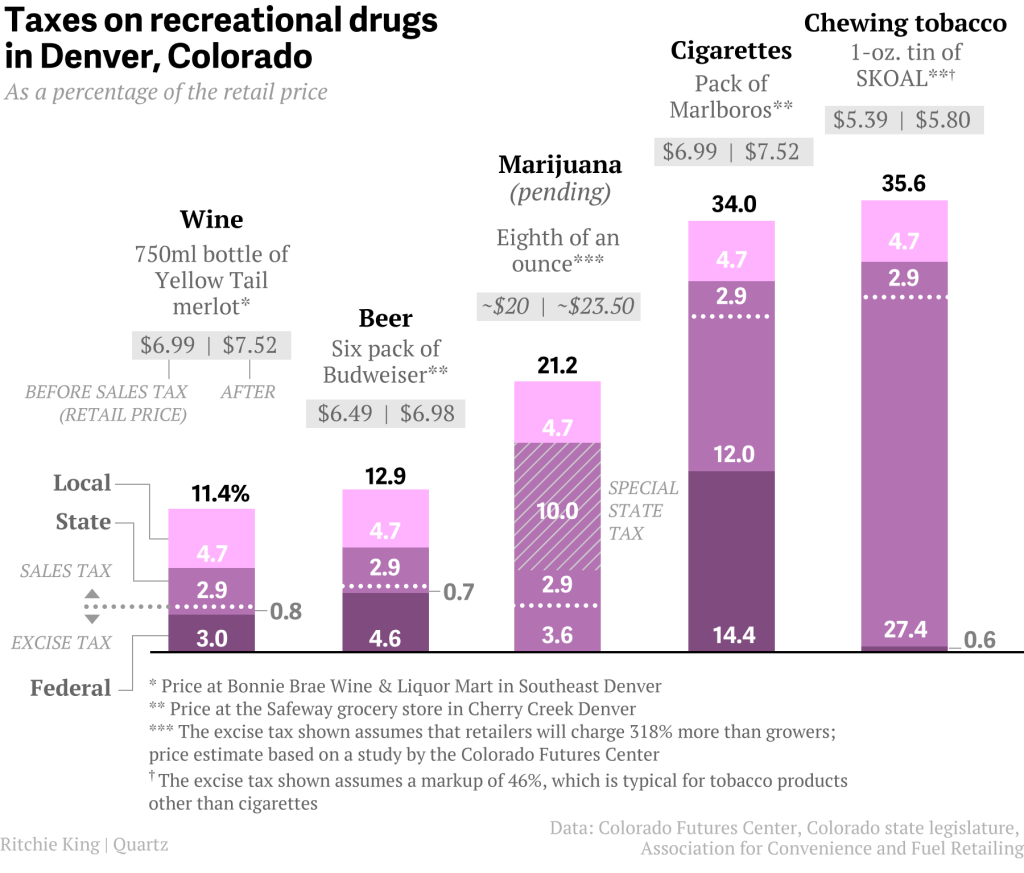
Ritchie King checks in on pot taxes in Colorado:
One of the bills (pdf), passed on Wednesday, lays out the tax rates: a 15% excise tax on wholesale pot and a 10% special state sales tax, in addition to the standard sales tax of 2.9%. The taxes will take effect at the beginning of next year, when licensed retail stores first start selling the drug (pending approval of the bill by the governor and the state’s citizens, which are both expected). These rates will put pot in a tax realm that is somewhere in between a case of beer and a pack of cigarettes.
The big picture:
[Researchers at Colorado State] estimate that next year, 642,772 Coloradans (about 13%) will buy an average of 3.53 ounces apiece, making for a total tax revenue of $94.4 million. Though that amounts to almost a one percent increase in total state revenue, some, including the study’s authors, have expressed concern that the money raised won’t be enough to cover the cost of enforcing new marijuana laws, such as legal driving limits. But they don’t take into account the money that will be saved by not prosecuting and incarcerating the many marijuana users who were breaking the law prior to legalization but aren’t anymore. The Colorado Center on Law and Policy estimates those savings (pdf) to be $12 million per year.
Be prepared to be shocked. Here’s what Ben Rhodes wrote in an email after the initial confusion about what happened at the Benghazi diplomatic outpost and CIA base:
“All – Sorry to be late to this discussion. We need to resolve this in a way that respects all of the relevant equities, particularly the investigation.
There is a ton of wrong information getting out into the public domain from Congress and people who are not particularly informed. Insofar as we have firmed up assessments that don’t compromise intel or the investigation, we need to have the capability to correct the record, as there are significant policy and messaging ramifications that would flow from a hardened mis-impression.
We can take this up tomorrow morning at deputies.
Outrageous political meddling to cover the State Department’s ass, right? Just as the Weekly Standard insinuated, right? Er, no. Tapper’s take-away:
Whoever leaked the inaccurate information earlier this month did so in a way that made it appear that the White House – specifically Rhodes – was more interested in the State Department’s concerns, and more focused on the talking points, than the e-mail actually stated.
Just an early, failing attempt to smear Hillary for 2016. Because the GOP has no relevant policies for our times, just politics.
Jessica Helfand considers the appeal of list-making:
Occasionally, lists provide a therapeutic benefit, as if the very act of writing something down can help keep chaos at bay. (The famously apprehensive Alfred Hitchcock once shared the order in which he had come to anticipate the surge of adrenaline preceding an anxiety attack: “1: small children, 2: policemen, 3: high places, 4: that my next movie will not be as good as the last one.”) If the internet itself can be considered a kind of list, then Google is the über-list, and indeed, once online, you can massage the formal qualities of the list-as-template to chronicle your own peripatetic priorities…. For that matter, there is Craigslist. (And not to be outdone, Angie’s List!) Finally, for those of us determined to make our own mortality the defining feature of all essential decision-making, there is the recent phenomenon known as the “100 Things To Do/Eat/See/Before You Die” list: in common parlance, we call this a bucket list.
At the opposite end of the spectrum, there is the shopping list — a willy-nilly compendium that mirrors the unparalleled idiosyncrasies of its maker. Here, the order of items can be intentionally cryptic or just plain loopy. (If you’re lucky, it will be both.) Lists such as these typically sit rather far down on the information food chain: in the universe of list-making, they’re doomed to an all-too-brief life expectancy. This is particularly true of the grocery list, a study in planned obsolescence if ever there was one, which is basically an aide-memoire rendered ineffectual once complete. Simply put: grocery lists are ephemera writ large, which is precisely what makes them so engaging.
Previous Dish on the allure of lists here and here.
(Image: Johnny Cash’s to-do list from Lists of Note)
At some point, when tackling completely new models of form and content and business in journalism becomes exhausting, you just let go and try to enjoy it. Here’s Ann Friedman’s advice to young journalists:
Chaos is good for creativity. When traditional paths to professional success are closed, those of us who love journalism so much we’d never give up altogether are forced to redefine success—and our methods of seeking it. Luckily, at a moment when everyone is hungry for new models and solutions, there are more ways to gather and disseminate the news than ever before.
Here’s a little secret: Even if I’m wrong and it’s not the best moment, we’d all be well-served to operate as if it is. Because you know what? The old models aren’t coming back. Lamenting the death of classifieds and display advertising and annual subscribers isn’t serving anyone. The sooner journalists start seeing disruption and technology as opportunity, the better off we’ll all be.

