Why Pass Keystone Now?

Mary Landrieu

Congress is preparing to vote on Keystone XL pipeline:

Incumbent Sen. Mary Landrieu (D-LA) and Rep. Bill Cassidy (R-LA) are competing against each other in a run-off election next month for the seat — the last race still up in the air. And, by way of appealing to voters in the oil-rich state, they’re each sponsoring a bill in Congress to approve the pipeline, which would bring oil from the tar sands of Alberta, Canada, down to Nebraska and on to refineries in Texas.

Cassidy’s Keystone bill in the House is expected to pass easily on Friday during the lame-duck session. Republicans, who control the chamber, are overwhelmingly in favor of approving the project — which has been held up by the Obama administration over concerns that it could exacerbate climate change.  Landrieu, meanwhile, is co-sponsoring a Keystone bill in the Senate with Sen. John Hoeven (R-ND) — and Democrats have now agreed to schedule a vote on it for Tuesday.

Joe Romm is puzzled:

Having spent months negotiating such a breakthrough deal with China — whose ultimate goal is to enable a global agreement that can stabilize CO2 levels and keep total warming as close to 2°C (3.6°F) as possible — why would the U.S. then approve a pipeline whose operation is incompatible with 2C warming? Why would the U.S. approve a pipeline that makes it harder for the country to meet its previous 2020 target (17 percent reduction in greenhouse gases vs 2005 levels), let alone the tougher 2025 target (26-28 percent below 2005 levels) that was part of the breakthrough deal?

Chris Mooney tries to put a positive spin on the news:

[W]hat may happen here is that the more politically radical climate change grassroots loses out on a symbolic issue (blocking a pipeline that will transfer dirty tar sands oil) but climate moderates win really meaty progress on cutting greenhouse gas emissions. And that aligns nicely with the theory of “radical flank effects” in social movements, as suggested in 1988 by the scholar Herbert Haines, who argued that in the Civil Rights Movement, a “radical flank” — groups like the Black Panthers — paved the way for the ultimate success of moderates, like Martin Luther King, Jr.

Alex Rogers contemplates Landrieu’s Hail-Mary pass:

Landrieu’s gambit may help her re-election chances, but it comes at a cost. Forcing a Keystone vote in Congress will give McConnell and Boehner an unexpected win on the list of issues they want to tackle when the GOP takes control of both chambers of Congress early next year. White House press secretary Josh Earnest signaled Wednesday that the President would oppose the legislation, as he has in the past.

“We have indicated that the President’s senior advisors at the White House would recommend that he veto legislation like that,” said Earnest. “And that does continue to be our position.” And it’s not even clear how much Landrieu’s push will help her chances.

Josh Voorhees highly doubts the vote will save Landrieu:

Even if we suspend disbelief—and, again, we shouldn’t—and imagine a world in which Congress passed this Keystone bill and Obama signed it, it’s highly unlikely that would be enough for Landrieu to win over the conservative voters she needs to hold on to her seat. Polls show Cassidy winning a one-on-one matchup with Landrieu, and whatever happens in the lame-duck session is unlikely to change that. Adding to Landrieu’s woes is the fact that the GOP’s midterm successes will strip her of one of her chief selling points: her power as the chairwoman of the Energy and Natural Resources Committee. Things are so bleak, in fact, that the Democratic Senatorial Campaign Committee has pulled the plug on nearly $2 million worth of ads it had planned to run on her behalf.

Drum declares that there’s “simply zero chance that this is going to help Landrieu”:

There’s not a person in Louisiana who doesn’t know that she supports the oil industry and hates hates hates President Obama’s energy policy. She’s made that crystal clear, and everyone who’s persuadable has already been persuaded. A Keystone XL vote just won’t move the needle.

So Democrats would be giving something away and getting literally nothing in return. In fact, since this would outrage all the people who do care about Keystone XL, Democrats would probably be giving something away and losing support from key supporters at the same time. It’s crazy.

Waldman wants Democrats to get something in return for approving the pipeline:

Republicans have been desperate to build the pipeline for years now; ask them what they would do to improve the economy, and “Build the pipeline!” is often the first thing out of their mouths, despite the fact that the effect it would have is so small as to be barely distinguishable from zero. So if you’re going to give in to them, wouldn’t it make sense to get them to give you something in return? If Obama threatens a veto, he could then say, “All right, well let’s add this to the bill, and I’ll sign it,” this being something Democrats want.

Aaron Blake points out that the pipeline is popular:

Poll after poll has shown support for Keystone is somewhere between very strong and overwhelming. A Pew Research Center survey this month showed support for the project at nearly two-to-one, 59 percent to 31 percent. And that was about the lowest level of support we’ve seen to date. Support has registered as high as two-thirds of Americans. And as another recent Pew poll showed, it’s not just Republicans and independents driving support for the project. In fact, basically the only group that opposes it is the most liberal of Democrats.

But Blake also admits that fracking doesn’t poll so well anymore:

As of March 2013, the Pew Research Center showed Americans approved of this technique by 10 points, 48-38. As of today, they oppose it, 47-41. Support for fracking has fallen most notably among younger Americans and among independents, who supported it 51-36 in early 2013 but oppose it 53-37 today.

Rebecca Leber wonders whether Keystone can still be stopped:

If Obama does veto, then the question is whether the Senate has enough votes to override this veto. Because the Senate doesn’t turn over until January, they probably won’t have the 67 votes needed to override it, yet. They might with the Republican majority, though.

All this makes the Keystone drama’s final act, years in the making, look like a lost cause for activists. But they have one last chance to block the project. The pipeline would go through Nebraska and there’s a legal dispute over whether the governor or a state agency has authority to approve it. The Nebraska Supreme Court has heard the case and if the court rejects the route, then TransCanada, the company building the pipeline, would have to push back its timeline while it develops a new route. The longer the delay, the more expensive, and less financially viable it becomes.

Along the same lines, Jared Bernstein keeps an eye on the price of oil:

Crude is trading at $75/barrel as we speak, and the [Canadian Energy Research Institute] just cut its year-ahead forecast by $18 to $85/barrel. Of course, they could be wrong and oil could climb to a high-enough perch to make tar sand extraction profitable. Meanwhile, the timing of the politics could easily push Congress to offer bipartisan support for Keystone this week, as Louisiana Sen. Mary Landrieu wants this behind her in her upcoming runoff election. But for now, the economics may be doing the environment a favor by pricing oil at a level that could keep the tar sands underground.

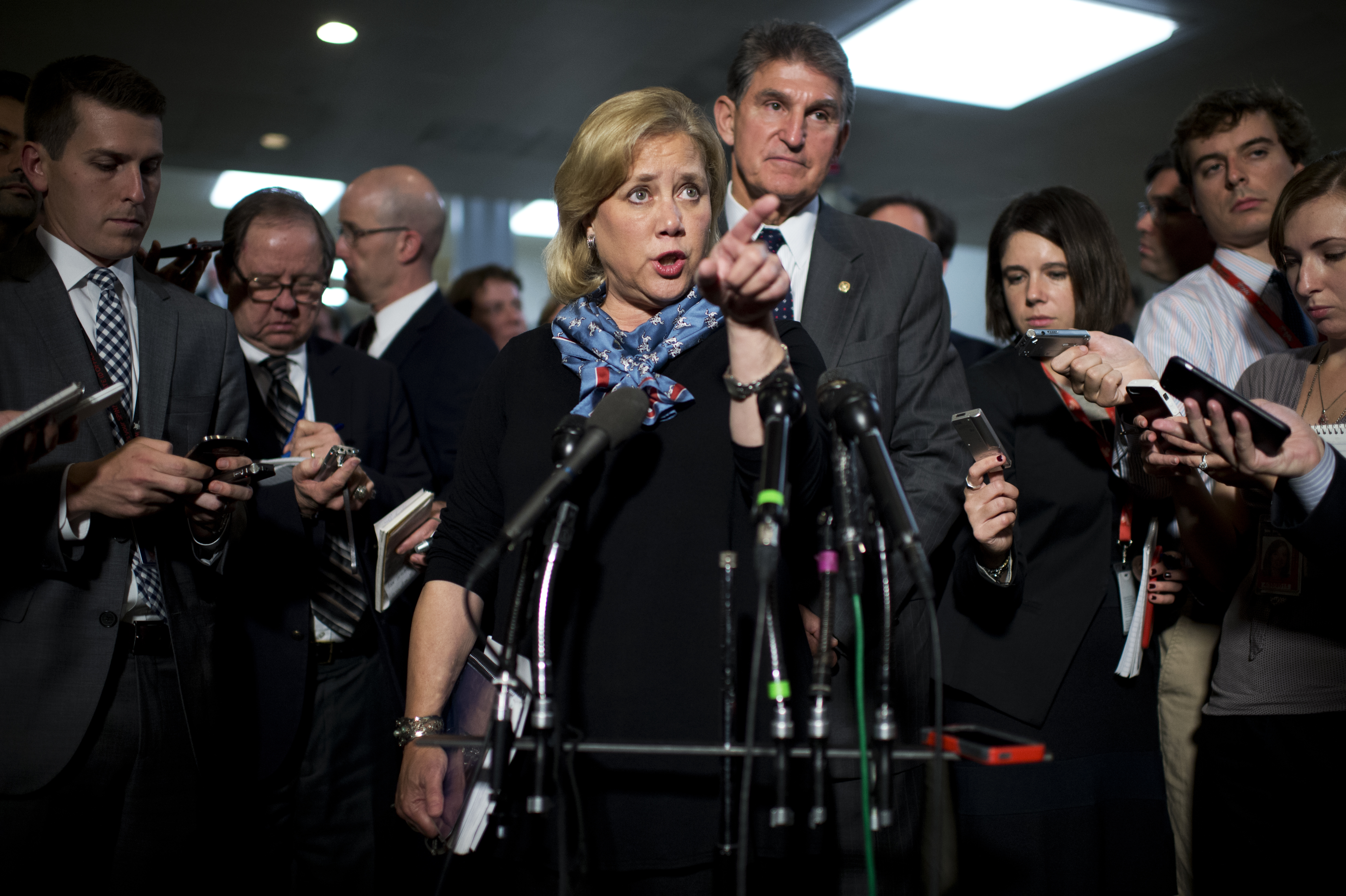
(Photo: Senators Mary Landrieu, D-La., and Joe Manchin, D-W.Va., conduct a news conference on the Keystone XL pipeline in the basement of the Capitol on November 12, 2014. By Tom Williams/CQ Roll Call)
“Just How Influential Are The Very Rich?”

In a review of Darrell West’s BillionairesMichael Lewis wonders:

[S]o far the evidenceand evidence here is really just a handful of anecdotessuggests that rich people, when they seek to influence political outcomes, often are wasting their money. Michael Bloomberg was able to use his billions to make himself mayor of New York City (which seems to have worked out pretty well for New York City), but Meg Whitman piled $144 million of her own money in the streets of California and set it on fire in her failed attempt to become governor. Mitt Romney might actually have been a stronger candidate if he had less money, or at least had been less completely defined by his money. For all the angst caused by the Koch Brothers and Sheldon Adelson and their efforts to unseat Barack Obama, they only demonstrated how much money could be spent on a political campaign while exerting no meaningful effect upon it. …

One trouble for a writer who wants to see the concentration of wealth at the very top chiefly as a political problem is that the politics of the very rich are not all that predictable or consistent. Obviously billionaires are not perfect reflections of the societies they inhabit, but it’s not insane to consider that their quirks and proclivities might be politically self-canceling, like the irrationalities of consumers in models in classical economics, and so might be assumed away. Even on the most obvious political issues, on which you might think all billionaires could agree, they are often at war with each other. In the end, West more or less concludes that even if money cannot directly rig the democracy, and buy political outcomes, the public’s perception that it can will lead to public cynicism, and corrode the democracy. That may be true. But it tells you something when someone sets out to write a book about the effects of rich people on politics and can’t do any better than that.

Native Tongue Twister

The Economist‘s S.A.P. provides background on a Navajo-proficiency controversy:

DINÉENA bizaad doo shi? Do you speak Navajo? If not, good luck running for the Navajo presidency. Chris Deschene has learned this the hard way. Mr Deschene was in second place in the polls before he was booted from the ballot two weeks ago for refusing to take a Navajo proficiency test. The presidential election, which should have taken place on November 4th, was put on hold until the issue could be resolved. In defending this policy, Ben Shelley, the current Navajo president, waxed deep: “Diné bizaad is sacred. Navajo leaders should have both language and cultural fluency in order to be qualified. Every society has an obligation to hold on to their traditions.”

Navajo is the most widely spoken indigenous language in America, but its speakers are dwindling. Just over half of enrolled tribal members—around 170,000 people—are fluent. It’s little wonder that Navajo leaders are so sensitive about this language requirement. Navajo is one of the rare languages to have survived the onslaught of the English juggernaut that laid waste to North America’s native linguistic diversity. That the nation could even consider a strict language requirement for its president underscores the vigour of the language, but the continued popularity of Mr Deschene hints that many Navajos don’t see language as an indispensable carrier of their culture anymore.

“The Privacy Paradox”

Claire Cain Miller flags a survey illustrating it:

People harbor equal distrust of advertisers and the government, Pew found. Eighty percent of users of social networks say they are concerned about advertisers or businesses gaining access to their information there, and 70 percent say they are at least somewhat concerned about the government doing so without their knowledge.

Yet highlighting the privacy paradox, 55 percent of people say they are willing to share information about themselves with web companies in order to use their services free, and 36 percent say they appreciate that these services are more efficient because they have access to this information.

The types of digital information that people consider to be most sensitive are their Social Security numbers, health information, the content of emails and phone calls and their location. They are least sensitive about their purchasing habits, media consumption, political and religious views, and the identities of their friends.

People with more education and higher incomes tend to be more sensitive about their online privacy, Pew found. And despite perceptions that young people care little about digital privacy, they often care more than older people.

How The Penny Got Coined

Diamon Searls remarks that “when the penny eventually goes the inevitable way of the half cent and the Canadian penny (extinct as of 2012)” – and good riddance – we will lose “the last possible link between our language of money and the everyday physical world”:

[The etymology of penny] is uncertain, though the ending implies a Germanic origin—the dish_pennyword used to be penning, with an -ing, like shilling and farthing, instead of a -y. The root may be Pfand, which turned into the English word pawn meaning “a pledge or token”: in that case, penny basically just means money. …

A quarter is a fourth of a dollar, a dime a tenth (Old French dîme, Latin decima), a cent a hundredth or one percent—all math. Anyway, a cent is not a piece of money: a U.S. penny is technically a cent or one-cent coin, but in spoken language, a cent is a value and a penny is a coin. We offer someone our two cents, not two pennies; pennies can clink in your pocket, cents can’t.

(Image by Flickr user yaybiscuits123)

Tweeting While Parenting

Dean Karlan, “a believer in free range parenting,” flags research on the dangers of ignoring your young child because you can’t get off your damn iPhone:

Craig Palsson, a graduate student in the Yale economics department, argues in a new paper that the expansion of the 3G cellphone network led to more widespread adoption of the iPhone, which led to parents who discovered new apps and continual email on their cellphone; which led to parents who paid attention to their new toys at playgrounds and not necessarily to their small children; which led to 10 percent more accidents for those children from 2005 to 2012, including broken bones and concussions. The paper assembled data from the National Electronic Injury Surveillance System, run by the Consumer Product Safety Commission. The government does not collect any information from the phone, but instead relies on a sample of hospital emergency room visits involving consumer products.

The War To End All Progress?

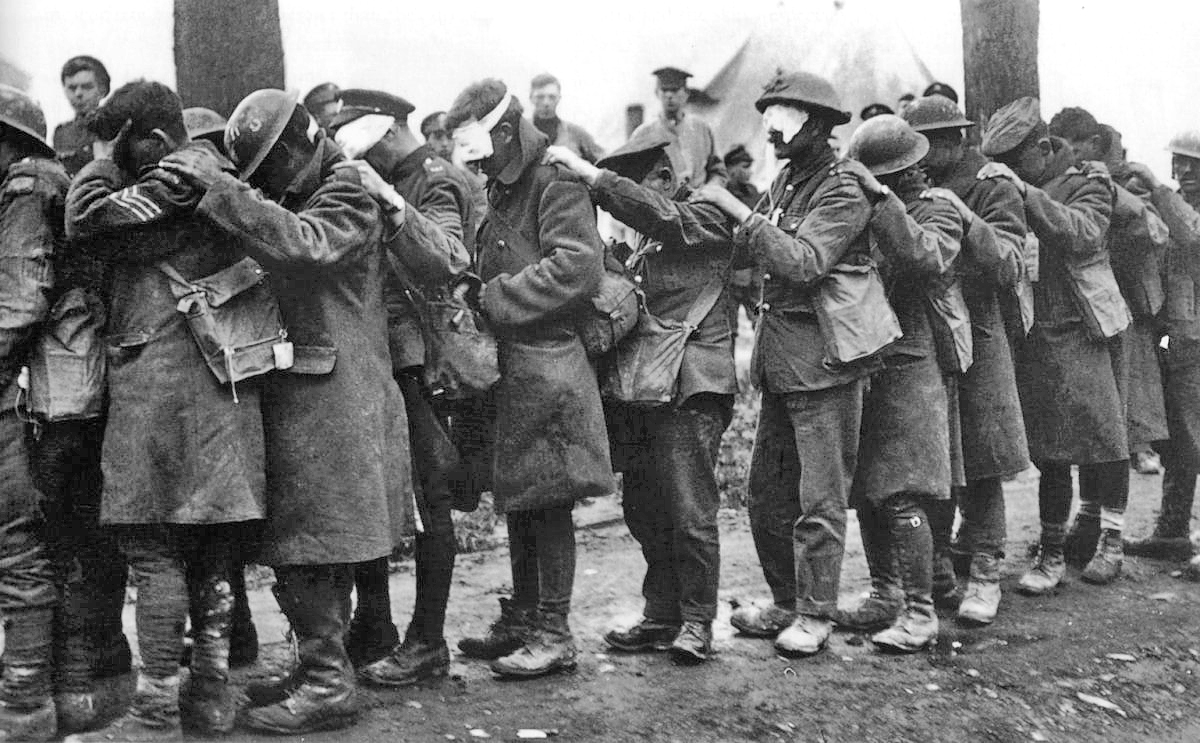
British_55th_Division_gas_casualties_10_April_1918

Wilfred McClay interrogates the common notion that “the Great War’s chief accomplishment was its wanton destruction of an entire political and social order and, with it of a certain blithe European optimism about the future.” Not so fast, he argues – it’s more complicated than that:

[O]ne of its lasting consequences has been to make us uneasy with the very concept of progress. We are not prepared to give up that concept entirely. That would be nearly inconceivable. … [O]ur culture is borne along by the flow of enormous progressive inertia. It does not necessarily have to affirm its earlier commitments, or even be aware of them, in order to be propelled or guided by them for a very long time. We teach our children that it is good, nay imperative, that they should want “to make a difference.” But there is no doubt that we do not feel quite as ready as we once were to endorse explicitly the idea of progress, without always employing the protective mechanisms of qualifiers or quotation marks. We live with a certain split-mindedness in that regard.

To further explain his point, McClay describes going to an academic conference on moral progress in history – timed to coincide with the 200th anniversary of the abolition of the slave trade. He was surprised to find himself the only participant overtly defending progress, though upon closer inspection he noticed even his colleagues hadn’t quite let go of the concept:

That said, the opposition to the idea of progress that I saw in my colleagues did not seem to me to go very deep. It seemed almost entirely professional and notional, without any echo in the conduct of their busy, well-organized, ambitious, and purposeful lives. No such thing as progress? Seriously? Who actually lives with such an assumption? Even our occasional efforts to sound fatalistic in our speech betray all the things that such speech silently presumes: that, as free and purposeful beings, we cannot help projecting certain ideals or goals, if even only short-range or proximate ones, into the inchoate future. This is particularly so in the United States, where every lamentation has a way of turning into a jeremiad, and thereby into a form of moral exhortation and a call to improvement, and thus to become the polar opposite of fatalism. The language of true fatalism would be stony and resigned silence, and that is not what we see or hear. There is a difference between what we think, and what we think we think.

(Image: British 55th Infantry Division soldiers, blinded by tear gas during the Battle of Estaires, 10 April 1918, via Wikimedia Commons)

“Suspended” In Translation

Adam Kirsch reviews a collection of novellas by Nobel winner Patrick Modiano now available in an English translation:

The first to arrive is Suspended Sentences, which Yale University Press was already scheduled to publish, but is now rushing into print thanks to the Nobel announcement. For almost all American readers curious about Modiano, it will be their first introduction to his work. What sort of writer does it reveal?

First of all, a dedicated Parisian. Of the three novellas that make up this short volume, two take place in Paris and one in the suburbs; and Modiano writes about the French capital with a possessive affection that feels almost erotic. The narratorwho is always a version of the authorthinks back to the Paris of his teenage years, in the 1960s (Modiano was born in 1945), as to a shadowy paradise lost. He dwells on the changes time has brought to the citythe destruction of a neighborhood to make way for a highway, the disappearance of old haunts and old friends. Like Walter Benjamin, who believed that a whole civilization could be conjured from scraps of the Parisian past, Modiano seizes on even the smallest scraps of history. …

These novellas were originally published separately, but the decision to group them together makes perfect sense. In mood and often in subject matter, they read like variations on a theme: the missing man, the absent parents, the ravages of time, keeping coming back under different names. In each tale, the narrator remains bewildered by history, his own and his family’s, trying to make a coherent narrative out of the fragments he inherited.

Jonathan Gibbs recommends the collection, calling the author “as accessible as he is engrossing”. He gives a more detailed overview of the three novellas:

In “Afterimage” we have the  narrator’s memories of lapsed photographer Francis Jensen, whom he knew as a young man, and whose personal archive he undertook to catalogue, while trying to work out why he had turned so resolutely away from life. The other two stories, “Suspended Sentences” and “Flowers of Ruin”, circle around “the Rue Lauriston gang”, a set of criminals whose black market dealings, during the Occupation, bled into dirtier work on behalf of the Gestapo.

“Suspended Sentences” is the liveliest offering, a childhood memoir in which young Patoche is palmed off by his parents onto a surrogate family of loveable freaks in a town outside Paris. Life there is immeasurably enlivened by the strange “friends of the family” who swing by in expensive American cars for clandestine meetings, or to whisk them all off for suspicious jaunts around Paris.

Flowers of Ruin” is darker, and starts from an anecdote about a young married couple, living in Paris, who committed suicide “for no apparent reason” in 1933, after an evening partying with two other, more dubious couples. The narrator, thinking back to his own teenage years in Paris in the 1960s, wonders if the people he knew then might offer some connection back to that “tragic orgy”.

Sam Sacks provides a broader context:

Each of these sketches is framed as the narrator’s search through his imperfect recollections for telling clues that might somehow illuminate periods of time “whose very reality I sometimes doubted.” A strange and affecting feeling of guilt pervades the narrator’s investigations, drawing obscurely from the unknowns surrounding his estranged Jewish father, “who had weathered all the contradictions of the Occupation period, and who had told me practically nothing about it before we parted forever.” In all three novellas the author-narrator explains that his father was a black-market profiteer who may have been saved from deportation by his connection to the Rue Lauriston gang, the French branch of the Gestapo. Mr. Modiano was born in 1945 (“a product of the dunghill of the Occupation,” in his words), and he portrays the taint of collaboration as an inherited trait, oppressing a postwar generation who never fully understood the nature of their parents’ crimes.

Such themes give this autobiographical fiction a broader national significance. But Mr. Modiano is also profoundly regionalist. For all his stories’ ambiguities, Paris’s streets and sights are transcribed with emphatic specificity: “That Sunday evening in November, I was on Rue de l’Abbé-de-l’Epée. I was skirting the high wall around the Institut des Sourds-Muets. To the left rises the bell tower of the church of Saint-Jacques-du-Haut-Pas. I could still recall a café at the corner of Rue Saint-Jacques” and on.

Face Of The Day

This embed is invalid


Senator Elizabeth Warren, a Democrat from Massachusetts, looks on as Senate Majority Leader Harry Reid speaks during a news conference following a private meeting at the U.S. Capitol Building on November 13, 2014. Senate Democrats plan to elevate first-term Massachusetts Senator Elizabeth Warren to their leadership ranks on an expanded communications and policy committee led by third-ranking Democrat Charles Schumer. By Andrew Harrer/Bloomberg via Getty Images.