Rant Of The Day

The context:

The impassioned and impromptu rant was recorded on the street outside the London offices of the Royal Bank of Scotland hours after it was announced that six banks on both sides of the Atlantic had been fined more than $4 billion for rigging foreign currency exchanges without any sign of forthcoming prosecutions.

And what’s great about this is that the man in the video, Paul Mason, is now economics editor for Channel 4 News in Britain. Financial journalism doesn’t to be about access and acceptance of the terms of the debate preferred by the powerful. It can actually give a damn and hold these people to account. I just hope that attitude spreads in the US media.

Our Climate Pact With China, Ctd

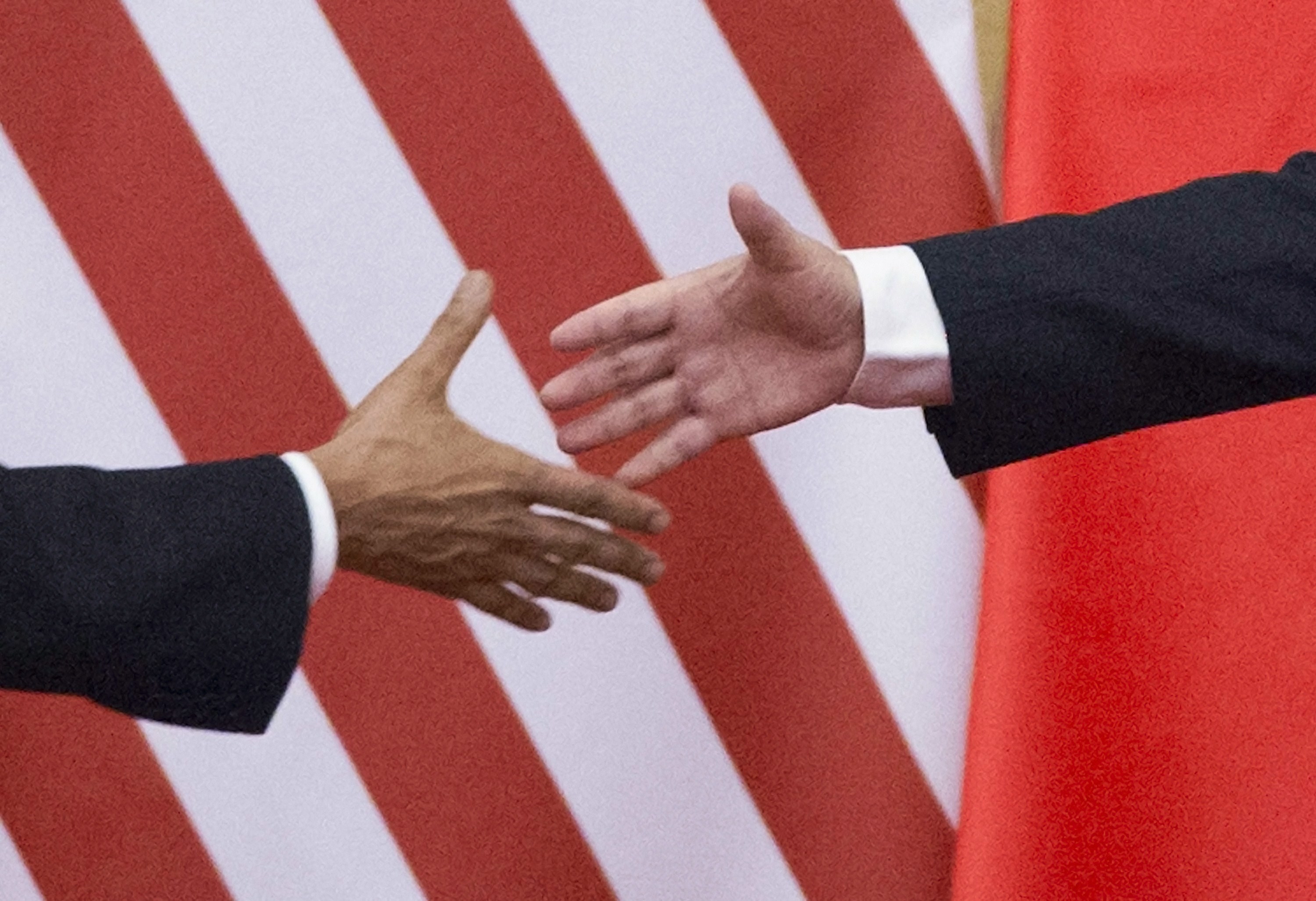
Krugman insists that the “agreement between China and the United States on carbon emissions is, in fact, a big deal”:

CHINA-US-DIPLOMACY[T]he principle that has just been established is a very important one. Until now, those of us who argued that China could be induced to join an international climate agreement were speculating. Now we have the Chinese saying that they are, indeed, willing to deal — and the opponents of action have to claim that they don’t mean what they say. Needless to say, I don’t expect the usual suspects to concede that a major part of the anti-environmentalist argument has just collapsed. But it has. This was a good week for the planet.

Douthat, on the other hand, downplays the importance of the agreement:

Symbolism and public leadership do matter in international affairs, even if they don’t necessarily matter as much as climate hawks (like other sorts of hawks) persistently believe. But nothing about this widely-hailed bargain as yet invalidates the basic case for skepticism about the quest for a global climate regime, because nothing about China’s actions as yet invalidates the argument that the globe’s diverse group of developing-world actors are only ever likely to act to explicitly cap emissions when it seems to be in their immediate national interest (or when, as in this case, that “cap” may just a description of a trend), and that they are therefore very unlikely to be meaningfully bound by international rules or regulations that in any way directly constrain their ability to emit as their economies seem to require.

Being skeptical of climate change regulations in this sense does not mean believing that no developing nation’s emissions will ever level off or fall, or that no developing nation will ever take steps to limit their emissions. Indeed, the skeptics assume that both will happen, as those nations get richer, technology advances, domestic constituencies for environmentalism develop and so forth. They’re just doubtful about the power of diplomacy and international treaties and carbon regimes to meaningfully accelerate this process (as such regimes have mostly not to date in contexts far more promising than the People’s Republic of China). And with that doubt, in turn, comes a skepticism about the wisdom of having the United States take steps on its own that don’t necessarily pass a domestic cost-benefit test in order to somehow set up a larger process that probably isn’t going to work anyway, and that our rivals will have every incentive to seek to game in order to gain at our expense.

But Ryan Cooper thinks China has good reason to act:

China is very seriously vulnerable to climate change. It could gut the nation, taking the ruling Communist Party down with it. Fifty million or more Chinese citizens could be displaced by rising seas in the coming decades. Drought and desertification, both fueled by climate change, will cause havoc with China’s water supply and farmland, which are both already insecure. Additionally, China’s reliance on filthy coal power is responsible for jaw-dropping environmental problems, causing a reported 670,000 deaths annually, and many times that number of respiratory illnesses.

All this points towards a massive Chinese self-interest in slashing emissions as fast as possible.

Ronald Bailey keeps his expectations low:

Looking at the previously announced energy and climate policies of both the U.S. and China, the new pledges appear to add little to their existing plans to reduce their emissions. The new Obama pledges basically track the reductions that would result from the administration’s plan to boost automobile fuel economy standards to 54.5 miles per gallon by 2025 and the Environmental Protection Agency’s new scheme to cut by 2030 the carbon dioxide emissions from electric power plants by 30% below their 2005 level. Xi was no doubt aware that a week earlier an analysis of demographic, urbanization, and industrial trends by Chinese Academy of Social Science had predicted that China’s emissions peak would occur between 2025 and 2040.

Supporters hope that the joint announcement is the prelude to a “great leap forward” to a broad and binding global climate change agreement at Paris in 2015. Perhaps, but the U.S. and China left themselves plenty of room to step back if their pledges become inconvenient.

Ben Adler doesn’t want to “let the enemy be the perfect of the good”:

Senate Republicans have made it impossible for Obama to sign a binding treaty to reduce emissions, because they wouldn’t vote to ratify it. So now that Obama has made a non-binding agreement with the world’s largest carbon polluter, they criticize it for … not being a binding treaty. Speaking on Fox News, Peter Brookes of the Heritage Foundation cynically asked, “How are you going to monitor it? Is there any enforcement? Will the Chinese abide by the agreement?” No sir, there is no enforcement mechanism, because your favored party would never vote for an agreement that contained one. But we can track progress — as China builds wind farms and solar arrays, they won’t be invisible.

And Elizabeth Economy thinks the “real win for U.S. President Barack Obama is keeping China in the tent or, in political science speak, reinforcing Beijing’s commitment to the liberal international order”:

The real takeaway from the Obama-Xi meetings at the Asia-Pacific Economic Cooperation (APEC) summit is that China has put itself back in the U.S. game. The entirety of the package—extending visas, establishing rules of the road for maritime and air encounters in the western Pacific, reducing or eliminating tariffs on as many as two hundred information technology goods, and pledging to do more on climate change—is a win for the United States. That doesn’t mean it is not a win for China too; it is. It is just a win that binds China more deeply to U.S.-backed international security, trade, and environmental regimes.

(Photo: US President Barack Obama and China’s President Xi Jinping reach out to shake hands following a bilateral meeting at the Great Hall of the People in Beijing on November 12, 2014. By Mandel Ngan/AFP/Getty Images)

The Amnesty Plan Cometh

Yesterday, administration officials leaked that Obama still intends to go ahead with executive action on immigration, and may roll out his order as soon as next week:

One key piece of the order, officials said, will allow many parents of children who are American citizens or legal residents to obtain legal work documents and no longer worry about being discovered, separated from their families and sent away. That part of Mr. Obama’s plan alone could affect as many as 3.3 million people who have been living in the United States illegally for at least five years, according to an analysis by the Migration Policy Institute, an immigration research organization in Washington. But the White House is also considering a stricter policy that would limit the benefits to people who have lived in the country for at least 10 years, or about 2.5 million people.

All in all, the NYT reports, up to five million undocumented immigrants could be protected from deportation. Waldman sees the logic behind the plan:

What’s significant about that isn’t just that it covers millions of people, but where the focus is: keeping families together.

Obama could have gone farther and extended protection to people without children who had been here a certain length of time, but it’s no surprise that he would want to lead with changes to the immigration system that stand a strong chance of getting wide support among the public. Nobody likes to see families broken up, and if you’re looking for a sympathetic face of undocumented immigration, you can’t do much better than an American kid who is terrified that his parents will be deported.

Needless to say, Republicans are apoplectic. John Boehner is considering tacking immigration onto his proposed lawsuit against Obama, and yesterday’s revelation gave several of the GOP’s 2016 hopefuls the opportunity to slam the president on this issue once again:

Sen. Marco Rubio (R-Fla.) is calling the plan a “terrible idea,” warning it would badly damage any possibility of compromise on immigration legislation. “As someone who supports immigration reform, that wants to see us achieve something, I believe it will set us back. I believe it will make it harder for us to achieve the sorts of reforms our country needs,” Rubio told reporters on Thursday. “It will be deeply divisive. I’ve been saying that for months, and I’m glad others are beginning to say the same thing because it’s true. If he takes executive action, I believe it will make it harder, even impossible in the short term, to achieve what we’re trying to achieve in immigration reform.”

Mataconis believes “the President’s current position is politically unrealistic if the he really wants Congress to pass an immigration reform bill”:

Whether he likes it or not, the bill that passed the Senate is dead. It probably would not have passed the House in any case, but it most certainly would not pass during a lame duck session. More importantly, it would not pass the new Senate that will take office in January. Rather than setting up a confrontation based on a bill that will be dead once the current Congress ceases to exist, the answer will be to start over in a new Congress. Which means that the new bill will have to be something that can pass both the House and the new Senate.  That is a political reality that the President doesn’t seem to recognize.  Of course, that assumes that he is making this threat because he wants to see Congress act. I don’t think he does. I think that, like every other Democrat, he wants to keep the immigration unresolved so that his party can continue to exploit it to appeal to Latino voters.

Continetti suggests how Congressional Republicans should strike back:

Boehner and McConnell can announce a simple rule: No immigration reform if Obama commits such a brazen and unconstitutional act. No piecemeal bills. One bill: border security legislation authorizing the construction of an actual wall (call it infrastructure spending) and making E-Verify compulsory. Such measures do not preclude legalizing the population of illegal immigrants. They are prerequisites for it. They are not anti-immigrant. They are anti-illegal immigrant. They are not part of the corporate agenda of comprehensive reform, fast-track authority, and corporate tax cuts. They are part of a middle class agenda of family tax relief, sound money, and replacing Obamacare. Nor is that a weakness. It’s a strength.

Allahpundit has another idea:

Boehner and McConnell call a press conference flanked by Marco Rubio, Rand Paul, Ted Cruz, and Paul Ryan. If any Republican governors eyeing 2016 want to attend too, they’re invited — Christie, Walker, Jindal, Jeb Bush, whoever. At the presser, B&M make a short statement: The GOP intends to challenge Obama’s amnesty in court as an unconstitutional infringement on separation of powers. If, however, they lose that suit, they’ll encourage any Republican successor to O to use the amnesty precedent in other areas of policy, starting with tax reform. … The point, obviously, is that the practice of dubious executive power grabs at Congress’s expense can work for both parties. And will.

But Cillizza figures Obama is just past caring at this point:

No matter what congressional response McConnell and Boehner craft — and they are undoubtedly looking at their options right now — the most obvious and predictable outcome of Obama’s move on immigration is that any hope of bipartisanship on much of anything in the 114th Congress is probably now out of the question. Obama knows that.  And it would seem he doesn’t care. Or rather, he has made the calculation that the chances of genuine bipartisanship on virtually anything was so low in the first place that it didn’t make sense to not do what he believes is the right thing.

I urge the president to delay his executive order on immigration here.
The View From Your Weirder Windows

Birmingham-Alabama

Birmingham, Alabama, 9.14 pm. Many more after the jump:

ogden-UT

Ogden, Utah, 7.11 pm

cape-horn

“Cape Horn after crossing the Drake Passage from my cabin (#303) aboard the Polar Pioneer on the final day of a 10 day voyage to Antarctica.  We lucked out and had smooth sailing the whole trip, including while crossing the Drake.”

middletown-new-jersey

Middletown, New Jersey, 3.08 pm

Kiawah-Island-south-carolina

Kiawah Island, South Carolina, 10 am

chicago-IL

Chicago, Illinois, 5.55 pm

Columbiana-Alabama

“Our family farm in Columbiana, Alabama”, 7.08 am

Previous views from your weirder windows here. Airplane views here.

What Torture Investigation?

At some point, the US’s refusal to abide by its clear Geneva Convention legal obligation to investigate and prosecute all rumors or evidence of torture or cruel, inhuman and degrading treatment of prisoners was bound to get some formal push-back from the international community. And, sure enough, the UN Committee on Torture has been interrogating envoys from the Obama administration this week. These sentences appear in the NYT today:

In a two-day presentation in Geneva, the American delegation acknowledged that the United States had tortured terrorism suspects after the Sept. 11 attacks.

It took a long time for the US government to say that and for the NYT to print it. But it begs the question: So where were or are the investigations and prosecutions that are mandatory under international law? The Torture Report by the Senate Intelligence Committee (with prosecutions ruled out of bounds) is still being slow-walked two years after it was finished, and turned into indecipherable mush by the CIA itself, with the eager help of Denis McDonough. At this point, the only guarantee that it will ever see the light of day is outgoing Senator Mark Udall’s admirable intent to use his Senatorial privilege to release it himself.

As for criminal investigations, well, there was one, if you remember, and it was conducted at Eric Holder’s request by John Durham, an assistant US attorney in Connecticut. No evidence of torture was found and no charges were filed. One reason for this is simple: Durham never even bothered to interview the victims of the torture, the people most intimately connected to what happened:

Attorneys representing five other former CIA detainees, all of whom allege the agency was involved in their detention or rendition, now say Durham never interviewed their clients, either. One of them said he specifically suggested to Durham that he speak with his client. Lawyers for Walid bin Attash, one of the co-defendants in a military tribunal for the 9/11 attacks, said that Durham did not interview their client. Bin Attash is one of several people held at Guantánamo Bay’s Camp 7, for “high-value” detainees once in CIA custody.

In a secret CIA prison, believed to be in Poland, Bin Attash’s captors placed a collar around his neck that they would use to “slam me against the walls of the interrogation room”, he told the International Committee of the Red Cross in a leaked report. He estimates that for days on end, his captors kept him standing, naked, chained to the ceiling.

It’s a very strange idea of an investigation into crimes never to interview that actual victims of such crimes, don’t you think? But then this was a self-evidently sham investigation, a Potemkin piece of Beltway ballet, to give the appearance of giving a fuck about basic human rights, but never enough to actual do anything or hold anyone accountable.

Do your best, Senator Udall. Do your best.

Americans Less Afraid To Quit

Quits

Danielle Kurtzleben celebrates new job-quitting numbers:

This is great news because the quits rate is generally taken as a sign of how current workers feel the job market is — if they feel they can easily find a job elsewhere, they are more likely to leave their current work. If the job market looks terrifying, they are more likely to cling to even a job they hate for dear life.

Ben Casselman also praises this development:

Voluntary quits, which don’t include retirements, have been rising steadily for the past two years and are now back — more or less — to normal: September’s figure is almost exactly equal to the average level in the five years leading up to the recession. The rising number of quits is good news for several reasons. It’s a sign of confidence. Quitting your job almost always entails some risk, even if you have a new one lined up, so workers’ increasing willingness to do so suggests they think the job market is getting better. Changing jobs is also an important source of wage growth, particularly for younger workers. And job turnover of all kinds acts as a kind of lubricant in the job market, as employees who leave jobs create opportunities for others.

Job openings are relatively high:

Job openings declined to 4.7 million in September from 4.9 million in August. Job openings in August were the highest since 2001, indicating that this component of the JOLTS report is also near one of the best readings in years.

Michael Strain adds that “the number of job openings is helpful because we can use it to construct a measure of the number of unemployed workers seeking a job for every job opening”:

That ratio is now around two — there are roughly two job seekers for every job opening — down from nearly seven during the darkest days of the Great Recession. So good news on both fronts. But let’s not get too excited: The quits rate is still lower than we would like it to be in a healthier labor market, and the number of job seekers per job opening still higher. The labor market recovery remains unfinished, judged both by these and other measures.

Warren Joins The Leadership, On Paper

Maya Rhodan passes along the news:

Following an hours-long leadership vote, Senate Majority Leader Harry Reid told reporters he expects “Elizabeth Warren to be Elizabeth Warren” in her new role as the Democratic Policy and Communications Committee’s strategic policy adviser. The role, several outlets are reporting, was created specifically for Warren. The addition of Warren brings some star power to the Democrat’s senior ranks, though it’s not clear how much clout will come with the new position.

Jim Newell puts a couple extra nails in the Elizabeth Warren 2016 coffin:

The biggest signal that this sends is that Warren, who has said she’s not running for president about 50 million times but you never know, is … still not running for president. In accepting this leadership position, she’s helping craft the party’s top position and priority, all right, ensuring smooth sailing for Hillary Clinton to win the Democratic presidential nomination. You don’t set the groundwork for an outsider campaign against the Democratic establishment by moving further inside the Democratic establishment. Especially right now, when we’re nearing form-an-exploratory-committee season.

Jaime Fuller provides a history of such made-up leadership titles in the House:

It wouldn’t be the first time party leadership has seen the utility of conjuring a leadership position from thin air in order to serve as a bit of political WD-40. It has been a favorite tool in the House in recent years. In 2011, Majority Whip Rep. James Clyburn (D-S.C.) and Majority Leader Rep. Steny Hoyer (D-Md.) were both hoping to be whip after Democrats got demoted to the minority, but Clyburn wasn’t going to get the votes. So, realizing it would be useful — and look good — to have someone with support among liberals and the Congressional Black Caucus in a leadership position, Pelosi offered him the No. 3 position of assistant Democratic leader. Months later, the specifics of what his title meant still seemed confusing.

Russell Berman wonders “whether Warren’s new role will be more than symbolic”:

With the exception of the top spot and a couple of other specific jobs, there’s not a whole lot that members of congressional leadership do besides sit in meetings and help the party hash out policy and strategy. And there’s an argument to be made that Warren is getting short shrift, being given a nominal post at the bottom of the ladder while Reid and other leaders win reelection despite presiding over the loss of at least eight seats and the majority.

Drum’s asks “Am I the only person who thinks this is probably not a great move for Warren? “:

She’s now officially part of the Democratic leadership, which makes her implicitly responsible for party policy and implicitly loyal to the existing leadership. And what is she getting in return? Unless I’m missing something, a made-up leadership position with no actual authority.

Is this a good trade? I’m not so sure.

A Poem For Friday

15542276956_ff746840a6_k

“Tinsel” by Robin Robertson:

Tune to the frequency of the wood and you’ll hear
the deer, breathing; a muscle, tensing; the sigh
of a fieldmouse under an owl. Now

listen to yourself—that friction—the push-and-drag,
the double pulse, the drum. You can hear it, clearly.
You can hear the sound of your body, breaking down.

If you’re very quiet, you might pick up loss: or rather
the thin noise that losing makes—perdition.
If you’re absolutely silent

and still, you can hear nothing
but the sound of nothing: this voice
and its wasting, the soul’s tinsel. Listen . . . Listen . . .

(From Sailing the Forest: Selected Poems by Robin Robertson © 2014 Robin Robertson. Used by permission of Farrar, Straus and Giroux. Photo by Andrey Solovev)

Pushing Happy Meals On The Poor

Roberto A. Ferdman flags research on class disparities – and, by extension, racial disparities – in fast-food marketing:

In a new study, a team of researchers at the University of Illinois at Chicago and Arizona State lovinUniversity found that fast food chains in predominantly black neighborhoods were more than 60 percent more likely to advertise to children than in predominantly white neighborhoods. The researchers also found that fast food restaurants in middle- and low-income areas tended to direct their ads toward children more often than those in high-income neighborhoods, and those in rural communities tended to market their products to kids more often than those in more urban settings

“Fast food restaurants in black neighborhoods have significantly higher odds of using kids’ meal toy displays to market their products to children compared to restaurants in white neighborhoods,” said Punam Ohri-Vachaspati, the lead author of the study. “The associations we observe are troubling because we know that black children are at higher risk for consuming unhealthy diets including fast food, and have higher prevalence of obesity.”

Ferdman ends on a nanny-state note:

Given the public health stakes, it might be time to reconsider whether the industry is capable of regulating itself. “The companies will argue that they can’t control it if some people eat more fast food than others, but at the same time, they’re increasing the disproportionate demand through their marketing,” Harris said. “For that reason regulating marketing in fast food companies is the only way to solve this problem.”

But as a NYT report from last year indicates, companies like McDonald’s are doing just fine regulating themselves:

Under pressure to provide healthier meals, McDonald’s announced on Thursday that it would no longer market some of its less nutritional options to children and said it also planned to include offerings of fruits and vegetables in many of its adult menu combinations. …

This latest move by McDonald’s, which it estimated would cost about $35 million, is one in a series of steps it has taken toward changing its menu to suit contemporary tastes and to try to address health concerns raised for years by nutritionists and other critics about the fat and caloric content of its food. It has added calorie counts to its menu boards in advance of a federal requirement for such labeling that goes into effect next year, and now sells options like egg-white McMuffins and premium wraps, which offer a choice of grilled rather than fried chicken rolled into a flour tortilla with lettuce, tomatoes and cucumbers.

The company also has faced rising competitive pressure from Subway, which has courted women aggressively with marketing promoting its healthier options, as well as from other chains. This week, Burger King unveiled a new way of making fries that reduced fat and calories, and earlier this year, that chain added a turkey burger to its menu. “We’ve been trying to optimize our menu with more fruits and vegetables and giving customers additional choices when they come to McDonald’s,” said Don Thompson, McDonald’s chief executive. He ticked off some of those additions, like smoothies, salads and whole grains in oatmeal.

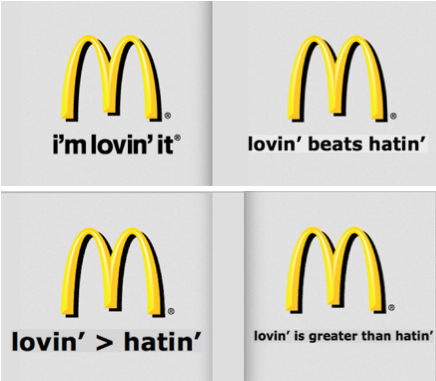
Other marketing ideas from the company aren’t quite as cool, as Copyranter explains of the above images:

[The WSJ] reported that starting in January, McDonald’s is going to launch a new campaign tagged with the childish na-na-na-na-na na! line “Lovin’ Beats Hatin”. The entire internet immediately hate-shat on it. Then [last] week, McDonald’s said that they are not going to use it (yeah, we’ll see), but they did trademark two other phrases, above bottom, which are, as you can see, even more inane.

Being Conscious Of Your Own Circumcision

A reader writes:

I always read your circumcision posts with great interest because both my husband and I are both circumcised and we elected NOT to have our boys (ages seven and eleven) circumcised.  We have no regrets.  Unfortunately, we are now faced with a very unexpected dilemma:  our seven-year-old’s foreskin does NOT functionally retract, and this has caused some problems with urination.  We are also told that this will cause a bigger problem as he matures.  Currently, our urologist has him applying steroid cream treatment four times a day, but this has produced no positive results.  We are NOW faced with very real fact of circumcising our seven-year-old son.  This was the last thing we ever expected and, believe it or not, have never heard of such a condition.  The information available to us via our doctor and online research is both limiting and overwhelming, respectively.

So, as a shot in the dark, I wonder if you and your gifted readers could shed any light on this condition and/or any solutions other than circumcision.

That problem with retraction was apparently why my own willy was mutilated when I was an infant. I have no medical expertise on this … but I bet the Dish collective mind has some. Meanwhile, another reader underscores the difference between circumcising a newborn and a child:

I’m pro-circumcision, but when I saw the story you linked to yesterday about the four-year-old boy in Florida whose father went and obtained a court order to authorize a circumcision, my reaction was “No fucking way!”  My own gut reaction surprised me.  So I stopped and thought further: Wait, why would I be opposed to this boy’s circumcision and not to an infant, when the health benefits cited by the American Academy of Pediatrics would still apply either way?

To answer that question I thought back to an incident at my dentist’s office just this week.

As my dentist and his assistant were working away at my problem tooth I could hear from the next room over a child who was very unhappy about being at the dentist.  The whining and complaining eventually turned into blood curdling screams as his procedure was getting under way.  I’ve never been in the presence of someone being tortured, but I can only imagine that the sounds coming from this child are similar.

I have a small child myself.  It’s heart wrenching to see him in pain or fear when getting an inoculation or exam at the doctor.  All I wanted to do was run into that next dentist’s room, stop whatever was going on, give him the boy a hug and tell him it’s all over.  But that would be wrong.  We (parents) put our kids through these things because we know in the end that the benefits of the shots and the dental work outweigh the pain and psychological trauma the kids experience when it happens.

So what of circumcision then?  Do the benefits outweigh the pain and psychological trauma?  Even as someone who is pro-circumcision, I knew immediately that the benefits for this boy will not outweigh the pain and psychological torture he would suffer by going through the procedure at that age.  A newborn infant heals quickly, cannot even reach his genitals, and has no mental understanding of them.  None of those conditions applies by the time a boy is four.  He should be left alone.  The benefits of circumcision are less notable in a modern clean civilization such as ours – and non-existent when looking at it in the context of what that boy will have to endure.  I pray that no urologist will actually perform this procedure at that father’s request.

While I’m not moved enough to change sides on the overall debate (I still think parents should have this option for their newborns), the whole incident has be thinking and questioning it all.  This would not have happened without the Dish, as I would not have even known about this story with you.  Thanks again for making me think.  Keep the circumcision debate going.