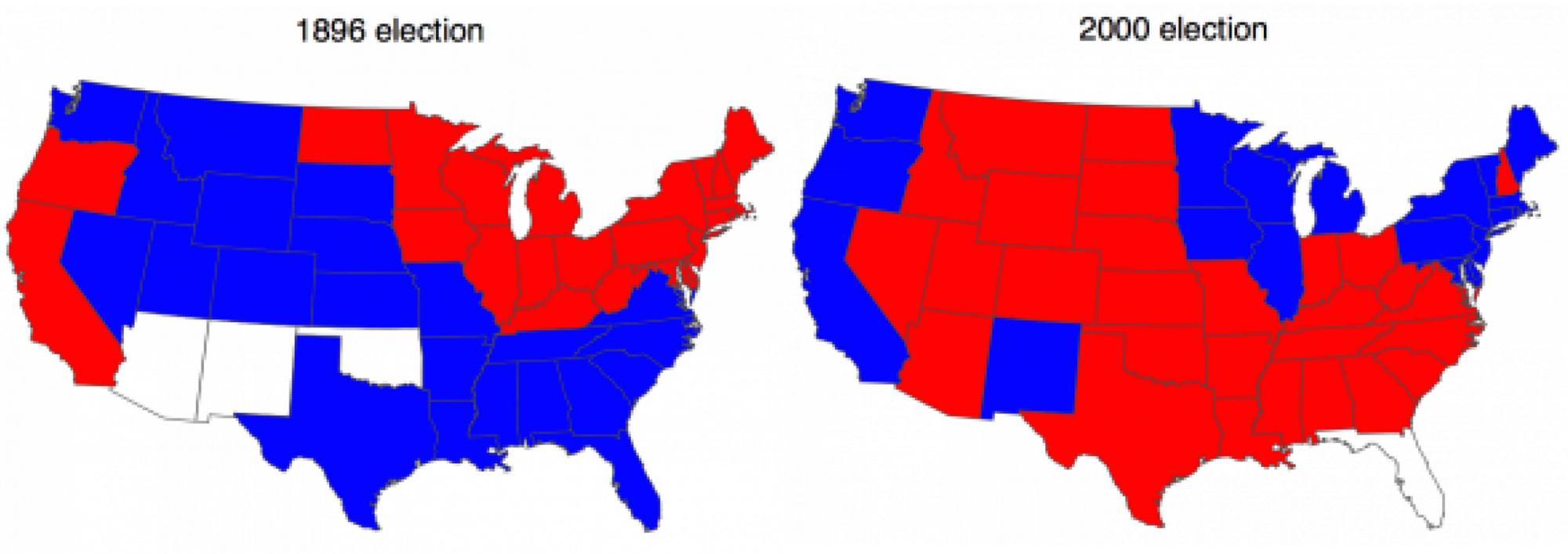
In a new paper (pdf), Andrew Gelman scrutinizes that reversal:
We are used to our current political divides, but in many ways the political alignment of 1896 also makes economic sense, with the richer northeastern states supporting more conservative economic policies. Even in a world in which parties have static positions on issues, there is no obvious way that liberal New Yorkers, say, should vote: should they follow the 1896 pattern and support business-friendly policies that favor local industries, or should they vote as they do now and support higher taxes, which ultimately redistribute money to faraway states with more conservative values? A similar conundrum befalls a conservative Mississippian or Kansan in the other direction.
In that sense, it perhaps is plausible that, although economic issues have been and remain most important in any particular election, social issues can be the determining factor that can, over a century, reverse the electoral map.
No, nothing to do with Social Justice Warriors; the Dish has covered the subject of diversity in the superhero genre since the summer. The latest: Breaking Bad director Michelle MacLaren is in top contention to direct the upcoming Wonder Woman movie. Jesse David Fox notes that “MacLaren would be the first female director in the recent history of major comic-book movies.” Homeland’s Lesli Linka Glatter and The Babadook‘s Jennifer Kent are also in contention. Sean O’Connell speculates on the challenges a female director could face with the project:
The pressure to deliver on the superhero front is being given as a reason why one female director, Lexi Alexander, says she’d never accept the Wonder Woman gig that’s currently being set up at Warner Bros. Alexander hasn’t been offered the job, even though her name is frequently attached to wish-list features (like one we ran recently) because of the work she did on the gritty, bloodthirsty Punisher: War Zone. But in an interview with Fast Company, she spells out why the pressure to deliver on the first female-driven superhero film would be too much to get her into the director’s chair:
We finally get Wonder Woman with a female director: imagine if it fails? And you have no control over marketing, over budget. So without any control, you carry the fucking weight of gender equality for both characters and women directors. No way.
Not exactly a profile in courage. O’Connell continues:
Who will fanboys blame if Wonder Woman isn’t good? If Lexi Alexander feels this way and willingly shares this concern, is it possible that other qualified contenders like Jane Goldman or Michelle MacLaren share this early concern and don’t want to step off of that ledge? I certainly hope this isn’t the case.
I’d like to believe that there are big enough ideas at play in a possible Wonder Woman movie that any director – male or female – could dial in and turn the material into a hit. Audiences are extremely receptive to superhero films, at the moment, and even “failures” like The Amazing Spider-Man 2 earn north of $700 million at the global box office. Wonder Woman seems destined to succeed, just off the curiosity factor, alone. If the studio goes ahead as planned and makes it a period piece – a la Captain America: The First Avenger – the interest level could even be higher than expected.
At the same time, any director contemplating the solo Wonder Woman movie has to deal with a handful of unknowns at the moment. They haven’t see [lead actress] Gal Gadot in action. They don’t know, fully, how the character will be introduced in Zack Snyder’s Batman v Superman: Dawn of Justice. And they don’t know how the movie landscape will change between now and 2017. But that isn’t about being a female director trying to get a foot in the door of the comic-book genre. That’s about being part of the mysterious process of building a Cinematic Universe… and that comes with it’s own unique forms of pressure.
There’s no rule that says that a Wonder Woman movie being about a woman means it has to be directed by a woman. Down that road lies ache; down that road lies “well, then I guess Kathryn Bigelow can’t direct an Aquaman movie, nyah.” The issue is more, for me, that I’ve lost all belief that they’re anywhere close to entrusting a male superhero to a female director, so it’s either this or nothing for the indefinite future.
Anybody tells you different, politely get up and excuse yourself from the room, walk briskly to the elevator, and then sprint out of their building (unless the person is your boss, then just sit there and nod your head like one of those toy dogs in the back of a car).
Josh Marshall makes the point that he didn’t set out to specifically execute a content marketing strategy. That push came after looking at the marketplace. It’s about something all good journalists know, what he calls “high information,” even if the ad information is plainly commercial: “Content marketing is something we fit into this concept. Content marketing is part of high information messaging, and high information ad creation.”
If you have any idea what he’s talking about, you’re, well, far more worldly and better informed than I. But it’s winning:
Making good on a base-baiting campaign promise, Wisconsin Governor Scott Walker plans to push forward with a law that would impose stringent drug testing requirements on welfare recipients:
In Wisconsin, an estimated 836,000 people receive FoodShare benefits, about 40 percent of them children, according to the state Department of Health Services. As of last week, 39,958 people had filed weekly unemployment compensation claims, according to the Wisconsin Department of Workforce Development.
Gillespie calls Walker’s crusade morally repellent, but that’s not the half of it:
Walker is supposed to be tight with a penny, right? That’s part of his, er, charm. Yet his sort of drug-testing is not only repellent on ethical grounds, it’s a clear waste of money.
If a recent program in Missouri is any indication, Wisconsin will be collecting urine by the bucketful to catch very few bad actors (and that assumes smoking dope, say, should be a reason to pull somebody’s benefits). Last year, Missouri started testing suspected drug users (note: suspected, meaning there was at least some hypothetical reason to think a person was using drugs). The state ended up spending $500,000 to test 636 people, of which 20 were found to be using. So around 3 percent of suspects tested positive and each test cost around $786. Before courts ruled Florida’s drug-testing regime illegal, the Sunshine State spent $115,000 on piss tests and ended up coughing up $600,000 in reimbursements to applicants who had been denied benefits.
The Dish has previously covered why these drug testing laws are terrible ideas. Alan Pyke reviews further evidence that they have no basis in reality:
While food stamps recipients are a bit more likely to use drugs casually than the general population according to one study, age is a far better predictor of drug use than economic status or public assistance enrollment. And the raw numbers are too low to justify a dragnet policy of testing everyone who applies, according to critics at the American Civil Liberties Union (ACLU) and the Centre for Addiction and Mental Health in Canada. Just 3.6 percent of welfare recipients qualify as having a drug abuse or dependence problem according to 2011 data. About 8 percent of Americans and 9 percent of Wisconsin residents used drugs in the past month, according to the National Survey of Drug Use and Health.
A federal judge struck down Florida’s infamous drug testing law in January on the grounds that it violated the Fourth Amendment. Even Noah Rothman admits that what Walker is proposing is likely unconstitutional:
Unlike Walker’s union reforms, which inspired a similar level of apoplexy in his Democratic opponents, these reforms may be a legitimate violation of constitutional rights. The state Supreme Court vindicated Walker’s collective bargaining reforms, but the conservative reformer may be setting himself up for a rebuke from the courts with his latest move. While states have slightly more freedom to experiment with similar reforms, federal law prohibits drug testing prospective beneficiaries. In September, Walker told the Milwaukee Journal-Sentinel that he welcomes a fight with the federal government over his proposed reforms. “We believe that there will potentially be a fight with the federal government and in court,” Walker said.
Why would Scott Walker want to set up a fight with the courts and the federal government? The answer seems clear. These reforms are rather popular with base Republican voters, and the institutions which would oppose Walker’s reform are not. This is a pretty clear indication that Walker is interested in translating his successes in Wisconsin into the Republican presidential nomination.
Jeff, who began his foray into pot gastronomy as a hobby, is rapidly turning it into a full-time pot-repreneurial business. He’s been traveling from coast to coast since early 2013 catering to celebrities (he won’t say who) and the upper echelons with a penchant for delectable edibles. His cannabis-infused menus range from truffle tuna casserole and coconut chicken to French toast and omelets. Every meal is included, including desserts and yes, even wedding cakes. The possibilities of the types of cuisine that can be made are endless once you turn pot into butter (or oil) to cook with. …
I had one, small bite of a chocolate cupcake, and was on my ass in an hour. The presence of marijuana was almost unrecognizable. Had I never had an edible before, I wouldn’t have known it was baked with THC. Jeff had warned me that it was a strong batch—and I’m already a lightweight—so when it hit, I could only stay vertical for a short time before I had to call it a night.
Would I eat it again? Hell yes. The taste was that good.
Nicholas Carr muses about the relationship between social media and scrapbooking:
Pinterest makes its scrapbooky nature most explicit, but, really, all social networking platforms are scrapbooks: Facebook, Twitter, Tumblr, Instagram, Flickr, Ello, YouTube, LinkedIn. … Blogs are scrapbooks. Medium’s a scrapbook. A tap of a Like button is nothing if not a quick scissoring. Scrapbooking and data-mining are the yang and the yin of the web: light and dark, aboveground and underground, exposed and hidden. Today’s scrapbooks serve both as a counterweight to the bureaucratic file and as part of the file’s contents. The Eloi’s pastime is fodder for the Morlocks.
Inherently retrospective — a means of preemptively packaging the present as memory — the scrapbook is a melancholy form. Pressed insistently forward, we spend our time arranging the bits and pieces of our lives into something we think looks something like us. If the material scrapbook of old was familial and semiprivate, the new scrapbook is social and altogether public. It’s still a melancholy form, but now it’s an anxious one, too. It’s one thing to construct an idealized life, a “best self,” for your own consumption; it’s another thing to construct one for all to see.
(Image collage from the Instagram account of Zoe Di Novi, beloved Dish alum: “Hat inspiration BFF selfie Saturday.”)
The faux outrage you are drumming up is ridiculous. People are ignorant because Gruber (and Bill Maher) are right: the American public is stupid. All you have to do is look at Jimmy Kimmel’s skit about Obamacare vs the Affordable Care Act or “keep your government hands off my Medicare.” Why do the individual pieces of the ACA poll so well, but the overall law does not? It makes no sense, and no the answer is not the Dems didn’t educate; the answer is people are too effing lazy to learn the truth and are too easily manipulated by nihilists and liars because they choose to remain uneducated. The only thing stupid here was Gruber deciding to pull back the curtain; it would have been better keeping the rubes in the dark.
America should be run by elites. No, that does not mean rich or wealthy, but it does mean smarter and more knowledgeable. It is beyond reason why I, as someone who takes pride in my thirst for knowledge (see reading your blog daily), have to deal with morons who are intellectually lazy yet have the ability to thwart basic and good things that would help me, people I care about, and worse, the people too stupid to understand they are actually being helped. I hate liberal paternalism as much as you do, but sometimes you just need to get shit done.
Another shares that disdain for most Americans’ intelligence:
I would say the fact that the elite journalists treat America as smarter than they are is a big problem. At this point, if the American people don’t understand Obamacare, it is on them. You have the following statistics coming from your gloriously under-appreciated smart public:
According to a survey by the Kaiser Foundation just last year (April), 42 percent of Americans didn’t even know Obamacare was still a law on the books. Some (12 percent) thought it was already repealed by Congress while others (7 percent) believe the Supreme Court overturned it. So why even lie about something that many likely still believe doesn’t exist in the first place? Here’s a few more fun yet disturbing findings to chew on:
– 65 percent can’t name a single Supreme Court justice (Annenberg Public Policy Center). Best part: 27 percent knew Randy Jackson was a judge on American Idol.
– 36 percent of Americans can’t name all three branches of government. Best part: 35 percent can’t name a single branch, period (Annenberg)
But I guess Obama holding a joint session of Congress to explain Obamacare while being called a liar in public is just him not explaining it right.
The point of messaging on this kind of thing is that it should be constant, clear and endlessly repeated. You can’t just give one big speech and expect people with busy lives to keep it in their heads. It can be done – and must be done if this democracy is to mean anything. Another is a bit more nuanced:
Voters are stupid. I would have used the word irrational, but stupid gets the point across. I’m stupid, you’re stupid, most everyone is stupid. One common example of the particular brand of stupidity that economists love to ridicule is loss aversion; if I gave you ten dollars then demanded five back, you would be much less happy then if I just gave you five dollars. If you ask people if they’d rather have a mortgage rebate (free money for owning a house!), or a tax penalty for those people that do not own a home, there would be a pretty clear split. But as long as the government’s books eventually balance, those are the same thing.
Gruber seemed to be saying that people respond irrationally to how things are phrased, so the ACA decided not to raise everyone’s taxes and then give people a rebate for having insurance, even though that would be completely equivalent to the mandate. They also chose not to just tax healthy people and send checks to the less healthy, even though that would have some of the same effects as ending preexisting conditions. You could argue that one way is more or less honest (personally I think the mandate makes sense to the extent that having insurance is a social obligation), but it’s fine to choose the way that most people are comfortable with.
Another reviews some recent history:
One point, somewhat cynical, that I see no one making about the Gruber statement is the fact that whatever misleading arguments were trotted out in support of the ACA while it was being debated in Congress, at least as many misleading arguments were proffered in opposition. The Politifact page for health care is illuminating on this subject, and a good refresher if you fail to recollect how disingenuous the campaign against the bill was.
There was all sorts of general talk about socialized medicine and a government takeover of a sixth of the American economy that is deeply misleading, much more so in my opinion than the esoteric debate over what is a tax and what is a mandate. But beyond generalizations, there were a number of VERY SPECIFIC claims made about the bill, from the notion that it contained “death panels” set up to deny care to elderly patients deemed no longer useful to society, to the assertion that abortions would be directly paid for by tax dollars in contravention of the Hyde Amendment, to Allen West’s bizarre claim that the health care law allowed the federal government to take over education. My favorite of course is the lie that the bill covered the healthcare of undocumented workers, so pervasive that President Obama had to reference and deny it in a speech to a joint session of Congress, only to have a Congressman, falsely, shout “You Lie!” on national television.
These statements did not come from policy experts not directly connected to the ACA or Congress. They came from elected representatives, party officials, and others who should be held to a much higher standard than Jonathen Gruber.
Look, I would have loved nothing more than to have an honest debate in this country about the benefits and trade-offs of the ACA. I would have loved to have had a serious discussion of alternatives, either the ephemeral conservative version or even actual, single-payer socialized medicine. I believe the country would have been much better served, and much less divided, by an honest assessment of the existing situation and exploration of various policy fixes, but that was just never, ever in the cards.
Since the opposition to the bill was ideological, rather than pragmatic, there was just no constructive discussion to be had. And you can’t have that kind of debate when only one side is engaged. You can’t have one side saying “LARGEST TAX INCREASE IN AMERICAN HISTORY” while the other side says, “well, technically not the largest, but in the top dozen or so, if you count the mandate, which isn’t quite right but probably fair, and hey, it’s not like you get nothing in return. Listen…” That’s just lousy politics.
So yes, the President and his allies, Gruber included, sold the best possible (self-serving) narrative to the American voter. This was at at times misleading. The most prominent examples are the “if you like it, you can keep it” fib and the repeated Gruber Gaffes, but in a political environment where much of the oxygen was spent debating ludicrous, unhinged assertions about jack-booted thugs, a sober cost-benefit analysis just wasn’t going to cut it, if the goal was to improve the lives of uninsured Americans, rather than winning on points in Debate Club.
The AP reported yesterday that leaders of ISIS and Jabhat al-Nusra, al-Qaeda’s Syrian affiliate, have agreed to set aside their intra-jihadi feuds and cooperate against their enemies:
According to [a source], two decisions were reached: First, to halt infighting between Nusra and IS and second, for the groups together to open up fronts against Kurdish fighters in a couple of new areas of northern Syria.
This merger, along with growing signs that Washington is resigning itself to Bashar al-Assad’s long-term presence, could be an indication that the overlapping and intersecting battle lines in Syria are starting to clarify themselves. At the moment, the U.S., the Kurds, Iraqi Shiites, and—whether the Obama administration will admit it or not—the Syrian government are on one side, and ISIS and al-Qaida are on the other. The big loser in all of this is likely to be the U.S.-backed rebels.
In addition to ISIS and Nusra finding common cause, there are reports this week that the White House is considering revamping a Syria strategy many senior officials have come to see as unworkable. That strategy, which involved focusing primarily on rolling back ISIS in Iraq and didn’t involve strikes against Assad, never sat well with the rebels. A new one, which could involve a new diplomatic push for a cease-fire deal whose terms would likely be very disadvantageous to the Syrian opposition, would be even worse.
But Aymenn al-Tamimi recommends taking these reports with a grain of salt:
The rift between JN and IS is too great to heal at this point beyond the highly localized alliance between IS and JN in Qalamoun that reflects an exceptional situation where neither group can hold territory alone and both contingents are geographically isolated from members of their groups elsewhere in Syria, in addition to being preoccupied with constant fighting with regime forces and Hezbollah. At the broader level, IS still believes that JN is guilty of “defection” (‘inshiqāq) from IS in refusing to be subsumed under what was then the Islamic State of Iraq [ISI] to form the Islamic State in Iraq and al-Sham [ISIS] back in April 2013. The zero-sum demands of IS have only solidified with the claimed Caliphate status since 29 June demanding the allegiance of all the world’s Muslims. In turn, JN refuses even to recognize IS’ claim to be an actual state, let alone a Caliphate.
In response to this and other recent developments, Gopal Ratnam hints that the Obama administration is “edging closer to establishing a safe zone in northern Syria” for our “moderate” rebel allies:
Setting up such safe zones inside Syria will also address a key demand by Turkey, which sees the Assad regime as a greater threat than the self-proclaimed Islamic State, and has been pushing the United States to set up such areas as a condition for fuller participation in the coalition against the Sunni militant group that is also known as ISIS and ISIL. “If these safe havens are not established in northern Syria, the rebels will be effectively squeezed out by the Assad regime in a short time,” said Soner Cagaptay, director of the Turkish research program at the Washington Institute for Near East Policy. “So this is a last call to maintain and preserve rebel presence in northern Syria.”
Meanwhile, rumors that “caliph” Abu Bakr al-Baghdadi had been injured or even killed in an airstrike were thrown into doubt with the release of a new audio recording of Baghdadi that refers to recent events:
The timing of the recording was unclear, but it referred to Barack Obama’s recent decision to send a further 1,500 US military advisers to train the Iraqi army and to a pledge of allegiance by Egyptian jihadis to the Islamic State last weekend.
In a triumphant survey of what he described as the group’s growing influence, the speaker also mentioned support from Saudi Arabia, Yemen, Libya, Algeria, Tunisia and Morocco. In Saudi Arabia, singled out in the message as the “head of the snake and stronghold of disease”, people were urged to “draw their swords” to fight and to kill Shia Muslims – referred to in pejorative sectarian terms as “rafidah”. Shia worshippers were indeed attacked in a terrorist shooting in the country’s Eastern Province 10 days ago.
The behemoth distributor and the small publishing house settled their long-running dispute over e-book pricing in a deal announced yesterday. While the details of the agreement weren’t made public, David Streitfeld reports that it “broadly follows a deal Amazon recently worked out with Simon & Schuster”:
A source with knowledge of that deal said it was negotiated relatively quickly and gave the publisher control over most of its pricing but offered incentives to sell at lower prices. Amazon got increased co-op funds, the payments for placement on the retailer’s website. Simon & Schuster declined to confirm the terms.
James L. McQuivey, a Forrester analyst, said that if Hachette won in the short term, it would be a different story in the long run. “Hachette got Amazon to allow them to control pricing while also cutting the amount of money Amazon takes if the publisher does engage in discounts, which appears like a victory,” the analyst said. “But in the end this all cements Amazon’s ultimate long-term role in this business, which will only put Hachette right back in this situation every time they are up for renegotiation.”
The deal is undoubtedly good news for Hachette’s authors, but Hillary Kelly is disappointed that the publishers “forfeited all of the gains they had made in the larger battle against Amazon”:
While it certainly would have hurt Hachette in the short-term to keep up the battle, they should have. What’s at stake here is much bigger than the price of e-books. If Amazon continues to interfere in publishers’ pricing decisions, publishers will be forced to produce more and more high-revenue yielding books, which means decisions about who gets published and who doesn’t will trend even further toward who can sell a lot of books and who can’t. That means the variety of books in the marketplace diminishes even further, and readers see fewer and fewer high-risk, high-reward books on physical and digital shelves.
Amazon has proven they can turn off the faucet whenever they please. Hachette could have proven that, with enough support from their friends in the publishing industry, they can force Amazon to keep the water flowing. But they missed their opportunity.



 The Dish