The Internet seen through the lens of Law & Order:
Facebook Regret
Emily McManus points to “one of the most entertaining academic papers ever written” (pdf):
Our research reveals several possible causes of why users make posts that they later regret: (1) they want to be perceived in favorable ways, (2) they do not think about their reason for posting or the consequences of their posts, (3) they misjudge the culture and norms within their social circles, (4) they are in a “hot” state of high emotion when posting, or under the influence of drugs or alcohol, (5) their postings are seen by an unintended audience, (6) they do not foresee how their posts could be perceived by people within their intended audience, and (7) they misunderstand or misuse the Facebook platform. Some reported incidents had serious repercussions, such as breaking up relationships or job losses.
One of many anecdotes cited:
Sometimes, people accidentally post sexual content. One survey2 respondent said, “I accidentally posted a video of my husband and I having sex . . . I didn’t mean to post it, I had accidentally clicked on the video of my daughter taking her first steps and on that video and they both uploaded together . . . I didn’t know I had posted it until the day after, when I logged on again, and saw all the comments from all of our friends and family, and my husbands coworkers (he’s in the army).”
A Poem For Saturday

“To Be Called a Bear” by Robert Graves:
Bears gash the forest trees
To mark the bounds
Of their own hunting grounds;
They follow the wild bees
Point by point home
For love of honeycomb;
They browse on blueberries.Then should I stare
If I am called a bear,
And is it not the truth?
Unkept and surly with a sweet tooth
I tilt my muzzle toward the stary hub
Where Queen Callisto guards her cub,But envy those that here
All winter breathing slow
Sleep warm under the snow,
That yawn awake when the skies clear,
And lank with longing grow
No more than one brief month a year.
(Used with the kind permission of The Robert Graves Copyright Trust. Photo by Flickr user Marshmallow)
Giving The Kid A Bottle
Max Fisher points to a study by UNICEF debunking some assumptions about which Europeans start drinking at a young age:
Despite the strong wine cultures in Italy, France and Spain – or maybe because of them, given the degree to which it cultivates drinking “to enjoy,” as I’ve heard many French say – children in those countries are among the least likely to get drunk.
Kids appear to be much more likely to get drunk in former Soviet states, particularly the Baltic states and Finland, the latter of which might be a surprise given that its kids otherwise score among the highest well-being in the Western world. That may be a partial legacy of Soviet bloc drinking culture, which have the highest alcohol consumption rates in the world and tend to be plagued by alcoholism.
The US ranks last in the surveyed countries.
Face Of The Day

If Dalí were a bird, he’d be an Inca Tern:
Found along the rocky Pacific coastline, from northern Peru south to central Chile, the uniquely plumaged bird is easily recognizable for its dark grey body, its red-orange beak and feet and, of course, that curling white mustache. Sadly, its population has decreased at a rapid rate due to the loss of suitable nesting areas. They’re only an estimated 150,000 left, classifying them as near threatened.
(Photo by Maks Rozenbaum)
Bourgeois Babbling
William Deresiewicz points out that the distortion of the English language often starts with the elite:
There is a lesson here. Idiomatic mistakes, at least the ones that stick, are not produced by the hoi polloi. They happen when people try to sound educated—or to be precise, when educated people try to sound more educated than they actually are. A little learning is a dangerous thing. You hear a word like vagariesor misnomer, you think it sounds impressive, you think you know what it means, and you deploy it the next chance you get. And then somebody who has less cultural capital than you, and who looks to you as an authority, picks it up and uses it in turn.
Mental Health Break
Enjoy, stoners:
Comprehending E-text
Ferris Jabr goes through the research suggesting that e-reading may come up short when it comes to comprehension and memory:
[E]vidence from laboratory experiments, polls and consumer reports indicates that modern screens and e-readers fail to adequately recreate certain tactile experiences of reading on paper that many people miss and, more importantly, prevent people from navigating long texts in an intuitive and satisfying way. In turn, such navigational difficulties may subtly inhibit reading comprehension. Compared with paper, screens may also drain more of our mental resources while we are reading and make it a little harder to remember what we read when we are done. A parallel line of research focuses on people’s attitudes toward different kinds of media. Whether they realize it or not, many people approach computers and tablets with a state of mind less conducive to learning than the one they bring to paper.
The View From Your Window
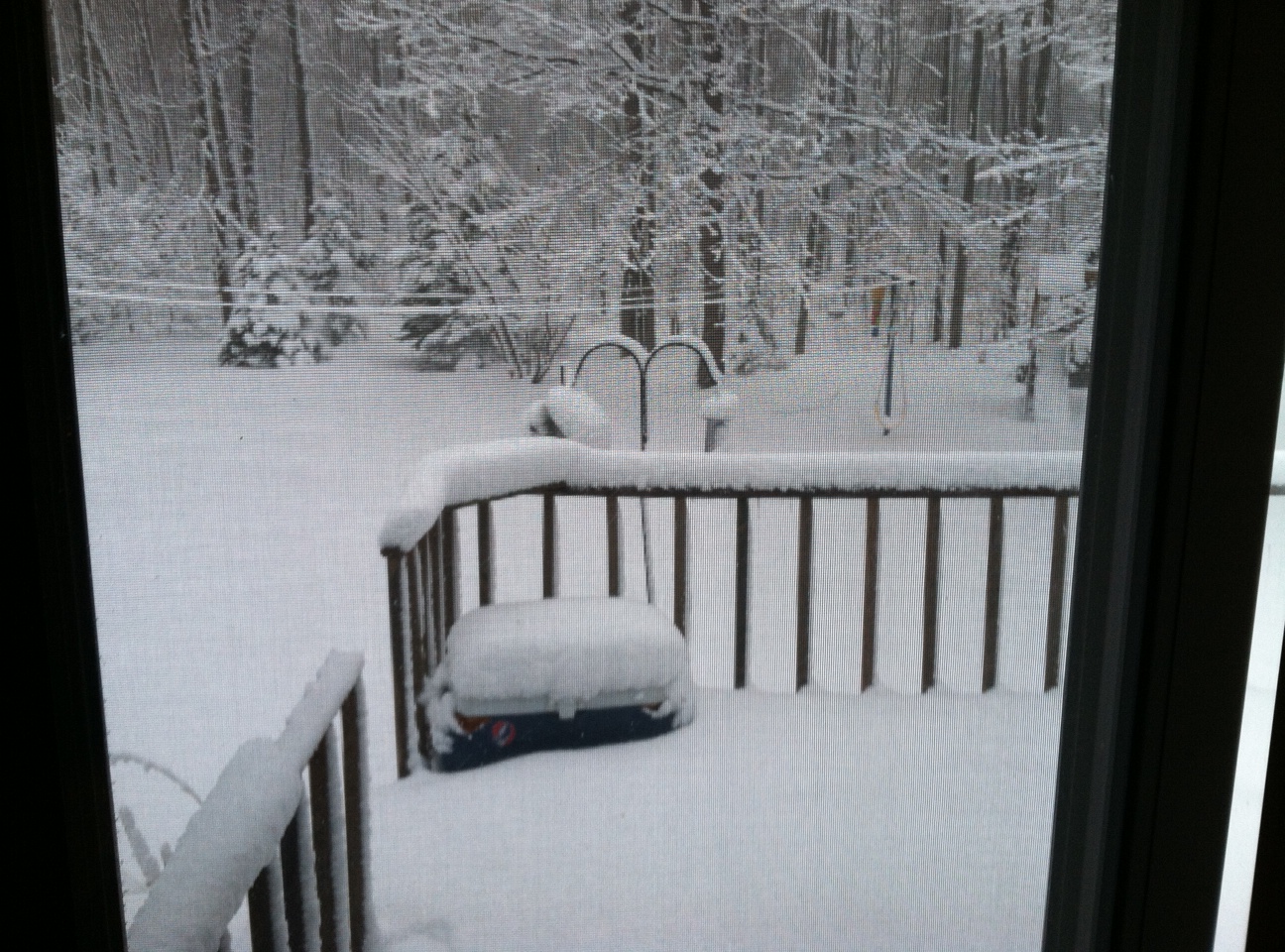
Isle, Minnesota, 7.44 pm
The Finer Points Of Failure
Tom Jokinen isn’t afraid of falling short:
Making friends with failure is different than squinching your eyes shut and hoping it will go away. The latter is called the Oprah Law of Cause and Effect, which says that bad luck is always just a prelude to success. Think positive, visualize, seize the day, listen to Adult Contemporary music and ride out the bad, because the good always comes… always! The genius of the Law is that you can’t prove it wrong: you can fail all your life, but there’s still tomorrow. This is the logic of slot machines. Keep feeding it twenty dollar bills, like a reverse-ATM, and if it won’t pay out that only means it’s hot. Only an idiot would quit while he’s behind.
Gambling is rational. It’s an act of pure potential. Believing in failure as a necessary condition of life, on the other hand, is not rational, it’s mystical and counter-intuitive, until you make friends with it—not to encourage failure but to keep it from surprising you. Which is what artists and some veteran ball players are able to understand: misfortune is always there, we can manage it or ignore it, but if we ignore it the inevitable bite is that much deeper. In his short novel Seize The Day, Saul Bellow runs his hero Tommy Wilhelm through an existential wringer like God hammering Job, not as a moral lesson but to say: this is how it is. Not only does shit happen but for most of us it never goes away.
Bellow, in Seize The Day:
… since there were depths in Wilhelm not unsuspected by himself, he received a suggestion from some remote element in his thoughts that the business of life, the real business–to carry his particular burden, to feel shame and impotence, to taste the quelled tears–the only important business, the highest business was being done. Maybe the making of mistakes expressed the very purpose of his life and the essence of his being here.

