Our Climate Pact With China, Ctd

Jack Goldsmith calls the emissions reductions “aspirational”:

US China Emissions[T]he two sides do not promise to, or state that they will, reduce emissions by a certain amount. Rather, they state only that they intend to achieve emissions reductions and to make best efforts in so doing.  Whether and how the goals expressed in these intentions will be reached is left unaddressed, and one nation’s intention is not in any way tied to the other’s.  Nor would it be a violation of the “announcement” if either side’s best efforts fail to achieve the intended targets.  As we have seen with a lot with climate change aspirations, intentions are easy to state, and they change over time.  The key point is that this document in no way locks in the current intentions.  In fact it creates no obligations whatsoever, not even soft ones (except that, in a different place, both sides “commit” to “reaching an ambitious … agreement” next year, an empty commitment).  It is no accident that the document is called an “announcement” and not a treaty or pledge or even an agreement.

Tyler Cowen also provides a reality check:

First, China is notorious for making announcements about air pollution and then not implementing them.

This is only partially a matter of lying, in part the government literally does not have the ability to keep its word.  They have a great deal of coal capacity coming on-line and they can’t just turn that switch off.  They’re also driving more cars, too.

Second, China falsifies estimates of the current level of air pollution, so as to make it look like the problem is improving when it is not.  Worse yet, during the APEC summit the Chinese government blocked the more or less correct estimates coming from U.S. Embassy data, which are usually transmitted through an app.  A nice first step to the “deal” with the United States would have been to allow publication (through the app) of the correct numbers.  But they didn’t.  What does that say about what one might call…”the monitoring end”…of this new deal?

Chris Mooney is more upbeat:

[T]he experts underscore that this deal has a symbolic value that goes far beyond the literal emissions cuts (or caps) that have now been pledged, precisely because the world’s top two greenhouse gas emitters have now both come to the table. If the agreement lays the groundwork for a broader global agreement — one that encompasses other major emitters like India, Japan, and Russia — then that is the real payoff. That agreement could happen in Paris in late 2015, when the nations of the world gather to try to achieve a global agreement to cut greenhouse gas emissions.

What Michael Levi will be keeping an eye on:

I wouldn’t expect much more negotiation over either U.S. or Chinese targets, even though European leaders may want to have a discussion. Over the next year, rather than focus on any haggling over emissions numbers, it will be worth watching three things. What will the remaining details of the Chinese plan look like? How will the U.S. goals be received politically – and could they spook a Congress currently considering how much to try to interfere with pending EPA regulations? And, perhaps most important, could this display of pragmatic U.S.-China diplomatic cooperation be a sign of more to come in international climate change diplomacy – which will need to go well beyond target-setting – over the coming year?

Scott Moore reads the fine print:

Other areas covered by the agreement include new partnerships linking water scarcity and sustainable energy, a demonstration project for carbon capture and storage (CCS), and a sustainable cities initiative. Integrating energy and water issues promises to expand U.S. – China climate cooperation from an almost exclusive focus on emissions mitigation to one that also helps both countries adapt to climate change. Greater cooperation on CCS, meanwhile, will help develop a technology that is needed to help wean the world off fossil fuels by storing carbon dioxide deep underground instead of releasing it into the atmosphere.  The sustainable cities initiative, finally, builds on dynamic sub-national action on climate change in both the United States and China, with the leaders of places as diverse as New York and Jiangsu Province pledging to work together to reduce emissions.  Washington must devote serious resources to ensure that these initiatives fulfill their promise.

Max Fisher puts the announcement in context:

[I]t’s a very promising precedent of the two countries working together as global leaders on difficult issues. Over the next century, the US and China are going to face many, many more global issues on which they disagree, but on which they will both be better off if they cooperate. Indeed, the world as a whole is better served by Chinese and American cooperation and joint leadership. That’s why even Chinese state-run media is trumpeting the climate deal as “highlight[ing] a new type of major-country relations.”

But Alexa Olesen finds that China is downplaying the news at home:

Deborah Seligsohn, an expert on the Chinese environment at the University of California San Diego, told FP that Chinese leaders “tend not to enthuse,” so that may in part explain Xi’s reserve. But she also said that Beijing is under fire domestically for its unsuccessful efforts to curb local air pollution, noting that people were furious that authorities managed to clear the air for the visiting APEC dignitaries but can’t do it on a daily basis for their own citizens. ” There may be worries that focusing on climate change rather than air pollution doesn’t meet the public’s main concerns,” Seligsohn said via email.

And Michael Grunwald keeps focused on the role technology must play:

You don’t see the U.S. or China ditching oil yet, because when it comes to transportation, there’s nothing cost-competitive with oil yet. Electric vehicles are getting cheaper, and their sales are doubling every year, but internal combustion engines still rule. No international agreement will change that—and until there are viable alternatives to oil, international agreements that try to change that by fiat will end up being ignored. Ultimately, it’s unrealistic to expect developing countries or developed countries to ignore the short-term economic interests of their people, even when medium-term environmental disaster looms.

After all, the end of the Stone Age had nothing to do with stones at all. It ended when the world found stuff it liked better. It ended when better technology could do the same things more efficiently. Governments can do a lot to promote cheaper alternatives to fossil fuels, but the Fossil Fuel Age won’t end until they’re here.

Everything else is just words.

Earlier Dish on the agreement here.

(Chart from Philip Bump)
The State Of Global Gay Rights

Rights And GDP

Jay Michaelson offers an overview:

Two reports released Tuesday contain some surprising new conclusions about why some countries are more accepting of sexual minorities than others. It’s not quite religion, and not quite homophobia. It’s the economy, stupid.

The first report, “Public Attitudes about Homosexuality and Gay Rights Across Time and Countries,” was produced by the Williams Institute at UCLA School of Law and NORC at the University Chicago, and is essentially a survey of surveys, ultimately comprising 2,000 individual survey questions. … Economic development seems to matter most. According to Andrew Park and Andrew Flores of the Williams Institute, “Residents of countries whose economies that are in the top quartile are on average twelve times more likely to be supportive of homosexuality than residents of countries who economies are in the bottom quartile.”

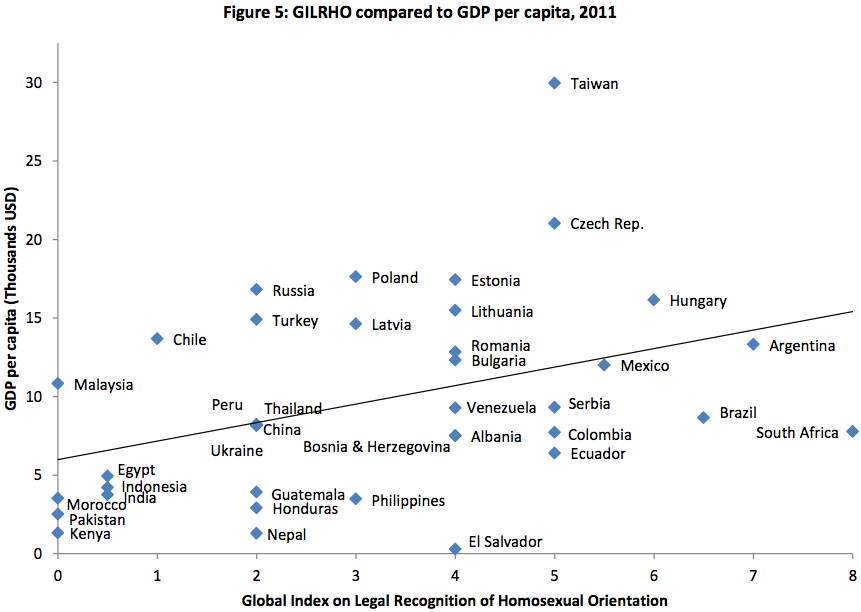
The second report, “The Relationship between LGBT Inclusion and Economic Development: An Analysis of Emerging Economies,” was produced by the Williams Institute at the UCLA School of Law, this time in partnership with the U.S. Agency for International Development (USAID), and studied 39 emerging economies. It, too, shows an overall increase in pro-LGBT policies. Using the Global Index on Legal Recognition of Homosexual Orientation (GILRHO), a new metric of eight categories of legal protection created by Dutch law professor Kees Waaldijk, it finds that the average number of SOGI rights went from one in 1990 to more than three by 2011. And again, money matters. In a neat statistic, the report shows that each additional right in the GILRHO is associated with approximately $320 in GDP per capita.

Michaelson mulls over the relationship:

Which is the chicken and which is the egg? Intuition would suggest that economic development is the cause, and pro-gay policies are the effect. The more affluent a society, the more educated, the more democratic, the more networked, and so on. But the report also suggests that anti-gay policies may harm economic development. The discrimination against, marginalization of, and criminalization of LGBT people removes them from the job market, among other things. “This research delineates the macro- and micro-level costs of not having an LGBT-inclusive workforce,” said Stephen O’Connell, USAID’s chief economist.

The Road To Libertarian Utopia

Brian Doherty lauds the now-shuttered black market Silk Road as “pretty close to a perfect site in a perfect agorist anarcho-world”:

The anonymous folk running Silk Road professed they were on a mission to do more than make money. They were out to demonstrate something important about the combination of crypto and Bitcoin: that a world made by freely chosen, private, uncoerced transactions was possible and mostly beautiful. When asking people to support Silk Road, its operator Dread Pirate Roberts once wrote, “Do it for me, do it for yourself, do it for your families and friends, and do it for mankind.” They believed in the power of agorism-the variant of libertarianism that valorizes and promotes black markets as spaces where people can live in freedom, rather than struggling fruitlessly to change the political system.

It wasn’t just the people running Silk Road who saw something wholesome in the site. In a May working paper, David Decary-Hetu, a criminologist at the University of Lausanne, and Judith Aldridge, a law professor at the University of Manchester, pointed out that Silk Road-style drug sales drastically reduced the comparative advantage that credible threats of violence brought to a drug enterprise. Good communication, good customer service, and good product were now the keys to success, not muscle.

“Call It The Stupidity Of The American Voter”

This video of Obamacare architect Jon Gruber is going viral:

Money quote:

The bill was written in a tortured way to make sure CBO did not score the mandate as taxes. If [CBO] scored the mandate as taxes, the bill dies. Okay, so it’s written to do that. In terms of risk-rated subsidies, if you had a law which said that healthy people are going to pay in — you made explicit that healthy people pay in and sick people get money — it would not have passed … Lack of transparency is a huge political advantage. And basically, call it the stupidity of the American voter, or whatever, but basically that was really, really critical for the thing to pass.

Gruber has apologized for the remarks. The White House is distancing itself while Republicans are talking about making Gruber testify. Suderman feels the video “validates much of what critics have said about the health care law, and the tactics used to pass it, for years”:

For one thing, it is an explicit admission that the law was designed in such a way to avoid a CBO score that would have tanked the bill. Basically, the Democrats who wrote the bill knowingly gamed the CBO process.

It’s also an admission that the law’s authors understood that one of the effects of the bill would be to make healthy people pay for the sick, but declined to say this for fear that it would kill the bill’s chances. In other words, the law’s supporters believed the public would not like some of the bill’s consequences, and knowingly attempted to hide those consequences from the public.

Most importantly, however, it is an admission that Gruber thinks it’s acceptable to deceive people if he believes that’s the only way to achieve his policy preference.

Philip Klein goes further:

Gruber, in a moment of candor, acknowledged what has always been true about Obamacare and liberalism — that the masses have to be tricked into ceding control to those who know what’s best for them.

But Tyler Cowen is uninterested “in pushing through the mud on this one”:

It’s a healthy world where academics can speak their minds at conferences and the like without their words becoming political weapons in a bigger fight.  Or how about blogs?: do we want a world where no former advisor can write honestly about the policies of an administration?  I’ve disagreed with Gruber from the beginning on health care policy and I thought his ObamaCare comic book did the economics profession — and himself — a disservice.  But I’m simply not very interested in his proclamations on tape, which as far as I can tell are mostly correct albeit overly cynical.  (If anything he is overrating the American voter — most people weren’t even paying close enough attention to be tricked.)

Neil Irwin is likewise underwhelmed by the comments:

Mr. Gruber was exposing something sordid yet completely commonplace about how Congress makes policy of all types: Legislators frequently game policy to fit the sometimes arbitrary conventions by which the Congressional Budget Office evaluates laws and the public debates them. … This kind of gamesmanship is very much a bipartisan affair. President George W. Bush’s expansion of Medicare in 2003 was carefully designed so that its costs were backloaded, rising sharply just after its 10-year mark. Estimating costs in the 10-year window is an (arbitrary) convention for C.B.O. scoring of pending legislation. The design of the law made it seem less costly than it was expected to be over a longer time period.

Drum weighs in:

First, he noted that it was important to make sure the mandate wasn’t scored as a tax by the CBO. Indeed it was, and this was a topic of frequent discussion while the bill was being debated. We can all argue about whether this was an example of the CBO scoring process being gamed, but it has nothing to do with the American voter. Rather, it has everything to do with the American congressman, who’s afraid to vote for anything unless it comes packaged with a nice, neat bow bearing an arbitrary, predetermined price tag.

As for risk-rated subsidies, I don’t even know what Gruber is talking about here. Of course healthy people pay in and sick people get money. It’s health insurance. That’s how it works. Once again, this was a common topic of discussion while the bill was being debated—in fact, one that opponents of the bill talked about constantly. They complained endlessly that healthy young people would pay relatively higher rates than they deserved, while older, sicker people would get a relative break on their premiums. This was no big secret, but the bill passed anyway.

Beutler notes that “nearly everyone who’s attacking Gruber as if he were a White House political employee or a Democratic senator is simultaneously trying to require the Congressional Budget Office to say that tax cuts pay for themselves”:

The people who brought you the phony arithmetic of the Bush tax cuts and Medicare Part D and the self-financing Iraq war are upset about the ACA, which is genuinely fiscally sound. By any reasonable standard, ACA respected budgetary constraints much better than most other laws. That the authors took pains to meet concrete budgetary goals actually underscores the point that they took CBO, and budgetary questions in general, very seriously. If they didn’t take CBO seriously, they could’ve just ignored it, or fired the messenger. That’s what the George W. Bush administration threatened to do when the chief Medicare actuary prepared to say the Part D drug benefit would cost more than the White House was letting on.

And Chait’s take:

“Stupidity” is unfair. Ignorance is a more accurate term. Very few people understand economics and public policy. This is especially true of Obamacare — most Americans are unaware of the law’s basic functions or even whether their state is participating.

Since people know so little about public policy in general and health-care policy in particular, they tend to have incoherent views. In health care and other areas, they want to enjoy generous benefits while paying low taxes and don’t know enough details to reconcile those irreconcilable preferences. Gruber’s error here is that, by describing this as “stupidity” rather than a “lack of knowledge,” he moves from lamenting an unfortunate problem both parties must work around to condescending to the public in an unattractive way.

Huckabee 2016?

The former governor and current Fox News pundit may be gearing up for another presidential run. Luke Brinker takes him seriously:

While it’s early yet, public polling places Huckabee near the top of the GOP’s field; according to RealClearPolitics’ polling average, he’s in a statistical tie for first place with Rand Paul, Bush, Christie and Paul Ryan. Huckabee certainly stands an excellent chance of once again winning the Iowa caucuses, where RCP gives him a 6.2 point lead over Ryan, his nearest competitor. What’s more, his net favorability rating is the highest among the Republican pack, although a surprising number of voters remain unfamiliar with him.

Douthat deduces that a Huckabee campaign “is probably good news for Team Rand, since Huck is more likely to take votes (at least initially) from potential Paul rivals like Cruz than he is from Paul himself”:

As for Huckabee’s own odds of winning the nomination … well, they’re probably slightly better than the press and the political class assumes, because he’s a gifted politician who appeals the most important G.O.P. constituency, has a Fox News fan base and substantial gubernatorial experience, and polls as well as anyone at the moment.

But speaking as a longtime Huckenfreude afficianado, I think it’s fair to say that his moment (if there was one) came and went in 2012, a year when the party’s populists cycled through every possible anti-Romney candidate before finally settling on Rick Santorum and then losing (but surprisingly narrowly) with him. In those circumstances, what you might call Huckabee’s “Teavangelical” appeal and genuine populist background probably would have given him a better shot than Santorum or Gingrich (or Cain or Bachmann or help me I’m having flashbacks) at defeating Romney, who was, let’s face it, pretty much his ideal foil. But in 2016, with a much stronger field that might actually feature a little more populist substance and fewer corporate raider gazillionaire candidates, it’s much harder to see how Huckabee would expand beyond his big-in-Iowa base. At best, he’d be an important spoiler; at worst, his voters would ultimately jump to Cruz or Carson or even Rubio before the first ballot was even cast.

Larison dreads a Huckabee run:

On foreign policy, Huckabee has always been a hawk, but he went from occasionally saying somewhat sensible things during the 2008 campaign to being a predictable, awful hard-liner since then. In fact, he always was a hard-liner on some issues. His views on Israel and Palestine are so unreasonable that his presence in the 2016 field could only make the Republican debate on foreign policy much worse than it already will be. Especially if Santorum also chooses to run again, a Huckabee campaign would appear to add nothing to the debate that won’t already be there.

Waldman sizes up the growing GOP field:

Huck will certainly stand out as the friendliest, happiest candidate in a phalanx of grim and angry contenders. And there sure will be a lot of them. The RNC recently sent out a straw poll to its supporters and included a remarkable 32 candidates. Many of them won’t actually be running (I’m doubtful that “Ready For Pawlenty” is gaining steam), but I count no fewer than 15 Republicans whom I’d say were more likely than not to run. They’ll all be playing “Who’s the most conservative?” while bludgeoning each other desperately, and with Huckabee in the race, there’ll be no shortage of folksy aphorisms. It’s going to be a lot of fun.

Lab-Grown Ghosts

Joshua Krisch flags new research into the neurological basis of a ghostly presence:

Feeling of Presence, or FoP, is the disconcerting notion that someone else is hovering nearby, walking alongside you or even touching you. It’s the stuff of ghost stories, but also a real symptom of several neurologic conditions, including schizophrenia and Alzheimer’s disease. Scientists know so little about the underlying causes of FoP that long-term treatments and cures remain illusive.

Now, researchers are chipping away at the neurobiology behind that uncanny feeling. In a paper published November 6 in Current Biology, a team of scientists described how they used a custom-built robot to induce an eerie Feeling of Presence in healthy participants. Their findings confirm that sensorimotor conflict, a neurologic imbalance between what the mind perceives and what the body feels, lies at the root of some FoP illusions.

Rebecca Morelle discusses the study’s methodology:

To investigate, the researchers scanned the brains of 12 people with neurological disorders, who had reported experiencing a ghostly presence. They found that all of these patients had some kind of damage in the parts of the brain associated with self-awareness, movement and the body’s position in space.

In further tests, the scientists turned to 48 healthy volunteers, who had not previously experienced the paranormal, and devised an experiment to alter the neural signals in these regions of the brain. They blindfolded the participants, and asked them to manipulate a robot with their hands. As they did this, another robot traced these exact movements on the volunteers’ backs. When the movements at the front and back of the volunteer’s body took place at exactly the same time, they reported nothing strange. But when there was a delay between the timing of the movements, one third of the participants reported feeling that there was a ghostly presence in the room, and some reported feeling up to four apparitions were there. Two of the participants found the sensation so strange, they asked for the experiments to stop.

The robot is demonstrated in the above video. Morelle adds:

The researchers say that these strange interactions with the robot are temporarily changing brain function in the regions associated with self-awareness and perception of the body’s position. The team believes when people sense a ghostly presence, the brain is getting confused: it’s miscalculating the body’s position and identifying it as belonging to someone else. Dr Rognini said: “Our brain possesses several representations of our body in space. Under normal conditions, it is able to assemble a unified self-perception of the self from these representations. But when the system malfunctions because of disease – or, in this case, a robot – this can sometimes create a second representation of one’s own body, which is no longer perceived as ‘me’ but as someone else, a ‘presence.'”

Julie Beck notes, “Aside from just being cool and spooky, this study could have real implications for how science understands schizophrenia”:

It’s possible that the signal confusion Rognini describes could account for some symptoms schizophrenia patients experience—like feeling as though they’re being controlled by an alien presence, for example. That’s why the researchers’ next steps are to get schizophrenia patients to try out the robot, and see if the effect it produces feels similar to their symptoms.

It also reveals something interesting about consciousness in general – that it’s not necessarily a given that our brains always understand what our bodies are doing, or even that they’re our bodies. “The brain has multiple representations of the body,” Rognini says, “and these are usually integrated together and give us a unitary experience of the body and self in space and time. We show that when there is some damage to the brain or some trick played by a robot, a second representation of our body arises in a way that gets perceived by us but not as our body but as the presence of another human being. Physically this presence is already hidden inside our minds.”

Getting To The Head Of The Class

Carl Chancellor and Richard D. Kahlenberg argue that when it comes to education, economic segregation is worse than racial segregation:

African American children benefited from desegregation, researchers found, not because there was a benefit associated with being in classrooms with white students per se, but because white students, on average, came from more economically and educationally advantaged backgrounds. All-black schools that included the sons and daughters of doctors and lawyers and teachers alongside the offspring of less-advantaged parents often provided excellent educational environments because the economic, not racial, mix drives academic strength.

The solution, they say, is school choice:

School officials today emphasize public school choice – magnet schools and charter schools – to accomplish integration, having long rejected the idea of compulsory busing that gave families no say in the matter. In Hartford, Connecticut, for example, magnet schools with special themes or pedagogical approaches often have long waiting lists of white middle-class suburban families who are seeking a strong, integrated environment.

While many charter schools further segregate students, some are consciously seeking to bring students of different economic and racial groups together. The Denver School of Science and Technology, for example, uses a lottery weighted by income or geography to ensure a healthy economic mix in its seven middle schools and high schools. …

Today, more than eighty school districts, from Cambridge, Massachusetts, to Raleigh, North Carolina, to Champaign, Illinois, promote socioeconomic integration, almost always relying on choice. These districts educate more than four million students nationally.

But as Sara Neufeld notes, charter schools around the country are struggling with a separate problem – teacher turnover:

Since the “no excuses” movement began in the mid-1990s, its schools developed a reputation for attracting teachers who are young, idealistic and often white, available to families around the clock until they leave after a few years. Sometimes they’re ready to have children of their own or move on to more lucrative career prospects; other times they’re just tired. The phenomenon has been blasted for depriving students of stable adult relationships and creating mistrust in minority neighborhoods when white teachers serving black and Hispanic students come and go. So now the focus is sustainability.

The Best Of The Dish Today

Happy reunited 25th, Berlin:

A reader comments on our WAM/Twitter coverage:

I should clarify that I have disagreed with you many, many times before, but I have still enjoyed your writing and thinking on whatever issue. However, on this topic, I’ve found your approach very disheartening. Especially as you have frequently acknowledged your “outsider” status in this topic (video game culture, Twitter discourse between men and women, women in formerly “male” spaces, the objectification of women, etc.), I’ve found it disappointing that you wouldn’t attempt at least some more empathy and observation before jumping into the middle of the fray. I think this is a very important cultural discussion happening right now, and I feel you’re not treating it with the nuance and respect it deserves. I appreciate the reply, and thank you for all of your great writing and advocacy for many great causes over the years.

I never expect readers to agree or even sympathize with what I have to say, which is why almost everyone who comes up to me on the street begins any words of praise with “I don’t agree with everything you have to say, but …” It’s also why the Dish has been publishing lots of reader input and other voices challenging me – edited and curated by my colleagues. For example, there’s the long tough dissent posted today. Another from a woman on my gamergate blogging can be found here. Many more smart readers here, herehere. Our airing of other bloggers’ views different from mine can be found hereherehere and here. Much of it is extremely nuanced, and it’s the overall mix you should judge the Dish on – not my peculiar emphases or blind spots.

Still, I’m not budging from my basic position: first against harassment, threats, and stalking, but secondly also against the attempt to police the discourse in the name of social justice. Sticks and stones and all that …

Some light relief: I’m loving the thread on literary hangovers; and this parody of the Hollaback video is a hoot. Two heavy hitters: my dissent against a war we cannot win in a place we need to leave; and the growing threat of an increasingly reckless Putin.

The two most popular posts of the day were both about Twitter’s recourse to a “gender justice” group to nominate tweeters for suspension.

Many of today’s posts were updated with your emails – read them all here.  You can always leave your unfiltered comments at our Facebook page and @sullydish. 22 more readers became subscribers today. You can join them here – and get access to all the readons and Deep Dish – for a little as $1.99 month. Gift subscriptions are available here. Dish t-shirts are for sale here, including the new “Know Dope” shirts, which are detailed here.

See you in the morning.

What Washington Refuses To Admit

[Re-posted from earlier today]

Let me put this as baldly as I can. The US fought two long, brutal wars in its response to the atrocity of September 11, 2001. We lost both of them – revealing the biggest military machine in the history of the planet as essentially useless in advancing American objectives through war and occupation. Attempts to quash Islamist extremism through democracy were complete failures. The Taliban still has enormous sway in Afghanistan and the only way to prevent the entire Potemkin democracy from imploding is a permanent US troop presence. In Iraq, we are now confronting the very same Sunni insurgency the invasion created in 2003 – just even more murderous. The Jihadism there has only become more extreme under a democratic veneer. And in all this, the U.S. didn’t just lose the wars; it lost the moral high-ground as well. The president himself unleashed brutal torture across all theaters of war – effectively ending any moral authority the US has in international human rights.

These are difficult truths to handle. They reveal that so many brave men and women died for nothing. And so we have to construct myths or bury facts to ensure that we maintain face. But these myths and amnesia have a consequence: they only serve to encourage Washington to make exactly the same mistakes again. To protect its own self-regard, Washington’s elite is prepared to send young Americans to fight in a war they cannot win and indeed have already lost. You see the blinding myopia elsewhere: Washington’s refusal to release the Senate Intelligence Committee’s report on torture merely proves that it cannot face the fact that some of the elite are war criminals tout simple, and that these horrific war crimes have changed America’s role in the world.

What infuriated me about the decision to re-start the Iraq War last August – by a president explicitly elected not to do any such thing – was its arrogance, its smugness, and its contempt for what this country, and especially its armed forces, went through for so many long years of quagmire and failure. Obama and his aides revealed that their commitment to realism and not to intervene in Syria could be up-ended on a dime – and a war initiated without any debate in Congress, let alone a war authorization. They actually believed they had the right to re-start the Iraq War – glibly tell us it’s no big deal – tell us about it afterwards, and then ramp up the numbers of combat forces on the ground to early Vietnam levels.

This is not just a Republican fixation. It’s a function of the hegemony reflexively sought by liberal internationalists as well. Just listen to Jon Stewart calling Samantha Power’s smug bluff last night:


It was one of Stewart’s best interviews in a long while. One telling moment comes when Stewart asks Power why, if the threat from ISIS is “existential”, the regional powers most threatened by it cannot take it on themselves. She had no answer – because there is none. The US is intervening – despite clear evidence that it can do no real good – simply to make sure that ISIS doesn’t actually take over the country and thereby make president Obama look bad. But the IS was never likely to take over Kurdistan or the Shiite areas of Iraq, without an almighty struggle. And our elevating ISIS into a global brand has only intensified its recruitment and appeal. We responded, in other words, in the worst way possible and for the worst reasons possible: without the force to alter the underlying dynamic, without a breakthrough in multi-sectarian governance in Baghdad, without the regional powers taking the lead, without any exit plan, and all to protect the president from being blamed for “losing Iraq” – even though “Iraq” was lost almost as soon as it was occupied in 2003.

My point is this: how can you behave this way after what so many service-members endured for so long? How can you simply re-start a war you were elected to end and for which you have no feasible means to achieve victory?

The reason, I fear, is that the leadership in both parties cannot help themselves when they have a big shiny military and see something they don’t like happening in the world. If they can actually decide to intervene in a civil war to suppress an insurgency they couldn’t fully defeat even with 100,000 troops in the country, without any direct threat to national security, they can do anything. Worse, our political culture asks no more of them. The Congress doesn’t want to take a stand, the public just wants beheadings-induced panic satiated by a pliant president (who is then blamed anyway), and the voices that need to be heard – the voices of those who fought and lost so much in Iraq – are largely absent.

That’s why I found this op-ed in yesterday’s NYT so refreshing. A former lieutenant general in Iraq reminds us of the facts McCain and Obama both want to deny:

The surge in Iraq did not “win” anything. It bought time. It allowed us to kill some more bad guys and feel better about ourselves. But in the end, shackled to a corrupt, sectarian government in Baghdad and hobbled by our fellow Americans’ unwillingness to commit to a fight lasting decades, the surge just forestalled today’s stalemate. Like a handful of aspirin gobbled by a fevered patient, the surge cooled the symptoms. But the underlying disease didn’t go away. The remnants of Al Qaeda in Iraq and the Sunni insurgents we battled for more than eight years simply re-emerged this year as the Islamic State, also known as ISIS.

To go back in and try to do again with no combat troops what we could not do with 100,000 is a definition of madness brought on by pride. It is to restart the entire war all over again. It makes no sense – except as political cover. I was chatting recently with an officer who served two tours of duty in Iraq, based in Mosul. I asked him how he felt about ISIS taking over a city he had risked his life to save. And I can’t forget his response (I paraphrase): “Anyone who was over there knew right then that as soon as we left, all this shit would happen again. I’m not surprised. The grunts on the ground knew this, and saw this, but the military leadership can’t admit their own failure and the troops cannot speak out because it’s seen as an insult to those who died. And so we keep making the same fucking mistakes over and over again.”

At what point will we listen to those men and women willing to tell the ugly, painful truth about our recent past – and follow the logical conclusion? When will Washington actually admit its catastrophic errors and crimes of the last decade – and try to reform its own compulsive-interventionist habits to reflect reality rather than myth? Not yet, it appears, not yet. Washington cannot bear very much reality.

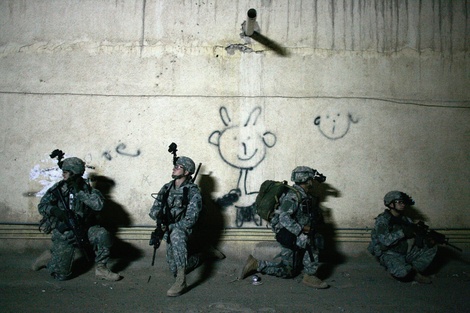
(Photo: U.S. Army soldiers of the D-CO 2/325 AIR 82nd Airborne Division during a dismounted movement to conduct early morning raids on homes in Baghdad, Iraq on April 26, 2007. The soldiers are part of the United States military surge as they try to help control the violence plagued city. By Joe Raedle/Getty Images.)